
Skip to content
Calcipedia
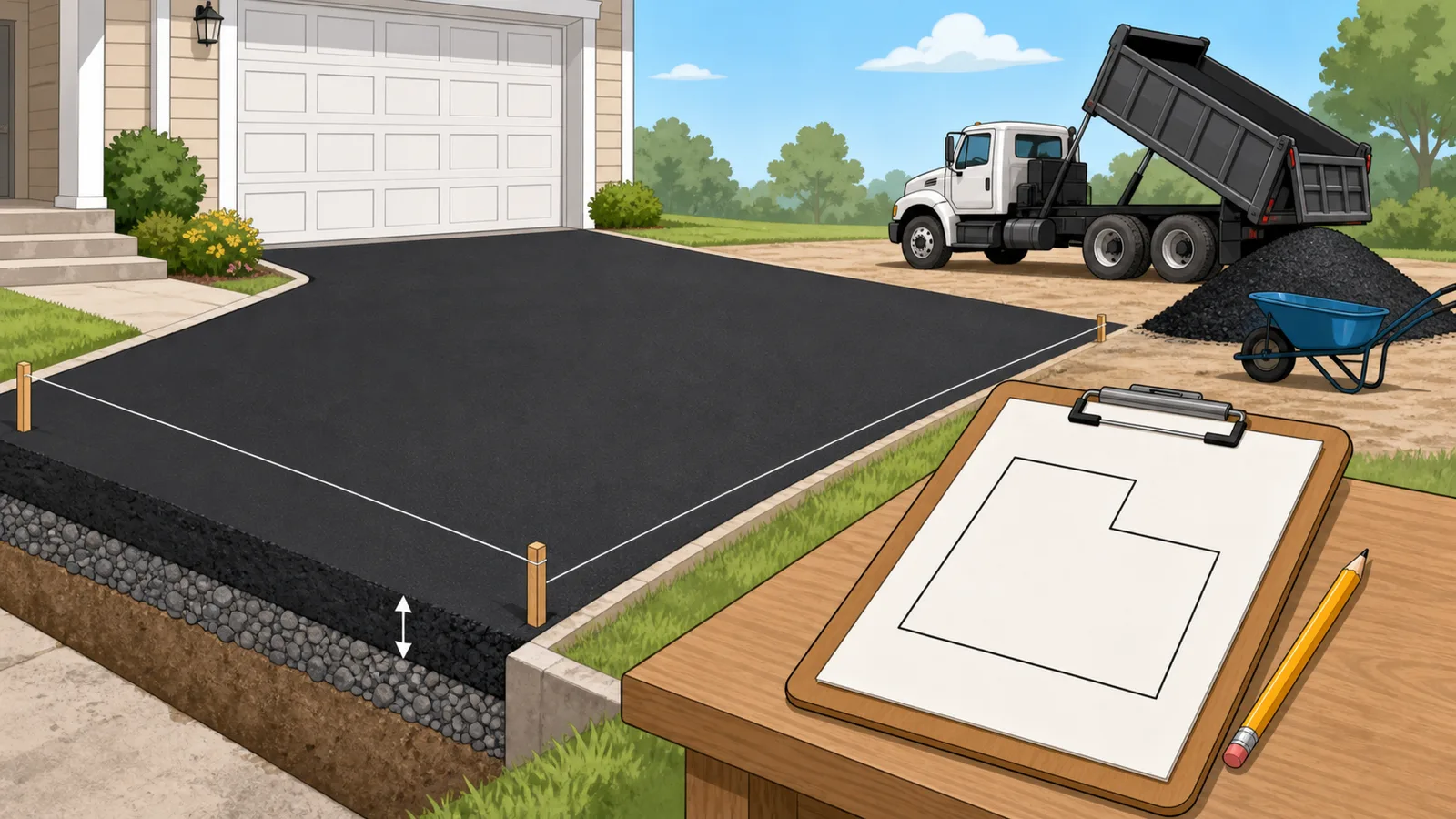
Asphalt Calculator instructional illustration

Asphalt Calculator

Use the asphalt calculator to estimate driveway or parking-area tonnage, coverage, truckload equivalents, and material cost from dimensions or known area.

Last updated

Asphalt planning

Estimate ordered tonnage, waste, and paving cost from compacted thickness

This asphalt calculator turns driveway dimensions, compacted lift thickness, density, waste allowance, and optional supplier pricing into an asphalt tonnage and quote-planning sheet you can use before you request a quote.

Quick project examples

Units

Area input

Display currency

Switch the displayed cost figures without changing the paving math.

Project guidance

Use the presets to sense-check common driveway, overlay, and parking-area cases. Then edit the actual project dimensions, thickness, density, and waste to match the quote you are reviewing.

If your site is irregular, split it into rectangles first and add the sections together before treating the result as a supplier order. For new pavement, confirm the gravel base separately because asphalt tonnage alone does not design the whole pavement section.

If the total area already came from a site plan, map measurement, or the general area calculator, switch to known-area mode and enter that footprint directly rather than forcing the job back into one rectangle.

Ordered quantity

9.4 tons

Order about 9.4 short tons for 480 sq ft at 3 in compacted thickness.

Paved area480 sq ft / 44.59 m²
Compacted volume4.44 yd³ / 3.4 m³
Density used145 lb/ft³ / 2,323 kg/m³
Base quantity before waste8.7 tons / 7.89 t
Extra quantity from waste allowance0.7 tons / 0.63 t
Estimated paving cost$939.60

Coverage guide

55.17 sq ft/ton

Approximate coverage at the current compacted thickness before waste is added.

Material cost intensity

$1.96/sq ft

Material only. Installation, prep, haul, and disposal can move the contractor quote much more.

20-ton load equivalent

0.47 loads

Useful when a supplier prices full truckloads or minimum delivery quantities instead of exact tonnage.

Same footprint at common compacted lift thicknesses

These rows keep the same area, density, and waste allowance while changing only the compacted asphalt thickness.

ScenarioThicknessOrder quantity
Thin resurfacing lift1.5 in4.7 tons
Typical driveway lift2 in6.26 tons
Heavier private drive lift3 in9.4 tons
Small parking bay lift4 in12.53 tons

How to use this asphalt tonnage result

If your supplier quotes by the truck, this order is roughly 0.47 of a 20-ton load. Ask whether they invoice by exact plant weight, by rounded whole loads, or by a minimum-delivery threshold.

The coverage guide is useful for quick “how much does a ton of asphalt cover?” checks, but it only reflects the thickness and density entered here. A thinner overlay covers more area per ton than a heavier private drive or parking area.

Planning estimate only Use the waste-adjusted order quantity as a planning figure only. Final tonnage still depends on the actual mix density, compaction target, paving method, site corrections, and whether irregular areas were measured separately.
← All Driveway calculators

Driveway and Paving Planning

Asphalt calculator: tonnage, coverage, truckload planning, and material cost

An asphalt calculator should do more than multiply length, width, and thickness. This page also explains the main assumptions behind the asphalt calculator result, highlights the supporting figures shown by the calculator, and helps the reader use the estimate without overstating what a quick online tool can prove.

What this asphalt calculator is estimating

A driveway asphalt calculator starts with area, but asphalt is usually bought and quoted by weight. That means the useful planning question is not only how many square feet or square metres you are paving. It is how that footprint translates into compacted volume, tonnage, waste-adjusted order quantity, and the rough delivery size a plant or paving crew may discuss with you.

This page is designed for search intent such as asphalt calculator, asphalt tonnage calculator, driveway asphalt calculator, and how much asphalt do I need. It converts paved area, compacted thickness, density, waste allowance, and optional supplier price into a planning sheet that stays closer to how asphalt is actually priced than a thin rectangle-only result would.

It is still an estimating tool rather than a pavement design service. The page helps you sanity-check tonnage, supplier pricing, and common lift-thickness scenarios, but it cannot diagnose drainage, subgrade weakness, frost susceptibility, or the right mix design for a specific site.
Core asphalt tonnage formulas and why density matters

The core math is simple, but the order of operations matters. First the page measures the paving footprint, then converts compacted thickness into volume, then uses density to turn that volume into weight. Waste is added after the base quantity so the result is closer to a practical order than a perfect geometric minimum.

Density matters because one ton of asphalt does not cover a fixed area at every thickness. A thinner overlay can cover much more square footage per ton than a heavier private drive or parking lot section. That is why the page keeps density visible instead of hiding the assumption.

If the paving footprint is already known, the calculator can start from that area directly instead of recalculating a rectangle. That keeps the same asphalt tonnage formula while avoiding a false length-by-width simplification for flares, turnouts, curved edges, parking-lot islands, or measured plan areas.

Area = Length x Width

The paved footprint is the starting point for every asphalt quantity estimate.

Known area = measured paving footprint

Use this input path when a plan, map, or separate area calculation already gives the total square footage or square metres.

Compacted volume = Area x Compacted thickness

Thickness must be converted into the matching length unit before the compacted volume is calculated.

Base tonnage = Compacted volume x Density

Density converts volume into the weight the supplier is more likely to quote.

Order tonnage = Base tonnage x (1 + Waste%)

Waste is added after the base quantity so the result is more useful for ordering and quote review.

How much does a ton of asphalt cover?

This is one of the biggest search questions around asphalt calculator tons and cost. There is no single universal answer because coverage changes with compacted thickness and density. At around 145 lb/ft³, one ton covers materially more area at 1.5 to 2 inches than it does at 3 to 4 inches.

That is why this page shows a coverage guide at your current settings instead of forcing a fixed rule of thumb. If the calculated coverage looks far away from the supplier's assumptions, that is a signal to check whether they are quoting a different compacted thickness, a different mix density, or a rounded truckload instead of exact plant weight.

Driveway thickness, parking areas, and gravel base planning

Competitor pages often stop after the tonnage math, but the practical planning question is whether the entered thickness is realistic for the project. Residential driveways are commonly discussed in the 2 to 3 inch compacted range, while heavier private drives and parking areas often need a thicker asphalt section or stronger supporting layers. Thin resurfacing lifts can make sense for sound existing pavement, but they are not a structural cure for a failed base.

Base preparation matters just as much as the asphalt tonnage. A gravel or crushed aggregate base, drainage, and stable edges often determine whether a driveway lasts or cracks early. This calculator does not estimate the base itself, so if you are building new pavement or replacing a weak section, pair the result with a base-material check rather than treating asphalt tons as the full project design.

Further reading

  • Gravel driveway calculator — Use this related planner to estimate the compacted gravel base separately when a new driveway or rebuild needs more than the asphalt surface layer.

Worked example: two-car driveway tonnage and material cost

Suppose a driveway is 40 feet long by 12 feet wide, the compacted asphalt thickness is 2.5 inches, the assumed density is 145 lb/ft³, the waste allowance is 8%, and the plant price is $100 per short ton. The calculator lands at roughly 7.83 short tons before waste and about 8.46 short tons to order, with a material-only cost a little under $850.

That example is useful because it answers several search intents at once. It shows how many tons of asphalt a driveway may need, what one ton covers at the selected thickness, and how the quote changes once waste is included. It also reminds you that the supplier rate is not the same thing as the full installed contract price, which still has to cover labor, equipment, haul, prep, disposal, and overhead.

Truckloads, quote review, and why material price is not the full driveway cost

The page shows a 20-ton load equivalent because many suppliers and paving contractors talk in truckloads as well as exact tonnage. If your result is only a fraction of one full load, the delivered cost can look higher than the plant price alone because minimum-delivery charges or rounded load pricing may apply.

That is also why material cost per square foot should be treated as a planning check, not as the installed driveway cost. A quote that looks expensive per square foot may still be reasonable if it includes base repair, milling, removal, grading, drainage corrections, or difficult site access. A quote that looks cheap may be under-scoped if those items are missing.

How to estimate an irregular driveway or resurfacing job

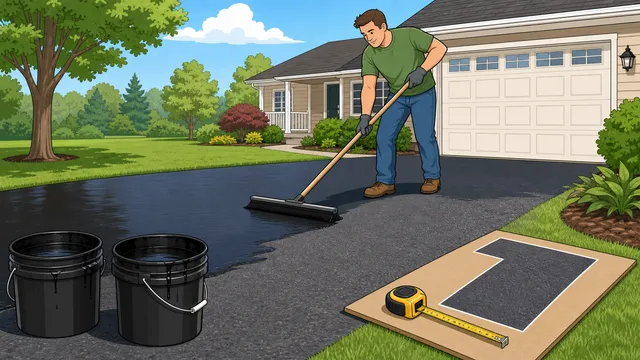
A lot of real paving work is not a clean rectangle. For an L-shaped driveway, a flare, or a parking area with islands, break the site into simpler rectangles, estimate each section, then combine the area before turning it into tonnage. That is materially better than averaging dimensions and hoping the error washes out.

For resurfacing work, remember that overlay tonnage is only part of the answer. A thin overlay can be appropriate for a sound surface that mainly needs renewal, but it will not fix structural failures underneath. If there is rutting, pumping, unstable edges, or drainage problems, the correct remedy may involve repair or rebuilding rather than just ordering a little more asphalt.

Known-area mode is the cleaner path once you have already combined the pieces. Enter the total square feet or square metres, then use compacted thickness, density, waste, and supplier price to estimate asphalt tons and cost without pretending the whole project is one perfect rectangle.

Further reading

  • Asphalt sealer calculator — Useful after paving or once an older driveway is ready for maintenance, especially if you are planning future sealcoat coverage rather than fresh hot-mix tonnage.

What this result does not cover

This calculator does not choose the correct asphalt mix design, gravel base depth, drainage slope, number of lifts, or structural thickness for weak soils and heavy traffic. It also does not include labor, milling, removal, striping, tack coat, geotextile stabilization, or permit costs unless you add them separately outside the page.

Use it as an early asphalt order and quote-review tool, then confirm the final section, density, and delivery assumptions with the paving contractor, asphalt supplier, or project specification before work starts.

Frequently asked questions

How much asphalt do I need for a driveway?

That depends on the driveway area, compacted thickness, density assumption, and waste allowance. This asphalt calculator combines those inputs and returns an estimated order quantity in short tons or metric tonnes.

How many tons of asphalt does a 2-car driveway need?

A common two-car driveway can easily land in the high-single-digit tonnage range, but the real answer depends on the exact footprint, compacted thickness, density, and waste allowance. Use the calculator with your own dimensions rather than relying on one universal driveway number.

How much does a ton of asphalt cover?

Coverage changes with compacted thickness and density. One ton covers much more area at a thin overlay depth than it does at a 3 to 4 inch structural section. The calculator shows the coverage at your current inputs instead of using a fixed rule.

Does this asphalt calculator include gravel base material?

No. It estimates the asphalt surface layer only. If your project includes a new gravel or crushed-stone base, estimate that separately so the full pavement section is not under-scoped.

Can I use this as an asphalt driveway cost calculator?

Yes, for material planning. Enter a supplier price per ton and the page will show an estimated material-only cost. Installed cost can be much higher once labor, prep, removal, drainage work, and equipment are included.

Can I use this for a parking lot or commercial paving area?

Yes, as a tonnage estimator. Just remember that parking lots and heavier-use areas may need a thicker asphalt section or stronger base than a residential driveway, so the entered assumptions should match the actual traffic and specification.

How should I estimate an irregular driveway?

Break the site into rectangles or other simple shapes, estimate each piece, and combine the total area before converting it into tonnage. That is more reliable than averaging dimensions across the whole footprint. Once you have that combined footprint, switch the calculator to known-area mode and enter the total square feet or square metres directly.

Can I use a measured square-foot area instead of length and width?

Yes. Use known-area mode when a site plan, map tool, contractor sketch, or separate area calculator already gives the paving footprint. The calculator then applies thickness, density, waste, and supplier price to that area just as it would for a rectangular driveway.

Why add waste to an asphalt estimate?

Waste helps cover edge trimming, level corrections, and the gap between perfect geometry and the way asphalt is really placed on site. A zero-waste estimate is useful for theory, but it is often too thin for actual ordering.

Will a thin overlay fix a failing driveway?

Usually not. A resurfacing lift can renew a sound pavement, but it will not solve structural base failure, unstable edges, or drainage problems underneath the asphalt.

Also in Driveway

Related

More from nearby categories

These related calculators come from the same leaf category, nearby sibling categories, or the same top-level topic.