Use the asphalt sealer calculator to estimate driveway sealer volume, 5-gallon bucket count, lighter second-coat demand.
Last updated
Driveway sealer planner Estimate how much driveway sealer to buy, how many pails to order, and how much of the order comes from coat strategy, surface texture, add-on area, and waste rather than footprint alone.
Quick examples
Compare a maintenance coat, a weathered two-car driveway, a rougher porous job, or an area-only estimate without re-entering every field.
Measurement input
Use dimensions for a rectangle plus apron math, or switch to total area when you already have the driveway square footage from a site plan, quote, or prior measurement.
Order volume
10.63 gal
Buy 3 containers for 504.00 ft² of sealing area, 2 coats, and a weathered driveway assumption.
Total sealed area
504.00 ft²
Container count
3
First-coat volume
5.80 gal
Estimated sealer cost
117.00
Buying plan
One container covers about 500.00 ft² at the entered label rate. The first coat uses about 5.80 gal before waste.
Each follow-up coat is planned at roughly 3.86 gal, which reflects a lighter second pass rather than assuming every coat is equally heavy.
Coverage and waste check
The rectangular driveway footprint is 480.00 ft², plus 24.00 ft² of extra sealing area. The weathered driveway profile applies a 15% texture adjustment relative to an average surface.
The effective coat load is 1.67 base coats, so the raw pre-waste demand is 9.66 gal and waste adds 0.97 gal.
How to use this result
Use the volume as a purchasing baseline, then confirm the exact label yield and coat instructions for the sealer you plan to apply. Weathered asphalt usually absorbs more sealer on the first pass, so two thin coats and a modest waste allowance are safer than buying to the exact label minimum.
At the entered price, the sealer-only material cost is about 0.23 per ft² of sealed area.
Rounding to whole containers leaves about 4.37 gal in reserve, which is usually cheaper than running out and needing a last-minute extra pail.
Lighter follow-up coat selected This mode assumes the first coat does the heaviest filling work and later coats use roughly two-thirds of that volume. Keep the label instructions in charge if your chosen product wants equal full coats instead.
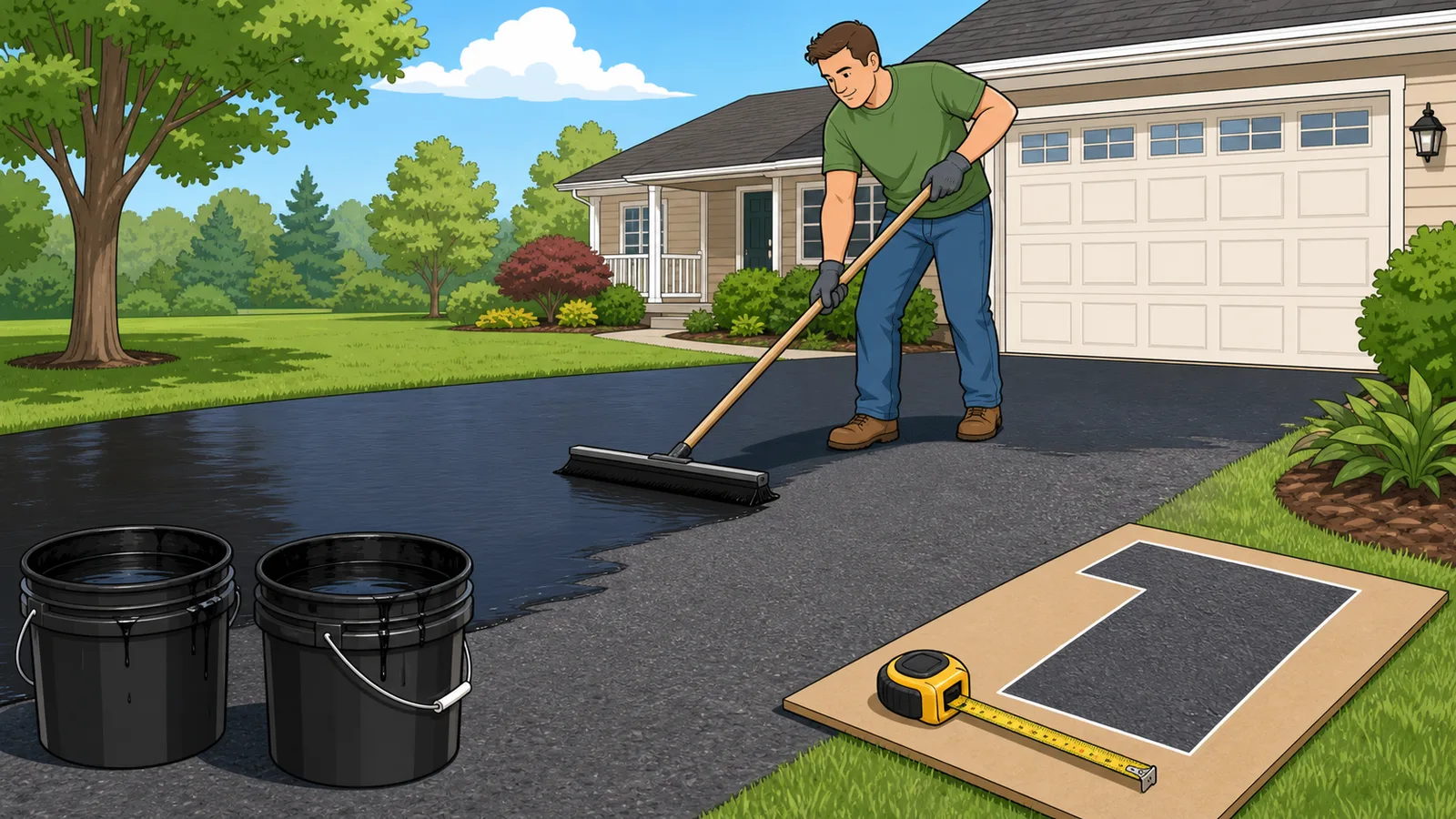
An asphalt sealer calculator should answer more than the bare geometry question. This driveway sealer calculator estimates how much driveway sealer to buy from length, width, add-on area, coats, surface condition, label coverage, container size, and waste so you can plan pails, compare products, and avoid running short halfway through a sealcoating job.
What this asphalt sealer calculator is estimating
A weak driveway sealer coverage calculator usually stops at length times width. That is not enough for real ordering because the same footprint can need materially different amounts of sealer once you account for surface texture, a second coat, and any extra sealing area such as a turnaround, apron, or short walk.
This page is designed for the homeowner or small-project search intent behind phrases such as asphalt sealer calculator, driveway sealer calculator, and how much driveway sealer do I need. It converts the driveway footprint into a practical purchase plan, shows whole-container ordering, and makes the planning assumptions visible instead of hiding them behind one headline number.
The calculator is still a planning tool, not a product selector. It cannot tell you whether your pavement should be sealed yet, whether the cracks need repair first, or whether your chosen sealer wants a roller, squeegee, or brush. Those decisions still belong to the label and the actual driveway condition on site.
Core driveway sealer formulas and why extra area matters
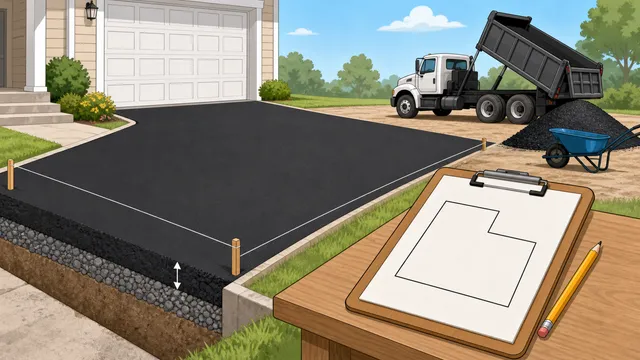
The starting point is still the driveway footprint, but real jobs often include more than the main rectangle. A useful driveway sealcoat calculator should let you bring in extra sealing area for aprons, parking pads, or small side sections instead of pretending every driveway is one clean box.
After the total sealing area is established, the calculator applies the selected surface-condition factor, coverage rate, coat strategy, and waste allowance. That ordering matters because surface absorption and waste are not the same thing. Surface condition changes how much sealer the pavement really needs, while waste covers spillage, edging losses, over-application, and the practical decision to round up to whole pails.
Base driveway area = Length x Width
The main driveway rectangle is the base for the sealer estimate.
Total sealing area = Base driveway area + Additional sealing area
Turnarounds, aprons, or other non-rectangular sections can be added instead of ignored.
Adjusted coverage load = Total sealing area x Effective coat factor x Surface multiplier
The effective coat factor can model either equal coats or a lighter follow-up coat.
Order volume = (Adjusted coverage load / Coverage rate) x (1 + Waste%)
Waste is applied after the raw coating load so the result is closer to a real purchase plan.
How much area does a 5-gallon bucket of driveway sealer cover?
This is one of the biggest real-world questions behind searches for how many 5 gallon buckets of driveway sealer do I need. The honest answer is that there is no single fixed coverage number. Manufacturer guidance commonly separates smooth, previously sealed pavement from rough, porous, or never-sealed pavement because rougher asphalt can absorb far more product.
For example, Latex-ite product guidance commonly puts a 4.75-gallon pail around 400 to 500 square feet per coat on smoother previously sealed driveways, but around 300 to 400 square feet per coat on rougher or unsealed surfaces. Other consumer driveway sealer labels also split coverage by pavement condition rather than offering one universal number. That is exactly why entering the label coverage rate and surface condition matters more than relying on a fixed bucket rule.
The calculator keeps both coverage per gallon and coverage per container visible so you can answer the quick homeowner question and still stay anchored to the actual product label you plan to buy.
Worked example: weathered two-car driveway with apron
Suppose the main driveway is 40 feet long by 12 feet wide, there is another 24 square feet of apron or walkway to seal, the asphalt is weathered, the label coverage rate is 100 square feet per gallon, and you want a 10% waste allowance. If you also expect the second coat to be lighter than the first, the calculator lands at about 10.63 gallons, which means buying 3 standard 5-gallon containers.
That example is more useful than a flat rectangle-only result because it reflects how many driveway jobs really behave. The total sealing area is 504 square feet, the first coat does most of the filling work, and the second coat tops up protection rather than repeating the exact same material demand. The reserve left by buying 3 pails is a lot safer than trying to thread the job through 2 pails and hoping the rougher spots do not drink in extra sealer.
If your label expects every coat to go down at the same volume, switch the calculator back to equal coats. That produces a higher order figure. The point is not that one strategy is always correct; it is that the coating plan should match the product and the pavement instead of being guessed.
Why a second coat can use less sealer than the first
Many searchers assume two coats always means exactly double the first-coat quantity. That is not always how driveway sealer behaves in practice. Manufacturer guidance for poor-condition driveway sealing often notes that two thin coats are better than one thick coat, and some consumer guidance notes that the second coat can use less product than the first because the first pass has already filled more of the surface texture.
That is why this page lets you choose between equal coats and lighter follow-up coats. If your driveway sealer label or product guide suggests the second pass will go down more lightly, the calculator can model that directly instead of forcing you into a full double-count assumption. This is especially useful for weathered residential driveways where the first coat does most of the filling and the second coat is more of a finishing and protection pass.
Do not treat that lighter follow-up assumption as universal. Some products want consistent full coats, and some rough surfaces can still pull hard on the second pass. The correct answer is whatever the label and the real driveway condition support.
How to plan an irregular or L-shaped driveway
A lot of competing pages tell you to break an irregular driveway into rectangles, then stop there. That advice is correct but incomplete. The practical question is how to get those extra areas into the purchase plan without losing sight of coats, condition, and whole-pail ordering.
The simplest method is to measure the largest main rectangle, estimate the side pad, flare, turnaround, or short walkway separately, and add that figure into the calculator's extra sealing area field. That gives you a cleaner result than pretending the whole driveway is rectangular or trying to average the width and hoping the error washes out.
If you already have a reliable square-foot or square-metre figure from a contractor quote, site plan, or prior measurement, you should not have to reverse-engineer the driveway back into a neat rectangle. The calculator now supports direct total-area entry as an alternative workflow, which is useful for curved, flared, or awkward residential layouts where the total measured area is more trustworthy than a made-up length-and-width pair.
This is a meaningful advantage over many simple driveway sealer calculators because it lets you keep the page useful for real suburban layouts without turning the tool into a full CAD takeoff system.
Weather, preparation, and newly installed asphalt
Coverage math is only one part of a successful sealcoating job. Manufacturer guidance routinely warns against applying too thick a coat or sealing in cold weather. Latex-ite application guidance emphasises dry weather, warm pavement, and thin coats instead of one heavy flood coat, while its Acrylic Grade product guidance warns that the overnight temperature should stay at least around 50°F for proper curing.
Preparation affects both performance and quantity. Dust, oil spots, loose aggregate, open cracks, and patch repairs can all change how much sealer the driveway actually uses. That is why the result should be treated as a buying baseline rather than a promise that the exact entered gallons will always finish the job.
If the driveway is heavily cracked, badly raveled, or still curing after a recent installation, the most useful decision may be to delay sealing or repair the pavement first rather than obsessing over the pail count.
Further reading
Latex-ite sealer calculator — Manufacturer calculator showing bucket planning for driveway condition and follow-up coat assumptions.
This calculator does not include crack filler, pothole patch, oil-spot primer, decorative sand loading, contractor spray dilution, or full commercial sealcoat mix design. If you are pricing a parking lot spray application with water, additives, and sand, a dedicated contractor sealcoating calculator is the better tool.
It also does not decide whether your product should be applied with a roller, brush, or squeegee, whether the driveway should receive one coat or two coats, or whether the pavement is too porous or too new for sealing. Use the estimate as the buying step, then confirm the final plan against the product label, technical data sheet, and the actual surface on site.
Frequently asked questions
How much driveway sealer do I need?
That depends on the total sealing area, the number of coats, the product coverage rate, the driveway condition, and how much waste margin you want to carry. This asphalt sealer calculator combines those inputs and turns them into an order volume plus a whole-container count.
How many 5-gallon buckets of driveway sealer do I need?
Divide the estimated gallons by the container size, then round up. The exact bucket count can change materially when a driveway is weathered, porous, or getting a second coat, which is why the page shows whole-pail ordering rather than only a decimal gallon total.
How much area does a 5-gallon bucket of driveway sealer cover?
Coverage varies by product and pavement condition. Smooth, previously sealed driveways often land closer to roughly 400 to 500 square feet per pail, while rougher or unsealed surfaces can be much lower. Always use the exact label coverage rate for the product you plan to apply.
Why does an older asphalt driveway need more sealer?
Older or more porous asphalt can absorb more product because the surface texture is more open. That is why the calculator includes a driveway-condition adjustment instead of assuming every surface uses sealer at the same rate.
Does the second coat use as much sealer as the first?
Not always. Some driveway sealer products and consumer guides treat the follow-up coat as lighter than the first because the first pass has already filled more of the surface. Other products expect equal coats. Match the calculator setting to the label instructions you are actually following.
Can I use this for an L-shaped or irregular driveway?
Yes. Measure the main rectangle first, then add the side pad, apron, flare, or walkway as extra sealing area. That is usually more accurate than averaging the width and hoping the error cancels out.
Can I use this calculator if I only know the driveway square footage?
Yes. Switch to the total-area entry mode and enter the measured square footage or square metres directly. That is often the cleanest option when the driveway was already measured from a site plan, quote, or irregular-layout takeoff.
Should I seal new asphalt right away?
Usually no. Product guidance commonly warns against sealing very new asphalt because the pavement needs time to cure. Check the exact product instructions before sealing a recently installed driveway.
Does this include crack filler and patching material?
No. The estimate is for the main sealer only. Crack filler, pothole patch, oil-spot treatment, and other prep products should be planned separately.
Should I dilute driveway sealer?
Only if the chosen product explicitly allows it. Many residential driveway sealers are intended to be applied without thinning, while some contractor-grade systems handle dilution and additives differently. Follow the label, not a generic rule.
Should I buy exactly the calculated amount of sealer?
Usually not. It is safer to round to whole containers and keep some reserve for texture variation, edge work, and the possibility that the driveway absorbs more sealer than the best-case label figure.