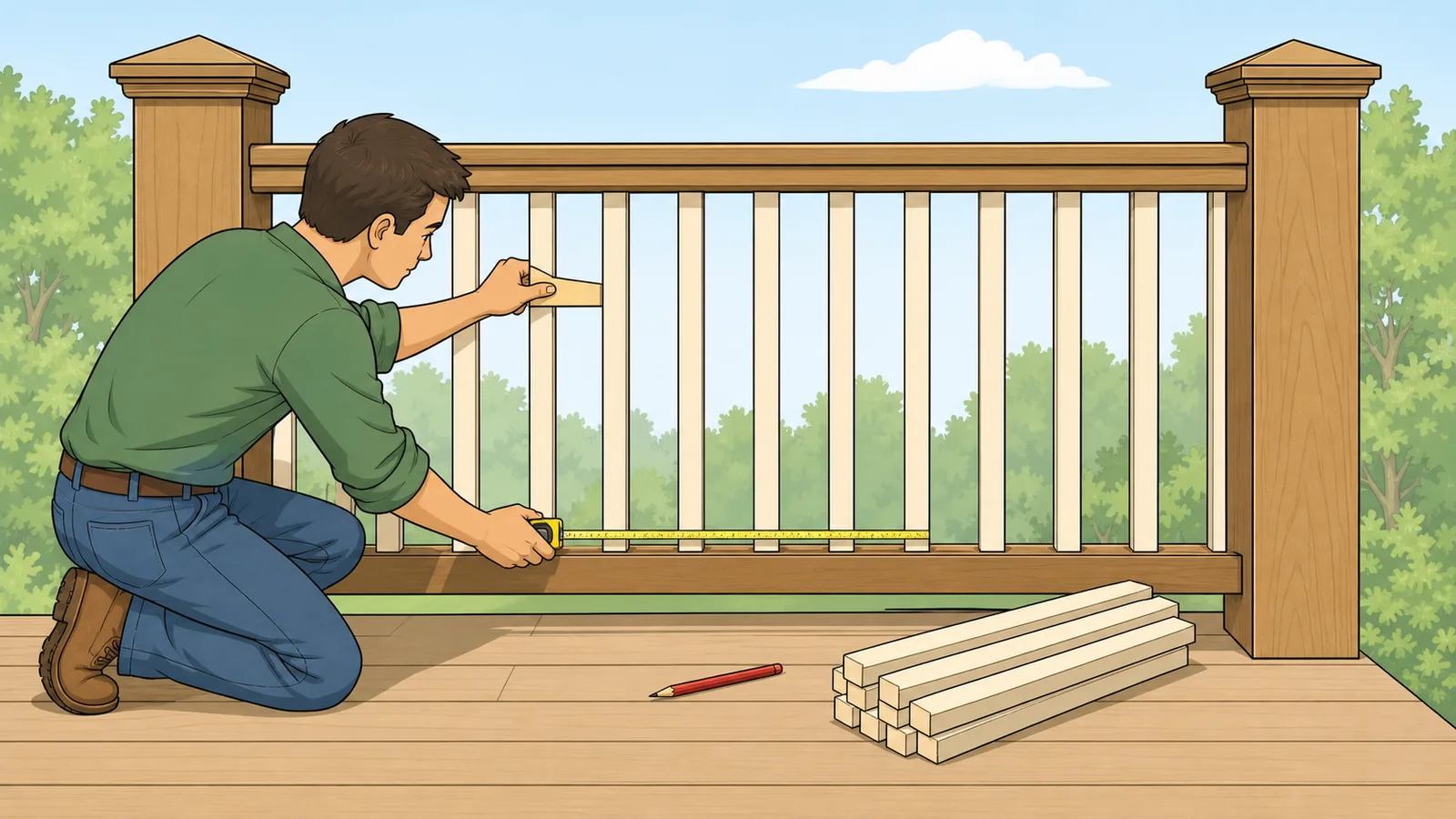
Estimate baluster count, clear gap, on-center spacing, repeated section totals, and order quantity for level deck railing openings.
Last updated
Deck railing baluster planner Balance a railing opening against your maximum allowed gap, then estimate on-center spacing, repeated section totals, and the baluster order quantity before you cut.
Quick layouts
Assumptions
The opening is treated as one straight section with equal clear gaps at both ends and between balusters. Enter one clear post-to-post opening, then use matching sections when several railing bays repeat the same layout.
Baluster count
13 balusters
Equal spacing works out to 3.75 in across each
6.00 ft clear opening.
Actual gap
3.75 in
On-center spacing
5.25 in
Order quantity
15 balusters
Total stock length
45.00 ft
Max gap target
4.00 in
Repeated sections
13 per section x 1 section = 13 balusters before waste.
Field layout check
Mark centers about 5.25 in apart, then verify the clear opening does not exceed 4.00 in after real post and rail details are installed.
How to use this result
Use the per-section count to lay out one post bay, then use the order quantity for purchasing. If post thickness,
rail grooves, stair angles, or code jurisdiction change the clear opening, remeasure the post-to-post opening rather than the outside rail length.
Deck baluster count, spacing, and railing opening planning
A baluster calculator helps you work out how many balusters a deck railing section needs and what the equalised clear spacing will actually be before you start cutting or ordering parts. It uses the clear opening length, baluster width, maximum allowed gap, and baluster cut length to turn a railing rule into a practical material and spacing plan.
What this baluster calculator is deciding
Deck railing planning usually starts with a code or project rule for the largest clear opening allowed between balusters. The hard part is turning that limit into a balanced layout that looks consistent across the opening rather than ending up with one odd end gap or a field change during installation.
This baluster spacing calculator is designed for that early planning step. It estimates the baluster count needed for a straight railing section, reports the equal gap that results once the bars are distributed across the opening, and converts the chosen baluster cut length into a simple stock estimate for ordering.
Core baluster spacing formulas
The calculator treats the railing opening as one straight clear length. It fits the smallest whole-number baluster count that keeps every clear opening at or below the allowed maximum, then recalculates the balanced gap that count produces.
Minimum baluster count = ceil((Opening length - Max gap) / (Baluster width + Max gap))
This finds the smallest whole-number baluster count that can satisfy the maximum clear-gap target across the opening.
Actual clear gap = (Opening length - (Baluster count x Baluster width)) / (Baluster count + 1)
Once the count is chosen, the remaining opening is spread evenly to create the final balanced spacing at both ends and between balusters.
Total baluster stock = Baluster count x Baluster cut length
This converts the layout into a simple material total for ordering and cut-list planning.
How to use the baluster count well
Use the baluster count as a material estimate and the actual clear-gap line as the installation reference. If the actual gap is comfortably below the maximum allowed opening, you usually have a workable layout. If it lands very close to the limit, it is worth double-checking the real field opening and the as-built post dimensions before ordering.
For example, a 6 ft clear opening with 1.5 in balusters and a 4 in maximum gap needs about 13 balusters, producing an equalised clear gap of about 3.75 in. That gives you a balanced layout without relying on guesswork at the last minute.
Baluster spacing versus on-center layout
A baluster spacing calculator normally needs two different spacing ideas. Clear spacing is the open gap between adjacent balusters, which is the value most code checks care about. On-center spacing is the distance from the centre of one baluster to the centre of the next, which is what many installers mark on the rail during layout.
This page reports both. The actual clear gap tells you whether the deck railing baluster spacing stays under the maximum opening you entered, while the on-center spacing gives you a practical mark-out distance for a straight level rail section.
Planning repeated railing sections and waste
Deck and porch rails are often built from several matching post-to-post sections. Instead of making you multiply the result manually, the calculator lets you enter how many matching railing sections use the same clear opening, then adds a waste allowance to create a simple order quantity.
That makes the result more useful for supplier quotes and job-site takeoffs. Use the per-section count for layout, the total before waste for the project count, and the order quantity for purchasing when you want spare balusters for cuts, damage, or future repair matching.
What this result does not cover
This is a straight-opening baluster layout tool, not a full code review. It does not account for outside rail length, post thickness unless you already deducted it from the clear opening, routed rails, angle changes, stair-rail geometry, manufactured panel systems, or jurisdiction-specific detailing requirements beyond the maximum clear-gap assumption you enter.
Use it to plan one level railing opening, then confirm the final layout against the project drawings, the chosen railing system, and the applicable building code or inspection standard before fabrication or installation.
Frequently asked questions
How far apart should deck balusters be?
Many deck railing layouts are planned around a maximum clear opening of about 4 in, but the exact requirement depends on the applicable code and the railing system. This calculator helps you turn that maximum opening into a balanced baluster count and actual spacing.
How do I calculate how many balusters I need?
Start with the clear opening length between the posts or inside the rail framing, then compare that with the baluster width and the largest clear gap you want to allow. The calculator fits the smallest whole-number baluster count that keeps the equalised gap at or below your limit.
Should I measure the whole rail or the clear opening?
Use the clear opening where the balusters will actually sit, not the outside rail length. Post thickness, grooves, brackets, or panel channels can all change the real spacing available for the balusters.
Does this baluster calculator work for stair railings?
Not directly. Stair railings and angled rails need their own geometry and often have different detailing constraints. This page is best for straight level deck-railing openings only.
What is the difference between clear gap and on-center spacing?
Clear gap is the open space between balusters. On-center spacing is measured from the centre of one baluster to the centre of the next. Building-code checks usually focus on the clear gap, while installers often use on-center marks to lay out the rail evenly.
Can I use the outside rail length in the calculator?
Only if it already represents the clear opening where the balusters will sit. If the measurement includes posts, sleeves, brackets, routed channels, or end blocks, subtract those first so the calculator works from the real post-to-post or rail-channel opening.
Why does the order quantity exceed the calculated baluster count?
The order quantity includes the number of matching railing sections and the waste allowance you enter. That gives you a purchasing number rather than only the exact theoretical count for one perfect opening.