Estimate deck boards needed, lineal footage, seams, fasteners, picture-frame boards, waste, and board cost from deck size, board width, gap spacing.
Last updated
Decking takeoff planner Estimate deck board count, lineal footage, seams, fasteners, optional picture-frame boards, and material cost from deck size, board width, gap spacing, stock length, and layout complexity.
Units and currency
Quick examples
Decking layout
Assumptions
The estimate assumes boards run along the deck length unless you choose a diagonal or complex pattern. Diagonal layouts add 15 percentage points of waste; complex patterns add 20 percentage points. Fasteners assume joists cross every board row.
Order quantity
29 boards
26 rows across 192.00 ft², including 10% total waste after layout adjustment.
Base boards before waste
26
Pieces per row
1
Ordered lineal
464.00 ft
Width overage
5.25 in
Fasteners with spare
744
Picture-frame boards
0
Joinery and waste
0 field seams, 13 joist lines, and 3 extra boards added for trimming, layout waste, and damaged stock.
Estimated material cost
$696.00 total board spend.
Takeoff breakdown
Field decking before waste
26 boards
Required lineal material
416.00 ft
Perimeter lineal material
0.00 ft
Layout waste added
0%
How to use this result
Use the ordered board count as a purchasing number, then compare the field seams, perimeter boards, fastener count, and layout-waste adjustment against your supplier quote. Stairs, railings, fascia, and product-specific clips still need a separate check.
Deck board count, lineal footage, seams, and ordering plan
A deck board material calculator helps you estimate how many deck boards a project will need before you start pricing or ordering stock. It turns deck size, board width, gap spacing, stock-board length, and waste allowance into row count, total lineal footage, ordered board count, seam count, and a simple board-cost estimate.
What this deck board calculator is estimating
Decking is usually bought in stock lengths, but the layout is driven by finished deck dimensions and board coverage. That gap between layout geometry and store inventory is where a deck board calculator is most useful. It turns the deck width into a row count, converts the run length into a lineal-foot or lineal-metre requirement, and then compares that with the stock-board length you plan to buy.
That makes the tool useful for timber decking, composite decking, and early deck-budget planning. It is especially helpful when you want to see whether full-length boards will cover the run cleanly or whether shorter stock will create seams that affect waste, labour, and appearance.
Core deck board formulas
The deck width is covered by rows of board plus the chosen installation gap. The run length is then checked against the stock length to decide how many pieces each row needs. Waste is applied after that base quantity is known so the ordered board count reflects a practical purchasing figure rather than a theoretical exact fit.
This finds how many rows of decking are needed to cover the finished width when the installation gap is included.
Pieces per row = ceil(Deck length / Stock length)
If the deck run is longer than the stock board, the row needs more than one piece and the layout will include seams.
Order boards = ceil(Base board count x (1 + Waste%))
Waste is applied to the straight-run base quantity to create a more realistic stock-board order number.
How to use the ordered board count
Use the ordered board count as the purchasing figure, then review the seam count and width overage to see whether the layout still makes sense visually. If the stock length matches the run, the deck is usually simpler to install and waste is easier to control. If the run is longer than the stock length, the seam count helps you judge whether you want to change board length, direction, or the deck geometry before you buy.
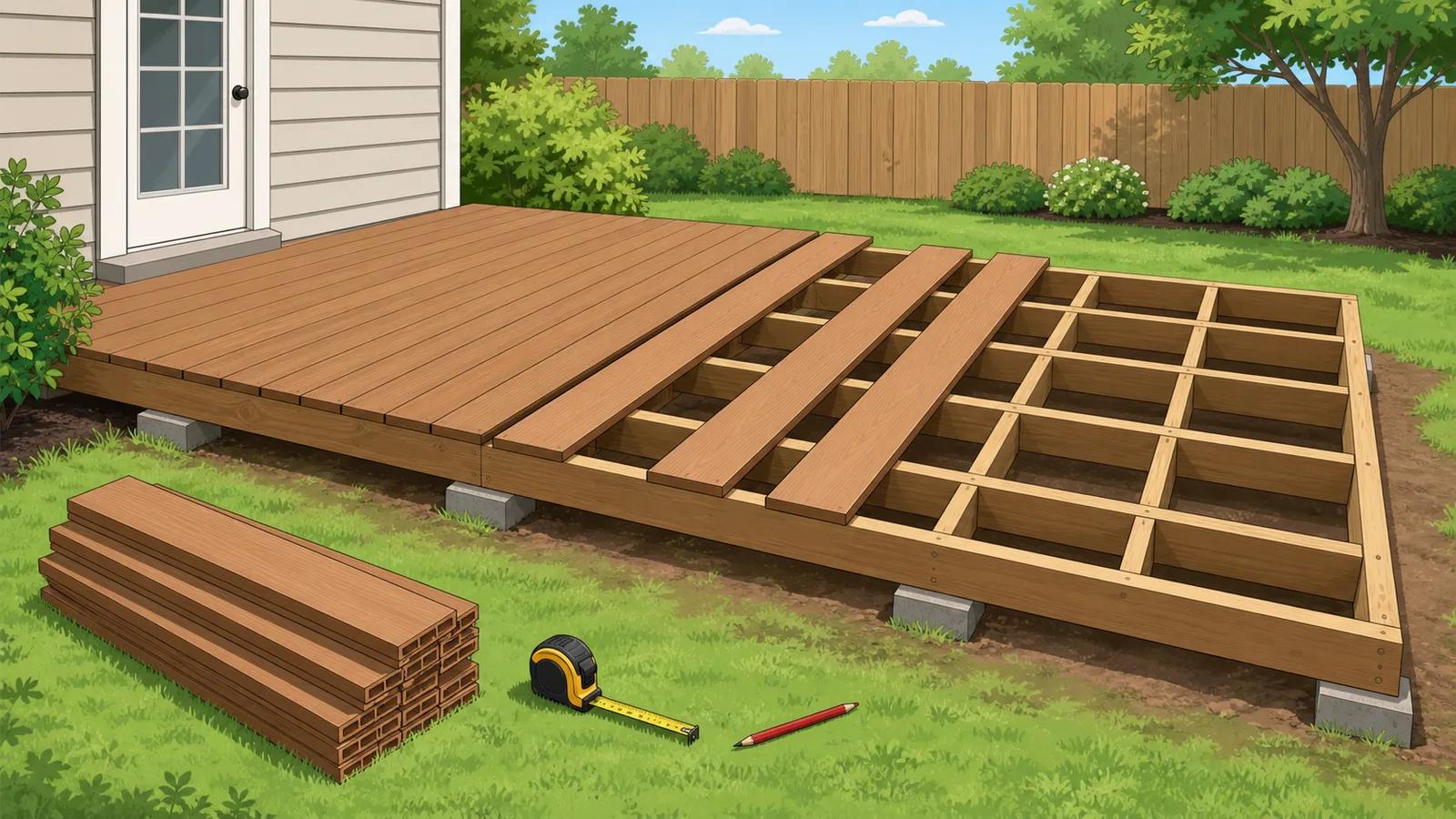
For example, a 16 ft by 12 ft deck using 5.5 in boards, 0.25 in gaps, 16 ft stock, and a 10% waste allowance needs about 26 rows and roughly 29 stock boards. That is the kind of estimate that lets you compare supplier quotes quickly before detailed framing and picture-frame details are added.
Diagonal decking, pattern waste, and picture-frame boards
A straight deck board calculator can understate the material order when the boards are installed at 45 degrees, in a herringbone-style pattern, or around a picture-frame border. Those layouts create more angled cuts, shorter offcuts, and edge pieces that are not represented by a simple rectangular row count.
The layout setting adds extra waste on top of the base waste allowance so the board order better matches diagonal decking and complex patterns. The picture-frame perimeter field lets you add a border-board run to the same takeoff, which is useful when the field boards and edge boards are the same product but need to be counted separately from the main rows.
Fasteners, joist spacing, and hidden clips
Deck board material planning is not only about boards. Screws, hidden fasteners, or clips usually scale with the number of board-to-joist crossings, so the calculator estimates joist lines from the joist spacing and multiplies them by the number of board rows. A small spare allowance is included because fasteners get dropped, bent, stripped, or rejected during installation.
Use the fastener result as a planning quantity, then check the selected decking manufacturer's instructions. Composite decking systems may specify proprietary clips, edge fasteners, starter clips, or closer joist spacing for diagonal layouts, while pressure-treated lumber may use different screw spacing and corrosion-resistant hardware requirements.
Choosing stock board length before ordering
Stock length changes the purchase count even when the deck area is unchanged. A 16 ft run can be covered cleanly with 16 ft boards, while the same run built from 12 ft boards creates field seams and extra stock pieces per row. Longer boards may reduce seams but cost more per piece, can be harder to transport, and may not be available in every decking line.
If two suppliers quote different lengths, compare the ordered board count, ordered lineal material, seam count, and total board spend rather than only comparing price per board. The cheaper single board can become the more expensive layout if it creates more seams, more waste, or a less efficient package size.
What this result does not cover
This is a deck board estimator, not a final cut list. It now accounts for straight-run rows, stock-board length, optional picture-frame perimeter boards, layout-waste adjustments, and a fastener estimate, but it still does not optimise every joint location, stair tread, fascia board, hidden fastener offset, or local expansion recommendation for a specific product line.
Use it for early material planning only. If your design includes angled boards, herringbone patterns, steps, benches, or mixed board directions, treat the result as a baseline and add project-specific extra stock separately.
Frequently asked questions
How many deck boards do I need for my deck?
That depends on the deck width, the actual board width, the installation gap, the stock-board length, and how much waste you allow. This calculator combines those factors so you can estimate rows, stock-board quantity, and lineal material in one place.
Why does the board count change with stock length?
Because shorter stock can force more than one piece in each row. That raises the number of boards you buy, adds seams, and often increases waste compared with using boards that match the deck run more closely.
Does this decking calculator include picture framing?
No. Picture framing, border boards, stairs, fascia, and decorative patterns are outside the straight-run estimate. Add those separately after you know the base decking quantity.
Should I order extra decking boards?
Usually yes. A waste allowance helps cover trimming, end cuts, damaged boards, future repairs, and colour matching. The exact extra percentage depends on the layout complexity and the product you are using.
How much waste should I add for diagonal deck boards?
Diagonal decking usually needs more waste than a straight run because each row has angled end cuts and shorter offcuts. The calculator adds an extra diagonal-pattern allowance on top of the base waste percentage so a 10% general allowance becomes a larger ordering estimate for 45 degree decking.
Does the calculator include picture-frame deck boards?
Yes, if you enter a picture-frame perimeter length. The calculator converts that perimeter into additional stock boards using the same stock-board length, then includes those boards before waste is applied. Leave the field at zero when the deck has no border-board run or when the border uses a different product that you want to order separately.
How are deck fasteners estimated?
The fastener estimate uses the board row count, joist spacing, and fasteners per board-to-joist crossing. It then adds a small spare allowance for dropped, stripped, or rejected fasteners. Always confirm the final quantity against the screw, plug, or hidden-clip system specified for your decking product.
Should I compare 12 ft, 16 ft, and 20 ft deck boards?
Yes when those lengths are available from your supplier. Changing stock length can change seams, total board count, transport needs, and waste. Run the calculator once for each stock length and compare ordered boards, ordered lineal material, seam count, and total board cost before choosing the package that looks cheapest per piece.
Guides
Featured in articles
Step-by-step guides that use this calculator to solve real problems.