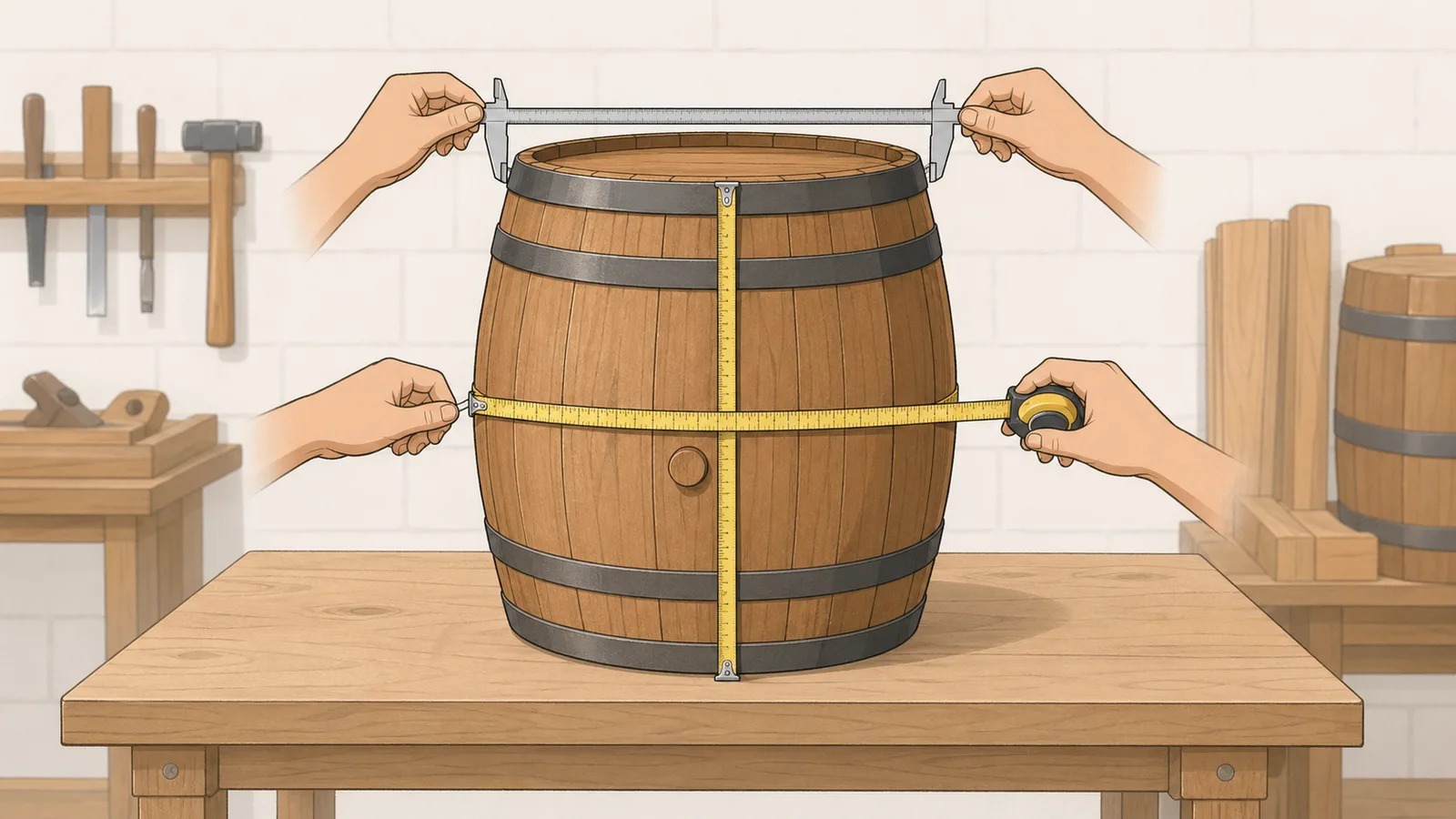
Calculate barrel, cask, or drum volume in litres and US or UK gallons from bilge diameter, head diameter, and height.
Last updated
Barrel volume calculator Estimate the capacity of a barrel, cask, or drum from bilge diameter, head diameter, and height. This page is built for barrel volume calculator, cask volume calculator, and drum volume calculator intent while keeping oil-barrel unit questions and other conversions separate from the geometric estimate.
Quick examples
Units
Liquid presets
How this estimate works
Bilge counts most: a curved barrel is widest at the belly, so the bilge diameter contributes more capacity than the head diameter.
Use actual dimensions: the formula assumes you measured the real inside profile of the barrel, not a nominal label or outer shell measurement.
Cylinder shortcut: when the bilge and head diameters match, the barrel behaves like a straight drum and the cylinder formula is a good approximation.
Enter barrel dimensions Provide a positive bilge diameter, head diameter, and height to calculate the barrel volume.
Barrel volume calculator: litres, gallons, cask and drum capacity
The barrel volume calculator estimates the capacity of a barrel, cask, or cylindrical drum from its bilge diameter, head diameter, and height.
How barrel volume is estimated from bilge, head, and height
A true barrel is wider at the middle than at the ends. The middle width is the bilge diameter and the end width is the head diameter. A standard barrel-capacity approximation treats that curved profile as a smooth solid of revolution and uses bilge diameter, head diameter, and height to estimate the internal volume.
This is why barrel and cask calculators usually ask for three dimensions instead of only one diameter and height. The extra width through the belly of the barrel adds volume that a plain cylinder formula would miss.
V = (pi * h / 12)(2D_b^2 + D_h^2)
D_b = bilge diameter, D_h = head diameter, h = height.
How to measure a barrel or cask correctly
Measure the bilge at the widest point across the middle of the barrel, the head diameter across the circular end, and the height or stave length from end to end. Consistent units matter: if you measure in inches, keep every input in inches; if you measure in centimetres, keep every input in centimetres.
A small measuring error can produce a noticeable volume difference because diameter is squared in the formula. If you are estimating the volume of a wooden cask, it is worth checking the middle width more than once because the bilge is the dimension most likely to vary between barrels that look similar at a glance.
When the barrel formula becomes a cylinder formula
If the bilge diameter and head diameter are the same, the barrel is effectively a straight-sided drum. In that case the geometry reduces to the standard cylinder formula. That makes this page useful for users searching both barrel volume calculator and drum volume calculator, because the same inputs cover both shapes.
This also helps with storage and process questions where the container may be described loosely as a barrel even though it behaves geometrically like a drum or tank. Equal diameters mean you are really calculating cylindrical volume.
Typical barrel and drum sizes
A Bordeaux-style wine barrel is commonly described as holding about 225 litres, while Burgundy-style barrels are often a little larger at roughly 228 litres. Straight-sided drums are usually discussed by nominal capacity, such as a 55-gallon drum, even though the exact capacity can vary with wall thickness and internal dimensions.
That is why searches like wine barrel volume calculator, whiskey barrel calculator, and barrel capacity calculator often need the same core geometry but slightly different expectations about the final number.
Bordeaux wine barrel: about 225 litres or 59 US gallons
Burgundy wine barrel: about 228 litres or 60 US gallons
55-gallon drum: nominal capacity that should still be checked against the actual internal dimensions
Worked examples: a 225 litre wine barrel and a 53 gallon whiskey barrel
Suppose you measure a coopered wine barrel at roughly 60 cm bilge diameter, 50 cm head diameter, and 90 cm height. The barrel formula gives about 228.55 litres, or about 60.38 US gallons. That puts the result almost exactly in the Burgundy/Bordeaux wine-barrel range and translates to roughly 305 standard 750 mL bottles, which is a more intuitive scale for many cellar users than litres alone.
Now compare that with a common American spirit barrel dimension set such as about 26.8 inches bilge diameter, 22 inches head diameter, and 35 inches height. That lands in the neighborhood of a 53-gallon whiskey barrel. Using a worked example like this is useful because it shows how the same geometry framework answers both wine barrel volume calculator and whiskey barrel calculator intent without pretending that every barrel in the trade has exactly the same profile.
How this estimate compares with common barrel benchmarks
A useful planning step is to compare the calculated barrel volume with familiar benchmark sizes rather than treating the output as a standalone number. If the estimate is close to a 225 litre or 228 litre wine barrel, it is probably in the cellar-size range that many users expect. If it lands much closer to a 55-gallon drum, the shape is behaving more like a straight storage container than a coopered wine cask.
That comparison is helpful for people searching barrel capacity calculator, how many litres in a barrel, or how many gallons in a barrel because it tells them not just the size but the size class. The same measured result can be described differently depending on whether the comparison target is a wine barrel, a cask, or a drum.
Why calculated barrel volume and real fill capacity can differ
The formula gives a geometric estimate, not a guarantee of usable fill volume. Real barrels vary in stave curvature, internal shape, wall thickness, and manufacturing tolerance. A nominal barrel size used in wine, whiskey, or brewing may also describe a customary trading size rather than a mathematically exact capacity from simple external measurements.
That is why two barrels with similar outer dimensions can still have slightly different internal capacities. For planning, transfer estimates, and quick conversions to litres or gallons, the formula is very useful. For legal fill, shipping, or bonded storage, measured internal capacity or the producer's stated specification is still the safer reference.
Gallons, litres, cubic feet, and water weight
The unit conversions matter because users usually want a practical answer rather than a pure geometry result. Litres are helpful for brewery and cellar work, US gallons are common in North America, and UK gallons are useful for imperial references. Cubic feet and cubic inches are also useful when you are comparing the barrel to other containers or storage calculations.
If the barrel is being filled with water or another liquid of similar density, the capacity result can also be converted into an approximate fill weight. That is useful for handling, support planning, and deciding whether a full barrel is too heavy to move by hand.
Wine users often want one more bridge: the result in 750 mL bottles or 12-bottle cases. A 225 litre barrel is about 300 bottles, or roughly 25 cases. Showing that equivalent makes the page more useful for cellar planning, racking estimates, and purchase conversations where people think in finished bottles rather than in cubic units.
Partial-fill and liquid-density planning
A full-capacity number is not always the final planning answer. Many storage, racking, shipping, and handling questions depend on how full the barrel will be and what liquid is inside it. A partial fill at 80% capacity weighs less than a full barrel, and a lighter liquid such as oil weighs less than the same volume of water.
The calculator therefore includes a fill-level and liquid-density scenario. Use 100% and 1.00 kg/L for a water-equivalent full barrel, choose a lighter preset for wine, beer, or oil planning, or enter a product-specific density when the handling load matters. Treat that weight as liquid-only: the stave, hoop, drum shell, pallet, and packaging weight still need to be added separately.
When to use this estimate and what to do next
Use this page when you need the amount of liquid a barrel, cask, or drum can hold. It is a strong fit for fill volume, transfer estimates, cooperative sizing checks, and quick litre-to-gallon conversions. It is also useful when you want a fast answer to how many gallons are in a barrel or how many litres are in a cask.
If the next question is how fast liquid moves, whether the line can be drained, or how pressure changes through a pipe, switch to a flow or velocity calculator next. Volume is stored capacity, not movement rate.
A Bordeaux-style wine barrel is approximately 225 litres, while a Burgundy-style barrel is commonly about 228 litres. Real barrels vary slightly, so the exact value depends on the cooperage and the internal dimensions.
How many bottles of wine are in a barrel?
A 225 litre wine barrel holds about 300 standard 750 mL bottles because 225 ÷ 0.75 = 300. A 228 litre Burgundy-style barrel holds about 304 bottles. That is roughly 25 to 25.3 twelve-bottle cases, which makes the bottle equivalent a useful planning shortcut for cellar and inventory work.
What is the difference between a barrel and a drum?
A barrel is usually curved and wider at the belly, while a drum is typically straight-sided or nearly straight-sided. If the bilge and head diameters are equal, this calculator behaves like a cylinder and is a good drum calculator as well.
Can I use external dimensions?
Only if you first subtract the wall thickness to get the actual internal dimensions. The formula needs the inside profile, because the liquid only fills the interior space.
Why does real fill capacity differ from the calculated volume?
Because this calculator is a geometric estimate. Stave curvature, wall thickness, manufacturing tolerance, and whether you measured inside or outside dimensions can all change the true usable capacity.
How many gallons are in a 55-gallon drum?
A 55-gallon drum is nominally about 55 US gallons, but the actual fill capacity can vary slightly by manufacturer. Check the internal dimensions if you need a precise capacity number.
How heavy is a full barrel of water?
As a quick planning rule, 1 litre of water weighs about 1 kilogram and 1 US gallon weighs about 8.34 pounds. That means a 225 litre wine barrel holds about 225 kg of water, or roughly 496 lb, before you add the barrel itself. Real liquids can weigh more or less depending on density, temperature, and dissolved contents.
How do I estimate the weight of a partly filled barrel?
Calculate the full barrel capacity, multiply it by the fill percentage, then multiply that filled volume by the liquid density in kg/L. For example, an 80% fill of a 225 litre barrel contains about 180 litres of liquid. If the liquid density is 0.92 kg/L, the liquid itself weighs about 166 kg before adding the barrel, pallet, or packaging.
Is an oil barrel the same as a physical barrel?
No. A barrel in the oil industry is a unit of volume equal to 42 US gallons. A physical barrel is a container, and its capacity depends on its actual dimensions.
What if bilge and head diameters are equal?
Then the barrel behaves like a straight cylinder or drum. In that case the cylinder formula is a good approximation and the barrel-specific shape effect disappears.
Can I use this for whiskey barrels or casks?
Yes. Barrel and cask shapes use the same geometry idea: a wider belly than the ends. The closer your measurements are to the actual inside dimensions, the more useful the estimate will be.
How close is my result to a standard wine barrel size?
Compare the output against the common benchmark sizes shown in the article and on the page: roughly 225 litres for a Bordeaux-style barrel and roughly 228 litres for a Burgundy-style barrel. If the result lands near one of those values, it is in the expected wine-barrel range rather than the larger or smaller storage-drum range.
Should I compare this result to a drum or a cask size?
Use the closest real-world benchmark for your use case. If the container is a cellar vessel or coopered barrel, compare against wine-barrel sizes. If it is a straight storage container, compare against a drum. The comparison matters because a barrel shape can hold more than a same-height cylinder with equal end diameters.
How do I convert litres to US gallons?
Divide litres by 3.78541 to get US gallons. The calculator shows both units automatically so you do not need to do the conversion yourself.
Does this work for tapered or oval barrels?
It gives a useful approximation if the barrel is roughly symmetric and coopered like a standard cask. For unusually irregular shapes, use the result as a planning estimate rather than a precise fill volume.