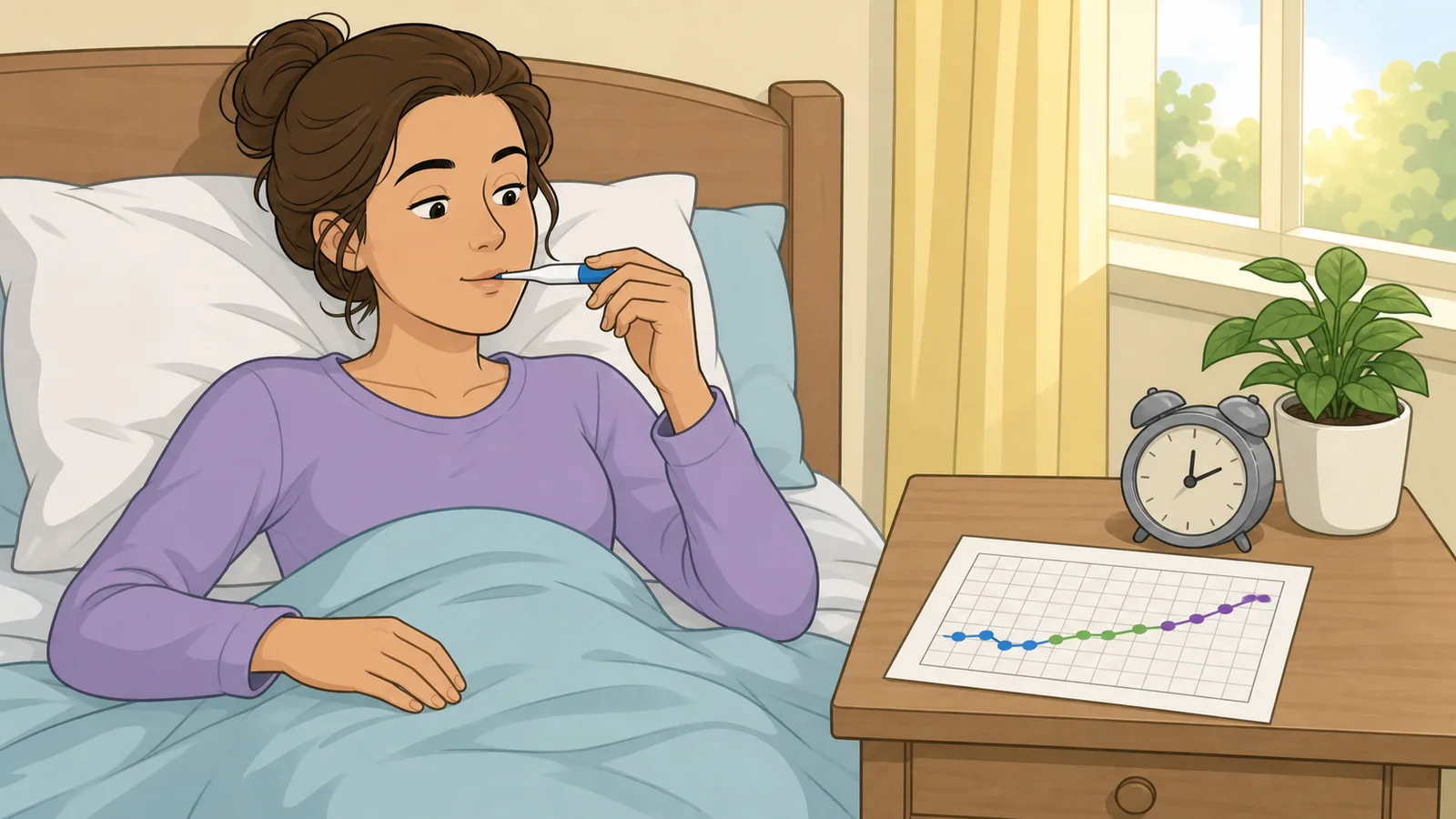
Basal body temperature calculator for real-world charting Use this BBT calculator to adjust a basal body temperature reading for wake-time differences, then decide whether the point is still usable for a basal body temperature chart, should be treated cautiously, or is better marked as disturbed.
Basal body temperature charting
Adjust a BBT reading, then judge whether it belongs on your chart
Strong basal body temperature charting depends on pattern quality, not just a corrected number. This calculator helps with both: it adjusts for early or late waking and then explains whether fever, poor sleep, alcohol, or schedule disruption make the point weak evidence for ovulation.
Quick BBT scenarios
Use a routine chart point, a possible first high-temperature run, or a clearly disturbed reading to see how the chart-quality and shift guidance changes.
Temperature
Recent chart context
Optional: add the highest of your last 6 lower-phase temperatures and how many higher mornings in a row you have, including today. That lets the calculator give a simple coverline and 3-day thermal-shift check instead of treating the reading as an isolated point.
Mark any factors that can distort a BBT chart point
Enter your BBT reading Add a waking temperature above, then compare the adjusted result with the reference ranges carefully. If you already know your recent low-phase baseline, you can also add it to check whether today looks like the start of a coverline-based thermal shift. Basal body temperature can support charting, but it does not confirm fertility or diagnose cycle problems on its own, especially when sleep, illness, or schedule changes affect the reading.
BBT calculator guide: adjusted basal body temperature, ovulation shifts
Basal body temperature (BBT) charting can help you see whether a sustained temperature rise has already happened in your cycle. This page also explains the main assumptions behind the bbt calculator result, highlights the supporting figures shown by the calculator, and helps the reader use the estimate without overstating what a quick online tool can prove.
Why wake time matters
BBT is most useful when it is taken at the same time every morning under the same conditions. If you wake meaningfully earlier or later than usual, the raw reading may drift enough to blur the temperature pattern you are trying to interpret.
This calculator uses a simple charting correction rule of thumb so that one off-schedule reading is easier to compare with the rest of your chart. That correction should be treated as a consistency aid, not as a lab-grade measurement.
How the adjustment works
The calculator estimates how far your actual wake time differed from your usual wake time, then applies a small correction so the adjusted value better reflects your normal schedule. Earlier wake times nudge the adjusted reading up, while later wake times nudge it down.
For Fahrenheit workflows the rule of thumb is 0.1°F per 30 minutes. For Celsius workflows the equivalent adjustment is 0.056°C per 30 minutes.
A lower temperature pattern is usually seen before ovulation. After ovulation, progesterone causes a sustained rise that often remains elevated until the next period. The calculator uses a simple reference threshold to show where an adjusted reading sits in that pattern.
The key word is sustained. A single higher reading can happen for many reasons, including illness, alcohol, stress, disturbed sleep, travel, or inconsistent measurement technique. Chart interpretation depends on several days of data, not one point in isolation.
Worked example: waking 30 minutes early
If your raw temperature is 97.4°F and you woke at 05:30 instead of your usual 06:00, the calculator applies a -0.1°F wake-time adjustment and reports an adjusted temperature of 97.5°F. That helps you compare the reading more fairly with the rest of a 06:00-based chart.
Even with that correction, the result still needs context. A single adjusted value around 97.5°F is only one data point. Ovulation charting is based on a pattern of consistently higher temperatures across the following days.
When BBT charting is helpful and when it is not
BBT charting can help people understand cycle patterns and confirm that an ovulatory temperature rise has already happened. It is more useful for retrospective charting than for predicting ovulation several days in advance.
If cycles are very irregular, temperatures are hard to interpret, or you are concerned about infertility, recurrent pregnancy loss, or not ovulating, speak with a clinician rather than relying on BBT alone. Formal fertility evaluation uses a broader clinical picture than home charting.
When to keep, mark, or discard a basal body temperature chart point
A useful basal body temperature chart does not require perfect data every day, but it does require honest charting. If you woke a little earlier or later than usual and otherwise slept normally, an adjusted reading may still be worth keeping as a chart point. If the wake-time shift was large, sleep was poor, or your routine was disrupted by travel or shift work, the reading is better treated cautiously instead of as strong ovulation evidence.
Fever and acute illness are different. Those readings can move temperature independently of progesterone, which means they may not belong on an ovulation chart at all. In practice, many charting systems mark those temperatures as disturbed so they are not mistaken for a genuine post-ovulation rise.
How to chart basal body temperature with cervical mucus or LH testing
A BBT calculator is most useful when it supports a wider fertility-awareness pattern rather than acting alone. Cervical mucus changes can help identify the approach to ovulation, while LH testing can show that the hormone surge is happening. Basal body temperature charting then helps confirm that the temperature rise came afterward.
That combination solves one of the biggest weaknesses of using a BBT chart alone: temperature is usually a retrospective sign. If your question is 'did ovulation likely happen already?' a sustained thermal shift can help. If your question is 'am I about to ovulate?' mucus and LH signs often become useful sooner.
What a temperature rise after ovulation usually looks like
Many people see a temperature rise after ovulation of roughly 0.2°F to 0.5°F, or about 0.1°C to 0.3°C, relative to the earlier follicular pattern. Exact numbers vary from person to person, which is why your own chart baseline matters more than any universal 'normal' reading.
The most convincing BBT chart ovulation pattern is not one isolated higher point. It is a cluster of higher temperatures that stays elevated for several mornings in a row. If one point looks high but the next few readings fall back immediately, the first reading may have been driven by noise rather than a real ovulatory shift.
How a coverline and 3 higher mornings help with BBT chart ovulation review
Some basal body temperature charting systems compare today's reading with the highest of the last several lower temperatures, then look for several higher mornings in a row before calling the shift established. The point of that approach is not to create a perfect fertility diagnosis from a home chart. It is to stop one noisy reading from being mistaken for proof that ovulation has already happened.
That is why this calculator now lets you enter the highest recent low-phase temperature and the number of higher mornings you have already seen, including today. If the adjusted reading does not clear that simple coverline, the chart still looks low-phase. If it clears the line but the run is short, it behaves more like a possible first higher temperature than a confirmed shift. If it stays above the coverline for several mornings in a row, the chart pattern becomes more convincing, even though disturbed sleep, fever, alcohol, travel, and irregular routines can still weaken the evidence.
Frequently asked questions
How accurate is the wake-time correction?
It is a practical charting heuristic rather than a precise biological constant. The correction can reduce wake-time noise, but illness, poor sleep, alcohol, travel, and other factors may still affect the reading.
Can one adjusted reading confirm ovulation?
No. Ovulation charting depends on a sustained temperature rise across several days. A single reading, even after wake-time correction, is not enough to confirm that ovulation has happened.
Can BBT charting be used as contraception or fertility diagnosis?
BBT is one part of fertility-awareness charting, but it is not enough by itself for reliable contraception or fertility diagnosis. If you need pregnancy prevention, conception support, or evaluation of possible ovulation problems, use clinician or trained-instructor guidance.
Why do illness or poor sleep affect BBT readings?
Illness, disrupted sleep, alcohol, travel, and other stressors can change body temperature independently of ovulation. That is why BBT is best interpreted as a pattern across several days rather than as proof from a single reading.
What is the best time to take basal body temperature?
Take it immediately after waking, before getting out of bed, eating, drinking, or doing anything else. The main goal is consistency, so taking it at the same time each morning under similar conditions gives the cleanest chart.
Can fever or illness ruin a BBT chart point?
Yes. Fever and illness can raise body temperature for reasons unrelated to ovulation, so that point may need to be marked as disturbed or left out of the chart. If you are unwell, resume normal charting once the illness has passed rather than assuming the reading reflects fertility timing.
What if I woke much later than usual for my basal body temperature reading?
A wake-time adjustment can make the reading easier to compare with your usual chart, but the further you move from your normal schedule, the less reliable the point becomes. Small differences may still be usable, while large timing shifts are better treated cautiously.
Can shift work make basal body temperature charting unreliable?
It can. Shift work, travel, and frequent schedule changes make it harder to capture a true resting temperature under similar conditions every day. Some people can still chart usefully, but they often need more caution and may benefit from combining BBT with cervical mucus or LH testing.
Does a higher temperature mean I am pregnant?
No single higher BBT reading proves pregnancy. Temperatures often stay elevated after ovulation because progesterone rises in the luteal phase. Pregnancy testing should rely on a home pregnancy test used at the right time, not on one temperature point alone.
What is a coverline in a basal body temperature chart?
A coverline is a simple guide drawn just above the earlier lower temperatures in a BBT chart so you can see whether newer readings are clearly higher. It is a charting aid rather than a diagnosis. A point above the coverline is more interesting than a point below it, but the strongest evidence still comes from several higher mornings in a row rather than from one isolated value.