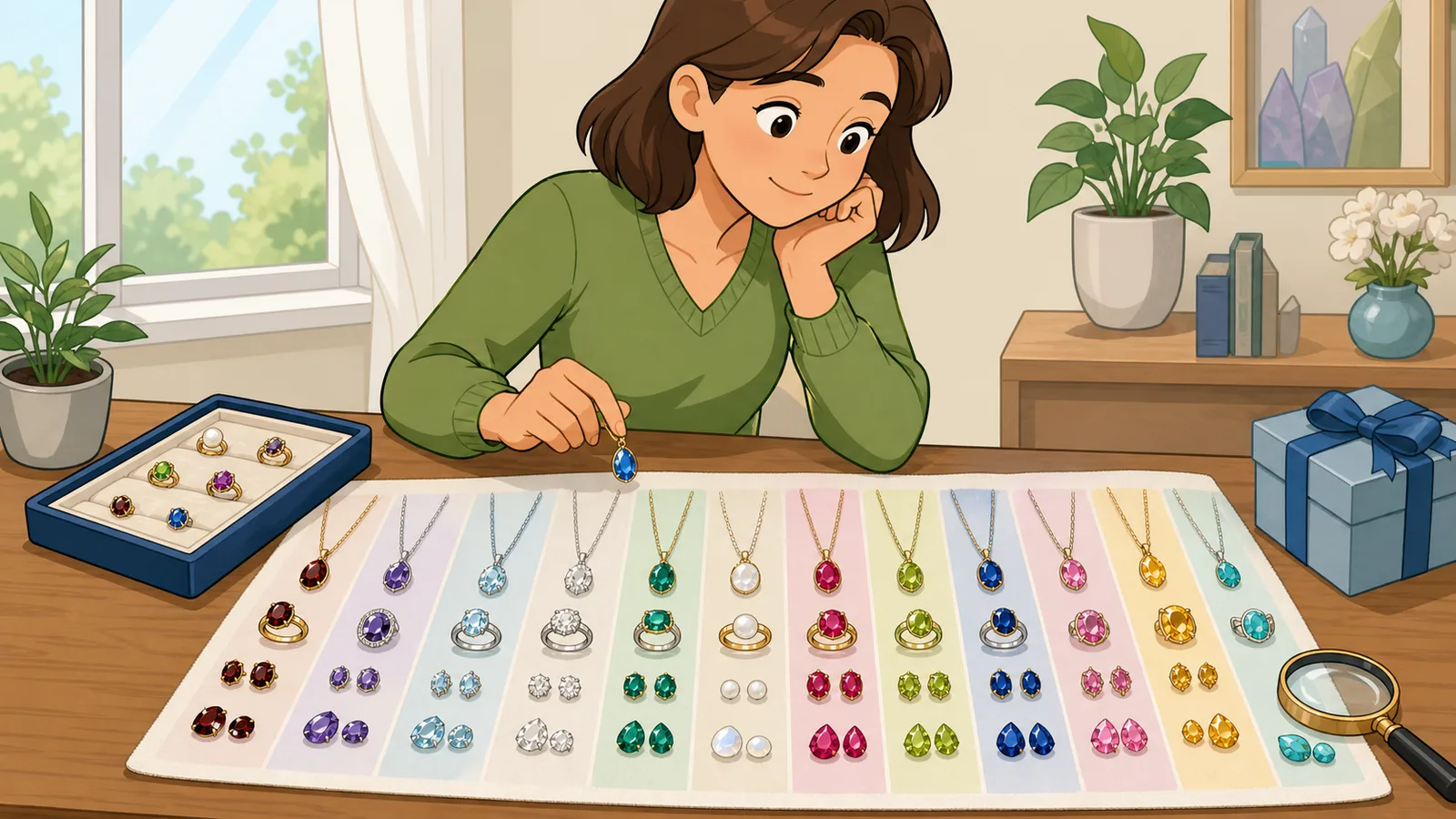
Use this birthstone calculator to find your birthstone by month, compare modern and traditional alternates, and check colour, hardness, wear profile.
Last updated
Quick month picks
How to use this
This calculator follows the modern mainstream birthstone chart used by major jewellery references and then adds the context people usually need next: accepted alternates, durability clues, and practical gift notes.
Birthstone traditions vary across countries, jewellers, and historical lists, so treat the result as a reference summary rather than a single universal standard or a zodiac-sign reading.
Choose a birth month Choose a birth month to see the associated birthstone details. Start with the month picker or tap a quick month chip to compare the mainstream stone, accepted alternates, and the practical wear notes.
All-month birthstone chart
Compare the modern primary stone, common alternates, colour family, hardness, and wear profile before choosing a gift or everyday jewellery piece.
Find your birthstone by month and compare alternates, durability, and chart notes
A birthstone calculator maps a birth month to the modern mainstream birthstone list and then adds the practical context people usually want next: accepted alternates, colour family, durability clues, and short gift-planning notes. It is a cultural and jewellery-reference tool rather than a scientific classifier or a zodiac-reading tool.
Why some months have more than one accepted birthstone
Birthstone charts changed over time as jewellers, trade groups, and publishers updated which stones they wanted to promote or keep in circulation. That is why June, August, October, November, and December are especially likely to show more than one accepted option.
That does not mean one chart is automatically wrong. In practice, different sites may be leaning on the current mainstream list, a traditional list, or a retailer-specific presentation of alternates that customers still recognise.
How to choose between the alternates when a month has more than one stone
The primary stone in this calculator is the modern mainstream option most people expect first. The alternates matter because they often solve a practical buying problem: a different colour preference, a lower budget, a harder stone for daily wear, or a more traditional historical choice.
For example, October buyers often compare opal with tourmaline because both are accepted, but the wear profile is different. June buyers often compare pearl with alexandrite or moonstone because the look, rarity, and durability can vary much more than the month label suggests.
Use the full birthstone chart before choosing jewellery
A quick birthstone by month lookup is enough when you only need the primary stone, but a full birthstone chart is more useful when you are choosing jewellery. Seeing every month side by side makes it easier to compare modern birthstones, traditional alternates, colour families, and stones that are better suited to daily wear.
That comparison is especially helpful for gift planning. Someone buying a June, October, November, or December gift may have several accepted birthstones to choose from, while someone buying an everyday ring may care more about hardness, setting protection, and wear profile than symbolic meaning alone.
Why hardness and wear notes matter in a birthstone calculator
Birthstones are not only symbolic labels. People usually buy them as rings, pendants, earrings, or keepsake gifts, so the practical questions arrive quickly: can this be worn every day, is it scratch-resistant, and is there a tougher alternate for the same month?
Hardness is only part of the answer, but it is a useful first filter. A softer option such as pearl, turquoise, or opal can still be a beautiful gift; it just benefits from gentler wear or a more protective setting than a stone such as sapphire or diamond.
Birthstone meanings are cultural, not scientific
Birthstone meanings belong to tradition, marketing history, and gift language rather than to science. A stone being linked with calm, courage, or clarity does not mean it has a proven effect on health, personality, or outcomes.
That still leaves the tool useful. If you are checking a birth month, comparing accepted stones, or planning a birthday gift with symbolic language, those traditional associations are often exactly the context you wanted.
Frequently asked questions
Why does another site list a different stone for my month?
Birthstone charts vary because some sites use the modern mainstream jewellery list while others include older traditional stones or retailer-specific alternates. This calculator leads with the current mainstream option and then notes widely accepted alternates where they exist.
Is my birthstone based on birth month or zodiac sign?
Birthstones are usually assigned by birth month, not by zodiac sign. Zodiac stones, anniversary stones, and other spiritual or retailer-created gem lists can overlap, but they are separate systems from the mainstream month-based birthstone chart used here.
Which birthstones are best for everyday rings?
The stronger mainstream everyday options are usually diamond, sapphire, and ruby, with aquamarine, garnet, and amethyst also being workable in many settings. Softer stones such as pearl, opal, and turquoise are often better in gentler wear pieces or more protective settings.
What is the difference between modern and traditional birthstones?
Modern birthstones are the mainstream month assignments most jewellery references use today, while traditional birthstones come from older or parallel lists. This calculator leads with the modern birthstone for each month, then lists widely recognised alternates where those older or accepted options still appear.
Can I use an alternate birthstone for a gift?
Yes. Alternate birthstones are commonly used when the primary stone is too delicate, too expensive, hard to source, or simply not the recipient's style. The comparison chart helps you check colour, hardness, and wear profile before choosing an alternate.
Are birthstone meanings scientifically proven?
No. The meanings are traditional symbolic associations and should be treated as cultural or gift-giving context, not as scientific claims about personality or wellbeing.