Use this coffee ratio calculator to plan coffee dose, brew water, espresso shot yield, cold brew concentrate, serving count, grind, brew time.
Last updated
Beverages
Plan coffee dose, brew water, and shot yield by method
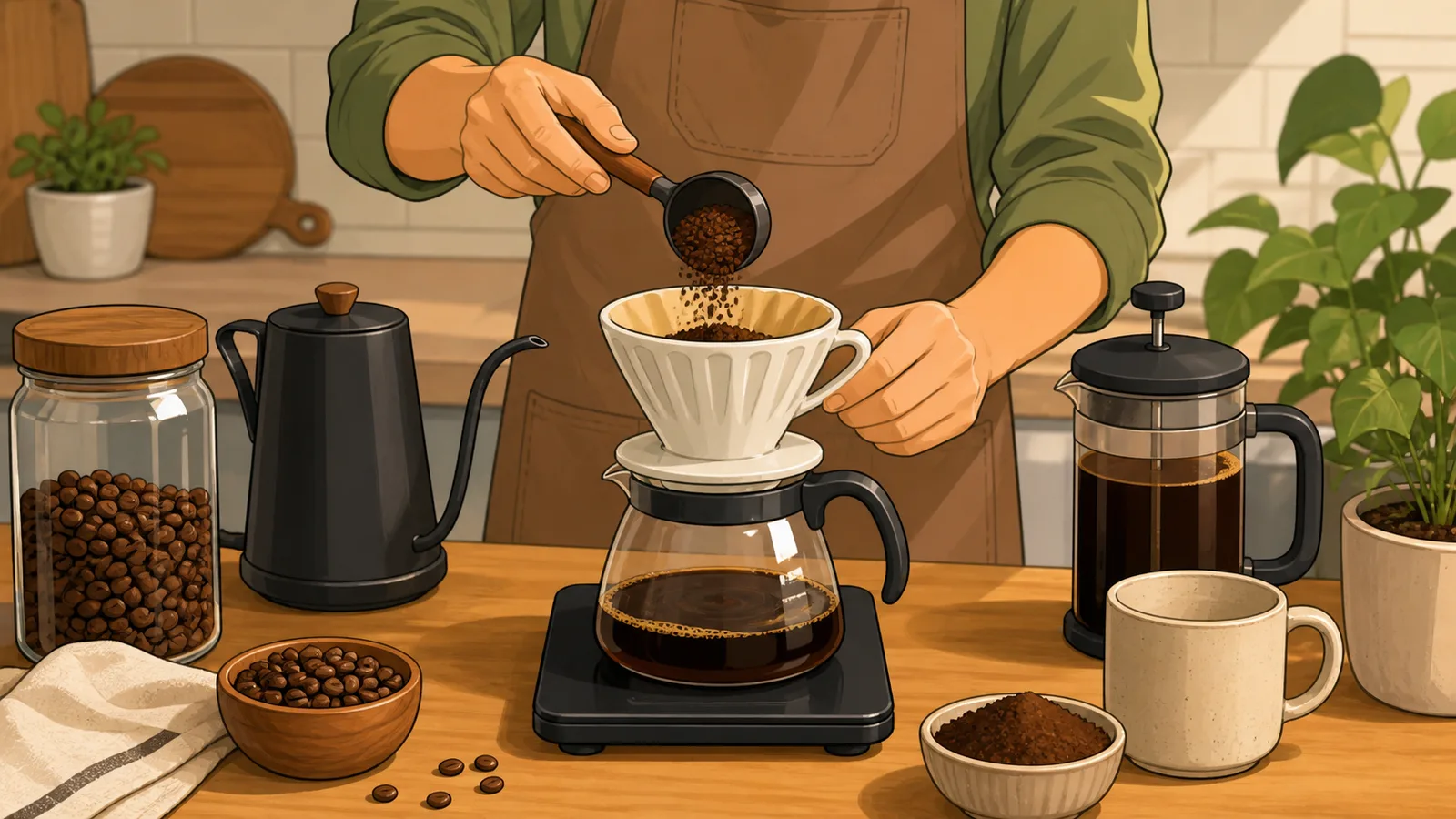
This coffee ratio calculator works for drip, pour over, French press, AeroPress, moka pot, espresso, and cold brew. Start from water or from coffee dose, then compare ratio presets that make sense for the brew method instead of applying one generic multiplier to everything.
Coffee ratio calculator for brew planning, not just one number Espresso is calculated as dose to shot yield, cold brew can be planned as ready-to-drink or concentrate, and every method keeps its own practical ratio band.
Starting point
Brewing method
Strength target
Used only to estimate how many cups, shots, or servings the planned recipe makes.
Use weight when you can. “Scoops” change with grind size and how the scoop is filled, while grams let you repeat the same recipe and adjust one variable at a time.
Starting recipe
18.8 g coffee
Drip / Filter at 1:16 using the balanced preset.
Ratio used
1:16
coffee to brew water by weight
Grind
Medium
Start here before making finer ratio tweaks.
Brew time
4-6 minutes
Useful for staying consistent while you dial the recipe in.
Water temperature
90-96°C / 195-205°F
A practical starting range for this method.
Servings
1.2
Based on 250 ml servings from 300 ml planned output.
Method note A good starting point for batch brewers and standard filter machines. If the cup tastes thin, tighten the ratio before making large grind changes.
Coffee ratio calculator guide: coffee-to-water ratios, espresso yield
A coffee ratio calculator is only useful if it respects how different brewing methods actually work. Filter coffee usually starts with coffee to brew water, espresso is usually dialed as dose to beverage yield, and cold brew can be planned either as ready-to-drink coffee or as a concentrate you dilute later. This page turns those differences into practical recipes instead of pretending one universal ratio fits every brewer.
Why a coffee ratio calculator needs method-specific logic
Many coffee ratio tools stop at a single formula such as coffee = water divided by ratio. That is a fine starting point for batch filter coffee, but it becomes weaker once you compare French press, pour over, espresso, moka pot, AeroPress, and cold brew side by side. Espresso is usually discussed as dry dose in to liquid out. Cold brew can be brewed as a strong concentrate or as a ready-to-drink batch. A calculator that ignores those differences may still produce a number, but it does not produce a recipe that feels trustworthy.
That is why this page keeps method-specific ratio bands instead of one blanket multiplier. It also lets you start from the variable you actually have in front of you: the brew water, the coffee dose, or the target espresso yield. That is closer to how people really brew coffee at home.
The standard coffee-to-water formula
For drip, French press, pour over, AeroPress, moka pot, and most cold brew batches, the basic planning formula is still useful. The ratio is written as coffee to water by weight, so a 1:16 recipe means one gram of coffee for every sixteen grams or millilitres of water.
That math works best when you measure by weight rather than by scoops. Water is close enough to 1 gram per millilitre for everyday brewing, but coffee volume changes with grind size and how loosely or tightly the scoop is packed. That is why a digital scale is more reliable than tablespoons when you want a repeatable brew.
Coffee dose (g) = Brew water (ml) ÷ Ratio
Example: 300 ml at 1:16 needs about 18.8 g of coffee.
Brew water (ml) = Coffee dose (g) × Ratio
Example: 20 g at 1:15 gives a 300 ml pour-over recipe.
Further reading
About Coffee - Brewing — Coffee brewing guidance from the National Coffee Association's consumer education site.
SCA - Coffee Standards — Specialty Coffee Association standards and references behind the Golden Cup style approach to coffee brewing.
How brew method changes the ratio
Filter methods often sit around the familiar golden-cup territory, but the practical band still moves with brew style. Drip and batch filter brewers often land around 1:15 to 1:17. Pour over often tastes balanced around 1:15 to 1:16 when the grind and pour pattern are tuned well. French press usually sits slightly tighter because the cup is fuller-bodied and the steeping method extracts differently. Moka pot is naturally much more concentrated than filter coffee, so a tighter ratio is normal rather than a mistake.
AeroPress is especially variable because recipes can be short and concentrated or longer and more filter-like. That is why this calculator uses practical starting bands instead of claiming a single official AeroPress number. The goal is not to eliminate taste preference. The goal is to give you a defensible place to start dialing in.
Cup counts and serving size make the ratio easier to use
A coffee grams to water calculator is more useful when it also tells you how far the planned batch will go. A 300 ml pour over at 1:16 gives about 18.8 g coffee, but it is also roughly 1.2 servings if your usual mug is 250 ml. A 1 litre batch is four 250 ml mugs, five 200 ml cups, or a larger carafe depending on how you serve it.
This page keeps the serving size separate from the brew ratio so the recipe does not change just because your cup is larger or smaller. Change the serving size to estimate mugs, espresso shots, cold brew servings, or tasting portions while the coffee-to-water calculation stays grounded in grams and millilitres.
Water temperature, grind, and time are part of the starting recipe
Competitor calculators often show the dose and water amount but leave the rest of the brew setup out of view. That can make the ratio look more precise than it really is. A 1:16 recipe with water that is too cool, a grind that is too coarse, or a brew time that is too short can still taste weak or sour.
For most hot filter methods, a practical starting range is around 90–96°C or 195–205°F. AeroPress recipes may use a wider range, moka pot depends more on controlled stovetop heat, and cold brew uses cold or room-temperature water over a long steep. The calculator shows method-specific temperature, grind, and time guidance so the ratio is tied to a usable recipe instead of a single arithmetic result.
Espresso is usually dose to yield, not coffee to brew water
Espresso is the method most often mishandled by generic coffee ratio calculators. In espresso, the useful planning ratio is usually the dry coffee dose relative to the beverage yield. A classic balanced target might be 18 g in and 36 g out, which is written as 1:2. A longer espresso or lungo may move closer to 1:2.5, while a shorter, stronger shot may land closer to 1:1.7.
That is why this page lets you start from either the coffee dose or the target shot yield when espresso is selected. The displayed ratio is the dose-to-yield relationship the barista would actually dial in, not an irrelevant brew-water estimate. The grind and shot time still matter, but the ratio gives you the backbone of the recipe.
Cold brew ready-to-drink versus concentrate
Cold brew creates a second planning problem that many competitors skip. Some recipes are designed to be poured and consumed after straining. Others are designed as concentrates that need dilution with water, ice, or milk. Those are not the same ratio. A ready-to-drink cold brew batch may sit around the low-teens, while a concentrate is much tighter and then diluted later.
That distinction matters because otherwise a user can end up with a batch that tastes far too strong or far too weak while still technically following the calculator. This page surfaces the style choice directly and, for concentrate mode, gives a simple 1:1 dilution starting point rather than making the user reverse-engineer the serving plan themselves.
Worked examples: pour over, espresso, and cold brew
Suppose you want a 300 ml pour over at a balanced 1:15 ratio. The calculator gives roughly 20 g of coffee. If the cup tastes a touch heavy, widening the ratio to 1:16 takes the dose closer to 18.8 g while keeping everything else the same. That is a small change, but it is exactly the kind of controlled adjustment that helps you learn a brewer rather than guess at it.
For espresso, an 18 g basket at 1:2 points you toward a 36 g shot yield. For cold brew concentrate, a 600 ml batch at 1:6 uses 100 g of coffee, and a simple first dilution is to add roughly another 600 ml water or milk after straining. The recipes are different because the methods are different, which is why the calculator should not force them into one generic format.
Why the same ratio can still taste different
A coffee ratio calculator does not replace grind size, water temperature, brew time, or coffee freshness. Two brews can use the same ratio and still taste different if one drawdown is too fast, the grind is too coarse, or the beans are stale. That is why the live calculator now keeps grind-size and brew-time guidance visible next to the ratio instead of presenting the ratio as if it were the whole recipe.
Use the ratio to set the structure of the brew. Then make one adjustment at a time. If the cup is weak and sour, the issue may be extraction rather than simply not using enough coffee. If it is harsh and bitter, making the ratio wider may help, but so might grinding coarser or shortening the contact time.
Frequently asked questions
What is the best coffee to water ratio?
There is no single best ratio for every method. Drip and batch filter brewers often start around 1:15 to 1:17, pour over often lives around 1:15 to 1:16, French press is usually a little tighter, moka pot is much more concentrated, and espresso is usually planned as dose to beverage yield rather than brew water.
How much coffee do I need for 300 ml of water?
At 1:16 you need about 18.8 g of coffee. At 1:15 you need 20 g. That is exactly why a coffee ratio calculator is useful: small ratio changes move the dose enough to change the cup.
Should I measure coffee by scoops or grams?
Grams are much better. Scoop volume changes with grind size, roast level, bean shape, and how tightly the scoop is packed. Weight is the repeatable way to dial in a brew recipe.
What ratio should I use for espresso?
Espresso is commonly planned as dry coffee dose to beverage yield. A balanced starting point is often around 1:2, such as 18 g in and 36 g out, while stronger or shorter shots may move closer to 1:1.7 and longer shots may move wider.
Is cold brew ratio different from hot coffee ratio?
Yes. Ready-to-drink cold brew is usually tighter than standard filter coffee, and concentrate is tighter still because it is intended for dilution after brewing. A generic hot-coffee ratio is not a reliable cold-brew recipe.
Why does my coffee taste weak even when the ratio looks right?
The most common causes are under-extraction, too coarse a grind, stale coffee, or a brew time that is too short for the method. Ratio matters, but it is only one of the main controls.
Why does the page show weak, balanced, and strong recipes for the same batch?
Because many users want to compare how a 300 ml or 500 ml batch changes as the ratio tightens or widens. Showing the whole band is more useful than hiding the alternatives behind one default number.
How many cups does a coffee ratio recipe make?
Divide the planned water, shot yield, or diluted cold brew output by your serving size. For example, 1000 ml of brewed coffee is four 250 ml mugs or five 200 ml cups. The calculator lets you change the cup or serving size without changing the brew ratio itself.
What water temperature should I use with the coffee ratio?
For most hot filter methods, start around 90–96°C or 195–205°F. AeroPress can work across a wider range, moka pot needs controlled stovetop heat rather than boiling brewed coffee, and cold brew uses cold or room-temperature water over a long steep.
Can I use this coffee ratio calculator for moka pot and AeroPress?
Yes. Both methods are included, but they use their own practical ratio bands, grind guidance, and brew-time expectations. That is more realistic than forcing them into a generic filter-coffee range.
Guides
Featured in articles
Step-by-step guides that use this calculator to solve real problems.