Convert land area between acres, hectares, square metres, square kilometres, and square feet with quick parcel examples, planning reference scales.
Last updated
Land planning
Convert land area units
Compare hectares, square metres, square kilometres, acres, and square feet for site briefs, agricultural parcels, and property listing checks.
Quick parcel examples
Optional land value check
Add a price per acre, hectare, square metre, or square foot to translate the converted land area into a rough planning value in your own currency.
Planning note Hectares and acres are the quickest high-level land benchmarks, while square metres and square feet are more useful when a parcel needs to connect back to detailed drawings, building footprints, or listing-floor-area language.
Result
Enter a land area Provide a non-negative parcel size above to compare hectares, acres, and detailed footprint units.
Land area converter: acres, hectares, square metres, and square feet explained
A land area converter helps you keep one parcel size consistent while the unit language changes around it. This page also explains the main assumptions behind the land area converter result, highlights the supporting figures shown by the calculator, and helps the reader use the estimate without overstating what a quick online tool can prove.
Why land and property area use different units
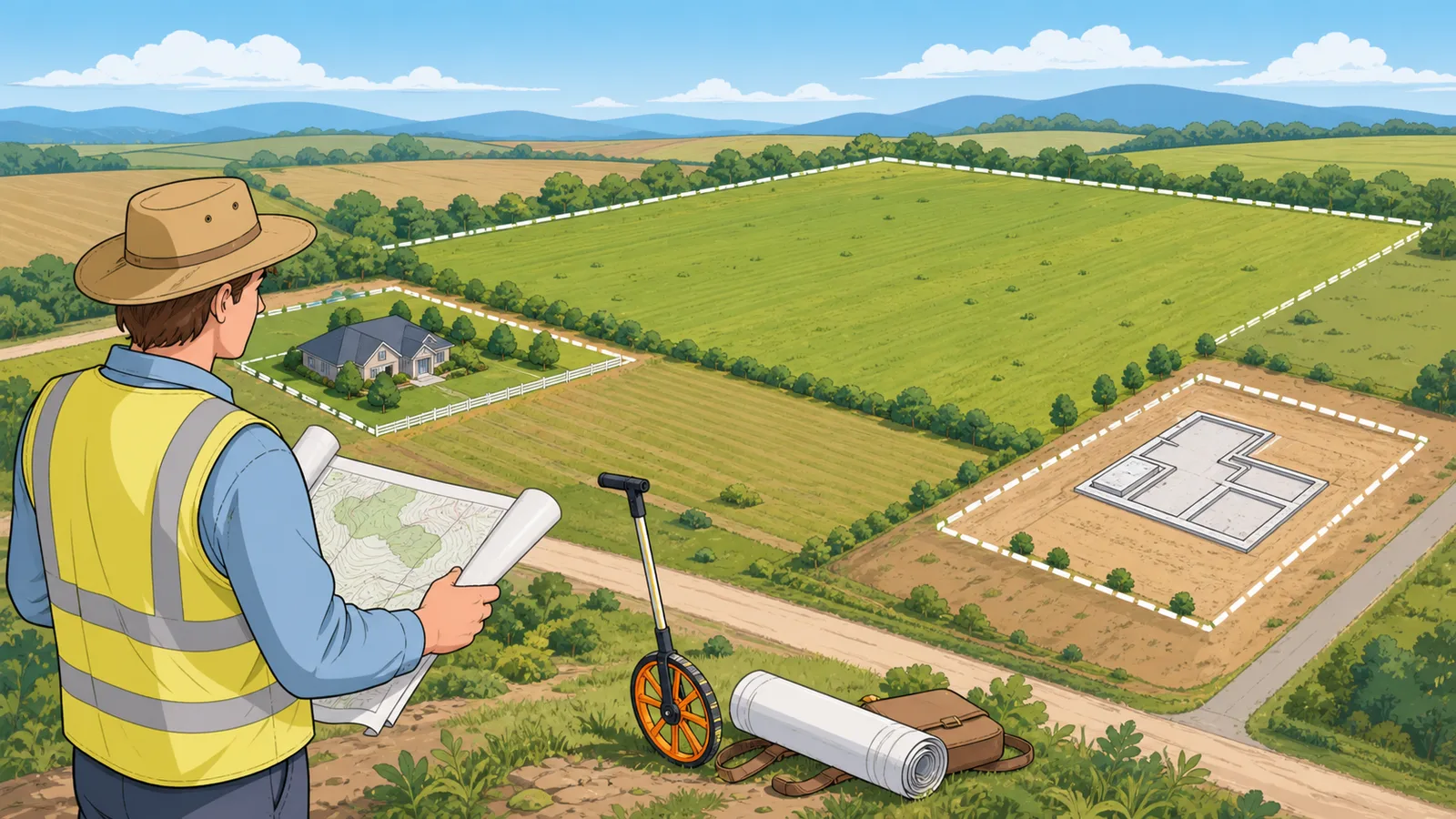
Large sites are usually summarised in hectares or acres because those units are easier to scan at a glance than long strings of square metres or square feet. Detailed design drawings, lease schedules, and floor-area references, however, often switch back to square metres or square feet because the scale is smaller and more specific.
That means the same parcel may be marketed in acres, assessed in hectares, and then broken down into square-metre or square-foot figures for more detailed planning. A land-area converter keeps those views aligned so the parcel itself does not change, only the label attached to it.
The core conversion relationships
The live converter uses square metres as the shared base. One hectare equals exactly 10,000 square metres, one square kilometre equals exactly 1,000,000 square metres, and one square foot equals exactly 0.09290304 square metres because the international foot is defined as exactly 0.3048 metres.
The acre is then linked back through the same international-foot system. That gives one international acre as exactly 43,560 square feet, or 4,046.8564224 square metres. Those relationships are enough to translate every supported land unit cleanly from one fixed parcel area.
1 ha = 10,000 m²
Exact metric land-area benchmark used across planning and agriculture.
1 acre = 43,560 ft² = 4,046.8564224 m²
International-acre relationship used for modern consumer land conversion.
1 km² = 100 ha
Useful scale jump for large estates, districts, and mapped land areas.
Why survey-foot caveats still matter
For general consumer conversion, the modern international-foot basis is appropriate and keeps parcel comparisons consistent with most current property and planning workflows. Older deeds, plats, and survey records can still contain historic US survey-foot references, and those definitions differ slightly from the international foot.
That difference is tiny for many everyday tasks, but it can matter in boundary or legal-description work. This converter is therefore best used for planning, estimation, and comparison rather than as a substitute for the controlling survey document when the underlying record is historic or legally sensitive.
Using parcel examples and price-per-unit checks
Many land area conversion searches start with a familiar parcel phrase rather than a clean unit table: one acre, one hectare, or a 10,000 square-foot lot. Quick examples shorten that workflow and make it easier to compare the same land area in acres, hectares, square metres, square kilometres, and square feet without typing a benchmark from memory.
The optional value check is deliberately a planning aid. Enter a price per acre, hectare, square metre, or square foot to see how the converted area scales into a rough total. That can help with early site screening, agricultural comparisons, or listing sanity checks, but it is not a valuation model because it does not account for zoning, access, utilities, soil, entitlements, comparable sales, or local market conditions.
Frequently asked questions
How many acres are in a hectare?
One hectare equals about 2.47105 acres. The reverse is that one acre equals about 0.404686 hectares. Hectares are more common in international planning and agriculture, while acres remain common in the US and UK.
How many square feet are in an acre?
Exactly 43,560 square feet. That relationship is one of the core acre definitions and is why an acre converts to 4,046.8564224 square metres under the international-foot system.
When should I use square metres instead of hectares or acres?
Square metres are better when the site needs to connect to building footprints, detailed drawings, lease schedules, or smaller development parcels. Hectares and acres are usually easier for high-level parcel summaries.
What is the difference between a land area converter and a general area converter?
A general area converter covers every common square unit, including room-scale and material units. A land area converter is narrower: it focuses on parcel-scale units such as acres, hectares, square metres, square kilometres, and square feet, plus property and agricultural interpretation.
Can I estimate land value from the converted area?
You can enter a price per acre, hectare, square metre, or square foot to get a rough planning value in your own currency. Treat that as a screening estimate only. Real valuation depends on location, legal rights, access, zoning, soil, improvements, comparable sales, and local market data.
Which unit should I use for a property listing lot size?
Use the unit the listing or record gives as the source, then compare acres and hectares for the high-level parcel size and square feet or square metres for detailed site planning. For legal or transaction work, always check the governing survey, deed, or title record.