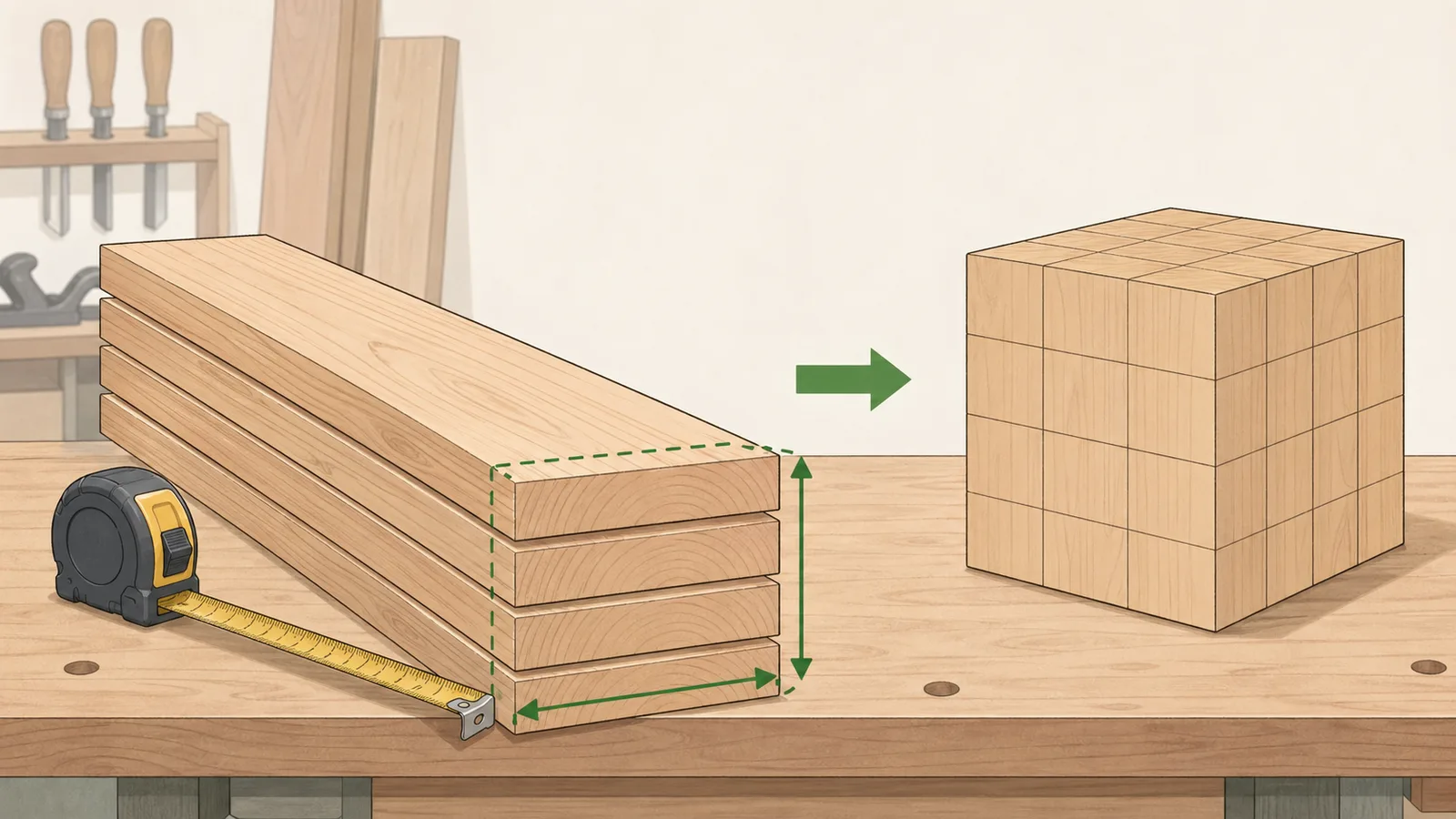
Convert lumber volume between board feet, MBF, cubic feet, cubic inches, cubic metres, and the standard 1×12 linear-foot shortcut.
Last updated
Convert trade lumber volume into geometric volume Switch between board feet, thousand board feet, cubic feet, cubic metres, cubic inches, and the standard 1×12 linear-foot shortcut without losing track of the trade assumption behind the conversion.
Quick presets
Trade note
Board feet and the linear-foot shortcut are trade volume conventions, not exact geometric dimensions for every board profile. Linear feet on this page assume a 1×12 section, and MBF simply means 1,000 board feet.
Result
0 bd ft
Equivalent lumber volume for 0 board feet: 0 bd ft, 0 ft³, 0 m³, and 0 MBF.
Cubic-metre base
Every unit on the page is translated into a shared cubic-metre base first, then expanded back into trade and cubic outputs.
Interpretation
Use board feet or MBF for lumber-yard style pricing, and use cubic feet or cubic metres when you need actual storage, transport, or mixed-metric planning volume.
Conversion sheet
Trade units
Board feet
0
Thousand board feet
0
Linear feet (1×12)
0
Imperial cubic units
Cubic feet
0
Cubic inches
0
Metric cubic units
Cubic metres
0
Quick reference
1 board foot
0.0833 ft³ / 0.0024 m³
The exact 144 cubic-inch trade volume used for board feet to cubic feet and board feet to cubic metres checks.
1 cubic foot
12 bd ft
A fast yard check when converting cubic feet of lumber volume back into board feet.
1 MBF
1,000 bd ft / 83.3333 ft³
The common thousand-board-feet shorthand used for larger lumber packs and price schedules.
A lumber volume converter helps when timber is described in trade units like board feet or MBF, in geometric units like cubic feet or cubic metres, or in the common 1×12 linear-foot shortcut.
What a board foot means
A board foot is the volume of a board that is 1 foot long, 1 foot wide, and 1 inch thick. It is a trade unit used because it translates lumber yield into a compact planning number for rough stock, framing take-offs, and material estimates.
That also explains why linear footage only works as a shortcut when the cross-section is fixed. If the stock is not based on the standard 1×12 board-foot assumption, a plain linear length is not enough to describe the actual volume.
In larger commercial or yard-scale conversations, timber may also be quoted in MBF, meaning one thousand board feet. The MBF label is still just a board-foot volume expressed at a larger scale, so it converts directly into cubic feet and cubic metres once the board-foot relationship is understood.
Common trade shorthand for larger timber lots, packs, or price schedules.
1 in = 25.4 mm
Official inch-to-millimetre bridge used when comparing imperial lumber planning with metric stock volume.
Why cubic units and trade units both matter
Board feet are convenient for lumber estimation, but cubic units are better when you need literal space, shipping volume, or metric planning. Showing both at once makes it easier to translate between supplier language, workshop notes, and engineering-style quantity checks.
The same stock can therefore be read as a board-foot quantity for purchase discussions and as a cubic-volume quantity for transport, storage, or mixed-unit project coordination.
This is especially useful when a supplier quotes MBF, an engineer wants cubic metres, and a workshop note still references board feet. Converting all three together prevents a small mismatch in trade language from becoming a large mistake in ordering or handling.
Common board feet, MBF, and cubic conversions
The most useful quick check is that one board foot equals one-twelfth of a cubic foot. That means one cubic foot of lumber volume equals exactly 12 board feet, before any waste, dressing loss, or cut-list yield adjustment is considered.
MBF conversions are just the same board-foot relationship scaled up. One MBF is 1,000 board feet, which is 83.3333 cubic feet and about 2.3597 cubic metres. This is why an MBF to cubic metres converter can use a fixed volume relationship, even though real purchasing still depends on grade, species, moisture, and supplier convention.
Metric comparisons are also exact once the board-foot volume is defined. One board foot equals 0.002359737216 cubic metres, so a board feet to cubic metres conversion is reliable as a unit conversion even when the practical order still needs a waste or dressed-size allowance.
1 ft³ = 12 board feet
Fast cubic feet to board feet relationship for lumber volume checks.
1 MBF = 83.3333 ft³ ≈ 2.3597 m³
Large-lot trade conversion used when comparing MBF quotes with geometric or metric volume.
Worked example: 120 board feet of framing stock
Suppose a framing order is listed as 120 board feet. That is exactly 10 cubic feet because one cubic foot contains 12 board feet. Using the same volume, the metric equivalent is about 0.2832 cubic metres.
The same result also reads as 0.12 MBF, because MBF is simply one thousand board feet. If someone tries to treat the stock as plain linear footage, the 1×12 shortcut would return 120 linear feet, but that is only valid because the shortcut assumes the 1×12 board-foot cross-section.
This is the practical reason to keep both trade and geometric units visible. Board feet and MBF are good for purchasing and mill communication, while cubic feet and cubic metres are better for transport, storage, and mixed-unit coordination.
What this page assumes
The linear-foot output on this page intentionally assumes the standard 1×12 cross-section because that is the classic board-foot shortcut. If the real board width or thickness differs, use cubic units or calculate the exact geometric volume from the true dimensions.
This page is a volume converter, not a stock-yield optimiser. Saw kerf, planing, dressed size reductions, and species-specific mass differences are outside scope.
It also does not decide whether nominal or dressed size is the right basis for the job. If a quote, cut list, or structural note uses actual dressed dimensions, confirm those dimensions before relying on a board-foot shorthand alone.
For dimension-based jobs, use a board foot calculator first to turn thickness, width, length, and quantity into board feet. Then use this lumber volume converter when the next task is translating that volume into cubic feet, cubic inches, cubic metres, MBF, or the 1×12 linear-foot reference.
Further reading
NIST Guide to the SI — Official NIST guide covering standard unit usage and exact inch-to-millimetre conversion.
One board foot equals one-twelfth of a cubic foot, or 144 cubic inches. That is why board feet can be converted directly into cubic feet and cubic metres. The relationship is exact, so a trade quantity can always be checked against geometric volume as long as the board-foot basis is the correct one for the stock being discussed.
Why does the linear-foot result assume 1×12 stock?
Because one linear foot of 1×12 stock equals one board foot. Without that fixed cross-section, linear length alone does not uniquely describe volume. A 1×6 board, a 2×6 board, and a 1×12 board can all share the same linear length while representing different actual volumes, which is why the shortcut must be called out instead of treated as universal.
Should I use board feet or cubic metres for planning?
Use the unit that matches the job. Board feet and MBF are common in lumber purchasing, while cubic metres and cubic feet are often better for transport, storage, or mixed-unit project coordination. The most reliable workflow is to keep both visible so the purchasing unit and the geometric volume stay aligned.
How do I convert board feet to cubic feet?
Divide board feet by 12. One board foot is one-twelfth of a cubic foot, so 120 board feet equals 10 cubic feet. This conversion is exact for volume, but it does not add waste, account for dressed dimensions, or decide how many physical boards you need.
How many board feet are in one cubic foot?
There are 12 board feet in one cubic foot. This is the reverse of the board-foot definition: a board foot is 144 cubic inches, and a cubic foot is 1,728 cubic inches. Dividing 1,728 by 144 gives 12.
How do I convert MBF to cubic metres?
Multiply MBF by 2.359737216 to convert thousand board feet into cubic metres. For example, 2.5 MBF is 2,500 board feet, which is about 5.8993 cubic metres. The volume conversion is fixed, but supplier pricing and usable yield may still depend on species, grade, moisture, surfacing, and waste.
Is board foot volume the same as linear feet?
No. A linear foot is a length, while a board foot is a volume. One linear foot of 1×12 stock equals one board foot, but one linear foot of 1×6, 2×6, or dressed material does not. That is why this converter labels the linear-foot output as a 1×12 shortcut rather than a universal length conversion.
Does this page account for dressed sizes or waste?
No. It converts volume units only. Dressed dimensions, waste factors, saw kerf, trimming, and grade-driven yield changes need a separate material-planning step. If the real stock section is smaller than the nominal label, or if you expect heavy waste, the conversion is still correct as a unit conversion but not sufficient as a final order quantity.
Can I use this as a lumber volume calculator for actual board dimensions?
Use this page after you already know the volume. If you have thickness, width, length, and quantity, a board-foot or lumber calculator is the better first step because it turns dimensions into board feet. This converter is strongest when the known starting point is already board feet, MBF, cubic feet, cubic inches, cubic metres, or the specific 1×12 linear-foot convention.