Skip to content
Calcipedia
Race Day Fueling Calculator instructional illustration

Race Day Fueling Calculator

Build a race day fueling plan for marathon, triathlon, cycling, or ultra events with carbs per hour, fluid, sodium, gel timing, drink-mix adjustments.

Health estimate

Topic review: Maria Santos

Diet & Lifestyle Coach. Assigned as the health topic reviewer for nutrition, macro, calorie, and lifestyle diet calculators.

Reviewed 11 May 2026 Updated 11 May 2026 View reviewer profile Contact editorial team
Race day fueling calculator Calculate your race day nutrition plan for a marathon, half marathon, ultra-marathon, or cycling event. Enter your race type, expected duration, body weight, and weather conditions to get a personalised fueling schedule with carbs per hour, fluid intake, sodium targets, and a checkpoint-by-checkpoint race nutrition plan.

Quick race plans

Body-weight unit

Use these fields to translate the carbohydrate target into packets and bottles. If your drink mix already covers part of the target, the calculator reduces the remaining gel count instead of double-counting carbs.

Temperature

Result

80 g/h carbs

Your race day fueling plan for a Marathon (3.5 h): target 80 g of carbohydrates per hour with 0.65 L/h fluid and 0.7 g/L sodium. This marathon fueling schedule totals 280 g carbs, 2.3 L fluid, and 1,575 mg sodium across the race. Pre-race meal: 228 g carbs (3.25 g/kg) 1–4 hours before start.

Carbs per hour
80 g
280 g total
Fluid per hour
0.65 L
2.3 L total
Sodium per litre
0.7 g
1,575 mg total
Pre-race carbs
228 g
3.25 g/kg · 1–4 h before
Gels equivalent
~12 gels
based on 25 g per serving

Packet and bottle translation

With 25 g per gel or serving and 0 g/h from drink mix, plan about 12 packets total, or roughly one every 19 minutes after accounting for bottle carbs.

Race checkpoints

Pre-race meal plus four pacing checkpoints with carbs, fluid, and sodium targets for each segment of your race day nutrition plan.

CheckpointTimingCarbsFluidSodiumFuel format

Pre-race

Meal timing

1-4 h before start228 gCarb-rich meal or drink

0%-25%

In-race window

0:00-0:5370 g0.57 L399 mgDrink mix, gels, and chews

25%-50%

In-race window

0:53-1:4570 g0.57 L399 mgDrink mix, gels, and chews

50%-75%

In-race window

1:45-2:3870 g0.57 L399 mgDrink mix, gels, and chews

75%-100%

In-race window

2:38-3:3070 g0.57 L399 mgDrink mix, gels, and chews

Practical fuel formats

Choose one or mix formats to hit the carbs per hour target without overloading the gut.

Multiple transport carbs with drink mix, gels, and chews
Practice gut tolerance at about 0.65 L/h per hour
Use approximately 0.7 g/L in hot or salty-sweat conditions
Important This is a planning tool, not a prescription. Carbohydrate, fluid, and sodium needs vary with sweat rate, heat, humidity, gut tolerance, and event intensity. Avoid deliberate overdrinking, because too much plain fluid can contribute to exercise-associated hyponatremia. Practise the plan in training and stop if you feel unwell.

Race fueling guide by distance

How many gels for a marathon, how many carbs per hour for a half marathon, and fluid targets for every race distance. This race nutrition chart shows typical fueling rates by event type.

EventDurationCarbs (g/h)Gels/hFluid (ml/h)Sodium (mg/h)
5K15–35 min000–2000
10K35–70 min0–300–1200–4000–300
Half marathon1:15–2:3030–601–2400–800300–600
Marathon2:30–5:0060–902–3500–800500–700
Cycling (100 km+)3:00–6:0060–902–3500–900500–800
Triathlon (70.3/140.6)4:00–17:0060–902–3500–900500–800
Ultra-marathon6:00–24:00+60–902–3500–1000500–1000

How race day fueling works

Race day fueling is the practice of consuming carbohydrates, fluids, and electrolytes during an endurance event to maintain blood glucose, delay glycogen depletion, and sustain performance. For events lasting longer than 60–90 minutes — such as a marathon, half marathon, cycling sportive, triathlon, or ultra-marathon — a structured race nutrition plan is essential.

Current sports science recommends 30–60 g of carbohydrate per hour for events lasting 1–2.5 hours, rising to 60–90 g per hour for longer races using multiple-transport carbohydrates (glucose + fructose). The number of gels for a marathon depends on your target carbs per hour and the carbohydrate content of each gel — typically 25 g per gel, meaning 2–3 gels per hour for a marathon fueling schedule.

Fluid intake should match sweat losses, typically 400–800 ml per hour depending on temperature, humidity, and body size. Sodium replacement at 500–700 mg per litre of fluid helps maintain electrolyte balance during prolonged exercise. Always practise your race day nutrition plan in training — never try new fueling products or strategies on race day. Consult a sports dietitian for a personalised marathon fueling calculator plan.

← All Sports Nutrition calculators

Health — Fitness

Race day fueling calculator guide: planning carbs, fluid, and sodium without overdrinking

A race day fueling calculator is most useful when it turns broad sports-nutrition guidance into a practical schedule without pretending one template fits every athlete. This guide explains how duration-based carbohydrate targets, fluid planning, and sodium context fit together, and why overdrinking is just as important to avoid as underfueling.

Why duration is the backbone of race fueling

The first question in race fueling is not which gel brand you use. It is how long the event is expected to last. Shorter efforts often need little or no in-race carbohydrate, while longer endurance races are much more likely to benefit from structured carbohydrate intake across the event.

That is why this page starts with duration bands first, then nudges the target within the band according to event type. It keeps the plan aligned with the strongest broad guidance while still leaving room for sport-specific practicality.

Why carb, fluid, and sodium have to be planned together

A race plan that only focuses on carbohydrate can fall apart if fluid intake is far too low in hot conditions or if sodium strategy is ignored during heavy sweat loss. On the other hand, drinking aggressively without a reason can create its own risk, especially if fluid intake outruns actual losses.

This is why the calculator shows all three together. Carbohydrate supports energy availability, fluid supports hydration planning, and sodium provides context for longer, hotter, or saltier-sweat situations where plain water alone may not fit well.

Why overdrinking matters

Many athletes worry about dehydration and respond by drinking as much as possible. That is not automatically safer. Exercise-associated hyponatremia is strongly linked to overdrinking, especially in longer events where athletes consume more fluid than they are losing.

The practical implication is simple: a fluid target should be individualized, not treated as a drinking challenge. This page frames fluid as a planning range, not as an instruction to force down the highest possible number of litres.

How to make the plan race-ready

A good race plan is not only physiologically reasonable. It is also logistically doable. The number of gels, bottles, chews, aid-station pickups, and pre-race meal timing all have to fit the event format and the athlete’s gut tolerance.

That is why the page includes checkpoints and format suggestions rather than a single headline number only. It should help the athlete rehearse a realistic plan in training before trying to use it in a goal race.

The live race nutrition calculator also lets you adjust the carbohydrate in each gel, chew packet, or serving and subtract carbohydrate already coming from drink mix. That makes the plan more useful than a bare carbs-per-hour target because it translates a marathon fueling calculator result into packets, bottles, and approximate timing without double-counting carbohydrate.

Turning carbs per hour into gels, chews, and bottles

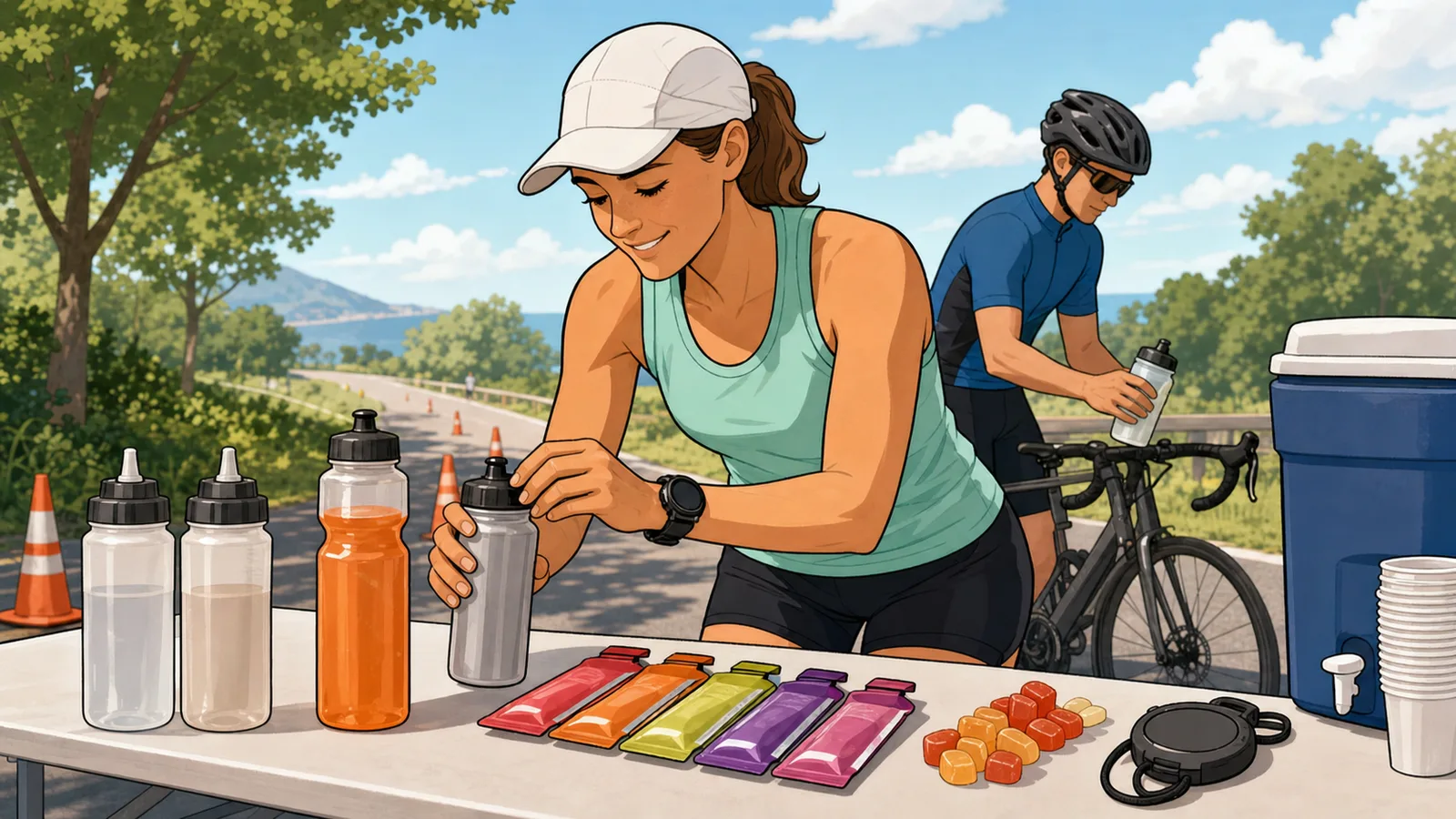
Many athletes search for how many gels for a marathon, how many carbs per hour to use on the bike, or how to combine gels with sports drink. The practical answer depends on the carbohydrate content of the product. A 25 g gel, a 30 g chew serving, and a bottle with 45 g of carbohydrate all change the remaining packet count.

The calculator’s product assumptions let you model that directly. Enter the grams per gel or serving, then enter any drink-mix carbohydrate you expect to take each hour. The result shows the remaining packets needed and an approximate interval, which is easier to rehearse than a generic race nutrition plan that ignores bottle carbs.

This is especially useful for cycling and triathlon fueling, where bottle-based carbohydrate can cover much of the target, and for marathon runners who want a clear gel schedule but still take sports drink at aid stations.

Frequently asked questions

Do I need in-race carbohydrates for a short race?

Often not for events under about 45 minutes, and sometimes only small amounts or a mouth rinse for efforts around 45 to 75 minutes. Longer races are where structured carb intake usually matters more.

Is more fluid always safer on race day?

No. Overdrinking can be harmful, particularly in long events. Fluid planning should be individualized to sweat losses, weather, pace, and gut tolerance rather than pushed blindly upward.

Why does the plan include sodium per litre instead of one fixed total?

Because sodium replacement depends heavily on how much fluid is being consumed and how sweaty or salty the conditions are. Per-litre context is often easier to turn into a bottle plan.

Should I test this plan before my goal race?

Yes. Race day is not the time to discover that a gel, drink mix, or bottle concentration does not sit well. Use the schedule in long training sessions first.

How do I count drink mix and gels without double-counting carbs?

Enter the carbohydrate you expect from drink mix as grams per hour, then enter the grams in each gel, chew packet, or serving. The calculator subtracts the drink-mix carbohydrate from the hourly carbohydrate target before estimating the remaining packet count.

What if my gel has more or less than 25 g of carbohydrate?

Change the grams-per-serving field to match the product label. A larger serving reduces the number of packets needed, while a smaller serving increases the packet count or shortens the suggested interval.

Also in Sports Nutrition

Related

More from nearby categories

These related calculators come from the same leaf category, nearby sibling categories, or the same top-level topic.