Skip to content
Calcipedia
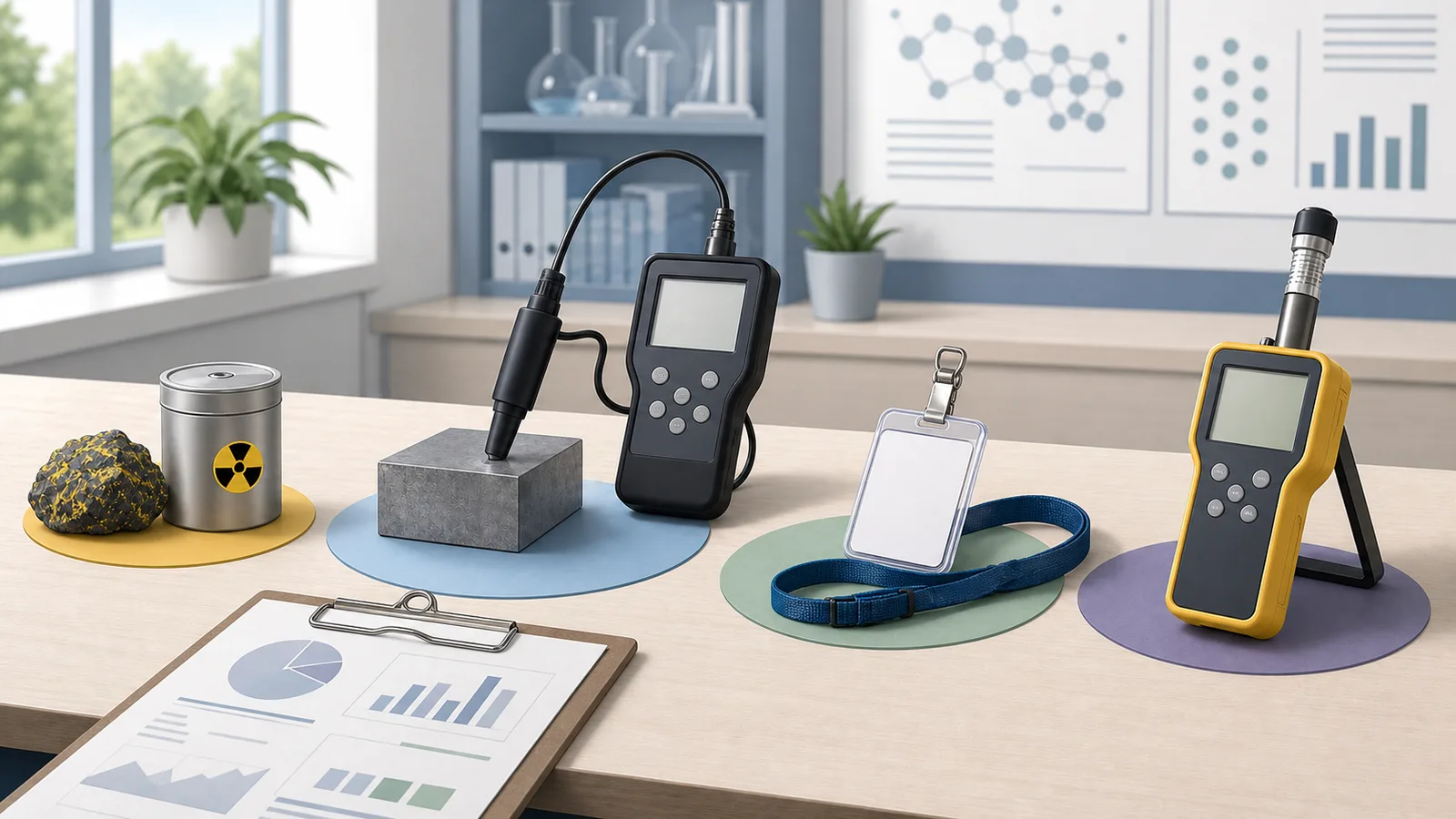
Radiation Units Converter instructional illustration

Radiation Units Converter

Convert radiation units across activity, absorbed dose, equivalent dose, and exposure families, including Bq, Ci, Gy, rad, Sv, rem, roentgen.

Last updated

Choose the radiation quantity first Radiation units are not one interchangeable pool. Activity, absorbed dose, equivalent or effective dose, and exposure use different physical quantities, so converting between families requires extra radiation context, not just a unit factor.

Radiation unit suite

Current family: Equivalent dose. Use the family comparison table below before translating legacy radiation records, survey notes, or medical-physics references.

Cross-family guard

Can these radiation units convert directly?

Use this before trying Bq to Sv, roentgen to sievert, gray to rem, or other mixed radiation unit searches. It shows whether the conversion is a direct unit factor, a stated teaching assumption, or a dosimetry problem.

Starting family
Target family

No direct activity-to-dose conversion

Activity counts nuclear transformations per second. Dose depends on emitted radiation, energy, time, distance, shielding, uptake route, and the material or body region receiving the energy.

Needed context: Radionuclide and emissions; Exposure duration; Distance, shielding, and geometry; Uptake route or target material.

Equivalent and effective dose

Convert sievert, millisievert, microsievert, rem, gray, and rad with the assumption visible

Sievert and rem describe equivalent or effective dose after weighting. This panel includes gray and rad only for the common educational gamma/X-ray shorthand, where 1 Gy is treated as about 1 Sv and 1 rad as about 1 rem.

Dose-family assumption This is a comparison aid, not a radiation-protection model. Particle-specific weighting, tissue weighting, patient-specific dosimetry, shielding design, and regulatory interpretation need a qualified method.

Result

1 mSv

Reference conversion sheet for 1 mSv, with SI and legacy absorbed/equivalent dose scales shown together under the stated assumption.

UnitFamilyValue
SievertsSI0.001 Sv
MillisievertsSI1 mSv
MicrosievertsSI1,000 µSv
GraySI0.001 Gy
Roentgen equivalent manU.S. legacy0.1 rem
Radiation absorbed doseU.S. legacy0.1 rad

Reference equivalences

1 sievert 100 rem
1 millisievert 100 mrem
Teaching shortcut 1 Gy ~= 1 Sv for gamma/X-ray examples only

Family comparison

Which radiation unit family should you use?

FamilyAnswersTypical unitsDoes not answer
ActivityHow often atoms decayBq, kBq, MBq, GBq, Ci, mCi, uCi, nCi, RdDose to a person, exposure in air, or health effect
Absorbed doseEnergy deposited per unit massGy, cGy, mGy, uGy, rad, mradBiological weighting, tissue weighting, or source strength
Equivalent/effective doseDose after radiation or tissue weightingSv, mSv, uSv, remA direct substitute for every gray or rad reading without context
ExposureIonization produced in air by photonsC/kg, mC/kg, uC/kg, R, mRAbsorbed dose in tissue or activity of a radioactive source
← All Radiology calculators

Radiology Reference

Radiation units converter: activity, absorbed dose, equivalent dose, and exposure

A radiation units converter is useful only when it keeps the radiation quantity visible. Becquerel and curie describe activity, gray and rad describe absorbed dose, sievert and rem describe equivalent or effective dose, and roentgen with coulomb per kilogram describes exposure in air. This page consolidates those specialist converters into one radiation unit suite without pretending the families are interchangeable.

Why radiation units must be separated by quantity

Radiation references often place Bq, Ci, Gy, rad, Sv, rem, R, and C/kg close together, but those symbols do not all answer the same question. Activity asks how often nuclei decay. Absorbed dose asks how much energy is deposited per unit mass. Equivalent or effective dose adds radiation or tissue weighting. Exposure describes ionization in air for photons such as X-rays and gamma rays.

The consolidated calculator therefore starts with a quantity-family choice. That structure protects long-tail tasks such as becquerel to curie, gray to rad, sievert to rem, and roentgen to coulomb per kilogram while avoiding unsafe cross-family shortcuts.

Activity conversions: becquerel, curie, and rutherford

Activity is source-strength notation. The SI unit is the becquerel, defined as one nuclear transformation per second. Curie-family labels still appear in older source records, U.S. practice, procurement sheets, and educational material.

Use the activity panel for Bq, kBq, MBq, GBq, Ci, mCi, uCi, nCi, and rutherford. Do not use activity alone to infer the dose a person receives, because distance, shielding, radiation type, energy, exposure time, and route all matter.

1 Ci = 3.7 x 10^10 Bq

Standard activity relationship between the curie and becquerel.

1 Rd = 10^6 Bq = 1 MBq

Historical rutherford activity relationship.

Absorbed dose conversions: gray, centigray, milligray, and rad

Absorbed dose measures deposited ionizing-radiation energy per unit mass. The coherent SI unit is the gray, where 1 Gy equals 1 joule per kilogram. Legacy absorbed-dose notes often use rad or millirad, and centigray remains a useful bridge because 1 cGy equals 1 rad.

Use the absorbed-dose panel for Gy, cGy, mGy, uGy, rad, and mrad. If the source is already reporting sievert or rem, switch to the equivalent-dose panel instead of forcing biological-weighting units into an absorbed-dose table.

1 Gy = 1 J/kg

Definition of the gray as absorbed dose.

1 Gy = 100 rad

Standard gray-to-rad relationship. This is the specific relationship the calculator applies when building the result.

Equivalent and effective dose conversions: sievert, millisievert, microsievert, and rem

Sievert and rem appear when the question is biological effect, equivalent dose, or effective dose. Those quantities are not the same as plain absorbed dose, because radiation weighting and sometimes tissue weighting are part of the interpretation.

The dose panel keeps the common educational gamma and X-ray shorthand visible: 1 Gy is often treated as about 1 Sv, and 1 rad as about 1 rem, when the context already supports that simplification. It is not a substitute for particle-specific weighting, patient-specific dosimetry, shielding design, or regulatory dose assessment.

1 Sv = 100 rem

Standard SI-to-legacy relationship for equivalent or effective dose units.

1 mSv = 100 mrem

Common millisievert-to-millirem relationship for low-dose comparisons.

Exposure conversions: roentgen and coulomb per kilogram

Exposure is an air-ionization quantity for photons, especially older X-ray and gamma-ray references. In SI notation it is expressed in coulomb per kilogram of air, while roentgen and milliroentgen remain common in historical survey, radiology, and educational material.

Use the exposure panel for C/kg, mC/kg, uC/kg, R, and mR. Exposure is not source activity and it is not absorbed dose in tissue, so converting from roentgen to sievert or gray requires a radiation-protection method rather than a direct unit factor.

1 R = 2.58 x 10^-4 C/kg

Standard roentgen-to-coulomb-per-kilogram relationship for exposure in air.

1 mR = 2.58 x 10^-7 C/kg

Milliroentgen exposure relationship. This is the specific relationship the calculator applies when building the result.

Cross-family checks for Bq to Sv, roentgen to sievert, and gray to rem

Many radiation unit searches mix physical quantities: Bq to Sv, curie to rem, roentgen to sievert, gray to rem, or counts per second to dose. The calculator now includes a cross-family guard so you can test whether the requested pair is a direct unit conversion, a conditional teaching comparison, or a dosimetry problem that needs more information.

A same-family conversion such as becquerel to curie, gray to rad, sievert to rem, or roentgen to C/kg is a multiplier. A gray-to-rem or rad-to-sievert comparison needs a radiation-weighting assumption. Activity-to-dose and exposure-to-dose questions require radionuclide, energy, exposure time, geometry, shielding, uptake route, medium, and the method used by the source or standard.

When a radiation unit conversion is not enough

A unit conversion can translate notation, but it does not decide medical risk, occupational compliance, shielding adequacy, transport classification, source handling, or emergency response. Those tasks depend on radiation type, energy, time, geometry, shielding, body region, route of exposure, and the governing standard.

Use this page as a clear unit reference. For medical imaging, radiation therapy, industrial radiography, nuclear medicine, laboratory safety, incident response, or regulatory decisions, rely on the responsible clinician, radiation-safety officer, physicist, or regulator.

Frequently asked questions

Can I convert becquerel directly to sievert?

No. Becquerel measures activity, while sievert is equivalent or effective dose. Converting between them requires source type, energy, distance, shielding, exposure time, uptake route, and a radiation-protection model.

Is gray the same as sievert?

No. Gray is absorbed dose and sievert is equivalent or effective dose. In simple gamma or X-ray teaching examples they may be treated as numerically similar, but that is not a universal rule.

How many rad are in 1 gray?

1 gray equals 100 rad. Centigray is a useful bridge because 1 cGy equals 1 rad.

How many rem are in 1 sievert?

1 sievert equals 100 rem. A millisievert equals 100 millirem.

How many becquerels are in 1 curie?

1 curie equals 37 billion becquerels, or 3.7 x 10^10 Bq. The page uses this rule as a quick reference, but the surrounding assumptions and units still matter when you interpret the result.

What does roentgen measure?

Roentgen is a legacy exposure unit for ionization in air from photons such as X-rays and gamma rays. It is not the same quantity as activity, absorbed dose, equivalent dose, or effective dose.

When should I use the absorbed-dose panel instead of the dose panel?

Use absorbed dose when the source is reporting gray, centigray, milligray, microgray, rad, or millirad. Use the equivalent-dose panel when the source is reporting sievert, millisievert, microsievert, rem, or a context that explicitly applies biological weighting.

Can I convert roentgen to sievert?

Not with a universal unit factor. Roentgen measures photon exposure in air, while sievert describes equivalent or effective dose. A roentgen-to-sievert estimate needs photon energy, medium or tissue, geometry, and the dosimetry method being applied.

Can I convert gray to rem?

Only after the radiation weighting is known. Gray is absorbed dose and rem is equivalent dose, so the numerical relationship depends on radiation type and the protection model. For simple gamma or X-ray teaching examples, sources often use a weighting factor of 1, but that shortcut is not universal.

Can this calculator be used for medical or radiation-safety decisions?

No. It is a unit reference and educational comparison tool. Medical, occupational, emergency-response, and regulatory decisions need the exact radiation context and qualified professional guidance.

Related

More from nearby categories

These related calculators come from the same leaf category, nearby sibling categories, or the same top-level topic.