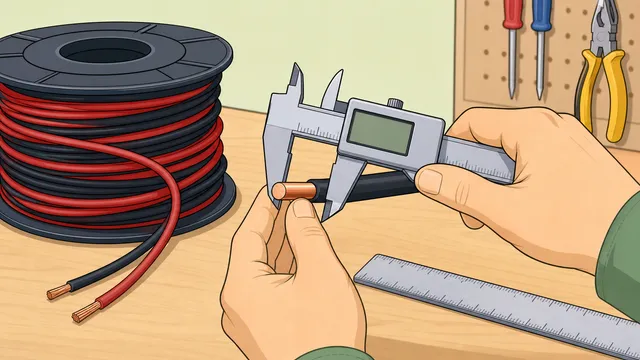
Convert SWG wire sizes from 7/0 to 50 into millimetres and mm² with a full Standard Wire Gauge reference table.
Last updated
SWG to mm calculator Convert Standard Wire Gauge sizes into bare-conductor diameter in millimetres and cross-sectional area in mm². The calculator keeps the SWG series discrete, so you can compare the published gauge steps without mixing in AWG notation.
Common reference sizes
How this page treats SWG
Higher SWG numbers are thinner wire. The calculator follows the published gauge series from 7/0 down to 50 and keeps SWG 0 as SWG 0 rather than mixing in other gauge families.
Result
SWG 14 = 2.032 mm
The selected SWG size corresponds to a bare-wire diameter of 2.032 mm and an estimated circular area of 3.2429 mm².
Diameter
2.032 mm
Cross-section area
3.2429 mm²
Method note This calculator looks up the published SWG diameter first, then derives cross-sectional area from the circular profile. That keeps the page consistent with source tables while still giving you the metric size you need for comparison work.
Nearby reference rows
Gauge
Diameter
Area
SWG 12
2.642 mm
5.4822 mm²
SWG 13
2.337 mm
4.2895 mm²
SWG 14
2.032 mm
3.2429 mm²
SWG 15
1.829 mm
2.6273 mm²
SWG 16
1.626 mm
2.0765 mm²
Full SWG reference table
Gauge
Diameter
Area
SWG 7/0
12.7 mm
126.6769 mm²
SWG 6/0
11.786 mm
109.0995 mm²
SWG 5/0
10.973 mm
94.5672 mm²
SWG 4/0
10.16 mm
81.0732 mm²
SWG 3/0
9.449 mm
70.1232 mm²
SWG 2/0
8.839 mm
61.3615 mm²
SWG 0
8.23 mm
53.1973 mm²
SWG 1
7.62 mm
45.6037 mm²
SWG 2
7.01 mm
38.5945 mm²
SWG 3
6.401 mm
32.18 mm²
SWG 4
5.893 mm
27.2749 mm²
SWG 5
5.385 mm
22.7752 mm²
SWG 6
4.877 mm
18.6808 mm²
SWG 7
4.47 mm
15.693 mm²
SWG 8
4.064 mm
12.9717 mm²
SWG 9
3.658 mm
10.5094 mm²
SWG 10
3.251 mm
8.3009 mm²
SWG 11
2.946 mm
6.8164 mm²
SWG 12
2.642 mm
5.4822 mm²
SWG 13
2.337 mm
4.2895 mm²
SWG 14
2.032 mm
3.2429 mm²
SWG 15
1.829 mm
2.6273 mm²
SWG 16
1.626 mm
2.0765 mm²
SWG 17
1.422 mm
1.5881 mm²
SWG 18
1.219 mm
1.1671 mm²
SWG 19
1.016 mm
0.8107 mm²
SWG 20
0.914 mm
0.6561 mm²
SWG 21
0.813 mm
0.5191 mm²
SWG 22
0.711 mm
0.397 mm²
SWG 23
0.61 mm
0.2922 mm²
SWG 24
0.559 mm
0.2454 mm²
SWG 25
0.508 mm
0.2027 mm²
SWG 26
0.4572 mm
0.1642 mm²
SWG 27
0.4166 mm
0.1363 mm²
SWG 28
0.3759 mm
0.111 mm²
SWG 29
0.3454 mm
0.0937 mm²
SWG 30
0.315 mm
0.0779 mm²
SWG 31
0.2946 mm
0.0682 mm²
SWG 32
0.2743 mm
0.0591 mm²
SWG 33
0.254 mm
0.0507 mm²
SWG 34
0.2337 mm
0.0429 mm²
SWG 35
0.2134 mm
0.0358 mm²
SWG 36
0.193 mm
0.0293 mm²
SWG 37
0.1727 mm
0.0234 mm²
SWG 38
0.1524 mm
0.0182 mm²
SWG 39
0.1321 mm
0.0137 mm²
SWG 40
0.1219 mm
0.0117 mm²
SWG 41
0.1118 mm
0.0098 mm²
SWG 42
0.1016 mm
0.0081 mm²
SWG 43
0.0914 mm
0.0066 mm²
SWG 44
0.0813 mm
0.0052 mm²
SWG 45
0.0711 mm
0.004 mm²
SWG 46
0.061 mm
0.0029 mm²
SWG 47
0.0508 mm
0.002 mm²
SWG 48
0.0406 mm
0.0013 mm²
SWG 49
0.0305 mm
0.0007 mm²
SWG 50
0.0254 mm
0.0005 mm²
What this converter does not decide for you
SWG to mm conversion is a size comparison tool, not a current-rating, insulation, or outside-diameter decision. If you need a safe conductor choice for a live electrical install, confirm the cable construction and the applicable code or manufacturer data.
SWG to mm calculator: convert standard wire gauge to diameter and mm²
An SWG to mm calculator converts Standard Wire Gauge sizes into bare-conductor diameter and cross-sectional area so you can compare British wire sizes with metric cable specs. It is most useful when a drawing, connector, gland, or wire table switches between SWG, millimetres, and mm², or when you need to check what an older gauge chart is actually saying.
What this SWG to mm calculator helps you compare
Standard Wire Gauge is a discrete series, not a continuous measurement scale. Each step maps to one published conductor diameter, so the practical job is usually a lookup rather than a free-form calculation.
This calculator turns an SWG size into bare-conductor diameter in millimetres and the equivalent cross-sectional area in mm². That makes it easier to compare supplier drawings, connector ranges, and legacy wire-size tables that use different notation.
It also keeps the SWG naming separate from AWG so you do not accidentally compare two different gauge families as if they were interchangeable. That matters because SWG and AWG can both appear in the same project once old data sheets, imported equipment, or cross-reference charts are involved.
How the lookup works
The SWG series is a published table of wire diameters. The calculator looks up the selected gauge, then calculates the circular cross-sectional area from the diameter.
That means the page is doing two jobs at once: it preserves the standard SWG value and also derives the metric area you usually need for comparison work.
A(mm²) = π × (d / 2)²
Cross-sectional area derived from the published conductor diameter.
Worked example: SWG 14 to metric
If you need the metric equivalent of SWG 14, the published diameter is about 2.032 mm. Applying the circle-area formula to that diameter gives about 3.243 mm² of conductor area.
That does not mean every insulated SWG 14 cable measures 2.032 mm across the outside. Insulation thickness, stranded construction, and jacket type all change the physical outside size. The SWG-to-mm result describes the conductor itself, which is why it should be paired with the manufacturer’s overall cable diameter when fit matters.
SWG versus AWG
SWG and AWG are different gauge systems. They both use numbers to describe wire size, but the numbering history and standard tables are not the same.
That is why a good conversion page should be explicit about which gauge family it is using. In SWG, the larger numbers represent thinner wire, while 7/0 is part of the larger end of the series. In many cross-reference charts, SWG 0 may also appear as 1/0, which is one reason the notation gets confused in older documents.
What this converter does not decide for you
This tool converts wire gauge size only. It does not decide whether a conductor is suitable for a given current, voltage drop, insulation class, ambient temperature, or installation method.
It also assumes the published SWG diameter table for the conductor itself. If you are checking gland fit, conduit fill, or external cable size, you still need the manufacturer’s cable data rather than the bare-wire gauge number.
SWG stands for Standard Wire Gauge. It is a published wire-size series that defines conductor diameter by gauge number rather than by a continuous metric measurement. In practice, the gauge number is just a shorthand for a specific conductor size.
Is SWG 0 the same as 1/0?
Some cross-reference charts use 1/0-style notation for SWG 0, but the calculator keeps the SWG label so the gauge family stays clear. That avoids mixing SWG with AWG or other gauge systems that happen to use similar slash notation.
Is a higher SWG number thicker or thinner?
A higher SWG number means thinner wire. The larger end of the SWG series is expressed with slash notation such as 7/0, 6/0, and 4/0, then the numbered series continues downward through SWG 0 and into the higher numerical sizes.
What is SWG 14 in mm?
SWG 14 is about 2.032 mm in diameter, which works out to roughly 3.243 mm² of cross-sectional area. That is the bare conductor size only, not the outside diameter of the finished insulated cable.
Can I use SWG to choose cable current rating?
No. SWG conversion only tells you the conductor size. Current rating depends on the conductor material, insulation temperature rating, installation method, ambient conditions, grouping, and the applicable electrical code. Use this page as a sizing reference, then move to an ampacity or voltage-drop calculator for design work.
Why do SWG and AWG look similar but not match exactly?
They are separate gauge standards with different published tables. The numbers may look comparable, but the diameters are not interchangeable across the two systems. If a drawing or catalogue mixes them, check the gauge family label before comparing sizes.