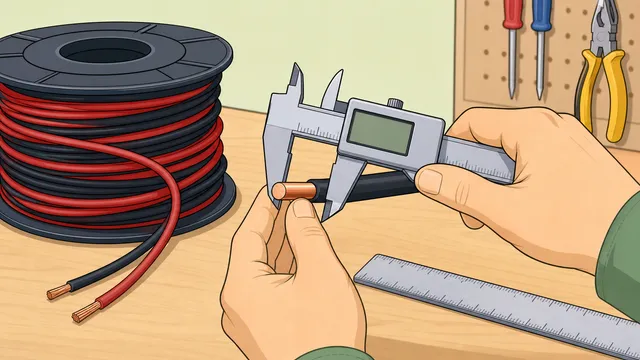
Use this wire ampacity calculator to derate copper or aluminum conductors for ambient temperature, conductor count, and terminal limits.
Last updated
NEC-style wire ampacity calculator Estimate wire ampacity for common copper or aluminum building wire by gauge, wiring family, ambient temperature, conductor count, and terminal assumptions, then compare the result against a practical load-planning target.
Conductor material
Temperature
Common ambient presets
Common conductor-count bands
Common load checkpoints
Selected modelling basis
Uses the 90°C column for ambient and conductor-count correction, then checks the final result against the selected terminal rating.
This page is a US NEC-style planning model for common building-wire scenarios. Final conductor and breaker selection still depends on your local code, terminal markings, cable construction, and installation method.
Adjusted allowable ampacity
20 A
12 AWG copper using THHN / THWN-2 / XHHW-2 (90°C conductor) at 86°F with 3 current-carrying conductors.
Base 90°C column
30 A
Ambient factor
1
Conductor-count factor
1
Final 60°C cap
20 A
Termination limit is capping the result
The corrected result cannot exceed the 60°C terminal column for this conductor size.
Assumption summary
Auto termination: 60°C small-conductor assumption. The final result is 33.3% below the raw 90°C column value under these conditions.
Load planning check
Entered load: 20 A. Required conductor ampacity:
20 A under the current noncontinuous planning basis.
12 AWG clears that load with 0 A of ampacity headroom under the current derating assumptions.
Selected wire clears the planned load The entered load needs at least 20 A of final allowable ampacity under the selected ambient, conductor-count, and terminal assumptions.
Minimum supported size under the same derating assumptions:
12 AWG
(20 A final allowable ampacity).
Smallest sizes that clear the planned load
Use this as a quick ampacity chart for the same ambient, conductor-count, and terminal assumptions.
Size
Final ampacity
Headroom
12 AWG
20 A
0 A
10 AWG
30 A
10 A
8 AWG
40 A
20 A
Selected gauge reference columns
Compare the unadjusted NEC-style column values for the selected conductor before ambient, bundling, and terminal limits are applied.
Column
Ampacity
60°C
20 A
75°C
25 A
90°C
30 A
Supported sizes under current conditions
Final allowable ampacity after the same ambient, conductor-count, and termination assumptions are applied across the supported wire-size table.
Wire ampacity calculator: NEC-style AWG ampacity with ambient and conductor-count derating
A wire ampacity calculator helps you move past a single chart value and estimate how much current a conductor can carry under your actual installation assumptions.
What this wire ampacity calculator covers
Ampacity is the current a conductor can carry continuously without exceeding its temperature limit under the assumptions built into the selected wiring method. A quick chart lookup is often enough for an idealised branch circuit, but real installations can run warmer because of higher ambient temperature, bundled conductors, or cable families that cap the final result below the raw 90°C column.
That is why this calculator asks for more than gauge. It lets you keep the familiar AWG or kcmil size front and centre while still applying the correction and adjustment factors that usually explain why a field result is lower than the chart value people remember from the 90°C column.
How the ampacity derating model works
The calculator starts from the selected conductor family’s reference ampacity column, then applies ambient-temperature correction and conductor-count adjustment. For higher-temperature conductor families such as THHN or THWN-2, those derating steps can start from the 90°C column, but the corrected result still cannot exceed the lower terminal or cable limit that actually governs the final installation.
That distinction matters in practice. A 12 AWG THHN conductor may have a 30 A value in the 90°C column, yet the usable installation ampacity can still be capped at 20 A or 25 A depending on the terminal assumptions and cable family. The tool keeps those steps separate so you can see whether the real bottleneck is ambient derating, conductor bundling, a 60°C cable cap, or a 75°C terminal limit.
Adjusted ampacity = Base ampacity x ambient factor x conductor-count factor
The starting ampacity comes from the selected 60°C, 75°C, or 90°C reference column tied to the wiring family, then the calculator applies ambient and bundling derating.
Final allowable ampacity = min(adjusted ampacity, terminal or cable cap)
The corrected result still cannot exceed the lower ampacity allowed by the applicable terminal temperature rating or fixed cable-family cap.
Worked example: 12 AWG copper THHN in warm conduit
Suppose you select 12 AWG copper THHN, 40°C ambient, and 4 current-carrying conductors in the raceway. The calculator starts from the 90°C column at 30 A, applies a 0.91 ambient factor and a 0.80 conductor-count factor, and arrives at an adjusted value of 21.84 A before the termination check.
If the final installation is treated as a 60°C small-conductor termination, the usable ampacity is capped at 20 A even though the corrected 90°C-column math produced 21.84 A. If you instead have a verified 75°C termination basis, the same scenario could remain above 20 A while still staying below the 75°C column cap. That is exactly the kind of distinction this page is built to make visible.
How to use the wire ampacity chart for a planned load
A strong ampacity tool should do more than return one adjusted number. It should also help you answer the next field question: does this conductor still clear the load you actually plan to run once the derating assumptions are applied? That is why this page now includes a planned-load check in amps and highlights the smallest supported size that still clears the target under the same ambient, conductor-count, and terminal assumptions.
That planning layer becomes even more useful for continuous loads. If a load is expected to run for three hours or more, designers commonly plan conductor ampacity at 125 percent of the expected load before final breaker selection is reviewed. A 20 A continuous load therefore needs a conductor ampacity basis of 25 A, not just a headline 20 A wire label. The page makes that jump explicit so you can see when a familiar wire size stops being adequate once continuous-load treatment is applied.
Required conductor ampacity for continuous load = planned load x 1.25
Use this as a planning checkpoint when the expected current will run for three hours or more before moving to final overcurrent-protection and equipment checks.
Why the 90°C wire column does not automatically become the final answer
One of the biggest search-intent gaps on competitor pages is the missing distinction between a wire's insulation rating and the final usable ampacity at the equipment. A THHN or THWN-2 conductor may legitimately start from the 90°C column for ambient correction and bundling adjustment, but that does not mean every installation can use the final 90°C number at the breaker or terminal.
In practice, the final answer is often limited by the termination basis or cable family. This calculator keeps those steps separate on purpose. It also uses an explicit auto assumption that defaults smaller conductors through 1 AWG to the 60°C basis and 1/0 AWG and larger to the 75°C basis unless you override it. That makes the result closer to the real question users ask when they search for a wire ampacity chart: not just 'what is the theoretical conductor column,' but 'what ampacity can I actually use here?'
Ampacity, breaker sizing, and what this estimate does not cover
Ampacity and breaker size are related, but they are not interchangeable labels. Breaker selection also depends on the load type, continuous-load treatment, equipment listing, conductor termination markings, and the code rules governing overcurrent protection. Use the result here as a conductor-temperature planning figure, not as an automatic breaker recommendation.
This page also stays deliberately narrow. It does not model conduit fill, rooftop solar adders, harmonic current, motor rules, parallel conductors, local amendments, or every conductor construction sold in the field. It is strongest as a planning tool for common copper and aluminum building-wire scenarios that still need a final code and equipment check before installation.
Ampacity is the allowable continuous current a conductor can carry without exceeding the temperature basis used for that installation. It is not just a property of the metal cross-section. Insulation temperature rating, ambient conditions, the number of current-carrying conductors grouped together, and terminal temperature limits can all reduce the usable ampacity below a headline chart value.
Why is 12 AWG THHN not always 30 amps?
Because the 30 A figure comes from the 90°C column before installation limits are applied. In many real branch-circuit scenarios, the final result is capped by 60°C or 75°C terminations, or reduced by ambient-temperature and conductor-count derating. That is why a conductor with a 30 A 90°C-column value may still land at a 20 A or 25 A usable ampacity under the actual installation assumptions.
How does ambient temperature change wire ampacity?
Higher ambient temperature leaves less thermal headroom for the conductor, so the base ampacity is multiplied by a correction factor below 1.00. The hotter the space around the conductor, the larger the reduction. Cooler ambient conditions can increase the factor above 1.00 in the supported ranges, but the final result still cannot exceed the lower terminal or cable limit used by the installation.
Is ampacity the same thing as breaker size?
No. Ampacity is the conductor-temperature limit under the selected assumptions, while breaker sizing also depends on the load type, continuous-load treatment, equipment listing, and the code rules that govern overcurrent protection. Use this page to estimate conductor ampacity, then confirm breaker selection separately against the applicable code and equipment markings.
What does continuous load mean in this ampacity calculator?
On this page, the continuous-load option is a planning check for loads expected to run for three hours or more. When that switch is enabled, the entered load is multiplied by 1.25 to show the conductor ampacity basis you should clear before final breaker and equipment checks. It is not a full breaker-sizing engine, but it does make the common 125% planning step explicit.
Should I use the 60°C, 75°C, or 90°C column for THHN wire?
For THHN or THWN-2 style conductors, the 90°C column can be the starting point for ambient and conductor-count derating, but the final usable ampacity still cannot exceed the lower terminal or cable limit that actually governs the installation. That is why this calculator separates the correction column from the final cap instead of pretending the 90°C number always survives unchanged.
Why does the auto terminal setting change at 1/0 AWG and larger?
The auto setting is a practical shortcut meant to reflect the common small-conductor versus larger-conductor temperature-limitation split users often need for planning. On this page, 14 AWG through 1 AWG default to the 60°C basis, while 1/0 AWG and larger default to 75°C unless you override the assumption. That default is still only a planning aid, so always confirm the actual equipment markings and code basis before installation.
Does this wire ampacity calculator replace a wire size calculator?
Not completely. A wire ampacity calculator tells you how much current a selected conductor can carry under the entered installation assumptions. A wire size calculator usually starts one step earlier by recommending a minimum conductor size from load, distance, voltage-drop, and code assumptions. In practice, many users need both checks before they treat the design as complete.