
Primary functions
Answers: sin, cos, and tan for a known angle
Use when: You know the angle and need a trigonometric ratio, exact value, or decimal value.
Watch for: Check whether the input is in degrees or radians before reading the result.
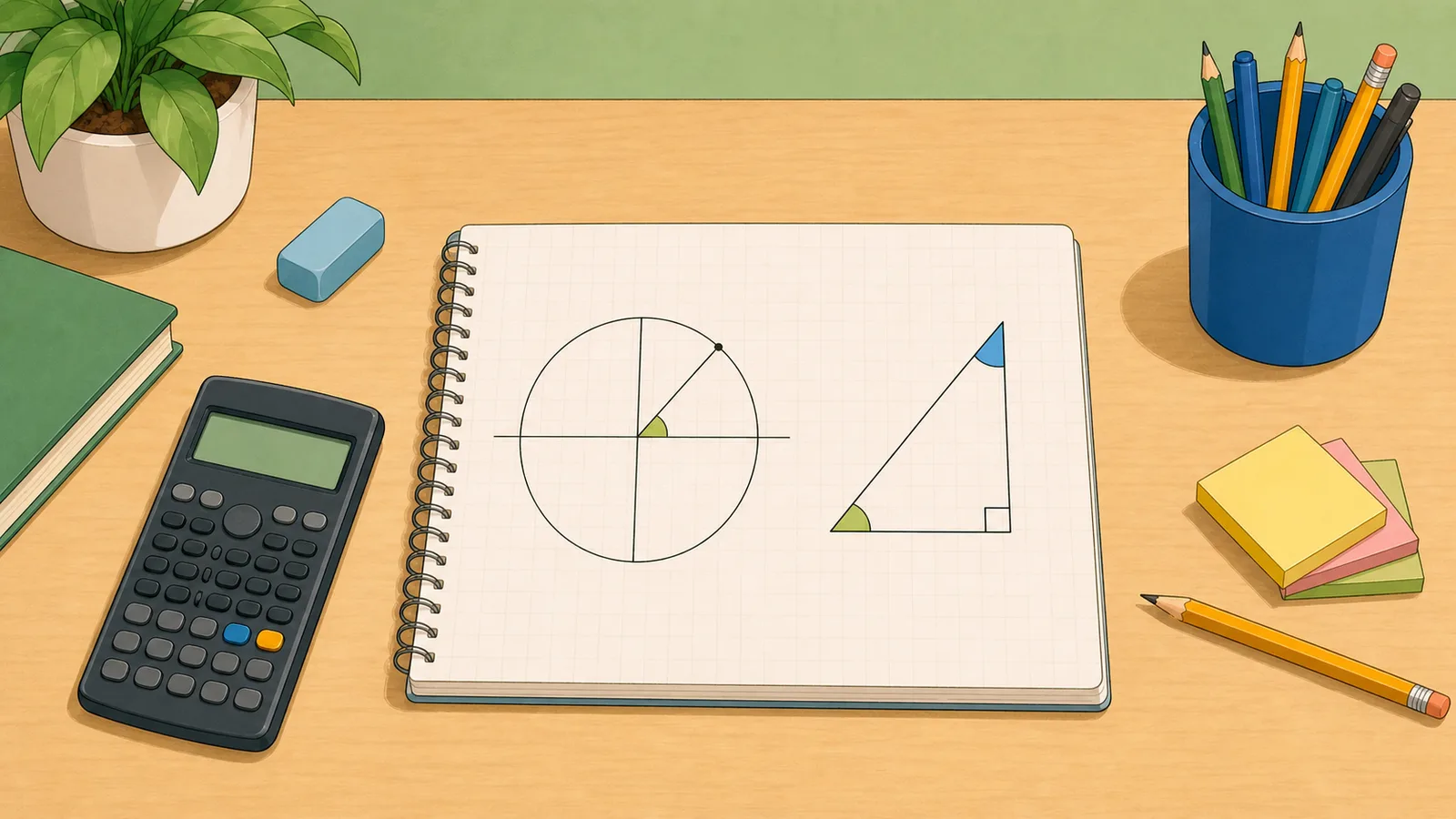
Use this trigonometry calculator to evaluate sin, cos, tan, reciprocal trig functions, inverse trig functions, unit-circle values, reference angles.
Last updated
Trigonometry workflows
Use one trigonometry calculator for sine, cosine, tangent, reciprocal trig functions, inverse trig functions, unit-circle values, reference angles, coterminal angles, and SOHCAHTOA right-triangle setup. Each anchored workflow keeps the degree/radian choice, exact-value context, undefined-angle warnings, and formula notes tied to the question you are solving.
Active workflow
Evaluate sine, cosine, tangent, cosecant, secant, and cotangent for one angle.
Results
sin(0°)
Primary functions
Answers: sin, cos, and tan for a known angle
Use when: You know the angle and need a trigonometric ratio, exact value, or decimal value.
Watch for: Check whether the input is in degrees or radians before reading the result.
Reciprocal functions
Answers: csc, sec, and cot for a known angle
Use when: A formula uses reciprocal trig functions directly.
Watch for: The result is undefined when the matching denominator is zero.
Inverse functions
Answers: arcsin, arccos, arctan, and arccot for a known ratio
Use when: You know the side ratio, slope, or trig value and need the angle.
Watch for: Inverse trig functions return principal values unless the context asks for another angle family.
Angle tools
Answers: unit-circle values, reference angles, coterminal angles, identities, and SOHCAHTOA setup
Use when: You need interpretation, quadrant signs, exact special angles, identity checks, or right-triangle setup help.
Watch for: Triangle-specific pages stay separate when they solve full non-right-triangle geometry.
| Workflow | Answers | Use when | Watch for |
|---|---|---|---|
| Primary functions | sin, cos, and tan for a known angle | You know the angle and need a trigonometric ratio, exact value, or decimal value. | Check whether the input is in degrees or radians before reading the result. |
| Reciprocal functions | csc, sec, and cot for a known angle | A formula uses reciprocal trig functions directly. | The result is undefined when the matching denominator is zero. |
| Inverse functions | arcsin, arccos, arctan, and arccot for a known ratio | You know the side ratio, slope, or trig value and need the angle. | Inverse trig functions return principal values unless the context asks for another angle family. |
| Angle tools | unit-circle values, reference angles, coterminal angles, identities, and SOHCAHTOA setup | You need interpretation, quadrant signs, exact special angles, identity checks, or right-triangle setup help. | Triangle-specific pages stay separate when they solve full non-right-triangle geometry. |
Strong trigonometry results depend on choosing the right direction before calculating. Use this guide to decide whether the problem is forward trig, inverse trig, exact unit-circle lookup, angle normalization, right-triangle setup, or coordinate direction.
I know an angle and need ratios
Use: All trig functions, sine, cosine, tangent, secant, cosecant, or cotangent
Watch for: Choose degrees or radians first; reciprocal functions can be undefined at axis angles.
I know a ratio and need an angle
Use: Arcsin, arccos, arctan, or arccot
Watch for: Inverse trig returns principal values. Use quadrant or context clues when a full angle family is possible.
I need exact special-angle values
Use: Unit circle
Watch for: Use exact values for standard angles, then apply quadrant signs and reference angles before decimal rounding.
My angle is outside one turn
Use: Reference angle or coterminal angle
Watch for: Normalize by full rotations, then use the reference angle to explain signs and matching values.
I have right-triangle sides
Use: SOHCAHTOA or triangle calculator
Watch for: SOHCAHTOA is right-triangle setup. Use the full triangle pages for law of sines, law of cosines, and ambiguous SSA cases.
I have signed x/y coordinates or direction
Use: Arctan for a ratio; atan2 in a coordinate tool
Watch for: A single tangent ratio loses quadrant direction. Use atan2-style logic when the signs of both axes matter.
| Problem | Use | Watch for |
|---|---|---|
| I know an angle and need ratios | All trig functions, sine, cosine, tangent, secant, cosecant, or cotangent | Choose degrees or radians first; reciprocal functions can be undefined at axis angles. |
| I know a ratio and need an angle | Arcsin, arccos, arctan, or arccot | Inverse trig returns principal values. Use quadrant or context clues when a full angle family is possible. |
| I need exact special-angle values | Unit circle | Use exact values for standard angles, then apply quadrant signs and reference angles before decimal rounding. |
| My angle is outside one turn | Reference angle or coterminal angle | Normalize by full rotations, then use the reference angle to explain signs and matching values. |
| I have right-triangle sides | SOHCAHTOA or triangle calculator | SOHCAHTOA is right-triangle setup. Use the full triangle pages for law of sines, law of cosines, and ambiguous SSA cases. |
| I have signed x/y coordinates or direction | Arctan for a ratio; atan2 in a coordinate tool | A single tangent ratio loses quadrant direction. Use atan2-style logic when the signs of both axes matter. |
The former specialist pages still represent valuable long-tail intents: sine calculator, cosine calculator, tangent calculator, secant calculator, cosecant calculator, cotangent calculator, arcsin calculator, arccos calculator, arctan calculator, arccot calculator, unit circle calculator, reference angle calculator, coterminal angle calculator, trigonometric identity checks, and SOHCAHTOA calculator. They now resolve into anchored workflows on this canonical trigonometry calculator instead of competing as separate general trig pages.
Law of sines, law of cosines, and full triangle calculators remain separate unless a future master fully supports their non-right-triangle geometry, ambiguous-case handling, and multi-side solving workflows.
Trigonometry
The trigonometry calculator evaluates sine, cosine, tangent, cosecant, secant, and cotangent for angles in degrees or radians. It also brings together inverse trig calculators, unit-circle lookup, reference-angle and coterminal-angle tools, Pythagorean identity checks, and SOHCAHTOA right-triangle setup so related trig questions live on one canonical page instead of being split across thin function pages.
Forward trigonometry starts with an angle and returns a ratio. The sine calculator workflow finds sin(theta), the cosine calculator workflow finds cos(theta), and the tangent calculator workflow finds tan(theta). On the unit circle, sine is the y-coordinate, cosine is the x-coordinate, and tangent is sine divided by cosine.
For right triangles, the same functions describe side ratios. Sine is opposite over hypotenuse, cosine is adjacent over hypotenuse, and tangent is opposite over adjacent. That is the SOHCAHTOA memory aid: sin = O/H, cos = A/H, tan = O/A.
The master calculator preserves function-specific intent with anchored panels, exact-value guidance where available, degree/radian switching, quadrant signs, and undefined-value warnings. That keeps searches such as sine calculator, cosine calculator, and tangent calculator useful without maintaining separate competing pages.
sin(theta) = opposite / hypotenuse
Right-triangle sine definition. This is the specific relationship the calculator applies when building the result.
cos(theta) = adjacent / hypotenuse
Right-triangle cosine definition. This is the specific relationship the calculator applies when building the result.
tan(theta) = opposite / adjacent = sin(theta) / cos(theta)
Right-triangle and unit-circle tangent definition.
The reciprocal trig functions use the same angle but invert a primary trig value. Cosecant is 1 divided by sine, secant is 1 divided by cosine, and cotangent is 1 divided by tangent. These workflows are useful when a formula is written in reciprocal trig form or when a textbook asks directly for csc, sec, or cot.
Undefined values matter. Secant is undefined wherever cosine is zero, cosecant is undefined wherever sine is zero, and cotangent is undefined wherever tangent has a zero denominator or sine is zero in the reciprocal setup. The calculator surfaces these cases instead of returning a misleading zero.
csc(theta) = 1 / sin(theta)
Cosecant is the reciprocal of sine. This is the specific relationship the calculator applies when building the result.
sec(theta) = 1 / cos(theta)
Secant is the reciprocal of cosine. This is the specific relationship the calculator applies when building the result.
cot(theta) = 1 / tan(theta) = cos(theta) / sin(theta)
Cotangent is the reciprocal of tangent. This is the specific relationship the calculator applies when building the result.
Inverse trigonometry reverses the direction of the problem. Instead of starting with an angle, you start with a ratio and solve for an angle. Arcsin answers which angle has a given sine value, arccos answers which angle has a given cosine value, and arctan answers which angle has a given tangent ratio.
Principal values are important for inverse trig calculators. A ratio can often match more than one angle over a full rotation, but inverse functions return a conventional principal angle unless the context asks for a full angle family. The arctan workflow also supports slope-style inputs such as rise/run and percent grade, which are practical forms of tangent.
Arccot is included for formulas and courses that use inverse cotangent directly. It is closely related to arctan, but the principal-value convention and reciprocal setup can differ by source, so the calculator keeps the interpretation visible.
arcsin(x) = theta where sin(theta) = x
Inverse sine maps a valid sine ratio back to a principal angle.
arccos(x) = theta where cos(theta) = x
Inverse cosine maps a valid cosine ratio back to a principal angle.
arctan(x) = theta where tan(theta) = x
Inverse tangent maps a tangent ratio, slope, or rise/run value back to an angle.
Degrees and radians measure the same rotation in different units. A full turn is 360 degrees or 2*pi radians, so 180 degrees equals pi radians and 90 degrees equals pi/2 radians. The calculator keeps both displays visible where the workflow benefits from conversion.
A reference angle is the acute angle between the terminal side and the x-axis. It helps explain why angles in different quadrants share related exact trig values while their signs differ. For example, 150 degrees has a 30 degree reference angle, so its sine and cosine are connected to the 30 degree special angle values.
Coterminal angles differ by whole rotations. In degrees, add or subtract 360. In radians, add or subtract 2*pi. Coterminal angles have the same trig-function values because they land on the same terminal side.
radians = degrees x pi / 180
Convert degrees to radians. This is the specific relationship the calculator applies when building the result.
degrees = radians x 180 / pi
Convert radians to degrees. This is the specific relationship the calculator applies when building the result.
coterminal angles = theta + 360k degrees or theta + 2*pi*k radians
Add or subtract full rotations for integer k.
The unit circle connects trig values to coordinates. At an angle theta, the point on the unit circle is (cos(theta), sin(theta)). That means cosine is the x-coordinate and sine is the y-coordinate. Tangent is the ratio y/x where x is not zero.
Special angles such as 0, 30, 45, 60, 90, 180, 270, and 360 degrees have exact values that appear frequently in algebra, calculus, physics, engineering, and test prep. The unit-circle panel is included so users can look up these exact values, quadrant signs, and coordinate pairs without leaving the canonical trigonometry calculator.
Exact values and decimal values both matter. Exact values such as sqrt(2)/2 are best for symbolic math, while decimal values are easier for measurement and numerical work. The page keeps both ideas connected rather than treating each function page as a separate topic.
The fastest way to avoid a wrong trig answer is to identify the direction of the problem first. If you know an angle and need a ratio, use a forward trig workflow such as sine, cosine, tangent, or the all-functions panel. If you know a ratio and need an angle, use inverse trig such as arcsin, arccos, arctan, or arccot.
If the problem asks for an exact value, a quadrant sign, or a point on the circle, start with the unit-circle or reference-angle workflow before relying on a decimal. If the angle is outside one turn, use coterminal angles to reduce it to the same terminal side, then use the reference angle to explain the sign.
If the input is a right-triangle side setup, use SOHCAHTOA or the right-triangle calculator. If the input is a signed coordinate direction, a single arctan ratio may lose quadrant information because tangent repeats every 180 degrees. In coordinate work, atan2-style logic is the safer model because it keeps both axis signs.
Trig identities are equations that remain true for valid angle inputs. The Pythagorean identity sin^2(theta) + cos^2(theta) = 1 is the foundation for many simplifications. Related reciprocal identities connect csc, sec, and cot back to sine, cosine, and tangent.
SOHCAHTOA is the right-triangle setup workflow. Use it when you know a side and an angle, or a pair of sides, and need to choose the correct sine, cosine, or tangent relationship. The master page includes this workflow but keeps full triangle solvers separate because law-of-sines, law-of-cosines, and general triangle solving require additional cases.
If you need a full geometric triangle solution, use the right triangle calculator, law of sines calculator, law of cosines calculator, or triangle calculator instead. Those pages handle side solving, angle solving, ambiguous-case logic, perimeter, area, and classification in ways that a general trig-function calculator should not hide.
Further reading
The most common mistake is using the wrong angle unit. A value of 1 means 1 degree in degree mode but 1 radian in radian mode, which is about 57.3 degrees. Always check the selected unit before comparing results.
The second common mistake is confusing inverse functions with reciprocal functions. Arcsin is inverse sine and returns an angle. Cosecant is reciprocal sine and returns a ratio. Arctan is inverse tangent, while cotangent is reciprocal tangent.
The calculator is designed for numeric trigonometry, exact-value lookup, identity checks, and right-triangle setup. It does not replace a symbolic algebra system, a proof assistant for identities, or a full triangle solver for non-right triangles with ambiguous geometric cases.
Frequently asked questions
It evaluates trig functions such as sine, cosine, tangent, cosecant, secant, and cotangent for an angle. This page also includes inverse trig, unit-circle, reference-angle, coterminal-angle, identity, and SOHCAHTOA workflows.
In a right triangle, sine is opposite over hypotenuse, cosine is adjacent over hypotenuse, and tangent is opposite over adjacent. On the unit circle, sine is the y-coordinate, cosine is the x-coordinate, and tangent is sine divided by cosine.
Inverse trig returns an angle from a ratio, such as arcsin(0.5) = 30 degrees. Reciprocal trig returns a ratio from an angle, such as csc(theta) = 1/sin(theta). Arcsin and cosecant are not the same operation.
Use a forward trig workflow when you know an angle and need sin, cos, tan, sec, csc, or cot. Use inverse trig when you know a ratio and need an angle. Use the unit-circle, reference-angle, or coterminal-angle workflows when the problem asks for exact values, quadrant signs, or angle normalization.
Use the unit required by your problem. Geometry and everyday measurement often use degrees, while calculus, physics, and many graphing contexts use radians. You can convert degrees to radians by multiplying by pi/180.
Tangent equals sine divided by cosine, so it is undefined where cosine is zero. In degree mode that happens at 90 degrees and 270 degrees plus full rotations.
A reference angle is the acute angle between the terminal side of an angle and the x-axis. It helps reuse special-angle values while applying the correct quadrant sign.
Coterminal angles share the same terminal side. Add or subtract 360 degrees, or 2*pi radians, to find coterminal angles.
SOHCAHTOA is a memory aid for right-triangle trig: sine = opposite/hypotenuse, cosine = adjacent/hypotenuse, and tangent = opposite/adjacent.
They solve broader non-right-triangle problems and can require ambiguous-case handling, multiple sides, and multiple angles. Those workflows are more specific than a general trig-function calculator.
Yes. The identities workflow checks core Pythagorean relationships for a chosen angle, including sin^2(theta) + cos^2(theta) = 1 and related reciprocal identities.
The same sine, cosine, or tangent value can occur at more than one angle around the unit circle. Inverse trig functions return a standard principal value first. Use quadrant information, a reference angle, or coterminal-angle context when the problem asks for every matching angle.
Use arctan for a single tangent ratio such as rise divided by run. Use atan2-style coordinate logic when you know signed x and y values because the signs identify the quadrant. A lone tangent ratio cannot distinguish angles that differ by 180 degrees.
Also in Functions
You may also need
Related
These related calculators come from the same leaf category, nearby sibling categories, or the same top-level topic.

Use the triangle calculator to solve general triangles, right triangles, hypotenuse, isosceles and equilateral triangles, special right triangles, area.
Solve a triangle using the law of sines — find missing sides or angles from a known side-angle pair and one additional measurement.
Solve a triangle using the law of cosines — find a missing side from two sides and the included angle, or find an angle from three sides.

Use an antilog calculator to turn log values back into original numbers for base 10, e, 2, or any custom base, with worked scenarios, inverse checks.