

How to Use Area, Volume, and Surface Area in Real Life
Learn when to use area, volume, circumference, and surface area so you can estimate paint, soil, storage, and materials without guesswork.
Geometry never really left
Most of us finished our last geometry exam, closed the textbook, and assumed we were done with shapes forever. Then life happened. You moved into a new flat and needed to know how many tins of paint to buy. You ordered a rug online and had to figure out whether it would actually fit. You helped a friend build raised garden beds and realised you had no idea how many bags of soil to get.
Geometry did not disappear after school — it just stopped announcing itself. The formulas you once memorised for tests are the same ones carpenters, decorators, gardeners, and home cooks rely on every day. The difference is that now you have a reason to care about getting them right, because mistakes cost real money and real time.
Growing up in Bangalore, I watched my grandfather tile his courtyard armed with nothing more than a measuring tape and mental arithmetic. He could estimate area faster than I could key numbers into a calculator. That quiet competence always impressed me, and it is what geometry looks like once it clicks: not abstract, just practical.
This article revisits four cornerstones of everyday geometry — area, volume, surface area, and circles — with a focus on the situations where you will actually need them. And because nobody wants to dig out a formula sheet at the hardware store, each section comes with an interactive calculator you can use right away.
When do you use area in real life?
Area tells you how much flat space a shape covers. Whenever you are dealing with a surface — a floor, a wall, a lawn, a tabletop — you are thinking about area, whether you realise it or not.
Painting a room. A standard tin of wall paint covers roughly 10 to 12 square metres per litre. To know how many litres you need, you first need the total wall area. Measure the height and width of each wall, multiply them together, subtract any windows and doors, and add the results. It is straightforward rectangle maths, but skipping it usually means an extra trip to the store or leftover tins gathering dust in the garage.
Laying flooring. Whether you are installing laminate, carpet, or tiles, suppliers sell by the square metre (or square foot). Order too little and you will stall mid-project waiting for a top-up delivery. Order too much and you waste material. Measuring accurately and calculating area saves both headaches.
Gardening and landscaping. Mulch, turf, gravel, and topsoil are all sold by area or volume. Knowing the area of your garden beds lets you convert to the volume of material you need (area multiplied by depth), so you are not eyeballing it at the garden centre.
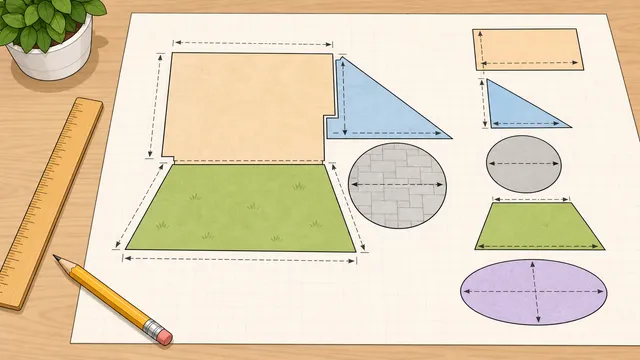
The core formulas are simple — length times width for rectangles, half base times height for triangles — but real rooms are rarely perfect rectangles. You often need to break an L-shaped room into two rectangles, or subtract the area of a circular pond from a rectangular lawn. The Area Calculator below handles multiple shapes and lets you experiment with dimensions instantly:
Quick examples
Shape
Unit
General area-planning guidance
Irregular shapes: split the outline into simpler rectangles, triangles, circles, or trapezoids, calculate each section, then add the totals.
Keep units consistent: measure every visible dimension in the same linear unit before using an area formula.
Use a specialist page when needed: if you need square-footage material planning, perimeter, or a more advanced sector or triangle workflow, switch to the more specific calculator once you know the basic area question.
That result is most useful when you connect it to the practical question underneath it: “how much flat space am I covering?” If the answer feels too large or too small, you have a very good clue about what went wrong. Maybe you forgot to subtract a window, mixed metres with centimetres, or treated an awkward shape as a neat rectangle. The calculator helps with arithmetic, but the geometry skill is still in the setup.
When do you need volume instead of area?
If area is about surfaces, volume is about what fits inside. Every time you fill a container, pour concrete, or estimate storage capacity, you are working with volume.
Fish tanks and pools. Setting up an aquarium means knowing its volume in litres so you can dose water treatments correctly and choose a filter rated for the right capacity. For a rectangular tank the calculation is length times width times height, then convert cubic centimetres to litres (divide by 1,000). Pools follow the same logic at a larger scale — and getting the volume wrong means the chlorine balance will be off all summer.
Cooking and baking. Ever tried to substitute a round cake tin for a square one? If both are described as “9-inch” but one is round and the other square, they hold different amounts of batter. The round tin has about 78.5 percent of the area of the square one (thanks to pi), which means you either need to adjust the recipe or accept a thicker cake.
Shipping and storage. Packing for a move? Knowing the interior volume of a box tells you whether your books will fit in one carton or two. Businesses calculate cubic volume constantly to estimate freight costs, because shipping companies charge by volume as much as by weight.
Concrete and landscaping. Pouring a concrete slab requires ordering the right number of cubic metres. Under-order and you are left with an unfinished pour that weakens the slab. Over-order and you pay for material that gets wasted.
Use the Volume Calculator to find the volume of boxes, cylinders, spheres, cones, and more:
Solid geometry
Calculate volume for common 3D shapes and convert it to litres or gallons
Use one general volume calculator for boxes, spheres, cylinders, cones, hemispheres, pyramids, and right triangular prisms, then compare the result as cubic units, litres, and both US and UK gallons.
Shape
Rectangular prism
Use this for boxes, bins, rooms, and any straight-sided rectangular container.
For irregular pools, barrels, tanks, and jobsite pours, switch to the specialist calculator once the general geometry stops matching the real object.
Result
384 ft³
Volume of the rectangular prism using V = L × W × H, with capacity conversions added for planning, packaging, and fill estimates.
- Surface area
- 352 ft²
- Cubic metres
- 10.8737
- Cubic feet
- 384
- Litres
- 10,873.669
- US gallons
- 2,872.5195
- UK gallons
- 2,391.8728
Result sheet
Volume and capacity breakdown
| Measure | Value |
|---|---|
| Volume | 384 ft³ |
| Surface area | 352 ft² |
| Cubic metres | 10.8737 |
| Cubic feet | 384 |
| Litres | 10,873.669 |
| US gallons | 2,872.5195 |
| UK gallons | 2,391.8728 |
Input snapshot
Current shape dimensions
| Dimension | Value |
|---|---|
| Length | 12 ft |
| Width | 8 ft |
| Height | 4 ft |
Quick reference
Supported shape formulas
| Shape | Formula |
|---|---|
| Rectangular prism | V = L × W × H |
| Cube | V = s³ |
| Sphere | V = (4/3) × π × r³ |
| Hemisphere | V = (2/3) × π × r³ |
| Cylinder | V = π × r² × h |
| Cone | V = (1/3) × π × r² × h |
| Square pyramid | V = (1/3) × b² × h |
| Right triangular prism | V = (1/2) × b × h × L |
Volume is where a lot of everyday mistakes happen because people keep thinking in two dimensions. If you are ordering soil for raised beds, water for a tank, packing space for boxes, or concrete for a mould, surface coverage alone is not enough. The depth matters, and the moment depth matters you have left area behind and moved into volume.
This is also why unit conversion becomes part of the job. Cubic centimetres, litres, cubic feet, cubic metres, and gallons can describe the same object in different ways. The calculator can convert for you, but the bigger lesson is that a sensible unit makes the result feel real instead of abstract.
When does surface area matter more than volume?
Surface area is the total area of the outside faces of a three-dimensional object. It matters when you need to paint, wrap, insulate, tile, line, or otherwise cover the outside of something rather than fill the inside.
Painting or coating a tank. If you are repainting a cylindrical tank or sealing a box-shaped storage chest, volume tells you almost nothing about how much paint you need. Surface area is the quantity that matters because paint covers the outside faces, not the inside capacity.
Packaging and insulation. Gift wrap, cardboard, thermal insulation, fabric covers, and adhesive film are all surface-area problems. A box with modest volume can still demand a surprising amount of material because every face counts.
Heat transfer. This is one of those places where geometry quietly becomes science. Radiators, baking trays, and cooling fins all depend on exposed area. More surface area usually means more contact with the surrounding air, which changes how quickly heat moves.
Use the Surface Area Calculator when the task is about covering the outside of a solid:
Solid geometry
Calculate total and lateral surface area for common 3D solids
Use one general surface area calculator for boxes, cubes, spheres, hemispheres, cylinders, cones, square pyramids, and right triangular prisms, then compare the result in both your selected square unit and standard metric or imperial coverage units.
Shape
Rectangular prism
Use this for boxes, cartons, rooms, or any straight-sided solid with rectangular faces.
The calculator keeps the total outside area separate from the lateral or curved area so you can decide whether to include flat ends, bases, or top and bottom faces.
Result
158 ft²
Total surface area of the rectangular prism using SA = 2(lw + lh + wh). Use side wall area when you only need the sides or curved shell rather than the full outside.
- Side wall area
- 78 ft²
- Top and bottom area
- 80 ft²
- Square metres
- 14.68 m²
- Square feet
- 158 ft²
How to use the result
Use the lateral area when you are covering only the sides of a box or room. Use the total surface area when you also need the top and bottom faces.
Formula substitution: 2(8×5 + 8×3 + 5×3) = 158
Result sheet
Surface area summary
| Measure | Value |
|---|---|
| Total surface area | 158 ft² |
| Side wall area | 78 ft² |
| Top and bottom area | 80 ft² |
| Square metres | 14.68 m² |
| Square feet | 158 ft² |
Worked steps
Break the total into faces or curved parts
| Part | Expression | Area |
|---|---|---|
| Top and bottom | 2 × 8 × 5 | 80 ft² |
| Front and back | 2 × 8 × 3 | 48 ft² |
| Left and right | 2 × 5 × 3 | 30 ft² |
Input snapshot
Current shape dimensions
| Dimension | Value |
|---|---|
| Length | 8 ft |
| Width | 5 ft |
| Height | 3 ft |
Here is the simplest way to keep it straight. If the question is “how much fits inside?”, think volume. If the question is “how much covers the outside?”, think surface area. That one distinction clears up a lot of confusion before any formula even appears.
How do circles change the maths?
Circles are everywhere — plates, wheels, pipes, ponds, pizza. And they come with their own special number: pi (roughly 3.14159). Two formulas do most of the heavy lifting: circumference (the distance around) and area (the space inside).
Pizza maths. Here is one of my favourite aha-moment examples. A 12-inch pizza has an area of about 113 square inches. A 16-inch pizza has an area of about 201 square inches — nearly double. So a single 16-inch pizza gives you far more food than a single 12-inch, even though the diameter only grew by a third. That is because area scales with the square of the radius, not linearly. This is why a large pizza is almost always better value than two smalls.
Fencing a circular garden bed. If you are building a round raised bed with a diameter of 2 metres, you need about 6.28 metres of edging material (circumference equals pi times diameter). Knowing the area (about 3.14 square metres) then tells you how much soil to buy.
Pipes and hoses. The cross-sectional area of a pipe determines how much water can flow through it. Doubling the diameter quadruples the area, which is why upgrading from a half-inch hose to a one-inch hose makes such a dramatic difference to water flow.
Wheels and distance. Every rotation of a wheel covers a distance equal to its circumference. If you know the wheel diameter, you can figure out how many rotations it takes to travel a given distance — useful for cyclists calibrating odometers or engineers designing conveyor belts.
Try the Circle Calculator below to explore the relationships between radius, diameter, circumference, and area:
Circle geometry workflows
Choose the circle problem first
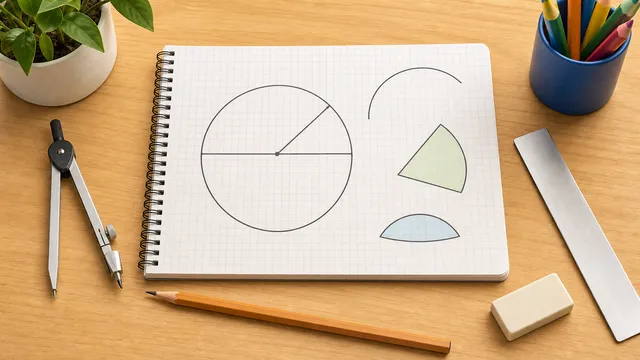
Use one circle calculator for radius, diameter, circumference, area, arc length, sector area, and segment area. The anchored workflows keep formula direction clear, so long-tail questions such as area of a circle calculator, circumference calculator, radius calculator, and arc length calculator still land on the exact tool they need.
Active workflow
Full circle
Solve radius, diameter, circumference, and area from any one known circle measurement.
Start with one known circle measurement, then the calculator solves the full circle for you.
Known measurement
Unit
What this page is for
Use radius or diameter mode when a sketch or object gives you a straight measurement. Use circumference when you know the distance around the circle. Use area when the covered surface is known and you need the matching width back.
This broader circle worksheet is the right page when you need to reverse-solve the whole circle from any one of the four core measurements instead of using a narrower radius-only, diameter-only, circumference-only, or area-only tool.
Solved circle
Circle workflow comparison
Full circle
Answers: radius, diameter, circumference, and area
Use when: You know one complete-circle measurement and want the rest solved together.
Formula: d = 2r, C = 2pi r, A = pi r^2
Area and circumference
Answers: surface area or distance around the circle
Use when: The question is a direct area-of-a-circle or circumference calculation from radius or diameter.
Formula: A = pi r^2, C = pi d
Reverse circle solving
Answers: diameter or radius from circumference or area
Use when: You measured around an object or know the area and need the hidden radius or diameter.
Formula: r = C / 2pi, r = sqrt(A / pi)
Partial circle geometry
Answers: arc length, sector area, and segment area
Use when: The shape is only part of a circle, such as a sector, arc, or circular segment.
Formula: s = r theta, sector area = 1/2 r^2 theta
| Workflow | Answers | Use when | Formula |
|---|---|---|---|
| Full circle | radius, diameter, circumference, and area | You know one complete-circle measurement and want the rest solved together. | d = 2r, C = 2pi r, A = pi r^2 |
| Area and circumference | surface area or distance around the circle | The question is a direct area-of-a-circle or circumference calculation from radius or diameter. | A = pi r^2, C = pi d |
| Reverse circle solving | diameter or radius from circumference or area | You measured around an object or know the area and need the hidden radius or diameter. | r = C / 2pi, r = sqrt(A / pi) |
| Partial circle geometry | arc length, sector area, and segment area | The shape is only part of a circle, such as a sector, arc, or circular segment. | s = r theta, sector area = 1/2 r^2 theta |
What moved into this circle calculator
The former specialist pages still represent useful long-tail intents: area of a circle calculator, circumference calculator, circumference to diameter calculator, radius calculator, arc length calculator, sector area calculator, and segment area calculator. They now resolve into anchored workflows on this canonical circle calculator instead of competing as separate general circle-geometry pages.
The circle sector calculator remains separate for now because it was previously upgraded as a richer sector worksheet with chord-length and major-versus-minor sector interpretation. This page still links the related partial-circle workflows together so users can move between arc, sector, and segment calculations.
Circles are a good reminder that one shape can lead to different useful quantities. Sometimes you need the area inside, as with pizza, ponds, and round tables. Sometimes you need the circumference around the edge, as with fencing, wheel travel, or trim. The radius and diameter are small inputs, but they unlock a lot of practical estimates very quickly.
Which geometry calculator should you use first?
If all of these ideas start blending together, use this quick rule:
- Use the Area Calculator for flat surfaces you want to cover.
- Use the Volume Calculator for containers, solids, and anything you are filling.
- Use the Surface Area Calculator for the outside coverage of a 3D object.
- Use the Circle Calculator when the shape is round and you need radius, diameter, circumference, or area.
That is the real “aha moment” with practical geometry. Most everyday problems are not asking you to remember a dramatic theorem. They are asking you to identify the shape, decide whether the job is about covering, filling, or going around it, and then measure carefully.
Putting it all together
The real power of geometry comes from combining these ideas. Painting a cylindrical water tank? You need the circumference (to find the curved surface area) and the area of the circular top. Building a circular pond with a known depth? You need the circle’s area and then multiply by depth to get volume. Tiling an oddly shaped bathroom? Break it into rectangles and triangles, calculate each area, and add them up.
None of this requires advanced maths. It is the same handful of formulas recycled in different contexts. The trick is recognising which shape you are dealing with, deciding whether you need area, volume, surface area, or circumference, and then letting the arithmetic take care of itself — or letting a calculator handle it so you can focus on the project.
Geometry is not something you learned and left behind. It is the quiet maths running underneath almost every hands-on task you will ever do. The next time you reach for a tape measure, you will know exactly what to do with the numbers.
Calculators used in this article
Math / Geometry / General
Area Calculator
Use this area calculator to find the area of common shapes, convert between square feet, square metres, acres, and hectares.
Math / Geometry / Solid Shapes
Volume Calculator
Calculate volume and surface area for common 3D shapes, then review the result in a conversion sheet covering cubic metres, cubic feet, litres, and gallons.
Math / Geometry / General
Surface Area Calculator
Calculate total and lateral surface area for cubes, prisms, hemispheres, cylinders, cones, spheres.
Math / Geometry / Circles
Circle Calculator
Use this circle calculator to solve radius, diameter, circumference, area, arc length, sector area.