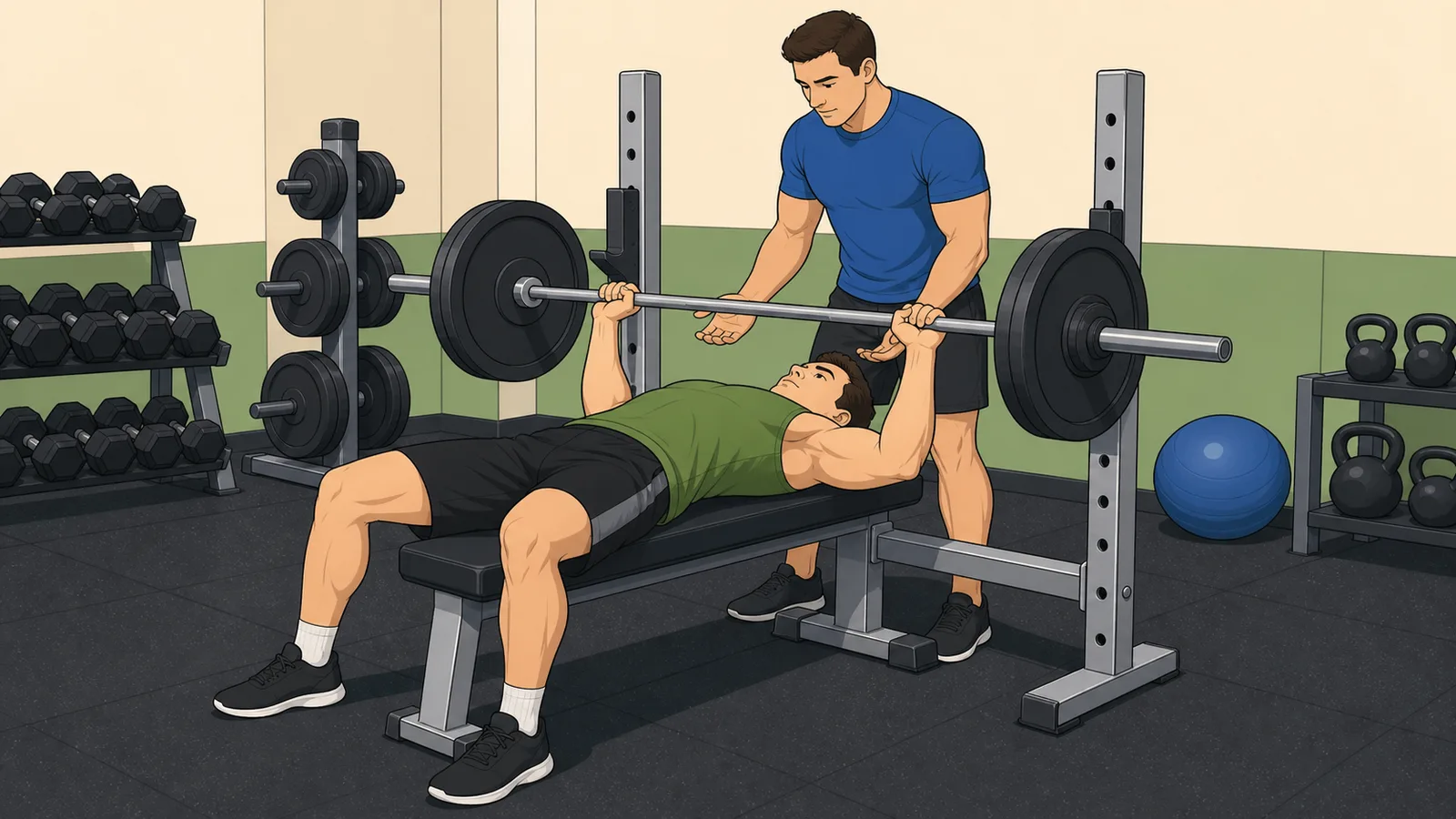
Estimate your bench press 1RM from a submaximal set, then turn it into a rounded bench press chart with training max rows, bodyweight-relative standards.
Last updated
Bench press calculator Estimate your bench press one-rep max from a recent working set, then turn it into a
training max, bodyweight-relative standard, milestone check, and practical bench-planning
sheet with rounded gym loads without needing to test a true max every week.
Units
Quick examples
Bench-specific use note Use a clean full-range barbell bench set for the estimate. Paused bench, touch-and-go bench,
close-grip bench, and Smith-machine bench can all be useful, but the projected single is
most comparable when the input set matches the bench style you care about.
Enter a recent bench set Add the weight you lifted and the reps you completed to estimate your bench press 1RM, training max, and bodyweight-relative standard.
Bench press standards by body weight
These generic relative-strength benchmarks help answer the usual “what is a good bench press for my bodyweight?” question without pretending every federation, gym population, or pause standard uses the same cutoffs.
Level
x BW
60 kg
70 kg
80 kg
90 kg
100 kg
Beginner
0.5×
30 kg
35 kg
40 kg
45 kg
50 kg
Novice
0.75×
45 kg
53 kg
60 kg
68 kg
75 kg
Intermediate
1×
60 kg
70 kg
80 kg
90 kg
100 kg
Advanced
1.5×
90 kg
105 kg
120 kg
135 kg
150 kg
Elite
2×
120 kg
140 kg
160 kg
180 kg
200 kg
About this estimate
Bench press estimates are strongest when the source set is a hard but technically clean set in the 2-10 rep range. Treat the estimated 1RM as a programming tool, not proof that a random-day max attempt is guaranteed. Benching style, pause standard, touch-and-go rebound, grip width, fatigue, and the presence of a competent spotter all change what a true single looks like in practice.
Bench press calculator guide: estimate your 1RM, training max, and bench press standards
A bench press calculator estimates your one-rep max from a heavier submaximal set so you can plan training without testing an all-out single every week.
How a bench press 1RM estimate works
The calculator averages three well-known formulas — Epley, Brzycki, and Lombardi — each of which uses the lifted weight and rep count to project the load you could lift exactly once. Averaging the three reduces formula-specific bias and gives a steadier bench planning number than relying on a single equation alone.
That formula comparison also matches what people search for on rival 1RM pages. Many users are trying to understand why one bench calculator uses Epley, another uses Brzycki, and a third shows a weighted average or strength-standard overlay. In practice, the formulas are closest when the set is heavy and low-rep, and they drift further apart as reps climb.
Why rep range and bench style change the estimate
Bench press 1RM predictions are usually most useful when the input set lands in a challenging but still controlled rep range, often around 2 to 10 reps. Very high-rep sets include more endurance and pacing effects, so the estimate becomes less precise even if the formula still returns a number.
Exercise style matters too. A paused competition-style bench, touch-and-go bench, close-grip bench, incline press, dumbbell press, and Smith-machine bench do not all represent the same strength expression. A useful calculator therefore gives a practical estimate for the version you actually performed rather than pretending every pressing pattern maps to one universal max.
Why a training max is usually more useful than the full estimated max
Many lifters get more value from a training max than from the raw projected single. A training max is a deliberately conservative working anchor, often about 90% of estimated 1RM, which makes percentage-based programming more stable across normal fatigue, sleep variation, and day-to-day readiness.
That matters because the projected max is not a guarantee that you should attempt the same load today. The better use is to convert the estimate into heavy-singles, volume, and repeated-set planning rows so your weekly bench work stays productive instead of turning into a series of near-max tests.
How bodyweight context and standards help
Bench press numbers are often interpreted against body weight because 100 kg on the bar means something different for a 70 kg novice than for a 100 kg experienced lifter. That is why strong bench pages pair one-rep-max estimates with relative-strength standards, next-tier targets, or milestone checks.
Those standards are best used as orientation, not judgement. The most valuable comparison is usually with your own recent history: whether your estimated 1RM, rep performance, or working weights are moving in the right direction over time, and how far the next benchmark sits above your current projected max.
Milestones like 135, 185, 225, and 315 are useful because they are concrete
One reason benchmark loads matter is that they give lifters a specific next target instead of a vague idea of getting stronger. A page that tells you that you are 3 kg from 225 pounds or 11 kg from 315 pounds is more actionable than one that only says your bench is intermediate or advanced.
That milestone framing also helps lifters scale expectations. If the gap to a benchmark is small, the next training block can be built directly around it. If the gap is still large, the smarter move is usually to progress through submaximal strength work and intermediate targets before chasing the headline single.
How to turn a bench press chart into real gym loads
A bench press chart becomes much more useful when it matches the plates you can actually load. If the calculator says 103.9 kg for a training max, the practical answer in most gyms is 105 kg. If it says 231.4 lb, the realistic choice is usually 230 lb or 235 lb depending on whether the day is meant to be conservative or aggressive.
That is why a bench PR calculator should show both the exact math and a rounded gym-load version. For heavy singles and top sets, rounding down is often the safer choice when the number lands between jumps. For ordinary volume work, rounding to the nearest 2.5 kg or 5 lb usually keeps the plan close enough to the estimate while still being easy to execute under the bar.
Worked example: 100 kg for 5 reps
Suppose you bench 100 kg for 5 controlled reps. A bench press calculator will usually project a one-rep max somewhere a little above that working load, then turn the estimate into training rows such as a conservative training max, a repeated-set strength row, and a heavier single-exposure row.
If the same lifter weighs 90 kg, the bodyweight-relative result gives more context. The bench is no longer just a number on the bar; it becomes a ratio relative to body weight, a standards tier, and a visible gap to the next milestone. That makes the output more useful for actual programming and goal-setting.
What this page does not tell you
A bench calculator cannot see bar speed, pause quality, technical breakdown, shoulder pain, or whether the set came after heavy fatigue. It also cannot know whether the next best step is hypertrophy volume, heavy singles, triceps work, or a competition-style pause block.
The estimate is therefore a programming aid, not a replacement for judgement. Use it to anchor loads, compare standards, and plan milestones, but not as proof that a true max is guaranteed or safe without proper setup, safeties, and spotting.
Frequently asked questions
How accurate is the estimated 1RM?
It is usually most useful when the source set is heavy enough to reflect real strength but not so high-rep that endurance dominates the outcome. A set of 2 to 6 reps is often the sweet spot for practical planning. Beyond about 10 reps, the estimate still gives a rough answer, but the uncertainty becomes much larger.
Should I attempt my estimated 1RM?
Not automatically. The estimated number is best used as a programming tool, not as proof that a true single is guaranteed. If you want to test a real max, do it with proper warm-up, a spotter or safeties, and a session designed for that goal rather than as an impulsive add-on at the end of a normal workout.
What rep range works best for a bench press 1RM calculator?
Most rep-to-max formulas work best when the set is fairly heavy, usually somewhere around 2 to 10 reps taken with good form. Many lifters find that 3 to 6 reps gives the most useful balance of safety and reliability for bench-specific programming.
Should paused bench, touch-and-go bench, and Smith-machine numbers be treated the same?
No. They can all be useful within their own training context, but they should not be treated as perfectly interchangeable. A paused flat barbell bench is the cleanest reference for powerlifting-style comparison, while touch-and-go, close-grip, incline, or machine numbers are better compared against their own prior history.
How should I compare my bench press number to bodyweight standards?
Use bodyweight-relative standards as orientation, not as a verdict. A 100 kg bench means something different at 70 kg bodyweight than it does at 100 kg bodyweight. The most helpful use is to see which broad tier you are near and how far the next load target sits above your current estimated max.
What is a good bench press for bodyweight?
That depends on training history and the standard system being used, but many lifters treat a bodyweight bench press as a major early milestone. Around 1.5x bodyweight is a much stronger benchmark and usually reflects advanced upper-body pressing strength in general-gym populations.
Why use a training max instead of the full estimated max?
Because most training weeks are not peak-performance days. A training max gives you a more stable anchor for percentages so 80%, 85%, and 90% work stays realistic across normal fatigue levels. This usually produces better long-term programming than treating every projected single as a weekly target.
Should I round calculator loads to the nearest plate jump?
Yes. A bench press chart is more useful when it maps to real plates. In metric gyms, rounding to the nearest 2.5 kg is usually practical; in imperial gyms, rounding to the nearest 5 lb is the common default. For heavier single-exposure work, many lifters round down if the number lands between jumps so the estimate stays conservative.
How often should I recalculate my bench 1RM?
Every few weeks or at the end of a training block is usually enough. Recalculate after a new rep PR or when your working weights clearly feel too light or too heavy for the intended effort. Constant recalculation is less useful than consistent tracking across meaningful training checkpoints.
How close is 225 pounds if my estimated max is below it?
The useful question is the gap, not just the label. If your estimate is only a few kilos below 225, the milestone may be close enough to plan directly toward with a focused strength block. If the gap is much larger, the smarter move is usually to progress through intermediate percentage targets before chasing the benchmark single.
Do I need a spotter when using a bench calculator?
You do not need a spotter to use the calculator, but you do need one when the result is used to guide heavy bench attempts that might fail. The closer you get to true-max territory, the more important a competent spotter or safety-arm setup becomes.