Use this deadlift max calculator to estimate your deadlift 1RM from a working set, then compare formula outputs, training max rows, bodyweight standards.
Last updated
Deadlift 1RM planner Use this deadlift max calculator to estimate your deadlift 1RM from a recent working set,
compare formula outputs, set a practical training max, and see how close you are to common
pulling milestones.
Quick examples
Deadlift planning note
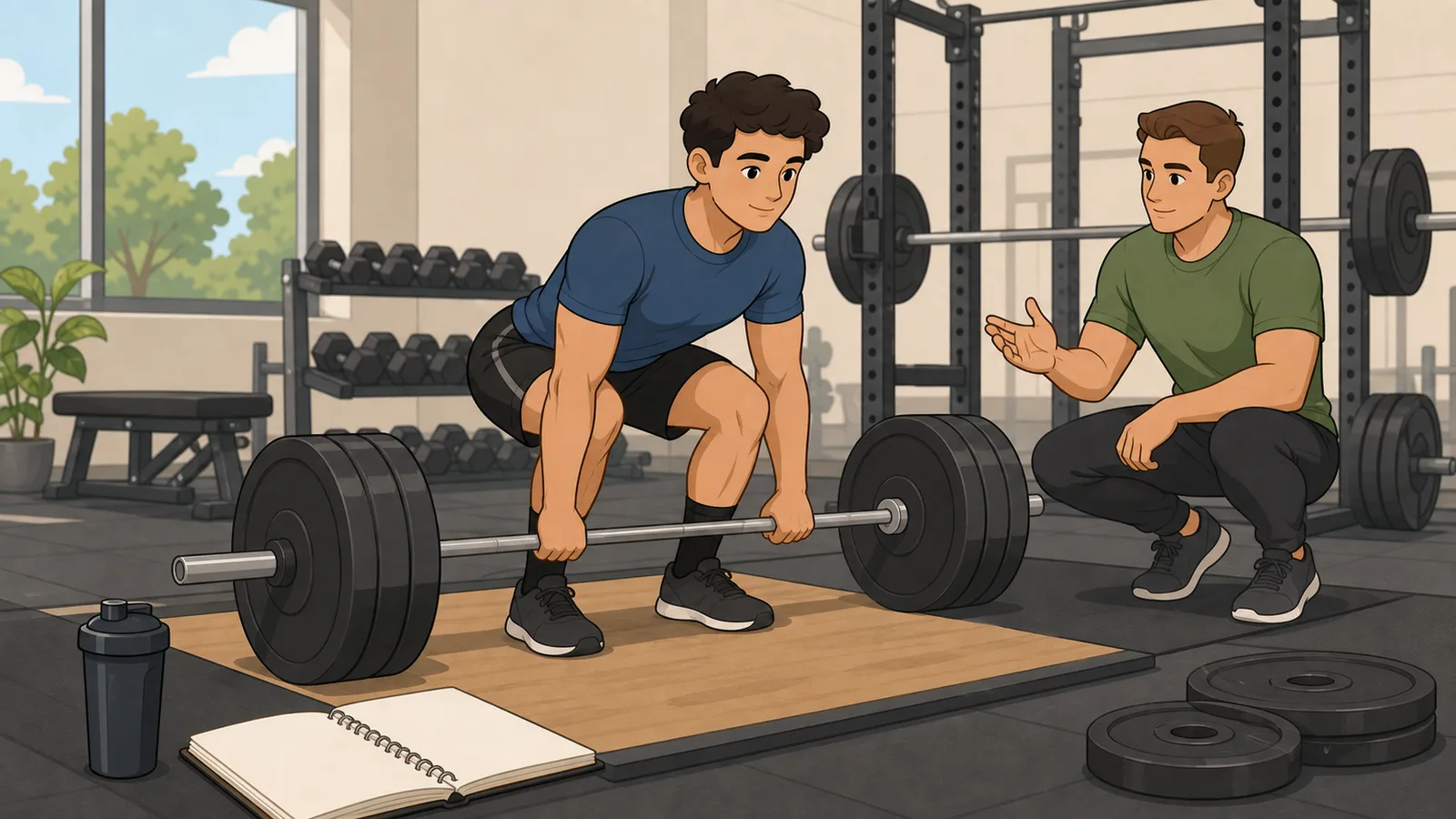
Deadlift estimates are most useful when the source set is clean and technically sound. Use the same stance, setup, and equipment conditions you actually train with, and prefer a solid working set of roughly 2-5 reps over a hitching grinder that overstates what a real single would look like.
Enter a recent deadlift set Add the weight you lifted and the reps you completed to estimate your deadlift 1RM, training max, and practical loading rows. Body weight is optional, but it unlocks bodyweight-relative deadlift standards.
Deadlift max calculator guide: estimate 1RM, training max, standards, and warm-up steps
A deadlift max calculator estimates the heaviest weight you could likely pull once from a recent working set. The best deadlift 1RM calculator should do more than output a single number: it should help you compare formulas, set a practical training max, check broad bodyweight-relative standards, and turn the estimate into useful percentage loads and warm-up steps for the next session.
What a deadlift max calculator is actually estimating
A deadlift max calculator does not measure your true one-rep max directly. It predicts a likely single from the weight and reps you recently completed, which makes it most useful when you want to estimate deadlift 1RM without turning every heavy training week into a full max-out attempt.
That is why the result should be treated as a planning tool rather than as a promise. A clean rep set can tell you a lot about current pulling strength, but it cannot fully capture bar speed, fatigue, grip security, or whether your technique would hold together under a true all-out single.
Estimated deadlift 1RM = average of the Epley, Brzycki, and Lombardi equations
Using multiple rep-max equations gives a steadier deadlift estimate than relying on only one formula.
Training max = estimated 1RM × 0.90
A 90% training max usually gives a safer anchor for weekly deadlift programming than treating the full estimate as a required working number.
Why deadlift estimates behave differently from squat and bench
Deadlift 1RM estimates often feel more stable than bench press estimates because the lift starts from the floor and does not rely on a descent, pause, or rebound pattern. At the same time, the deadlift is highly sensitive to grip choice, bar path, setup consistency, and whether the source set was a clean dead-stop effort or a fatigued touch-and-go grind.
That means a deadlift one rep max estimate can look precise on paper while still being noisy in practice if the setup changed from set to set. Compare like with like: conventional against conventional, sumo against sumo, straps against straps, and beltless against beltless. The page becomes much more useful when the inputs stay in the same lane.
Why a training max usually matters more than the headline 1RM
Most lifters do not actually need a deadlift max number for bragging rights. They need a useful weight for heavy triples, repeated strength sets, and technique work that does not bury recovery. That is why a strong deadlift calculator should show not only the projected single, but also a training max and a deadlift percentage chart.
A 90% training max helps keep loading honest. If the projected single is a little optimistic, the training max absorbs some of that error and keeps the next week productive instead of inflated. For deadlifts in particular, that buffer matters because pulling fatigue accumulates quickly and usually costs more recovery than the same mistake would on lighter assistance work.
Bodyweight-relative deadlift standards and plate milestones
Many people searching deadlift max calculator are really asking two questions at once: what is my estimated deadlift max, and is that good for my body weight? Broad deadlift strength standards help with the second question by comparing your estimated 1RM against simple bodyweight-relative tiers instead of pretending that one raw number means the same thing for every lifter.
Plate milestones serve a similar purpose. Benchmarks like 315 lb, 405 lb, 495 lb, and 585 lb are memorable because they translate the estimate into a next target. They should not be treated as universal judgments, but they are useful for planning because they show whether the next block should focus on closing a realistic gap or simply consolidating your current level first.
Conventional, sumo, straps, and touch-and-go reps should stay in separate lanes
The formulas themselves are stance-agnostic, but your comparisons should not be. A conventional deadlift estimate and a sumo deadlift estimate may both be valid, yet they reflect different mechanics, different sticking points, and often different load potential. Use the variation you actually train as the main source set for the estimate.
Equipment choices matter too. Mixed grip, hook grip, straps, a belt, and dead-stop versus touch-and-go execution can all change how many reps you complete and what the number means for a true single. If your current set used straps or bounce-assisted rhythm, the best move is to compare it against prior sets with the same conditions rather than against a stricter dead-stop benchmark.
Warm-up for the deadlift
Unlike the squat and bench press, many deadlift warm-up schemes start around 50% of estimated 1RM rather than with a long empty-bar progression. The deadlift groove tends to feel better with a meaningful load, so a ladder such as 50% for 5 reps, 65% for 3, 80% for 2, and 90% for 1 usually prepares the hinge pattern efficiently without wasting energy.
The exact jump sizes should still match your gym setup and training intent. If the calculator gives awkward decimals, round to the nearest realistic plate combination. The point of the warm-up table is not to force perfect math; it is to help you arrive at the work set with enough rehearsal and without unnecessary fatigue.
Why rounded loads are shown beside exact percentages
A deadlift percentage chart is only useful if the lifter can load the bar without doing extra arithmetic. Exact formula output may say 166.4 kg or 366.8 lb, but most gyms move in practical plate jumps. This calculator therefore keeps the exact percentage load visible and adds a rounded load column using the nearest 2.5 kg or 5 lb step.
Rounded loads should be treated as training decisions, not mathematical truth. If the set is meant to be crisp technique work, round down. If the goal is a planned heavy exposure and bar speed is good, rounding to the nearest practical load may be reasonable. The estimate is there to guide the next session, not to override what the warm-up sets show on the day.
Worked example: 160 kg for 5 reps at 82.5 kg body weight
If you pull 160 kg for 5 clean reps, the common formulas land in a fairly tight range and average out to an estimated deadlift max in the mid-180 kg range. From there, the page can turn the result into a more practical training max, a heavy-triple reference, and a warm-up ladder instead of leaving you with only a bare one-rep-max estimate.
At a body weight of 82.5 kg, that same estimate also gives broad relative-strength context. The result sits comfortably above an early-intermediate threshold but still leaves a meaningful gap to higher pulling tiers and to the next big plate milestone. That is a more useful answer than “your deadlift max is X,” because it tells you what to do next with the number.
When to trust the estimate and when to test a true max
A deadlift max estimate is most useful during ordinary training blocks, after rep PRs, and whenever you want a better percentage anchor without the cost of a full max test. Lower-rep sets, usually around 2 to 5 reps, give the cleanest estimates because they reflect strength more than endurance and because setup quality usually holds up better.
A true max test makes more sense when you have a specific reason for it: meet prep, attempt selection, or a planned testing day with the right warm-up, equipment, and recovery. Even then, the estimate remains useful because it can help you choose opener ranges and realistic jumps instead of guessing under the bar.
Frequently asked questions
Should I use conventional or sumo deadlift numbers?
Use whichever variation you primarily train or want to compare over time. The formulas only need the weight and reps, but the result is more meaningful when you keep stance, setup, and execution style consistent from set to set.
Why is my deadlift 1RM much higher than my squat?
That is common, especially for lifters whose hip hinge and posterior-chain strength are ahead of their squat pattern. The deadlift usually benefits from stronger leverage at lockout and from being less depth-sensitive than the squat, so a higher deadlift estimate does not automatically mean anything is wrong.
What rep range gives the most useful deadlift estimate?
A challenging set in roughly the 2 to 5 rep range usually gives the cleanest deadlift max estimate. Sets of 6 to 8 reps can still guide training, but confidence drops as fatigue, grip endurance, and touch-and-go rhythm influence the result more heavily.
Should I use the estimate as a training max or a true max?
Use it as a training max first. A projected single is best treated as a planning number for percentages, heavy triples, and warm-up decisions. If you later test a true max, let the estimate guide the attempt rather than treating it as guaranteed.
How often should I re-estimate my deadlift max?
Every few weeks is enough for most lifters, or sooner after a meaningful rep PR. Re-estimating after every ordinary session usually adds noise rather than better decision-making.
What is a good deadlift for bodyweight?
There is no single universal answer, but broad bodyweight-relative deadlift standards are useful for orientation. They help show whether your estimated max sits in beginner, novice, intermediate, advanced, or elite territory for a lifter of your size. Treat those tiers as rough benchmarks, not as a verdict on your worth or programming.
Do straps, mixed grip, or a belt change the estimate?
They can change what the estimate means in practice because they affect how the set was achieved. A strap-assisted or mixed-grip rep PR may still be a valid training reference, but it should be compared against sets done under the same conditions instead of against stricter dead-stop or raw-grip performances.
Can I use a 10-rep set to estimate my deadlift max?
Yes, but the answer should be treated more cautiously than an estimate from a heavier low-rep set. High-rep deadlifts often include more fatigue, more grip limitation, and more technique drift, so the result is better used as a broad trend than as an exact max prediction.
Why does the calculator show rounded deadlift loads?
The exact percentage load explains the math, while the rounded load shows what you can usually put on a real barbell. Metric rows round to the nearest 2.5 kg and imperial rows round to the nearest 5 lb, which makes the deadlift percentage chart and warm-up ladder easier to use in the gym.
Why do different deadlift formulas give different answers?
Each formula models the relationship between repetitions and a true single differently. Epley, Brzycki, and Lombardi are all trying to estimate the same thing from the same set, but they scale rep performance in slightly different ways. Comparing them helps you see whether the estimate is tightly clustered or more uncertain.
Should I compare touch-and-go reps with dead-stop reps?
Not directly. Touch-and-go sets can increase rep counts by changing the rhythm and reducing the reset demand between pulls. If you want the cleanest deadlift max estimate, compare dead-stop sets with dead-stop sets and touch-and-go sets with touch-and-go sets.
Does the weight entered include the barbell?
Yes. Enter the total weight on the bar, including the barbell and all plates. That is the same convention used by most one-rep-max and strength-standard tools.