Skip to content
Calcipedia
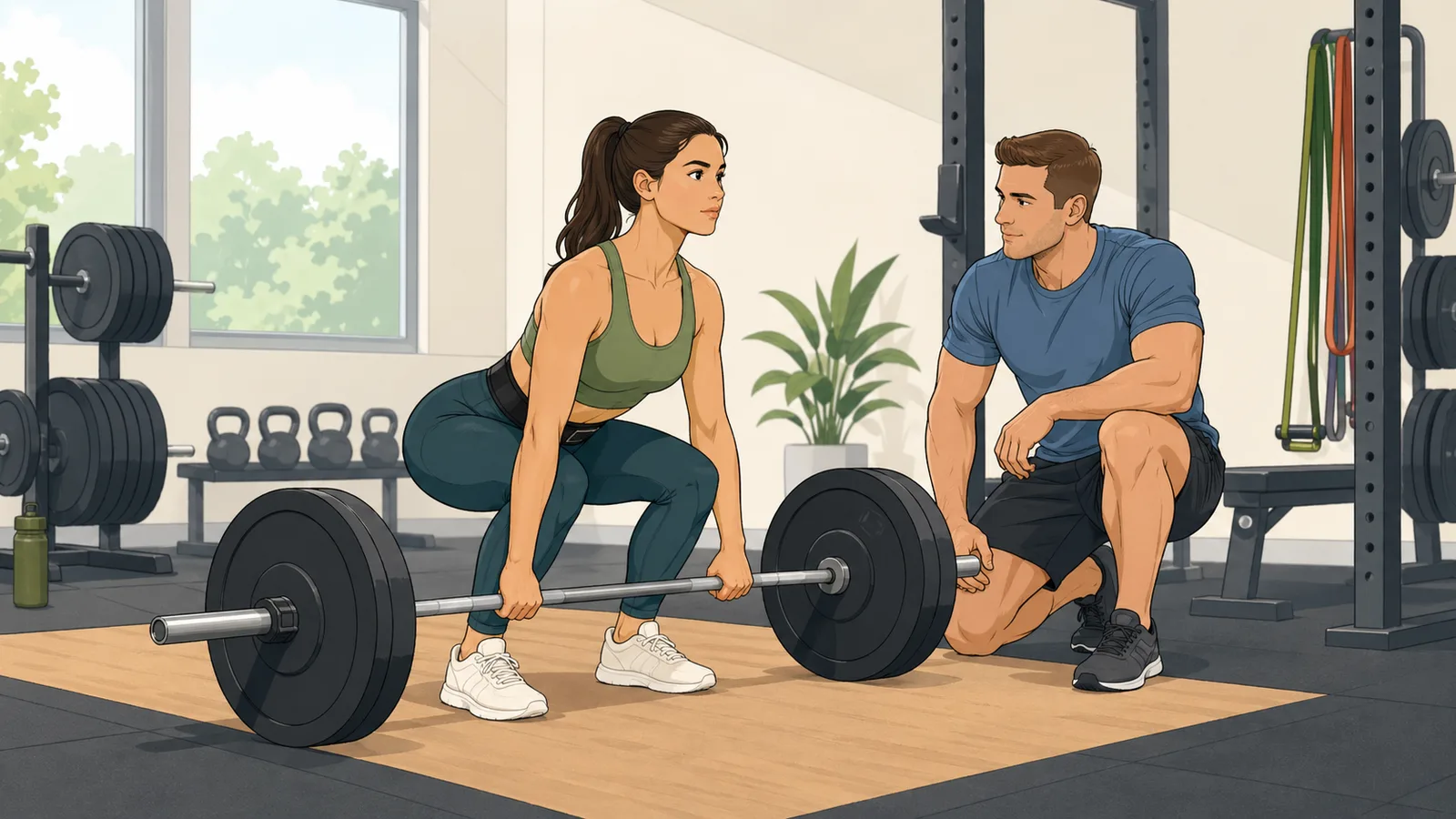
Lifting Strength Calculator instructional illustration

Lifting Strength Calculator

Classify your squat, bench press, deadlift, or overhead press strength level from bodyweight ratio standards using either a tested max or a recent work set.

Last updated

Lifting strength calculator Compare your squat, bench press, deadlift, or overhead press against bodyweight-based strength standards, then turn the result into a benchmark roadmap, cross-lift check, and bodyweight-sensitivity planning sheet.

Strength input

Quick examples

Strength standards sheet

Beginner

This page compares your lift against bodyweight-ratio standards for the selected lift, then extends the result into tier roadmaps, same-level cross-lift benchmarks, projected load jumps, and body-weight-change scenarios.

1.5x

Bodyweight ratio

120

Entered max (kg)

140

Next benchmark

20

Gap to next (kg)

Back Squat Beginner now. About 20 kg more reaches Intermediate.

Roadmap at your body weight

Use this sheet to see whether the next tier is one small jump, one good training block, or a much longer runway.

LevelRatioTarget loadGap
Untrained0.75x60 kgMet
Beginner1.25x100 kgMet
Intermediate1.75x140 kg+20 kg
Advanced2.25x180 kg+60 kg
Elite3x240 kg+120 kg

Standards at your body weight

These rows convert the bodyweight-ratio benchmarks into actual loads for the selected lift.

LevelRatioLoad
Untrained0.75x60 kg
Beginner1.25x100 kg
Intermediate1.75x140 kg
Advanced2.25x180 kg
Elite3x240 kg

If the lift moves up

These rows show how common strength jumps would change the classification without changing body weight.

ScenarioProjected liftRatioLevel
+2.5 kg jump122.5 kg1.5xBeginner
+5 kg jump125 kg1.6xBeginner
+10 kg block130 kg1.6xBeginner
+20 kg long block140 kg1.8xIntermediate

If body weight changes but the lift stays the same

This is useful when comparing a cut, maintenance phase, or bulk without pretending the bar weight moves instantly with body mass.

ScenarioBody weightRatioLevel
Cut 10%72 kg1.7xBeginner
Current weight80 kg1.5xBeginner
Lean gain 5%84 kg1.4xBeginner
Bulk 10%88 kg1.4xBeginner

Same-level cross-lift snapshot

These rows show what the same benchmark tier looks like across the other major lifts at your current body weight.

LiftRatioLoad
Back Squat1.25x100 kg
Bench Press0.75x60 kg
Deadlift1.5x120 kg
Overhead Press0.55x44 kg
Planning note Strength standards are approximate population norms, not a diagnosis of athletic potential. Equipment, range of motion, federation rules, leverages, and estimated-versus-true maxes all affect the comparison.
← All Strength & Performance calculators

Health — Fitness

Lifting Strength Calculator

Strength standards allow you to compare your squat, bench press, deadlift, or overhead press against population norms and track your progression from untrained to elite.

How strength levels are classified

Strength standards are typically expressed as a multiple of bodyweight lifted. An untrained male can typically squat around 0.75× bodyweight, while an elite level corresponds to roughly 3× bodyweight. These benchmarks reflect the performance distribution of trained individuals at each stage of their lifting career.

A bodyweight-ratio approach keeps the result easy to interpret because it shows what each standard band means in the actual lift you care about. Instead of only saying that a squat is 1.5 times body weight, the calculator also turns that ratio into benchmark loads and compares the same tier across the other main barbell lifts.

How to read your result

A strength classification is a benchmarking tool, not a verdict on whether someone is “strong enough.” It is most useful when you want to see where your squat, bench press, deadlift, or overhead press sits relative to other lifters of similar bodyweight. That is why search terms like lifting strength standards, one-rep max calculator, and good squat for my weight often overlap in practice.

Because different lifts have different mechanics and leverage demands, the same bodyweight ratio does not mean the same thing across every exercise. Squat and deadlift standards are usually higher than bench press standards, while overhead press standards are usually lower because the movement is less mechanically advantaged.

When a 1RM estimate is enough

If you know your true one-rep max, use that. If you do not, a reliable estimate from a recent rep set is usually good enough for a strength-standard calculator like this one. That is especially useful when you want a quick read on progress without maxing out every lift.

The main caveat is that estimated 1RM formulas become less reliable as the rep count rises. They work best for low-rep sets and for lifters who already know how their technique looks under load. If your training style is very different from a typical barbell program, treat the result as a directional estimate rather than a hard label.

That is why this page now accepts a recent working set directly. A lifter who has just hit 100 kg for 5 clean bench reps or 160 kg for 3 solid deadlift reps can classify the likely strength tier immediately, without having to bounce to a separate one-rep-max page first.

Use a recent work set when you do not want to test a max

Competitor pages that rank for lifting strength calculator and strength standards calculator often assume you already know a true one-rep max. In practice, many lifters do not. They know the heaviest set they hit this week, not the heaviest single they could attempt under fresh conditions.

A recent-set workflow is usually the better starting point for regular training. If the set is technically clean and reasonably hard, an average one-rep-max estimate is usually strong enough to place the lift in the right band, show the roadmap gap to the next tier, and reveal whether a 2.5 kg or 5 kg increase would actually change the label.

Why the same lift can change category when body weight changes

Relative strength is not only about how much is on the bar. It is also about how that load compares with your current body weight. If a lifter keeps the same squat while cutting body mass, the ratio usually improves. If the same lifter gains body weight faster than the lift rises, the ratio can flatten or even fall.

That is why the body-weight-change rows matter. They help answer practical questions such as whether a planned cut would make an existing bench look stronger on a relative basis, or whether a bulk would still leave the lift in the same tier until the next training block adds bar weight.

What a balanced strength profile usually looks like

Several competitor pages also answer an implied question users rarely phrase directly: are my lifts balanced? In broad terms, the deadlift usually sits highest, the squat often lands next, the bench press trails those lower-body lifts, and the overhead press is usually lowest because the movement has the least mechanical advantage.

That does not mean the right goal is to force every lift into the same ratio. It means a balanced profile should usually show a deadlift above the squat, a squat above the bench, and a bench above the overhead press when you compare like-for-like strength tiers. The same-level cross-lift table on this page is meant to make that comparison easier without pretending every lift should share one universal target.

Small loading jumps matter more than lifters think

A strength label can feel abstract, but the next useful question is usually concrete: what happens if the lift goes up by 2.5 kg, 5 kg, or 10 kg? Those are real programming jumps that match microloading, a solid strength block, or a longer cycle built around one lift.

That is why a planning table is more useful than a static standards chart on its own. The standards chart shows where the current lift sits. The load-change rows show whether the next realistic jump would leave the classification unchanged, push it to the edge of the next tier, or clearly move it up.

Use the roadmap table to set the next honest target

The roadmap table turns each ratio benchmark into a real target load at your body weight. That matters because an intermediate squat at 65 kg body weight does not mean the same load as an intermediate squat at 95 kg body weight. Without the converted target, the ratio can feel too abstract to guide training.

A useful roadmap also shows the gap to each tier. If the next tier is only a small jump away, the lifter can plan directly for it. If the gap is still large, the smarter move is usually to focus on the next near-term loading milestone rather than obsess over a category name.

Cross-lift comparisons are useful when they stay lift-specific

Many lifters want to know whether their bench is lagging behind their squat or whether the deadlift is unusually far ahead of the overhead press. That question is only meaningful when the comparison stays tied to lift-specific standards rather than forcing every exercise into the same ratio expectations.

The same-tier cross-lift table is helpful because it shows what the current benchmark level looks like across the other barbell lifts at the same body weight. That gives a cleaner answer to questions like what a good bench is for someone whose squat is already advanced, or whether an overhead press is truly behind versus simply being judged against the wrong standard.

Worked example

Suppose a male lifter weighs 80 kg and squats 120 kg. That is a 1.5x bodyweight ratio, which falls in the beginner band for the squat in this model. The standards sheet then turns each benchmark row into actual loads at 80 kg body weight, so the next intermediate target is about 140 kg rather than just an abstract ratio.

The cross-lift snapshot is useful too. At the same body weight and same benchmark tier, the model shows lower loads for the bench press and overhead press than for the deadlift. That helps explain why one lifter can be advanced in the squat while still sitting in a lower tier in the press, even when overall training age is similar.

Frequently asked questions

Should I use my 1RM or a recent training weight?

For the most accurate classification, use your estimated one-rep max (1RM). If you have not tested your true 1RM, you can estimate it from a recent multi-rep set using a 1RM calculator (e.g., Epley or Brzycki formula). Using a training weight below your max will result in a lower classification than your true level.

Can I use a 5-rep max instead of a tested single?

Yes. A hard 3-to-5 rep set is often one of the most practical ways to estimate strength level because it gives you a usable one-rep-max projection without forcing a true max attempt. It is still an estimate, but for most training decisions it is close enough to place you in the right tier and show the next roadmap target.

Why are squat, bench press, deadlift, and overhead press standards different?

Each lift has different leverage, range of motion, and muscle-group demands. Deadlift standards are usually highest because the movement lets you use a strong posterior chain and favorable leverage. Bench press standards are usually lower, and overhead press standards are lower still because the movement has a harder mechanical position.

What does the Wilks score tell me?

Older tools often used Wilks-style bodyweight adjustments for cross-lifter comparison, but most gym decisions are clearer when you focus on lift-specific bodyweight ratios and benchmark tiers. This page therefore emphasizes standards rows and same-tier cross-lift context rather than a single composite score.

Can I compare my score with lifters of a different sex or bodyweight?

Only with caution. Bodyweight ratio standards help, but leverages, sex-based strength distribution, and training background all affect the result. The calculator is best for tracking your own progress or comparing lifters in a similar lift context rather than making a universal ranking across all people.

What if my lift falls between two strength standards?

Treat it as sitting near the boundary between the two bands. Benchmark systems are approximate, so a result that lands between categories usually means your current performance is closer to the higher band than the lower one, but not yet fully established there.

Can cutting body weight change my strength classification even if the lift stays the same?

Yes. Because the result is based on lift-to-bodyweight ratio, the same bar weight can move up a tier if body weight falls enough. The reverse can also happen during a bulk if scale weight climbs faster than the lift. That does not automatically mean the athlete is stronger or weaker in an absolute sense, only that the relative-strength comparison changed.

Does a lighter body weight always mean a better relative-strength score?

Not automatically. Lower body weight improves the ratio only if the lift stays high enough. A cut can improve the classification when bar weight is maintained, but it can also hurt the result if the lift falls faster than body weight does. That is why the body-weight-change scenarios are more useful than assuming lighter always means stronger.

How much does a 2.5 kg or 5 kg increase usually matter?

It depends on the current gap to the next tier. For a lifter already close to the next threshold, a 2.5 kg or 5 kg increase can be enough to move the classification. For someone further away, the level may stay the same even though the lift improved meaningfully. That is why it is better to look at the roadmap and gap rows than at the label alone.

Is this page better for relative strength than a total-strength score?

For most lifters, yes. A total score can be useful in some ranking systems, but it often hides the information people actually want, such as whether the bench is behind the squat or whether the overhead press is unusually strong for body weight. A lift-specific relative-strength page usually answers the more practical training question.

Should I compare a bench press estimate and a true deadlift max the same way?

Only with caution. The page can still give useful context, but a true tested max and an estimated one-rep max do not have identical uncertainty. If one lift is estimated from reps and another is a tested single, treat the result as a planning comparison rather than a definitive ranking between the two lifts.

Why can someone be advanced in the deadlift but only intermediate in the bench press?

Because the standards are lift-specific and the movements have very different leverage and muscle-mass demands. Deadlift standards are usually higher than bench press standards, while overhead press standards are lower than both. The correct question is not whether the ratios match, but whether each lift is strong relative to the right benchmark for that exercise.

Does age change a lifting strength standard?

Age can change how a result should be interpreted, especially for older lifters, youth lifters, and anyone returning after a long layoff. This calculator keeps the benchmark focused on sex, body weight, lift type, and estimated one-rep max so the roadmap remains easy to read, but it does not apply age-adjusted strength standards. If age-adjusted context is important, treat the level as a broad training benchmark and pay more attention to safe progression, consistency, and technique quality.

Also in Strength & Performance

Related

More from nearby categories

These related calculators come from the same leaf category, nearby sibling categories, or the same top-level topic.