Skip to content
Calcipedia
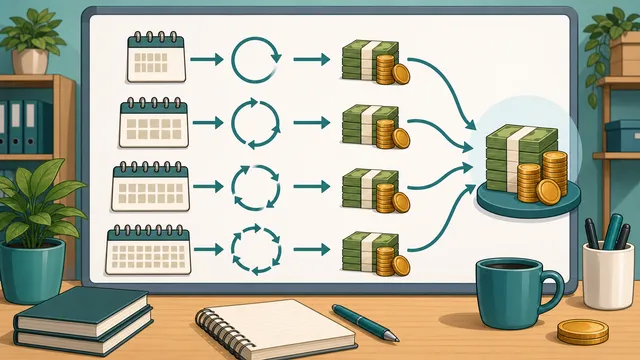
Compound Interest Calculator instructional illustration

Compound Interest Calculator

Use this compound interest calculator to project future value, compare simple versus compound interest, test daily, monthly, quarterly, annual.

Finance planning estimate

Topic review: James Whitfield

Retired Financial Planner. Assigned as the finance topic reviewer for mortgage, retirement, annuity, pension, and long-term planning calculators.

Reviewed 1 May 2026 Updated 2 May 2026 View reviewer profile Contact editorial team
Compound interest calculator Project future value from an initial investment, recurring monthly contributions, a rate assumption, and compounding frequency. Use the scenario rows to see whether contribution size, time, or the return assumption is doing most of the work.

Before you calculate

Match the input to the rate and deposit pattern

Compound interest calculators are most useful when the stated rate, compounding frequency, contribution timing, and time horizon all describe the same product or planning assumption.

Quoted APY

If an account advertises APY, it already includes compounding. Use the APR/APY converter before entering a nominal annual rate.

Monthly deposits

The main projection assumes one fixed monthly contribution. Use a future value or investment calculator when deposits are weekly, yearly, indexed, or irregular.

Real return

Taxes, fees, inflation, and market volatility are not built into the headline result. Lower the rate assumption when you want a more conservative real-world scenario.

Region and currency

Example scenarios

Contribution timing

Start-of-month deposits have slightly more time to compound. End-of-month deposits are the more conservative default for regular saving.

Result

$170,619.05

Projected future value after 20 years of compounding growth with end-of-month contributions.

Total contributions
$70,000.00
Total interest earned
$100,619.05
Effective annual rate
7.23%
Interest share
58.97%
What matters most In most realistic scenarios, the monthly contribution, time horizon, and rate assumption change the ending balance more than small compounding-frequency differences. Use the lower/base/higher rows before treating one return assumption as reliable. Do not mix APY and nominal rates Savings accounts often advertise APY because it already includes compounding frequency. If you enter an APY as the nominal annual interest rate and also choose daily or monthly compounding, the projection can double-count the compounding lift.

Growth projection

Contributions vs compound growth over time

Rate scenarios

Lower, base, and higher return assumptions

Lower rate

$129,884.82

5% rate, $59,884.82 interest

Base rate

$170,619.05

7% rate, $100,619.05 interest

Higher rate

$227,063.23

9% rate, $157,063.23 interest

Year-by-year breakdown

YearBalanceContributionsInterest
1$13,821.05$13,000.00$821.05
2$17,918.32$16,000.00$1,918.32
3$22,311.78$19,000.00$3,311.78
4$27,022.85$22,000.00$5,022.85
5$32,074.48$25,000.00$7,074.48
6$37,491.29$28,000.00$9,491.29
7$43,299.69$31,000.00$12,299.69
8$49,527.97$34,000.00$15,527.97
9$56,206.50$37,000.00$19,206.50
10$63,367.82$40,000.00$23,367.82
11$71,046.83$43,000.00$28,046.83
12$79,280.95$46,000.00$33,280.95
13$88,110.33$49,000.00$39,110.33
14$97,577.98$52,000.00$45,577.98
15$107,730.04$55,000.00$52,730.04
16$118,616.00$58,000.00$60,616.00
17$130,288.91$61,000.00$69,288.91
18$142,805.65$64,000.00$78,805.65
19$156,227.23$67,000.00$89,227.23
20$170,619.05$70,000.00$100,619.05

Simple, periodic, and continuous interest

Compare daily, monthly, quarterly, annual, and continuous compounding

This table preserves the simple interest calculator, daily compound interest calculator, and continuous compound interest calculator intents on one canonical page. It isolates one starting balance so the compounding schedule difference is easy to read.

MethodFuture valueInterestEAR / APY
Simple interest $24,000.00$14,000.007%
Annual compounding $38,696.84$28,696.847%
Quarterly compounding $40,063.92$30,063.927.19%
Monthly compounding selected$40,387.39$30,387.397.23%
Daily compounding $40,546.56$30,546.567.25%
Continuous compounding $40,552.00$30,552.007.25%

Solve the compound interest formula

Solve for final amount, principal, annual rate, or time

Use this solver when the question is backward: how much principal is needed, what annual rate is implied, or how many years it takes to reach a target amount.

Solve for

Solved value

$20,507.51

Formula used: A = P x (1 + r / n)^(n x t). The implied periodic rate is 0.5% and the effective annual rate is 6.17%.

Simple interest

Calculate simple interest with I = P x r x t

Simple interest is linear: interest is charged or earned on the original principal only. Use this section for simple-interest loan, note, and classroom formula questions.

Solve for

Simple interest result

$450.00

Total amount is $10,450.00. Annual compounding at the same rate would end at $10,450.00, a difference of $0.00. Day-based inputs use a 365-day year.

APR, APY, EAR, and EAY

Convert nominal APR to APY / EAR and back again

APR is the stated nominal annual rate. APY, EAR, and effective annual yield show the one-year effect after compounding. This section keeps the APR to APY calculator and effective annual yield calculator intent on the canonical page.

APY / EAR from APR
5.12%
Effective annual yield (EAY)
5.12%
Rate lift from compounding
0.12%
Periodic rate
0.42%
Continuous compounding equivalent
5.13%
APR implied by known APY
5%
Disclosure caution APY, EAR, and EAY isolate compounding. Product APRs can include fees, teaser terms, balance tiers, or credit disclosures, so use issuer or bank disclosures for the final comparison.
← All Saving & Investing calculators

Compound Interest Basics

How compound interest builds long-term growth

A compound interest calculator shows how money can grow when returns are added back into the balance and begin earning returns themselves. This page also explains the main assumptions behind the how compound interest builds long-term growth result, highlights the supporting figures shown by the calculator, and helps the reader use the estimate without overstating what a quick online tool can prove.

Simple interest versus compound interest

Simple interest is calculated only on the original principal. Compound interest, by contrast, is calculated on the principal plus previously earned interest. That repeated reinvestment effect is why compound growth can accelerate over long periods.

This is the reason many people use a free compound interest calculator or investment growth calculator rather than a simple interest calculator. Over short periods the difference may appear small, but over decades it becomes one of the most important drivers of portfolio growth.

Core formulas

The closed-form future value of a lump sum under periodic compounding is straightforward. Recurring contributions require either a future-value annuity formula or a period-by-period simulation when contribution timing and compounding frequency differ. A professional online calculator should make that distinction visible, especially when users compare monthly deposits with monthly, quarterly, or yearly compounding.

A = P x (1 + r / n)^(n x t)

A is the future value of the lump sum, P is the initial principal, r is the annual rate, n is the number of compounding periods per year, and t is time in years.

Interest earned = Future value - Total contributions

Total contributions include the original principal plus any recurring deposits made along the way.

Recurring deposits and planning use cases

Savings goal calculators, retirement calculators, and future savings calculators often rely on recurring deposits. Even modest monthly contributions can materially increase the ending balance because each new contribution has time to compound.

For practical planning, users usually compare three things: the final balance, the amount personally contributed, and the amount attributable to investment return or savings interest. Looking at those values side by side makes the mechanics of compound earnings much easier to understand, especially for anyone comparing a simple savings plan with a longer-term investment calculator online.

Contribution timing and rate scenarios

A compound interest calculator with monthly contributions needs to state when those contributions are assumed to arrive. End-of-month deposits are a conservative default because the new money starts compounding after that month has already passed. Start-of-month deposits produce a slightly higher result because each contribution has one extra month of growth.

The lower/base/higher rate rows are there because one return assumption is rarely enough. Investor education tools often encourage users to vary the assumed rate, and the same habit is useful here. If a small change in the annual rate produces a large change in the ending balance, the plan is highly sensitive to the return assumption.

This is also why the page separates total contributions from total interest earned. A result that depends mostly on your deposits is more controllable than a result that depends mostly on optimistic compound growth. The interest share helps show that split directly.

Start-of-month contribution result > end-of-month contribution result when the rate is positive

Deposits made earlier have more time inside the compounding cycle.

Interest share = Total interest earned ÷ Future value × 100

This shows how much of the ending balance comes from growth rather than direct contributions.

How to use lower, base, and higher return assumptions

For savings accounts, a lower/base/higher comparison can represent different possible account rates. For long-term investments, it is a way to avoid treating one average market return as a promise. The calculator keeps those scenario rows side by side so you can see whether the plan still works if the return is lower than hoped.

A good scenario set usually changes one variable at a time. Keep the starting balance, contribution, term, and compounding frequency fixed, then compare rate assumptions. After that, keep the rate fixed and test a higher monthly contribution or longer timeline. That makes it easier to see which lever matters most.

The practical takeaway is not that the highest row is the goal. It is that compound interest planning is more trustworthy when the user can see an optimistic case, a middle case, and a more conservative case before making a decision.

APY, nominal rates, and avoiding double-counted compounding

One of the easiest compound interest mistakes is mixing APY with a nominal annual rate. A bank savings account may advertise APY because APY already includes the effect of compounding over one year. A formula input labelled annual interest rate or APR is usually asking for the nominal rate before compounding frequency is applied.

If you type an advertised APY into a calculator field that expects a nominal annual rate and then also select daily or monthly compounding, the result can overstate growth by applying the compounding effect twice. Use the APR/APY converter section when you need to translate between quoted nominal APR, APY, EAR, and effective annual yield before running the main projection.

For investment scenarios, the same caution applies to average annual return assumptions. Market returns are not credited smoothly like bank interest, so a long-term expected return should normally be treated as a planning assumption rather than a product rate.

Monthly contribution assumptions versus real deposit schedules

The main projection uses a fixed monthly contribution because that is the clearest match for common savings-plan searches and for the SEC-style compound interest calculator pattern. Some competitor tools allow weekly, bi-weekly, quarterly, or annual deposits; those can produce different results because every deposit has its own amount of time to compound.

If your real plan uses irregular deposits, annual bonuses, contribution increases, or withdrawals, treat this page as a clean baseline rather than an exact account ledger. The future value and investment calculators linked from this page are better choices when contribution frequency, inflation, fee drag, or target-driven planning matters more than isolating compound interest mechanics.

Worked example: 10,000 plus 250 a month for 20 years

Suppose you start with 10,000, add 250 every month, assume a 7% nominal annual return, and choose monthly compounding for 20 years. Under this calculator's month-by-month projection, the ending balance is about 170,619.05.

Of that total, 70,000 comes from your own contributions and about 100,619.05 comes from compound growth. The displayed effective annual rate is about 7.23%, which is slightly higher than the quoted 7% because monthly compounding adds interest back into the balance throughout the year. That split between contributed cash and earned growth is what makes the result useful for planning rather than just headline reading.

Rule of 72 and quick reasonableness checks

The Rule of 72 is a mental shortcut for estimating how long a lump sum takes to double at a given annual return. Divide 72 by the annual rate. At 6%, the rough doubling time is about 12 years; at 8%, it is about 9 years. The rule is approximate, but it is useful for checking whether a calculator result is in the right range.

The rule is less precise when recurring contributions are involved because the balance is not one untouched lump sum. New deposits arrive throughout the projection and have different amounts of time to compound. Still, the shortcut can help users understand why time is often more powerful than small changes in compounding frequency.

If a compound interest projection looks surprisingly large, compare the yearly schedule with the Rule of 72 intuition and the total contribution row. That combination usually reveals whether the result is being driven by a long time horizon, a high assumed rate, large monthly deposits, or all three.

One canonical calculator for simple, compound, daily, continuous, APR, APY, EAR, and EAY

The old standalone simple interest calculator, daily compound interest calculator, continuous compound interest calculator, compound interest rate calculator, APR to APY calculator, APY calculator, and effective annual yield calculator all answered parts of the same family of questions. They are now consolidated here so users can move from one interest question to the next without choosing between near-duplicate pages.

That consolidation does not mean the long-tail topics disappeared. The page keeps dedicated sections, labels, formulas, and FAQ coverage for simple interest, daily compounding, monthly compounding, quarterly compounding, annual compounding, continuous compounding, APR to APY, APY to APR, EAR, EAY, and compound-interest formula solving. Old URLs redirect to the matching anchored workflow so searchers and bookmarks still land close to the intent they had.

The simple-interest workflow keeps the 365-day and 360-day year assumptions explicit for day-based inputs, and the compound-interest solver includes continuous compounding so the old continuous calculator intent is preserved for final amount, principal, rate, and time questions as well as for comparison rows.

Compare daily, monthly, quarterly, annual, and continuous compounding

The compounding comparison table keeps the same principal, nominal rate, and time period fixed while changing only the compounding schedule. That makes it easier to answer daily compound interest calculator and continuous compound interest calculator searches without splitting the topic across multiple thin pages.

At ordinary savings rates, daily compounding usually beats monthly compounding by only a small amount, and continuous compounding is the mathematical upper boundary for a fixed nominal rate. Time horizon, contribution amount, and the assumed annual rate usually matter more than the difference between monthly and daily compounding, but the table makes the frequency effect visible instead of asking the user to infer it.

Periodic compounding: A = P x (1 + r / n)^(n x t)

Used for annual, quarterly, monthly, and daily compounding where n is the number of compounding periods per year.

Continuous compounding: A = P x e^(r x t)

Used for continuous compound interest, where interest is treated as compounding at every instant.

Solve for final amount, principal, rate, or time

A compound interest rate calculator is really the same formula rearranged. Sometimes the unknown is the ending balance, but sometimes the question is how much principal is required, what annual rate would hit a target, or how long a balance needs to grow.

The solve-for section keeps those reverse calculations beside the main projection. That is useful for questions such as compound interest calculator solve for principal, compound interest calculator solve for rate, and compound interest calculator solve for time because the user can see the formula, the selected compounding frequency, the periodic rate, and the solved value in one place.

P = A / (1 + r / n)^(n x t)

Solves for the starting principal needed to reach a target final amount.

t = ln(A / P) / (n x ln(1 + r / n))

Solves for the time needed when principal, target amount, annual rate, and compounding frequency are known.

APR, APY, EAR, and EAY conversions

APR, APY, EAR, and EAY all appear in interest-rate comparisons, but they are not always used in the same product context. This page treats the entered APR or nominal annual rate as the quoted rate, then converts it into an APY/EAR/EAY-style effective annual figure using the selected compounding frequency.

The converter also works backward from a known APY to the nominal APR that would imply that yield under the same compounding schedule. That supports APR to APY calculator, APY to APR calculator, effective annual rate calculator, and effective annual yield calculator searches while keeping the scope clear: the math isolates compounding only and does not model fees, taxes, teaser rates, or account-specific disclosure conditions.

APY / EAR / EAY = (1 + APR / n)^n - 1

Converts a nominal annual rate into the effective one-year yield created by compounding.

APR = n x ((1 + APY)^(1 / n) - 1)

Converts a known effective annual yield back into an implied nominal annual rate for the selected compounding schedule.

What this projection does not capture

This is still a simplified planning model. It assumes one constant annual return, one fixed monthly contribution, and one compounding schedule for the whole period. Real savings products and investments can change rates, apply fees, create tax drag, or deliver volatile returns that do not follow a smooth path.

That means the calculator is best used for scenario planning rather than prediction. Conservative users often compare several return assumptions and contribution amounts instead of relying on one optimistic case. If the decision affects retirement, education funding, or another important goal, the projection should be checked against product-specific terms and personal financial advice.

Frequently asked questions

What is the difference between simple and compound interest?

Simple interest is calculated only on the original principal. Compound interest is calculated on the principal plus all previously earned interest. Over time, compounding accelerates growth because each period's interest itself earns returns — this is the interest-on-interest effect that makes compound interest powerful for long-term savings.

How does compounding frequency affect my result?

More frequent compounding produces slightly more interest at the same annual rate. Daily compounding yields slightly more than monthly, which yields slightly more than annual. The difference is modest at typical savings rates but becomes more noticeable at higher rates or over long periods.

Are the growth figures guaranteed?

No. This calculator models growth at a fixed assumed rate. Real investment returns fluctuate and are not guaranteed. The result is a planning estimate useful for understanding how compound growth works over time, not a prediction of actual future returns.

What is an effective annual rate?

The effective annual rate (EAR) is the actual annual return accounting for intra-year compounding. It is slightly higher than the stated nominal rate when compounding occurs more than once a year. For example, a 6% nominal rate compounded monthly produces an EAR of approximately 6.17%.

Should I enter APY or the nominal annual interest rate?

Enter the nominal annual rate when you are using the main compound interest projection. If a savings account advertises APY, that figure already includes compounding. Use the APR/APY converter section first if you need to convert an advertised APY into the implied nominal rate for the selected compounding frequency.

What is a compound interest calculator with monthly contributions?

It is a future-value calculator that combines an initial balance, recurring monthly deposits, an annual rate, a compounding schedule, and a time horizon. This is more useful than a lump-sum-only calculator when you are saving or investing gradually because each contribution has its own amount of time to compound.

Can I use weekly or annual contributions?

The main projection is built around a fixed monthly contribution. You can approximate annual deposits by dividing the annual amount by 12, but the timing will not be identical because the calculator treats the money as arriving monthly. Use a future value or investment calculator when contribution frequency is a critical part of the answer.

Should monthly contributions be made at the beginning or end of the month?

End-of-month contributions are a conservative default because the new money starts compounding after that month has passed. Beginning-of-month contributions produce a slightly higher result when the rate is positive because each deposit has one extra month inside the compounding cycle. The calculator lets you compare both assumptions.

Why does the calculator show lower, base, and higher rate scenarios?

Compound interest results are very sensitive to the annual rate over long periods. The scenario rows help you avoid anchoring on one optimistic assumption. If the lower-rate row still supports the plan, the projection is more robust. If the plan only works in the higher-rate row, the result deserves more caution.

What is the Rule of 72?

The Rule of 72 is a shortcut for estimating how long a lump sum takes to double. Divide 72 by the annual return rate: at 6%, the rough doubling time is about 12 years. It is only approximate and is less direct when monthly contributions are involved, but it is useful for checking whether a compound growth estimate feels reasonable.

Does this calculator include taxes, fees, or inflation?

No. The projection is nominal and before tax, before fees, and before inflation. If taxes, account fees, fund costs, or inflation matter, use a lower effective annual return or compare the result with a separate inflation-adjusted or after-tax planning tool.

Is daily compounding much better than monthly compounding?

Usually the difference is smaller than people expect at ordinary savings and investment rates. Time, contribution amount, and the annual return assumption usually matter more. Daily compounding still produces a slightly higher result than monthly compounding at the same nominal rate, but the scenario rows often reveal bigger differences from changing the rate assumption itself.

Can I use this calculator for debt?

You can use it to understand the mechanics of compounding, but real debts often use payment schedules, fees, minimum-payment rules, daily periodic rates, or amortisation methods that this savings-style projection does not reproduce. For a loan, credit card, or mortgage decision, use a debt-specific calculator or the lender disclosure.

Can this page replace a simple interest calculator?

Yes for standard simple-interest questions. The simple interest section applies I = P x r x t and can solve for interest, principal, rate, or time. It also keeps years, months, and days visible so simple-interest loan, judgment-interest, and basic interest questions are not forced into the compound-growth projection.

Can this page replace a daily compound interest calculator?

Yes for the common daily-compounding comparison. The compounding table shows daily compounding beside annual, quarterly, monthly, continuous, and simple-interest results for the same principal, rate, and time period. Use a product-specific disclosure or account statement if the real account has changing rates, fees, withdrawals, or exact transaction-date rules.

What is continuous compounding?

Continuous compounding uses A = P x e^(r x t), which treats interest as being added at every instant instead of at daily, monthly, quarterly, or annual intervals. For a fixed nominal annual rate, it is the upper mathematical boundary of compounding-frequency comparisons.

Can the calculator solve for principal, rate, time, or final amount?

Yes. The compound-interest solver can calculate the final amount, required principal, implied annual rate, or time needed to reach a target using the standard compound-interest formula and the selected compounding frequency.

Is APY the same as EAR or EAY?

They are closely related effective annual yield concepts. APY is the consumer deposit-disclosure term used for many savings accounts and CDs, while EAR and EAY are broader finance labels for the one-year rate after compounding. The formula is the same when the question is pure compounding math.

Can I convert APY back to APR?

Yes. Enter the known APY and compounding frequency in the APR/APY converter to estimate the nominal APR that would produce that effective annual yield. This reverse conversion isolates compounding and does not include fees, taxes, teaser terms, or product-specific disclosure adjustments.


Guides

Featured in articles

Step-by-step guides that use this calculator to solve real problems.

Also in Saving & Investing

🇺🇸 403(b) Calculator 🇺🇸 529 Plan Calculator AFFO Calculator After-tax Cost of Debt Calculator Altman Z-Score Calculator Annuity Calculator APC Calculator Appreciation Calculator Basis Point Calculator Beta Stock Calculator Bitcoin ETF Calculator Black Scholes Calculator Bond Calculator Budget Calculator CAGR Calculator Call Option Calculator Capital Gains Yield Calculator CAPM Calculator Carried Interest Calculator Cash Back Calculator 🇺🇸 CD Calculator CD Ladder Calculator Cell Phone Plan Calculator College Cost Calculator College Value Calculator Cost of Capital Calculator Cost of Equity Calculator 🇺🇸 Cost of Living Comparison Calculator Covered Call Calculator Credit Spread Calculator Cross Price Elasticity Calculator Current Ratio Calculator DCF Calculator Debt Service Coverage Ratio Calculator Debt to Asset Ratio Calculator Debt to Equity Ratio Calculator Debt-to-Capital Ratio Calculator Defensive Interval Ratio Calculator Discount Rate Calculator Dividend Calculator Dividend Discount Model Calculator Dividend Payout Ratio Calculator Dividend Yield Calculator Dollar Cost Averaging Calculator Dream Come True Calculator DRIP Calculator DuPont Analysis Calculator Earnings per Share Calculator Earnings Per Share Growth Calculator EBITDA Multiple Calculator Economic Value Added Calculator Effective Annual Rate Calculator Effective Duration Calculator Effective Interest Rate Calculator Enterprise Value Calculator Equivalent Rate Calculator EV to Sales Calculator Expected Utility Calculator Expense Ratio Calculator FIRE Calculator Fixed Deposit (FD) Calculator Forex Compounding Calculator Forward Premium Calculator Forward Rate Calculator Free Float Calculator Future Value Calculator Futures Contracts Calculator Graham Number Calculator Hedge Ratio Calculator Index Return Calculator Interest Calculator Interest Coverage Ratio Calculator Interest Rate Calculator Intrinsic Value Calculator Inventory Turnover Calculator Investment Calculator Investment Fee Calculator Investment Return Calculator Jensen's Alpha Calculator LGD Calculator Liquid Net Worth Calculator Long-Term Care Calculator Lottery Annuity Calculator Margin Call Calculator Margin Interest Calculator Margin of Safety Calculator Market Capitalization Calculator Maturity Value Calculator Maximum Drawdown Calculator 🇺🇸 Mega Millions Payout Calculator Million to Billion Converter Millionaire Calculator MIRR Calculator Money Counter Money Market Account Calculator Money Weight Calculator Moving Average Calculator MVA Calculator NAV Calculator Net Worth Calculator Operating Cash Flow Ratio Calculator Opportunity Cost Calculator Optimal Hedge Ratio Calculator Options Profit Calculator Options Spread Calculator PayPal Fee Calculator PEG Ratio Calculator 🇺🇸 Pennies to Dollars Calculator Portfolio Beta Calculator Position Size Calculator 🇺🇸 Powerball Calculator Present Value Calculator Price Elasticity of Demand Calculator Price Elasticity of Supply Calculator Price to Book Ratio Calculator Price to Cash Flow Ratio Calculator Price to Earnings Ratio Calculator Price to Sales Ratio Calculator Put Call Parity Calculator Quick Ratio Calculator Residual Income Calculator Retention Ratio Calculator Return on Capital Employed Calculator Rule of 72 Calculator Sabbatical Calculator Savings Calculator Savings Goal Calculator Savings Interest Rate Calculator Savings Plan Calculator Scrap Gold Calculator Scrap Silver Calculator Sinking Fund Calculator SIP Calculator Stock Average Calculator Stock Calculator Stock Profit Calculator Stock Split Calculator Sustainable Growth Rate Calculator Tax Equivalent Yield Calculator Unit Price Calculator Unlevered Beta Calculator US Income Percentile Calculator Value at Risk Calculator Wedding Budget Calculator Zakat Calculator

You may also need

Related

More from nearby categories

These related calculators come from the same leaf category, nearby sibling categories, or the same top-level topic.