Estimate countertop square footage, slab count, exposed edge footage, waste allowance, and optional cost from run dimensions, islands, backsplashes, overhangs.
Last updated
Countertop takeoff planner Estimate countertop order area, slab count, exposed edge footage, and optional cost from run dimensions, overhang, cutout deductions, material waste, and edge complexity.
Display currency
Switch the optional cost display currency without changing the countertop maths.
Quick examples
Layout shape
Planning baselines
The selected material sets the default waste allowance baseline, and the selected edge profile increases edge-fabrication effort only when you add an optional edge rate. Enter your own area and edge rates to keep the cost output aligned with your market.
Enter countertop dimensions Add the run size, overhang, cutout deductions, material family, and optional rates to estimate countertop area, slab planning, exposed edge footage, and cost.
A countertop calculator helps you turn cabinet-run dimensions into a countertop square footage, slab planning, exposed edge, and cost baseline before you ask for quotes or place an order.
What this countertop calculator is estimating
Countertop projects are usually ordered from net surface area, but the final material takeoff is rarely the same as the bare cabinet footprint. Overhang, inside corners, sink or hob cutouts, slab sizes, and fabrication waste all change the real amount of material that needs to be ordered or quoted.
That is why a useful countertop calculator needs to go beyond width times depth. It should start with the gross plan area, subtract large cutout deductions, add a material-specific waste baseline, and surface the exposed edge footage separately so you can compare area-driven and fabrication-driven pricing.
How to measure countertop square footage
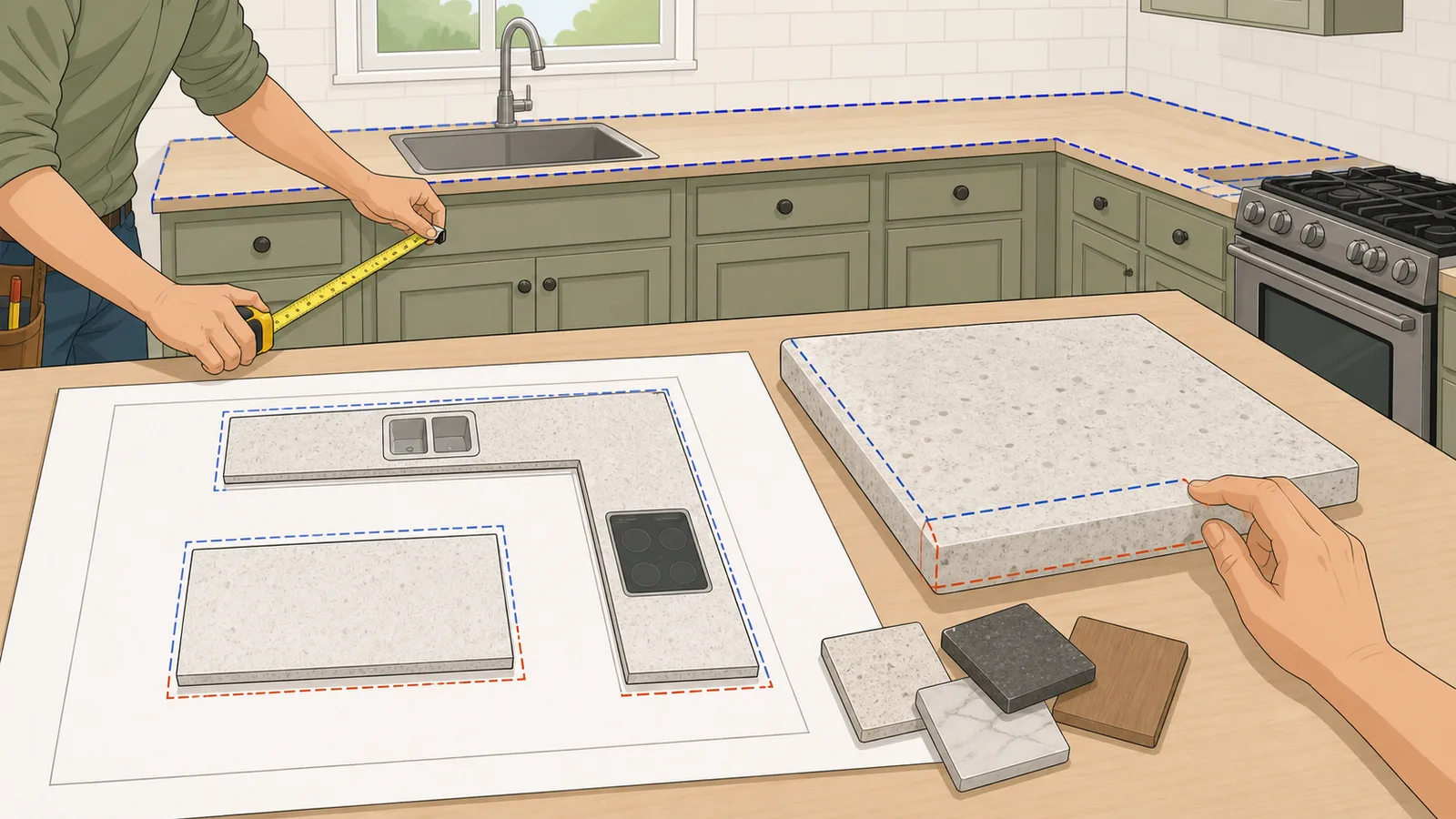
Measure each straight cabinet run as a rectangle, then add separate islands, bars, peninsulas, waterfall returns, or backsplash strips as extra area if they are being fabricated from the same material. For an L-shaped countertop, measure the two legs and let the calculator subtract the overlapping inside corner once so the shared corner is not double-counted.
Keep area and edge footage separate when you prepare a quote request. Extra island or backsplash area changes the square footage and slab utilisation, while extra finished edges change fabrication labour. That split is why this calculator has optional fields for both extra surface area and extra exposed edge length.
Core countertop planning formulas
The calculation begins with the finished run depth, which is the cabinet depth plus the front overhang. Straight runs use a simple rectangle. L-shaped tops add the two legs together and subtract the overlapping corner square once so the shared inside corner is not counted twice.
Finished depth = Cabinet depth + Front overhang
The finished countertop footprint is deeper than the cabinet box when the front edge projects beyond the doors or drawers.
Net countertop area = Gross countertop area - Cutout area
Large sink or hob cutouts are deducted from the plan area before waste is added.
Gross countertop area = Main run area + Extra island, bar, or backsplash area
Separate sections can be added to the same order estimate without forcing them into the main straight-run or L-shape geometry.
Order area = Net countertop area x (1 + Total waste%)
Total waste combines the selected material baseline with any extra overage for seams, vein matching, or complex fabrication.
Optional total cost = (Order area x Area rate) + (Exposed edge length x Edge rate x Edge profile factor)
Area and edge rates are entered by the user so the pricing stays aligned with the local fabricator or supplier rather than an assumed market.
Worked example: 10 ft straight run with sink cutout
Suppose a straight kitchen run is 10 feet long, the cabinet depth is 25 inches, the front overhang is 1 inch, and the sink cutout removes 4 square feet. The finished gross area is about 21.67 square feet and the net countertop area after the cutout is about 17.67 square feet.
If the material family is quartz with its 10% baseline waste and you add another 2% for fabrication tolerance, the order area becomes about 19.79 square feet. On the same run, the exposed edge footage is about 14.33 feet. If your local fabricator quotes 85 per square foot and 18 per linear foot of ogee edge, the planning total is about 1,970.83 in your selected display currency.
Countertop cost, cutouts, and quote comparison
Many online countertop cost calculators focus on an installed price range by material, but real quotes often split the job into surface area, edge profile, sink or cooktop cutout labour, backsplash work, template fees, delivery, removal, and sometimes minimum job charges. This calculator deliberately separates order area, exposed edge, slab count, and optional rates so you can compare supplier quotes line by line.
If a fabricator does not deduct sink or cooktop cutout area from the square footage, keep the cutout field at zero and use the result as a gross-area quote baseline. If the quote deducts large cutouts but charges a separate fabrication fee, enter the cutout area here and track the separate cutout fee outside the calculator when comparing bids.
What this planning tool does not cover
This calculator does not place seams, evaluate slab vein direction, decide on sink reveal detail, price cutout labour, size support brackets, or estimate template, removal, delivery, or minimum-job fees. It also does not replace a fabricator's own nesting or cut-plan software.
Use it as an early budgeting and measurement baseline, then confirm final seam strategy, slab utilisation, cutout dimensions, and edge details with the supplier or fabricator before you order.
Frequently asked questions
Should I deduct sink and hob cutouts from countertop area?
Large cutouts can be deducted from the net area because they remove real surface material, but fabricators may still charge for cutout labour and handling. This calculator deducts the area while keeping exposed edge and waste separate.
Why does the material family change the waste allowance?
Different countertop materials tend to have different fabrication and offcut behaviour. Laminate often needs less overage than stone slab work, while natural stone or vein-matched quartz can need more waste to keep seams and pattern direction acceptable.
Why is edge profile treated separately from area?
Many countertop quotes split the project into surface area plus edge fabrication. A more decorative profile often takes more labour than a simple eased edge even when the countertop area stays the same.
Can I use this calculator for an L-shaped countertop?
Yes. The L-shape mode adds the two legs together and subtracts the shared corner overlap once so the inside corner is not counted twice.
How do I include a kitchen island or peninsula?
Measure the island, bar, peninsula, or separate section as its own rectangle and enter that square footage in the extra area field. If that section has finished edges that are not part of the main run, add those linear feet in the extra exposed edge field.
Does the calculator include backsplash area?
It can include backsplash strips if you measure them separately and enter the extra area. For example, a 10 ft run with a 4 inch backsplash adds about 3.33 square feet before waste.
Is this a countertop cost calculator or a square footage calculator?
It does both when you have local rates. Without prices, it works as a countertop square footage, order area, slab count, and edge footage calculator. With area and edge rates entered, it becomes a quote-comparison cost estimator.
How much waste should I add for quartz or granite countertops?
The calculator starts quartz at 10% waste and granite at 12% waste, then lets you add extra overage for seams, vein matching, unusual shapes, or difficult slab utilisation. Your fabricator's final cut plan can still change the exact percentage.