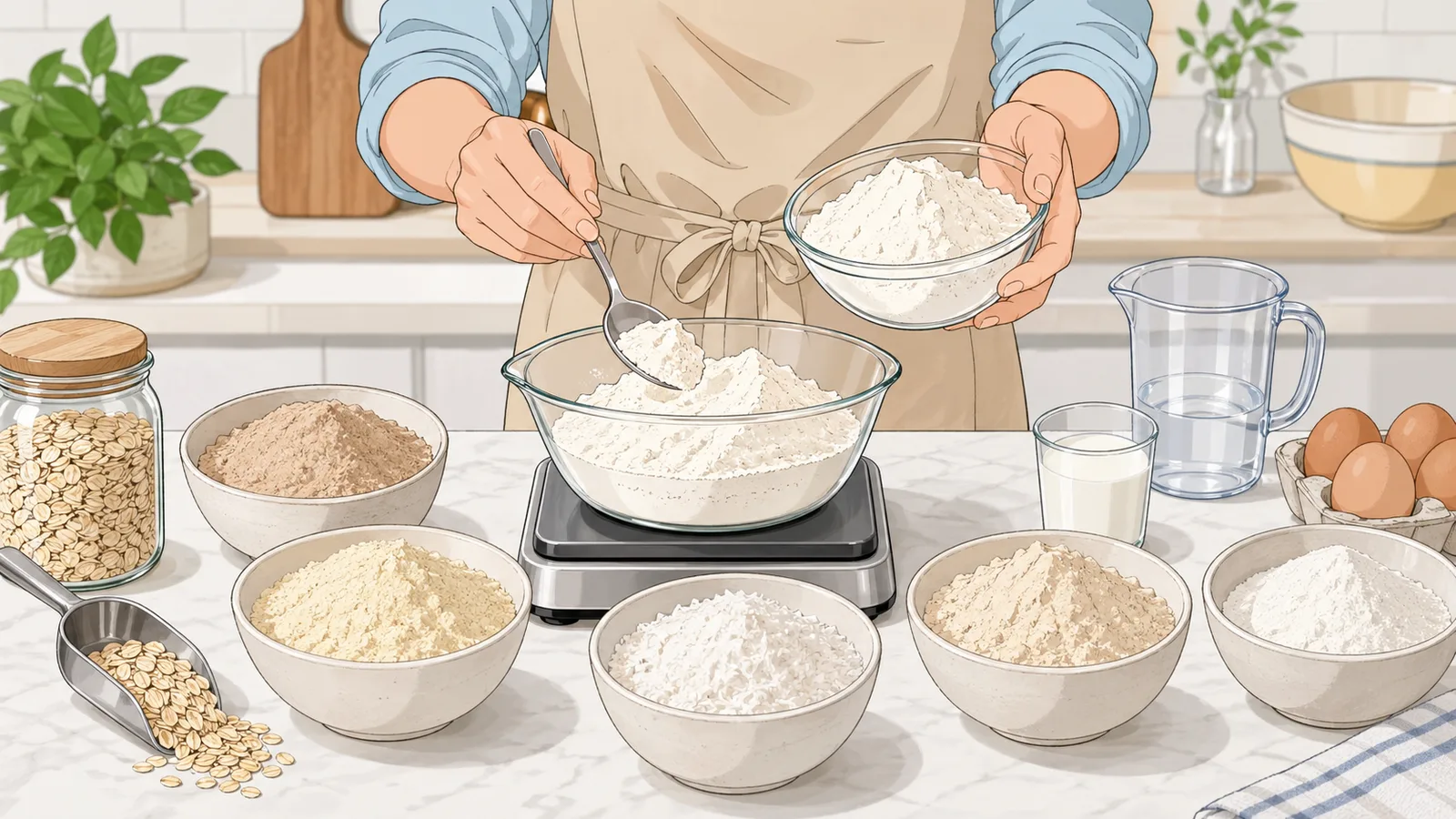
Compare flour swaps across wheat, almond, coconut, oat, and rice flour with direct-replacement, partial-swap, recipe-family fit, hydration, binder.
Last updated
Quick swaps
Compare straight wheat-flour substitutions with planning estimates for almond, coconut, oat, and rice flour. The goal is to show whether the target is a direct swap, a partial swap, or only a recipe-development starting point.
Conversion inputs
Use grams when you can. Cup values are practical for home baking, but grams make substitution rules easier to compare across different flours and different recipe styles.
Recommended target amount
93.75 g (0.73 cups) of Whole Wheat Flour
Based on 125 g of All-Purpose Flour, which represents 125 g of all-purpose-flour baseline for yeast bread & pizza.
AP baseline
1 cups
Target tablespoons
11.72 tbsp
Swap type
Partial swap starting point
Best use
Recipes where you want a nuttier flavour and more fibre without losing structure entirely.
Adjustment plan for yeast bread & pizza
The amount is only the first decision. Use this recipe-family guidance to judge hydration, binding, browning, and structure before treating a flour substitute as a direct replacement.
Recipe fit
Good partial fit, especially with extra hydration and resting time.
Liquid check
Add liquid gradually or give the batter a rest so bran has time to hydrate.
Structure check
Bran can interrupt gluten, so partial substitution is often safer than a full switch.
Bake check
A short rest before baking can soften the bran and reduce dry texture.
Substitution sheet
Flour swaps are not all equal. Wheat-flour swaps are usually easier than gluten-free swaps, and lower-structure flours often work better as partial substitutions than as total replacements.
Source amount
125 g
Source weight
125 g
Target equivalent
93.75 g (0.73 cups)
Target cups
0.73 cups
Process note
Many bakers start around three quarters of the all-purpose weight and add extra liquid because bran absorbs more water.
Compare other flour options
The same 125 g of All-Purpose Flour can map to very different
targets. This comparison sheet makes it easier to judge whether another flour is a
direct replacement, a partial swap, or only a recipe-planning estimate before you
commit to one path.
Target flour
Grams
Cups
Swap type
Recipe fit
Best use
Bread Flour
125 g
0.96 cups
Direct
Strong fit for yeasted doughs, pizza, bagels, and other chewy bakes.
Yeasted breads, pizza, and doughs where extra strength and chew are welcome.
Cake Flour
113.75 g
1 cups
Direct
Poor fit for chewy yeast doughs because it has less structure-building protein.
Tender cakes and softer bakes where lower protein is desirable.
Pastry Flour
120 g
1 cups
Direct
Usually too weak for chewy yeast breads and pizza dough.
Tender pie doughs, biscuits, muffins, and softer pastries.
Whole Wheat Flour
93.75 g
0.73 cups
Partial
Good partial fit, especially with extra hydration and resting time.
Recipes where you want a nuttier flavour and more fibre without losing structure entirely.
Self-Rising Flour
125 g
1 cups
Direct
Poor fit for yeasted doughs because the leavening system is wrong.
Quick breads, biscuits, and recipes that were meant to include built-in leavening.
Almond Flour
31.25 g
0.33 cups
Planning
Poor direct fit because it has no gluten network for rise or chew.
Partial gluten-free swaps, tender cakes, or recipes built around nut flour.
Coconut Flour
31.25 g
0.39 cups
Planning
Poor direct fit because it is gluten-free and absorbs far more liquid than wheat flour.
Recipes specifically designed for coconut flour or very small partial substitutions.
Oat Flour
125 g
1.36 cups
Partial
Weak direct fit because oat flour does not build the same gluten structure.
Soft muffins, pancakes, and cookies where a tender crumb is acceptable.
Rice Flour
106.25 g
0.67 cups
Planning
Poor direct fit unless used in a tested gluten-free bread blend.
Gluten-free blends or recipes already designed around rice flour.
Highlighted row = current target flour. Use the table for side-by-side recipe planning,
then read the process note and adjustment notes above before assuming a one-line swap
will behave identically in the oven.
Adjustment notes
Add extra liquid or allow more hydration time because whole wheat absorbs more moisture.
Partial substitution is often easier than a full switch in cakes, muffins, and softer cookies.
Flour substitution converter for wheat, almond, coconut, oat, and rice flour swaps
A flour substitution converter is most useful when it tells you whether the target flour is a direct swap, a partial substitution, or only a recipe-development estimate.
What a flour substitution converter should answer
People usually search for a flour substitution converter when they are trying to answer a recipe question, not a pure math question. They want to know how much cake flour to use instead of all-purpose flour, whether whole wheat flour needs extra liquid, or whether almond and coconut flour can really replace wheat flour one-for-one.
That is why this converter keeps an all-purpose-flour baseline in view. It shows the target flour amount, but it also labels the swap as a direct replacement, a partial-swap starting point, or a planning estimate. That distinction matters more than false numerical precision, especially when the target flour changes gluten structure, hydration, or fat content.
It also helps to compare several target flours from the same source amount instead of evaluating just one swap in isolation. If whole wheat, oat, and rice flour all look plausible for the same recipe, the better question is often which one fits the bake best, not simply which one produces the neatest number.
Direct wheat-flour swaps are different from gluten-free planning swaps
Bread flour, cake flour, pastry flour, and self-rising flour are all still wheat-based flours, so they tend to behave more predictably than almond, coconut, oat, or rice flour. The exact texture changes may still matter, but the recipe usually stays recognisably in the same family because gluten and starch behaviour are still doing most of the work.
Almond, coconut, and rice flour are different. Almond flour adds fat and no gluten, coconut flour absorbs a huge amount of liquid, and rice flour often works best as part of a larger gluten-free blend rather than as a solo stand-in for all-purpose flour. For those flours, the output here is a planning estimate, not a promise that the original recipe can survive unchanged.
all-purpose baseline grams = source grams ÷ source ratio
Normalises the source flour back to an all-purpose baseline so every other substitution can be compared on the same footing.
target grams = all-purpose baseline grams × target ratio
Uses the target flour’s planning ratio to estimate a realistic starting point rather than assuming every flour is a one-to-one replacement.
Worked examples: whole wheat and almond flour
Suppose a recipe starts with 125 grams of all-purpose flour and you want to use whole wheat flour instead. A practical starting point is lower than a straight gram-for-gram swap, because many bakers use a partial weight reduction and then increase liquid or resting time to help the bran hydrate. The calculation gives you a starting number, but the texture still depends on the style of recipe.
Now compare that with almond flour. The target weight falls much more sharply, because almond flour is usually a partial or recipe-specific substitution rather than a direct replacement. In cookies, cakes, or pancakes you may replace part of the wheat flour successfully, but in yeast bread or structured doughs you often need more than a simple flour swap to hold the recipe together.
Bread flour is usually one of the easiest full replacements for all-purpose flour in yeasted doughs.
Cake and pastry flour soften texture, so they are easier replacements in tender bakes than in chewy breads.
Whole wheat flour often needs extra liquid or longer hydration because bran absorbs moisture.
Almond, coconut, and rice flour are better treated as planning estimates unless the recipe was designed for them.
Use the recipe family before trusting the number
A weight-based flour swap is more useful than a cup-for-cup guess, but it still does not answer the whole baking question. The same almond flour substitution can be plausible in a soft cookie, risky in a delicate cake, and a poor direct fit in a yeast bread because each recipe family depends on flour for different jobs.
Cookies and quick breads can often tolerate more texture change than layered cakes or chewy bread doughs. Pancakes and coatings are more flexible again, especially when the goal is tenderness or crispness rather than tall structure. That is why the calculator now pairs the target amount with a recipe-family fit note, a liquid check, a structure check, and a bake check instead of leaving you with a bare conversion number.
Use those notes as the decision layer after the conversion. If the result says a flour needs a binder, a longer hydration rest, a lower-risk partial swap, or a tested gluten-free blend, that warning is part of the answer rather than an optional footnote.
Yeast bread and pizza dough are the least forgiving because they depend heavily on gluten structure.
Cakes and muffins need a balance of tenderness, moisture, and rise, so protein level and liquid changes matter quickly.
Cookies and quick breads can often handle partial whole wheat, oat, or almond flour swaps more gracefully.
Pancakes and coatings can be good places to test rice flour or oat flour because the structure demand is lower.
What this converter does not decide for you
This tool does not guarantee that a recipe will work unchanged after a flour swap. It cannot know the amount of sugar, eggs, fat, leavening, kneading, resting time, or pan geometry in the original formula, all of which influence whether a substitution succeeds.
It also does not replace a tested gluten-free flour blend or a recipe written specifically for coconut or almond flour. If the recipe depends heavily on gluten for structure, the best result often comes from using a purpose-built recipe rather than forcing a one-line substitution.
Sometimes, but not safely across every flour type. Wheat flours such as all-purpose, bread, cake, and pastry flour are much closer to one another than almond, coconut, or rice flour. Once the target flour changes gluten behaviour or absorption dramatically, cup-for-cup swaps become much less reliable than weight-based planning numbers and recipe-specific notes.
Why does whole wheat flour often need more liquid?
Whole wheat flour contains bran and germ, which absorb water differently from refined all-purpose flour. That can make dough or batter feel drier even when the total flour weight looks reasonable. Bakers often compensate by adding extra liquid, giving the flour more resting time to hydrate, or using a partial substitution instead of a full one.
Can almond flour replace all-purpose flour in bread?
Usually not as a direct full replacement. Almond flour works best as a partial substitution or in recipes specifically designed for nut flour. Because it has no gluten and more fat than wheat flour, it changes structure, spread, and tenderness. In yeast bread especially, almond flour is better treated as a planning estimate than a guaranteed bread-flour stand-in.
Why is coconut flour marked as a planning estimate instead of a direct swap?
Coconut flour is extremely absorbent and behaves very differently from wheat flour. It usually needs far more liquid and often extra eggs or binders, which means the rest of the recipe has to change with it. A simple one-line conversion number is still useful for planning, but it cannot act like a trustworthy cup-for-cup or gram-for-gram replacement rule.
What flour is closest to all-purpose flour?
Bread flour, cake flour, pastry flour, and self-rising flour are all closer to all-purpose flour than gluten-free options because they are still wheat-based. Bread flour is usually the most forgiving full replacement in yeasted doughs, while cake and pastry flour work better in tender cakes and pastries.
Can I use oat flour instead of all-purpose flour in baking?
Often as a partial substitution, yes. Oat flour is useful in pancakes, muffins, cookies, and softer quick breads, but it does not give the same structure as wheat flour in breads or recipes that depend heavily on gluten. Many bakers get a better result by replacing part of the all-purpose flour rather than all of it.
Is rice flour a direct substitute for wheat flour?
Usually no. Rice flour can be helpful in coatings, pancakes, and gluten-free blends, but on its own it is usually a planning estimate rather than a direct all-purpose replacement. Texture often improves when rice flour is part of a broader gluten-free mix with starches or gums instead of being used alone.
When should I use a gluten-free blend instead of a single flour?
Use a tested gluten-free blend when the recipe depends on structure and you want a more reliable replacement than trying to force one flour to behave like another. Almond, coconut, oat, and rice flour can all be useful ingredients, but they often work best as part of a purpose-built blend rather than as a stand-alone direct swap.
Why does the recipe family change the flour substitution advice?
Different recipe families ask flour to do different jobs. Yeast bread and pizza dough need gluten strength, cakes and muffins need controlled tenderness and rise, cookies can tolerate more spread and density changes, and pancakes or coatings are often more flexible. A flour substitution calculator is more useful when it combines the amount with recipe-fit guidance instead of assuming the same swap works equally well everywhere.
Do almond flour and coconut flour need binders?
Often, yes. Almond flour has no gluten and brings extra fat, while coconut flour is highly absorbent and usually needs more liquid plus eggs or another binder. If the original recipe depends on wheat flour for structure, a binder or a tested recipe designed for the target flour is usually safer than a simple one-line swap.