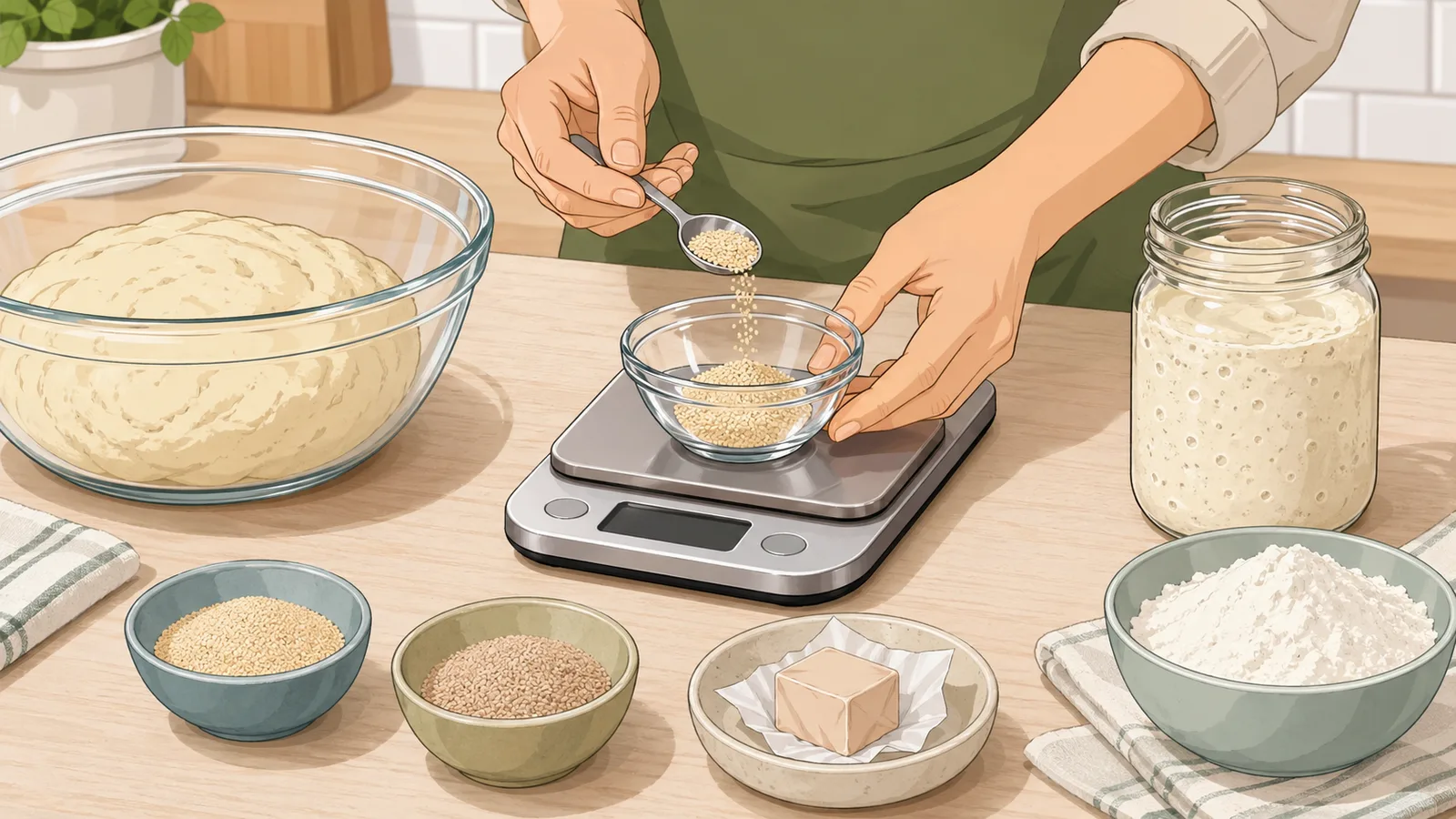
Yeast converter for active dry, instant, fresh, and sourdough starter swaps with grams, teaspoons, packets, flour-context yeast load, and planning notes.
Last updated
Yeast converter for active dry, instant, fresh, and sourdough starter swaps Use grams for the clearest result when you can. Dry-yeast swaps are usually direct, but sourdough starter is only a planning estimate because hydration, acidity, and fermentation timing change with the replacement.
Quick swaps
Compare direct dry-yeast substitutions or switch to the sourdough planning mode when you need a starter estimate rather than a one-line packaged-yeast swap.
Conversion inputs
Use grams for the most reliable comparisons. Teaspoon conversions are practical for dry yeast, while sourdough starter planning is shown in grams and cups because starter also changes flour, water, and fermentation timing.
Equivalent amount
5.25 g (1.69 tsp) of Instant / Rapid-Rise Yeast
Based on 7 g, which equals 7 g of active dry yeast.
Active dry baseline
2.26 tsp
Packet equivalent
1 packets
Conversion type
Direct yeast swap
Best use
Straight doughs where you want to mix yeast directly into dry ingredients.
Yeast load
1.4% of flour
Typical same-day bread range
Conversion sheet
Dry-yeast conversions are mostly weight swaps. Starter conversions are different because the starter brings flour, water, acidity, and much longer fermentation with it.
Source amount
7 g
Target equivalent
5.25 g (1.69 tsp)
Target weight
5.25 g
Target teaspoons
1.69 tsp
Target cups
Not used for this type
Flour context
Active-dry baseline is 1.4% of 500 g flour
Timing signal
This is a common quick-bread or same-day dough range. Watch dough volume and temperature rather than treating the clock as exact.
Process note
Usually mixed straight into flour; many bakers use about 25% less instant than active dry by weight.
Baking notes
Instant yeast is commonly used at about 25% less weight than active dry yeast and usually does not need proofing.
Yeast converter for active dry, instant, fresh, and sourdough starter swaps
A yeast converter is most useful when it explains not just the number, but the process difference behind the swap. This page compares active dry, instant, fresh yeast, and sourdough starter planning amounts so you can judge the weight, timing, flour context, and fermentation tradeoffs before changing a bread recipe.
What a yeast converter should answer before you bake
Most bakers search for a yeast converter when they need to replace one type of leavening with another without derailing the dough. The practical question is usually not just how many grams to use, but whether the replacement behaves at the same speed, needs proofing, or changes the rest of the formula.
That is why this converter keeps a direct active-dry baseline in view. It lets you compare dry-yeast swaps by weight, teaspoon, and packet equivalents, while treating sourdough starter as a planning estimate instead of pretending it is a direct like-for-like packaged yeast substitution.
Active dry, instant, and fresh yeast are related, but not identical
Active dry and instant yeast are often close enough to substitute in ordinary bread recipes, but they do not behave exactly the same way. Instant yeast gets moving faster and is commonly mixed straight into flour, while active dry is traditionally proofed or at least expected to rise a little more slowly at the start.
Fresh yeast is a different form again. Bakers often use roughly two and a half times as much fresh yeast by weight as active dry yeast, and they usually crumble it into liquid or dough rather than measuring it like a shelf-stable dry ingredient. The result can still be excellent, but storage life, handling, and rise timing are different.
active dry equivalent grams = source grams ÷ source ratio
Converts any source yeast amount into an active-dry baseline so every other comparison stays on the same footing.
target grams = active dry equivalent grams × target ratio
Uses the target yeast type’s ratio to estimate the direct replacement weight.
Worked examples: instant yeast and fresh yeast swaps
If a formula calls for 7 grams of active dry yeast and you want to use instant yeast instead, a common planning number is about 5.25 grams of instant yeast. The dough may also rise a bit faster, so the weight is only part of the adjustment. You still need to watch the dough rather than the clock.
Now reverse that logic for fresh yeast. A recipe written with 5 grams of instant yeast may need a much larger fresh-yeast weight to produce a similar amount of leavening. The total is still easy to calculate, but the handling changes because fresh yeast is soft, perishable, and commonly dissolved or crumbled into liquid.
Instant yeast is often used at about 25% less weight than active dry yeast.
Fresh yeast commonly needs a much larger weight than dry yeast to deliver similar leavening.
Packet counts are helpful for planning, but grams are more reliable than packet labels or teaspoons.
Rise speed can still change even when the weight conversion is mathematically correct.
Use flour weight to judge whether the yeast amount fits the dough schedule
A yeast conversion calculator becomes more useful when it can place the converted amount against the flour in the recipe. Seven grams of active dry yeast looks ordinary in a quick same-day loaf with about 500 grams of flour, but the same amount would be a very different signal in a small dough or in a formula meant for an overnight cold ferment.
The flour-context field expresses the active-dry baseline as a baker's percentage of flour. That does not replace the recipe's proofing instructions, but it gives you a fast reasonableness check: low yeast loads usually need more time, typical same-day loads move quickly at warm room temperature, and high yeast loads deserve extra caution in long fermentation or warm kitchens.
This is also where yeast substitution differs from plain unit conversion. A gram-to-teaspoon conversion can tell you how much to measure, but flour context helps explain whether the chosen amount is likely to behave like a slow dough, a same-day bread, or a fast enriched-dough formula.
active dry baker's percentage = active dry equivalent grams ÷ flour grams × 100
Compares the converted yeast amount with the flour in the recipe so the result has fermentation context.
Low percentages point toward slower or colder fermentation plans.
Moderate percentages can fit extended room-temperature doughs or pizza-style schedules.
Same-day bread ranges are useful for quick loaves, rolls, and many everyday doughs.
High percentages may be intentional for enriched or fast doughs, but they can overproof if the schedule is long.
Why sourdough starter conversions are only planning estimates
Sourdough starter is not just another dry yeast format. It brings flour, water, acids, and a living fermentation culture into the dough, so replacing commercial yeast with starter changes hydration, fermentation time, flavour, and often structure. That means a starter number is useful for planning, but it is not a guarantee that the recipe can be swapped without wider adjustments.
Use the starter mode as a rough starting point for recipe adaptation, not as a one-line substitute for any bread formula. If you convert to starter, expect to subtract some flour and water elsewhere in the recipe and to allow much longer proofing or bulk-fermentation time than a commercial yeast version would need.
Fleischmann’s — Yeast 101 — Manufacturer guide describing common substitution rules, including using 25% more active dry yeast than instant yeast in RapidRise-style recipes.
Red Star Yeast — Fresh cake yeast — Product reference for fresh cake yeast handling, storage, and the bakery-style format used for larger yeast swaps.
How the calculator keeps yeast math consistent
The converter keeps every swap anchored to an active dry baseline so direct dry-yeast substitutions and starter planning estimates can be compared on the same footing. That is why the result card shows grams, teaspoons, and packet equivalents together instead of hiding the intermediate math.
The tool treats 7 grams as the standard yeast packet and uses a gram-per-teaspoon assumption for the dry-yeast types that can reasonably be spooned out. For starter, it uses a 100% hydration planning estimate in cups and grams because starter is part yeast, part flour, part water, and part fermentation process.
active dry equivalent grams = source grams ÷ source ratio
Normalises the selected yeast back to active dry so the target swap can be calculated consistently.
packet equivalent = active dry equivalent grams ÷ 7
Shows how many standard yeast packets the source amount represents.
starter cups = starter grams ÷ 227
Uses a planning estimate for 100% hydration starter instead of pretending it behaves like a dry yeast packet.
When to use grams, teaspoons, or cups
Use grams whenever the recipe or your scale allows it. Gram weights are the easiest way to compare active dry, instant, and fresh yeast without rounding away the small differences that matter in bread recipes.
Teaspoons are practical for active dry and instant yeast when you are matching an older recipe, but cups are mainly useful for sourdough starter planning. Once starter enters the formula, the question is no longer a one-line yeast swap; it becomes a dough balance and fermentation planning problem.
Frequently asked questions
Is instant yeast the same as active dry yeast?
Not exactly. They are often interchangeable in ordinary bread recipes, but instant yeast typically acts faster and is commonly mixed straight into dry ingredients. Active dry yeast is slower off the mark and is often proofed first or given a little more rise time. The weight may be close, but the process can still change.
How much fresh yeast should I use instead of dry yeast?
A common baking rule is that fresh yeast needs a larger weight than active dry or instant yeast to do similar work. This converter uses a fresh-yeast weight that is much higher than the dry-yeast baseline, which matches the way many bakery references handle fresh cake yeast. Measure by grams when possible, because fresh yeast is too variable to judge accurately by rough spoon measures.
Do I need to proof active dry yeast before using it?
Sometimes, but not always. Many bakers still proof active dry yeast in warm liquid to confirm that it is alive and to get it started, especially in older recipes. Other modern recipes mix it directly into dry ingredients. The key point is that active dry and instant yeast are not identical in handling, so the recipe method still matters even when the conversion weight is clear.
Can sourdough starter replace commercial yeast one-for-one?
No. Starter can replace commercial yeast in the broader recipe sense, but not as a direct one-line substitution. It changes hydration, flour balance, acidity, flavour, and fermentation time. Use the starter output here as a planning estimate, then adjust the rest of the formula and expect a slower, longer fermentation process.
How many grams are in a standard yeast packet?
A standard yeast packet is 7 grams. This converter uses that packet size to show how much of the source amount corresponds to one packet or multiple packets, which makes it easier to compare packaged yeast with spoon or gram measurements.
How much yeast should I use for 500 grams of flour?
For many same-day bread recipes, a 7 gram packet of active dry yeast against about 500 grams of flour is a familiar starting point, but the right amount depends on dough style, temperature, sugar and fat level, and fermentation time. The flour-context output on this page turns your converted amount into a baker's percentage so you can see whether it looks like a slow, moderate, same-day, or high-yeast dough.
Should I change the rise time after converting yeast?
Often, yes. Instant yeast may start faster than active dry yeast, active dry yeast may need proofing or a longer first rise, and fresh yeast depends heavily on condition and storage. Treat the converted amount as the measurement answer, then use dough volume, temperature, and the recipe's proofing cues as the final timing check.
Can I use fresh yeast instead of instant yeast?
Usually yes, but not as a like-for-like handling swap. Fresh yeast is typically used at a much higher weight than active dry yeast and behaves more like a bakery ingredient that needs refrigeration and careful timing. Treat the output as a planning number, then watch the dough and fermentation rather than assuming the rise time will be identical.
Why does sourdough starter use cups in this converter?
Starter is shown in cups as a planning estimate because a ripe 100% hydration starter contains both flour and water, not just yeast. That makes the measurement useful for recipe adaptation, but it also means the rest of the formula usually needs adjustment. The cup figure gives you a practical starting point rather than a direct commercial-yeast replacement.
Can I use this as an active dry to instant yeast converter for bread machines?
Yes for the measurement step, as long as the bread machine recipe allows the yeast type you choose. Instant and bread-machine yeasts are often added with the dry ingredients, while active dry yeast may need different handling depending on the machine and recipe. Keep the converted amount in view, but follow the machine manufacturer's order-of-ingredients guidance when it conflicts with a generic yeast substitution rule.