Skip to content
Calcipedia
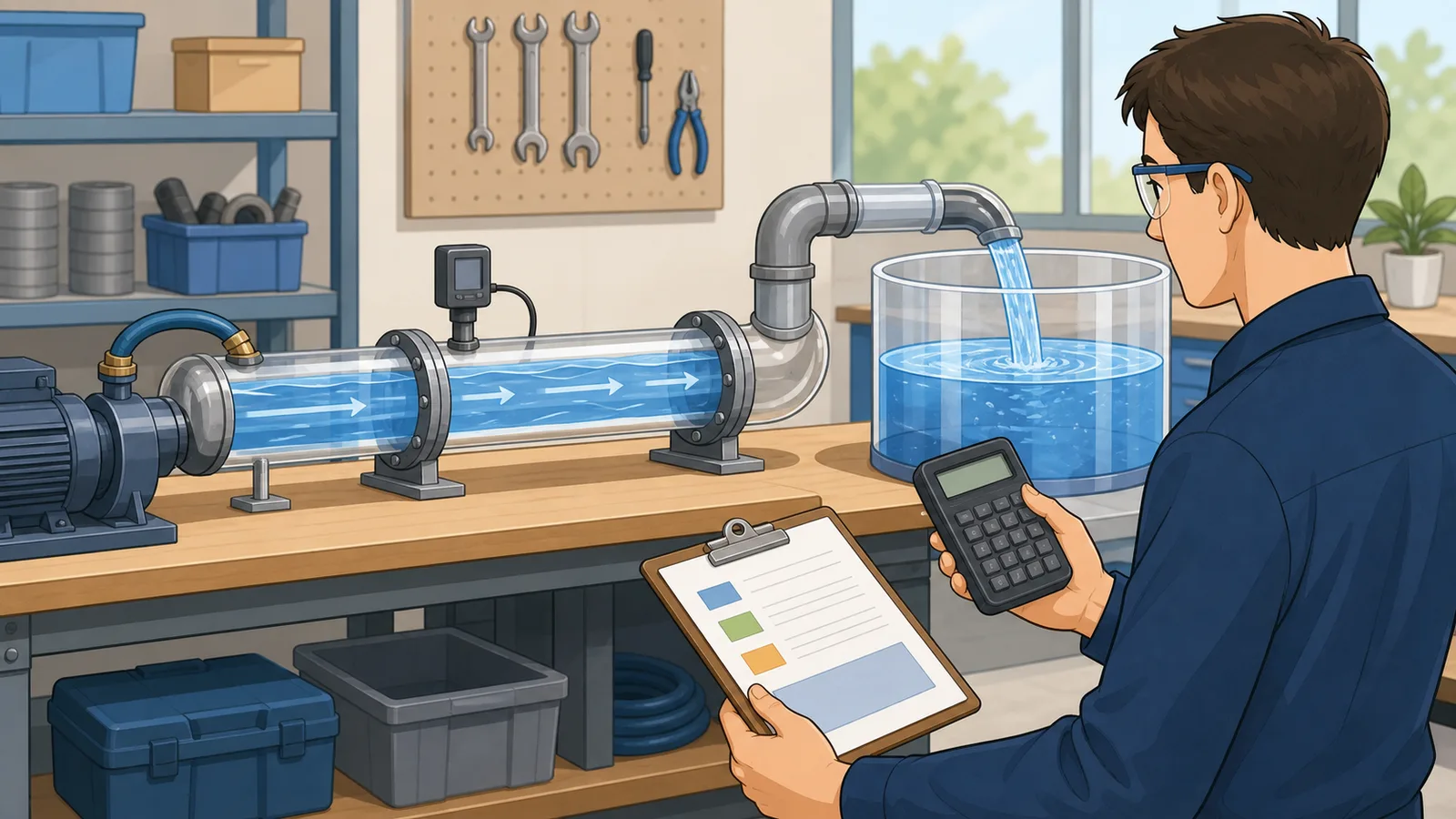
Flow Rate Calculator instructional illustration

Flow Rate Calculator

Solve flow calculator or flow velocity calculator tasks for flow rate, velocity, or area with continuity-equation context, then view litre, gallon, hourly.

Last updated

Flow rate calculator for flow rate, velocity, or area Use this flow rate calculator to solve the continuity equation for volumetric flow rate, fluid velocity, or pipe area, then see litre, hourly, mass-flow, and transferred-volume conversions in one place. It also helps answer common searches like flow velocity calculator, rate of flow calculator, and pipe flow rate calculator.

Use this flow calculator to solve for volumetric flow rate, fluid velocity, or pipe area from the same continuity-equation workflow many users mean by a flow velocity calculator, rate of flow calculator, or pipe flow rate calculator.

Solve for

Density presets

Flow result

0.08 m³/s

Volumetric flow rate derived from continuity-equation inputs and the selected fluid density, with litre, gallon, and fill-time planning rows.

0.08 m³/s

Volumetric flow

4,500 L/min

Litres per minute

1,188.77 US gal/min

US gallons per minute

989.86 UK gal/min

Imperial gallons per minute

75 kg/s

Mass flow

195.44 mm

Equivalent circular diameter

Flow sheet

Volumetric flow rate0.08 m³/s
Litres per second75 L/s
Litres per minute4,500 L/min
US gallons per minute1,188.77 US gal/min
Imperial gallons per minute989.86 UK gal/min
Cubic metres per hour270 m³/h
Mass flow rate75 kg/s
Mass flow per minute4,500 kg/min
Velocity2.5 m/s
Area0.03 m² / 300 cm²
Equivalent circular diameter0.2 m / 195.44 mm

Transferred volume over time

These rows help when you already know the flow and want to estimate how much fluid moves in a fixed time window.

DurationVolumeLitresMass
10 seconds0.75 m³750 L750 kg
1 minute4.5 m³4,500 L4,500 kg
1 hour270 m³270,000 L270,000 kg

Time to fill common volumes

Use the inverse of the same flow rate to estimate how long a tank, vessel, or batch would take to fill at this pace.

VolumeLitresUS gallonsImperial gallonsFill time
50 litres50 L13.21 US gal11 UK gal0.67 s
100 litres100 L26.42 US gal22 UK gal1.33 s
1 cubic metre1,000 L264.17 US gal219.97 UK gal13.33 s
10 cubic metres10,000 L2,641.72 US gal2,199.69 UK gal2 min 13 s
← All Engineering calculators

Engineering

Volumetric and mass flow rate from pipe area and velocity

A flow rate calculator determines how much fluid passes through a pipe or channel per unit time. This page also explains the main assumptions behind the volumetric and mass flow rate from pipe area and velocity result, highlights the supporting figures shown by the calculator, and helps the reader use the estimate without overstating what a quick online tool can prove.

The continuity equation

Volumetric flow rate Q equals the cross-sectional area A of the pipe multiplied by the average fluid velocity v. Mass flow rate adds fluid density to the equation: ṁ = ρAv. These relationships assume steady, incompressible flow with uniform velocity across the cross-section.

In practice, velocity varies across the pipe profile (faster in the centre, slower near the walls), so the "velocity" used here is the mean velocity. For engineering calculations, this simplification is standard.

Q = A × v

Q in m³/s, A in m², v in m/s. This is the specific relationship the calculator applies when building the result.

ṁ = ρ × A × v

Mass flow rate in kg/s, where ρ is fluid density in kg/m³.

What this calculator does not cover

This calculator assumes incompressible, steady-state flow. It does not account for compressibility effects (relevant for gases at high speeds), transient flow, or friction losses along the pipe.

How litres, gallons, and GPM fit together

Pump sheets and plant notes often use more than one unit family for the same flow. A North American spec may call out gallons per minute, a process sheet may use litres per minute, and a utility or plant drawing may prefer cubic metres per hour. This page keeps those outputs side by side so you can compare the same flow without doing the conversion work twice.

US gallons per minute is the common GPM shorthand in North American equipment labels, while Imperial gallons per minute is the older UK gallon convention. The calculator shows both because a number written as GPM is only useful if you know which gallon the source meant. If you are comparing two sources, the gallon size matters as much as the numeric value.

The core conversions are straightforward: 1 cubic metre equals 1000 litres, and the calculator translates the same flow into US and Imperial gallons using standard gallon definitions. Those are unit translations only — they do not change the underlying flow rate or the continuity-equation result.

1 m³ = 1000 L

Base volume conversion used to express the same flow in litres per second, litres per minute, and cubic metres per hour.

US gallons per minute = litres per minute ÷ US gallon factor

North American GPM display used to compare pump and process labels with metric flow units.

Imperial gallons per minute = litres per minute ÷ Imperial gallon factor

UK gallon display used to compare older gallon-based labels with metric flow units.

Further reading

Estimating fill time from a known flow

Once you know the flow rate, fill time is just the inverse question: how long does it take to move a fixed volume at that pace? That is why the calculator now shows common fill-time rows. A tank, vessel, or batch volume is only useful if you can translate it into a practical time window.

This is especially helpful when you are comparing a pump label against a real task. If the flow is high, a 50-litre or 100-litre move may only take seconds. If the flow is lower, the same ratio gives you minutes or hours instead. The inverse view helps you plan hoses, transfer windows, batching, and refill schedules without having to rearrange the equation by hand.

A simple worked example: at 0.075 m³/s, 1 m³ takes about 13.3 seconds, while 10 m³ takes about 2 minutes 13 seconds. If the same flow is being read as 75 litres per second, the fill-time table shows the same answer in the units a tank label or batch sheet may actually use.

time = volume / flow rate

The inverse of the continuity result, used to estimate how long a fixed tank or batch volume will take to fill.

What the equivalent circular diameter means for pipe sizing

The equivalent circular diameter is a convenience translation of the cross-sectional area. It tells you what round pipe would have the same area as the input, which makes the result easier to compare with nominal pipe sizes and internal-diameter tables.

That number is useful, but it is still a shortcut. A real pipe-sizing decision also depends on pressure loss, roughness, fittings, elevation, allowable velocity, compressibility, and the fluid itself. If you already know pipe diameter and need velocity, a pipe-velocity or pipe-volume calculator is usually the better next step.

For many users, the practical workflow is: solve the continuity equation here, read the equivalent diameter as a comparison clue, then move to a specialised pipe-volume or water-velocity calculator if the job turns into full pipe sizing rather than a flow check.

How to interpret litres, hourly flow, and mass flow

Many users do not only want m³/s. They want a number they can compare with pump labels, process sheets, or a tank-fill schedule. That is why the calculator shows litres per second, litres per minute, cubic metres per hour, and mass flow in kilograms per second.

The same continuity-equation result can therefore be read two ways: as a volume-moving rate or as a mass-moving rate. If you already know fluid density, the mass-flow result can be the most useful planning number.

Worked example

If a pipe has a cross-sectional area of 0.03 m² and the mean fluid velocity is 2.5 m/s, the volumetric flow rate is Q = A × v = 0.075 m³/s. That is 75 litres per second, 4,500 litres per minute, or 270 m³/h.

If the fluid is water at about 1000 kg/m³, the mass flow rate is 75 kg/s. Over one minute, that same flow would transfer 4.5 m³ of water, which is 4,500 litres.

Frequently asked questions

How do I find the cross-sectional area of a round pipe?

Use A = π × r², where r is the inner radius. For a pipe with inner diameter d, the area is A = π × (d/2)² = π × d² / 4.

What is the difference between volumetric and mass flow rate?

Volumetric flow rate (m³/s or litres/min) measures the volume of fluid per unit time. Mass flow rate (kg/s) measures the mass per unit time. They are related by fluid density: ṁ = ρ × Q.

Can I use this as a quick pipe flow rate calculator?

Yes, if you already know the mean velocity and the true internal area or can derive it from diameter. The result is a quick continuity-equation screen, not a replacement for a full pressure-loss or pipe-sizing calculation.

Why does the calculator show equivalent circular diameter?

The equivalent circular diameter helps you interpret the same area as a round pipe size. That makes the answer easier to compare against common pipe diameters even when the flow path is not perfectly round.

What density should I enter?

Use the fluid density for the actual fluid and temperature when you need mass flow. Water is a good default for water service screens, air is useful for rough gas planning, and light oil can be a helpful comparison for lower-density liquids.

What does GPM mean in a flow rate calculator?

GPM means gallons per minute. It is a common pump and plumbing label, especially in North America. The tricky part is that not every source means the same gallon size, so this page shows both US gallons per minute and Imperial gallons per minute alongside litres per minute and cubic metres per hour.

How do I estimate how long it will take to fill a tank?

Use the inverse of flow rate: fill time = volume / flow rate. If you know the tank volume in litres or cubic metres and the flow rate in litres per minute, litres per second, or cubic metres per hour, you can convert the time to seconds, minutes, or hours. The calculator’s fill-time table gives you common planning volumes without needing to do that rearrangement yourself.

Can I use this calculator to size a pipe?

You can use it as a starting point, but not as a full pipe-sizing tool. The equivalent circular diameter helps you compare the area with a round pipe size, yet real pipe sizing also needs pressure loss, fitting losses, roughness, elevation, and the acceptable velocity for the fluid. If you already know pipe diameter and want velocity, a pipe-velocity calculator or water-velocity calculator is usually the better next step.

Why does the calculator show both litres per minute and gallons per minute?

Because different industries use different labels. Water treatment, plumbing, and process work often use litres per minute or cubic metres per hour, while pumps and older specs often use gallons per minute. Showing both makes the same flow easier to compare across documents without manual conversion.

What is the difference between volumetric flow rate and mass flow rate?

Volumetric flow rate measures the amount of fluid volume moving each second, minute, or hour. Mass flow rate measures how much mass is moving in the same time. If you know density, the calculator can convert between them with mass flow = volumetric flow × density.

Is the equivalent circular diameter the same as pipe diameter?

It is a comparison diameter, not a promise that the channel is actually round. The calculator converts area into the diameter of a circle with the same cross-sectional area, which is handy for comparison and rough sizing. Real pipe selection still needs pressure-loss and velocity checks.

Should I use litres per minute or cubic metres per hour?

Use the unit that matches the document or equipment you are comparing against. Litres per minute is common for smaller flows and quick pump checks, while cubic metres per hour is often easier on process sheets and larger plant references. They are the same flow expressed at different scales.

Does fluid density change the volumetric flow result?

No. Density changes the mass flow result, not the volumetric flow result. The continuity equation uses area and velocity for volumetric flow, then density is applied to translate that flow into kilograms per second or kilograms per minute.

Can I use this for air as well as water?

Yes, as a planning tool. The continuity equation works for any fluid, but the calculator assumes incompressible, steady flow. That is a good approximation for many low-speed liquid and gas checks, but high-speed gas flow or strongly compressible systems need a more specialised model.

Also in Engineering

You may also need

Related

More from nearby categories

These related calculators come from the same leaf category, nearby sibling categories, or the same top-level topic.