Estimate terminal velocity from mass, drag coefficient, cross-sectional area, and fluid density, then solve backwards for the drag area, area, C_d.
Last updated
Quick scenarios
Use the projected frontal area facing the airflow, not total surface area.
Common drag coefficients
Output unit
Result
Terminal velocity
153.99 km/h
42.78 m/s · 153.99 km/h · 95.69 mph · 140.34 ft/s
How to read this result At this speed, upward drag equals weight; a larger area or higher Cd would lower the result, while thinner air or a more streamlined posture would raise it.
Weight balanced by drag
784.53 N
Fluid density
1.225 kg/m³
Drag area (Cd × A)
0.70 m²
Ballistic coefficient
114.29 kg/m²
Same object in different fluids
Air at sea level (1.225 kg/m³)153.99 km/h
Air at 1 000 m altitude (1.112 kg/m³)161.63 km/h
Air at 3 000 m altitude (0.909 kg/m³)178.77 km/h
Water at 20 °C (1 000 kg/m³)5.39 km/h
Target terminal speed planner
Solve backwards from a target speed to see the drag area, area, drag coefficient, or mass needed with the current fluid assumption.
Required drag area
1.1528 m²
Area if C_d stays 1
1.1528 m²
C_d if area stays fixed
1.647
Mass if drag area stays fixed
48.58 kg
The target needs a larger drag area by about 64.7% versus the current inputs.
Air at sea level (1.225 kg/m³). Dynamic pressure at terminal speed is 1,120.76 Pa, and the drag force equals 784.53 N.
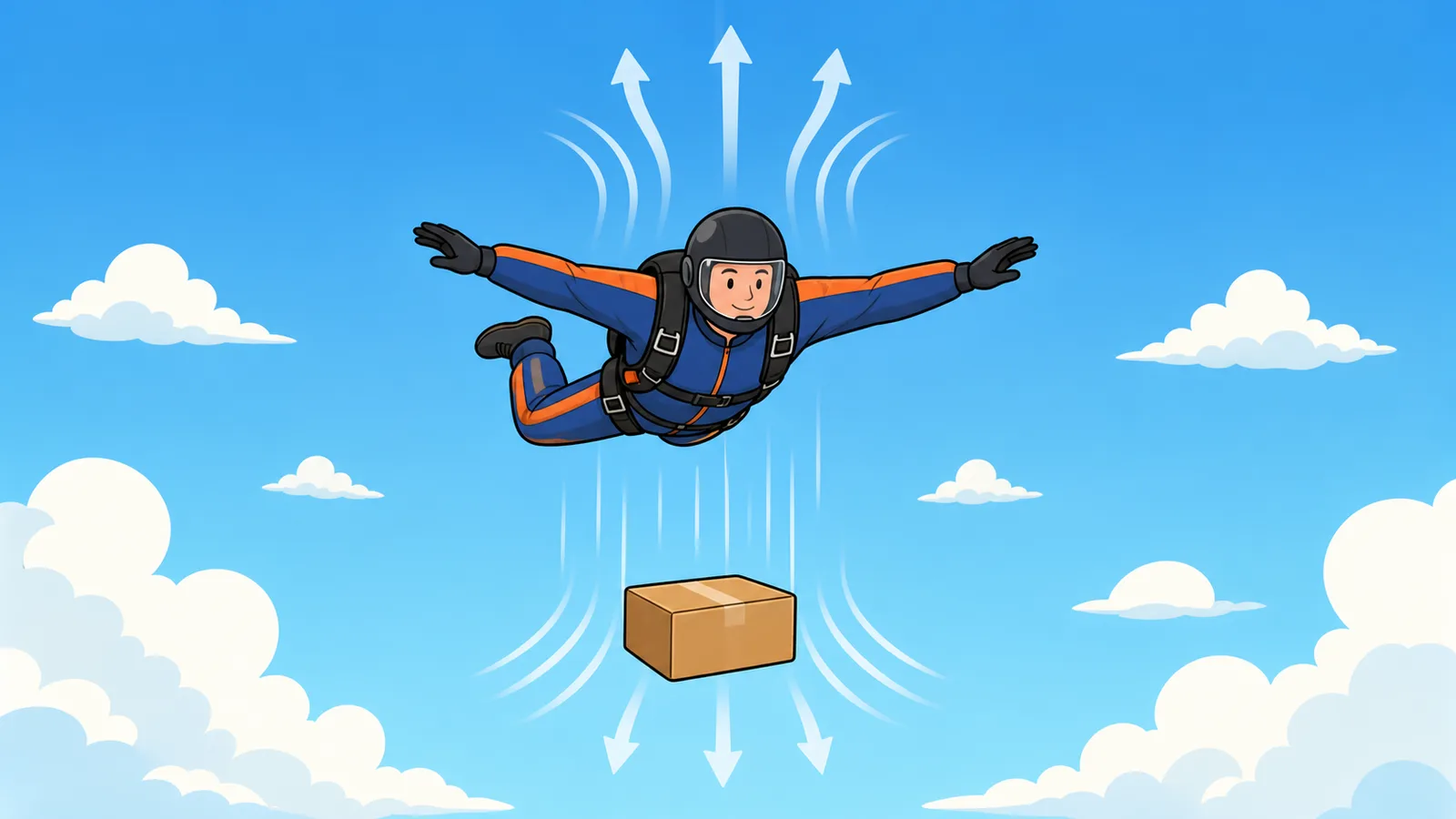
Terminal velocity is the steady speed reached when drag balances weight and a falling object stops accelerating. This terminal velocity calculator estimates the result from mass, drag coefficient, cross-sectional area, and fluid density so you can compare skydivers, spheres, baseballs, altitude effects, and denser fluids without hiding the underlying drag-equation assumptions.
Terminal velocity equation
v_t = √(2mg ÷ (ρ × A × C_d)), where m is mass, g is gravitational acceleration (9.80665 m/s²), ρ is fluid density, A is cross-sectional area, and C_d is the drag coefficient. Higher mass, lower drag coefficient, and lower fluid density all increase terminal velocity.
A human skydiver in a spread-eagle position (C_d ≈ 1.0, A ≈ 0.7 m²) reaches approximately 53–57 m/s (190–205 km/h). In a head-down dive position (C_d ≈ 0.7, A ≈ 0.1 m²), terminal velocity increases to around 140–160 m/s.
Worked example: skydiver at sea level
Using a mass of 80 kg, drag coefficient of 1.0, cross-sectional area of 0.7 m², and sea-level air density of 1.225 kg/m³ gives a terminal velocity a little above 53 m/s, or about 190 km/h. That is why a spread-eagle recreational skydiver tops out far below the speed a compact head-down diver can reach.
The same example also shows why the result is sensitive to posture and air density. If the body position becomes more streamlined or the air becomes thinner at altitude, the denominator in the drag equation shrinks and the terminal velocity rises.
Drag coefficient
The drag coefficient C_d is dimensionless and depends on object shape and the flow regime (Reynolds number). Common values: sphere 0.47, flat plate 1.28, streamlined teardrop 0.04, skydiver spread-eagle 1.0, baseball 0.35.
Increasing cross-sectional area (such as opening a parachute) is the primary method for reducing terminal velocity. A parachute increases area from ~0.7 m² to ~40 m², reducing speed from ~55 m/s to ~5–6 m/s.
What changes terminal velocity the most
Terminal velocity rises when mass increases and falls when drag area, drag coefficient, or fluid density increases. That is why a denser object does not always fall faster in practice: if the object is also much larger or has a high-drag shape, the drag term can dominate the result.
The calculator is useful for comparing those trade-offs side by side. A compact object in thin air can reach a much higher terminal speed than the same object in denser air or with a much larger cross-sectional area.
Using drag area and ballistic coefficient
The product C_d × A is often called drag area. It is a compact way to compare shapes because it combines the drag coefficient and the projected area into one term. If two objects have the same mass but one has twice the drag area, the higher-drag object reaches a lower terminal velocity.
The calculator also reports a simple ballistic coefficient, m ÷ (C_d × A), in kg/m². A higher value means more mass for each square metre of drag area, so the object tends to keep accelerating to a higher terminal speed before drag balances weight.
Solving backwards from a target terminal speed
A direct terminal velocity formula calculator answers "how fast will this object fall?" The reverse question is often more useful for design intuition: if you want a lower or higher target terminal speed, how much drag area, cross-sectional area, drag coefficient, or mass would be needed under the same fluid-density assumption?
The target-speed planner rearranges the same drag-balance equation around the selected target speed. For example, lowering an 80 kg spread-eagle skydiver estimate from about 154 km/h to 120 km/h requires more drag area, a larger projected area if C_d stays fixed, a higher C_d if area stays fixed, or a lower mass if the current drag area cannot change. Treat these reverse results as sensitivity checks, not equipment-design instructions.
Altitude, fluid density, and water estimates
Fluid density is one of the easiest assumptions to miss. Sea-level air is commonly approximated as 1.225 kg/m³, while air at 3 000 m is substantially thinner. Because density appears in the denominator of the terminal velocity formula, thinner air raises the calculated speed for the same object and posture.
Water is far denser than air, so the same object has a much lower terminal velocity in water. For very small particles, slow settling, oil droplets, or viscous fluids, the quadratic drag model may not be the right physics model; Stokes-style settling or Reynolds-number-specific drag correlations can be more appropriate.
Common input mistakes
Use projected frontal area, not total surface area. A human body in a belly-to-earth position may use a rough area near 0.7 m², while a compact head-down posture uses a much smaller area. Entering 70 instead of 0.70 m² will make the result unrealistically slow.
Treat drag coefficient as an estimate, not a fixed property. NASA and physics references emphasize that C_d depends on shape, reference area, Reynolds number, surface roughness, and inclination to the flow. If you are comparing a terminal velocity formula calculator against real measurements, uncertainty in C_d and area is usually the first place to look.
Frequently asked questions
Does terminal velocity differ at altitude?
Yes. Air density decreases with altitude. At 3 000 m, air density is about 74% of sea-level density. Lower density means higher terminal velocity — this is why base jumpers and skydivers from high altitudes reach greater speeds before opening their chutes.
Can terminal velocity occur in liquids?
Yes. Objects falling through water, oil, or any fluid eventually reach terminal velocity. Water is about 800 times denser than air, so terminal velocities in water are much lower. A 1 kg sphere might reach several hundred m/s in air but only a few m/s in water.
Why does a parachute reduce terminal velocity so much?
A parachute increases cross-sectional area dramatically and usually increases drag coefficient too. Both changes increase the drag force, so the equilibrium speed drops sharply even though the falling person still has the same mass.
Does terminal velocity depend more on mass or drag?
Both matter, but drag terms often dominate because area, shape, and fluid density can change the denominator a lot. A modest change in posture or parachute area can alter terminal velocity more than a small change in mass.
What happens in a vacuum?
There is no drag force in a vacuum, so terminal velocity does not exist. Without air or another fluid to balance weight, the object keeps accelerating under gravity until some other factor intervenes.
What drag coefficient should I use for a skydiver terminal velocity calculator?
A spread-eagle skydiver is commonly approximated with C_d near 1.0, while a feet-first or head-down position uses a lower drag coefficient and a smaller projected area. The exact value depends on body position, clothing, equipment, and flow conditions, so treat the result as a planning estimate.
Why does the calculator show drag area?
Drag area, C_d × A, shows the combined effect of shape and frontal area. It helps explain why changing posture can matter so much: reducing either C_d or projected area reduces the denominator in the terminal velocity equation and raises the speed.
Is this the same as a drag force calculator?
It uses the same quadratic drag equation, but it solves the special case where drag force equals weight. A general drag force calculator asks for speed and returns force; this page solves for the terminal speed where the force balance is zero.
Can I calculate terminal velocity for a baseball?
Yes, if you know or estimate mass, cross-sectional area, drag coefficient, and fluid density. The baseball preset uses a rough mass of 145 g, drag coefficient near 0.35, and a projected area around 42 cm²; spin, seams, and changing airflow can move real measurements away from the simplified result.
Can I work backwards from a target terminal velocity?
Yes. The target-speed planner rearranges the terminal velocity equation to estimate the drag area, projected area, drag coefficient, or mass that would match your chosen target speed under the current fluid-density assumption. This is useful for sensitivity analysis, classroom checks, and understanding why a parachute, posture change, or denser fluid changes terminal speed so much.