Calculate angular velocity from angle over time, rotational frequency, period, linear speed.
Last updated
Angular velocity calculator Solve ω, frequency, period, linear speed, or radius for circular motion. This calculator is built for angular velocity calculator, angular speed calculator, RPM to rad/s, and frequency-to-angular-velocity intent, with the formulas kept visible instead of hidden behind a single answer line.
Quick examples
Angular velocity (ω)
Solve ω from frequency, period, angle change plus elapsed time, or linear speed plus radius.
Enter the known values Use one of the quick examples or enter the values you already know. This calculator can solve angular velocity, frequency, period, linear speed, or radius from the standard circular-motion relationships.
An angular velocity calculator connects the standard circular-motion relationships so you can solve angular velocity, rotational frequency, period, tangential speed, radius, or direct angle-over-time rotation from the values you already know.
How angular velocity connects ω, frequency, period, and RPM
Angular velocity measures how quickly something rotates, usually in radians per second. If you know frequency, you can multiply by 2π. If you know period, you can divide 2π by the time for one revolution. The same rotation can also be described in revolutions per second or revolutions per minute, which is why users often search for angular velocity calculator and RPM to rad/s calculator at the same time.
The key idea is that the same physical motion can be expressed several ways. One wheel spinning once per second is 1 Hz, 60 RPM, and 6.283 rad/s. The calculator keeps those values linked so you can start from whichever quantity you actually have.
How to calculate angular velocity from angle change and time
Some angular velocity problems are given directly as angle over time rather than as frequency or period. In that case, the most direct formula is ω = Δθ/Δt. If the angle is entered in degrees or revolutions, it still needs to be interpreted as radians per unit time before the SI angular velocity is reported.
That is a useful workflow for wheels, turntables, robotics joints, and textbook problems that tell you an object rotates through a known angle in a known time interval. For example, if a rotor sweeps 180 degrees in 0.5 seconds, that is π radians in 0.5 seconds, or about 6.283 rad/s.
Degrees, radians, and RPM are just different ways to describe the same rotation
Radians are the natural unit for angular velocity because the standard formulas use angle in radians directly. Degrees are fine too, but they must be converted before the math is applied. That is why 180 deg/s is not the same as 180 rad/s — it is π rad/s, or 0.5 revolutions per second.
RPM is the format many people meet first in motors, tools, and machinery. A value of 60 RPM means one revolution per second, which converts to 2π rad/s. If you are moving between engineering, physics, and mechanical contexts, the calculator makes those unit shifts explicit so you can see what changed and why.
Worked examples
A 1 Hz turntable completes one full revolution every second. That is 2π rad/s and 60 RPM. If you only know the period and it is 2 seconds per revolution, the frequency is 0.5 Hz and angular velocity is π rad/s.
If a rotor spins at 180 deg/s, the angular speed is π rad/s and the frequency is 0.5 Hz. If a drum spins at 60 RPM, the period is 1 second and the angular velocity is again 2π rad/s. Those are the same relationships in different unit systems, which is why a single calculator can cover several search intents at once.
1 Hz = 6.283 rad/s = 60 RPM
180 deg/s = 3.142 rad/s = 0.5 Hz
60 RPM = 6.283 rad/s = 1 Hz
5 rad/s at 2 m radius = 10 m/s rim speed
Linear speed and radius at the rim
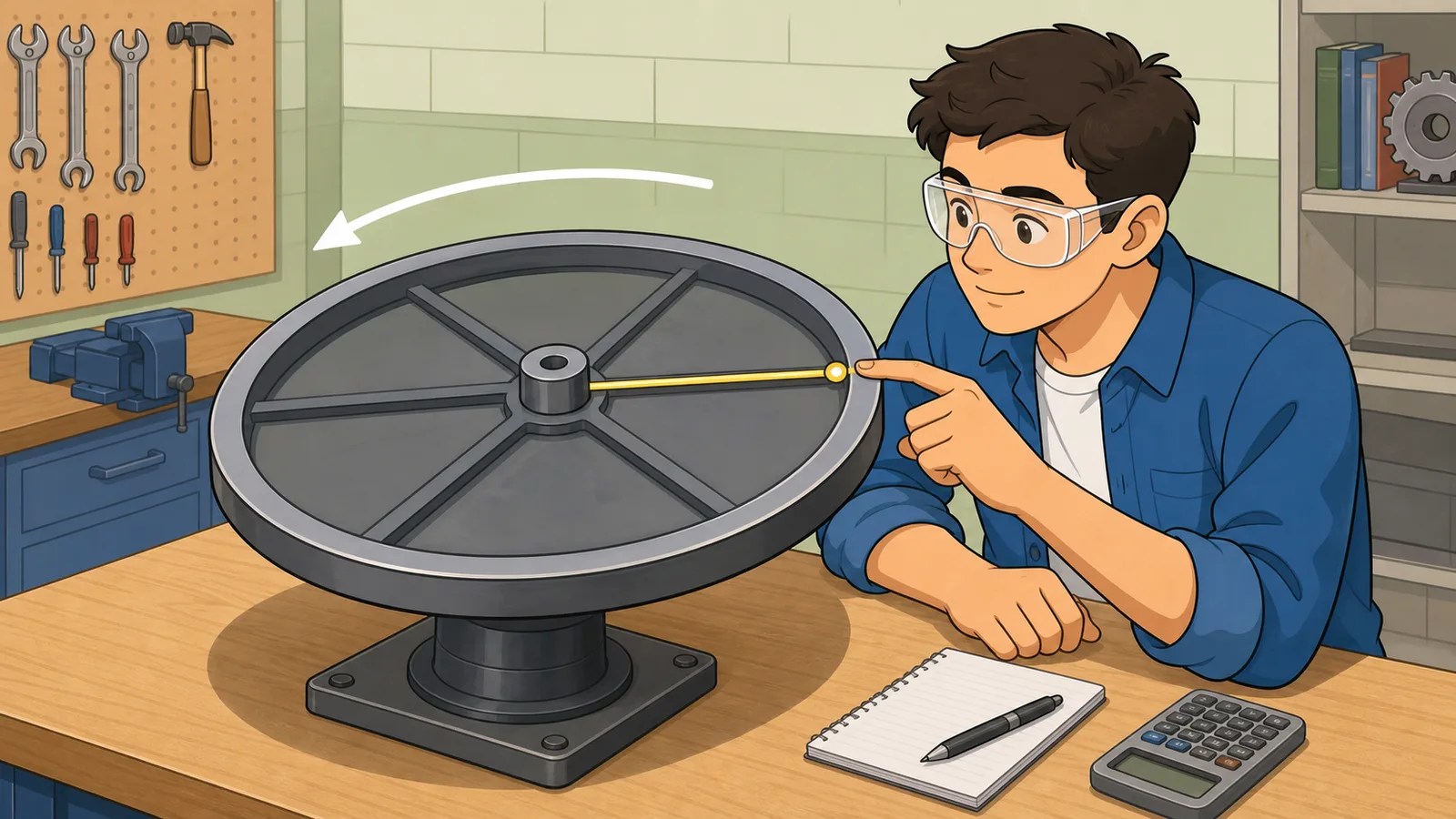
Tangential speed is the speed of a point on the edge of the rotating object. It increases linearly with radius, so the same angular velocity creates faster motion farther from the centre. That is why a wheel rim moves faster than a point closer to the hub even though both points share the same angular velocity.
Radius is the inverse of that relationship. If you know tangential speed and angular velocity, the radius is simply v/ω. Search phrases like linear speed calculator, radius calculator, and angular velocity from linear speed and radius all point to this same circular-motion relationship.
Angular speed versus angular velocity
Angular speed is the scalar magnitude of rotation. Angular velocity is the vector form and includes a direction along the axis of rotation. For most calculator use cases, people want the magnitude in rad/s, RPM, Hz, or period rather than a full vector treatment.
That distinction matters if you are doing dynamics, robotics, or a problem where direction is part of the setup. This page focuses on the magnitude relationships that are most useful for everyday rotational calculations, not on vector notation or sign conventions.
What this page does not replace
This calculator does not solve angular acceleration, torque, moment of inertia, or centripetal force. It also does not model changing radius, slip, precession, or any system where the rotation speed is not steady.
If you need acceleration, force, or a deeper dynamics model, use a calculator that is built for that job. If you need to move between units only, a converter is a better fit than a solve-for worksheet.
When to use related calculators
Use this page when the goal is to solve circular-motion relationships from known values. Use a frequency converter when the only task is unit conversion, and use a centripetal-force calculator when you need the force at a given radius and speed.
If you are comparing speed instead of rotation, a speed calculator is often the better starting point. If you need to connect angular motion to acceleration or energy, the related calculators below cover those next steps without forcing you to overwork this page.
Angular velocity is the rate at which an object rotates, usually measured in radians per second. It tells you how quickly the angle changes over time.
What is the difference between angular speed and angular velocity?
Angular speed is the scalar magnitude of rotation. Angular velocity is the vector form and includes direction along the axis of rotation. For most calculator work, people mainly need the magnitude.
What is the formula for angular velocity?
The core formulas are ω = Δθ/Δt, ω = 2πf, and ω = 2π/T. Use angle over time when the problem gives angular displacement directly, frequency when you know revolutions per second, and period when you know the time for one full revolution.
How do I calculate angular velocity from angle and time?
Use ω = Δθ/Δt. Convert the angle to radians first if it is given in degrees or revolutions. For example, 180° in 0.5 s is π radians in 0.5 s, which equals about 6.283 rad/s.
How do I convert RPM to rad/s?
Divide RPM by 60 to get revolutions per second, then multiply by 2π. For example, 60 RPM = 1 Hz = 2π rad/s.
How do I convert frequency to angular velocity?
Multiply frequency in revolutions per second by 2π. For example, 1 Hz becomes 6.283 rad/s.
How do I find linear speed from angular velocity?
Use v = ωr. Multiply angular velocity in rad/s by the radius in metres to get tangential speed in m/s.
How do I find radius from angular velocity and speed?
Use r = v/ω. Divide tangential speed by angular velocity to get radius.
Do I need radians or degrees?
Either can work, but radians are the natural unit for the formulas. Degrees are fine if the calculator converts them before solving.
What is centripetal acceleration from angular velocity?
Centripetal acceleration is a = ω²r. It points toward the centre of rotation and grows quickly as angular velocity increases.
When should I use an angular velocity converter instead?
Use a converter when the value is already known and you only need unit conversion. Use this page when you need to solve angular velocity, frequency, period, linear speed, or radius from a circular-motion relationship.