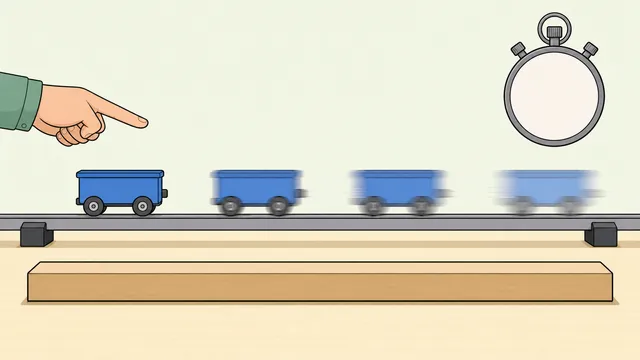
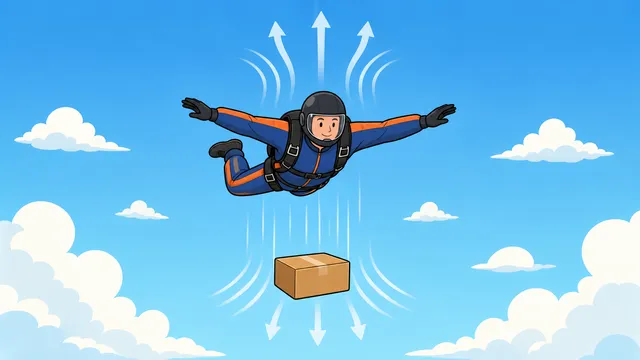
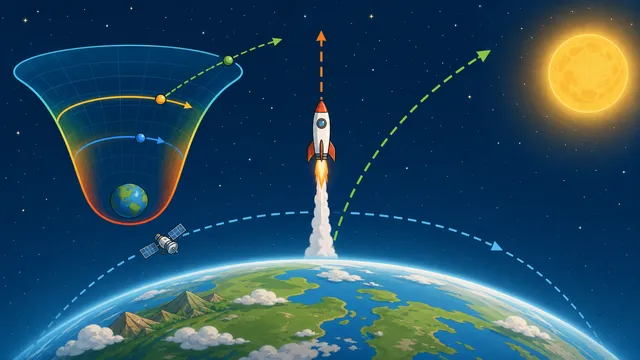
Calculate kinetic energy, mass, or velocity from the other two, then review energy conversions, equivalent drop height, and same-mass speed comparisons.
Last updated
Common motion presets
Solve for
Kinetic-energy result
138.89 kJ
Normalised to 1,000 kg moving at 16.67 m/s, which carries 138,888.89 J of kinetic energy.
138,888.89 J
Energy in joules
1,000 kg
Mass in kilograms
16.67 m/s
Velocity in metres per second
14.16 m
Equivalent drop height
Energy conversion sheet
Unit
Value
J
138888.89 J
kJ
138.8889 kJ
Wh
38.5802 Wh
kcal
33.1952 kcal
ft-lb
102439.0324 ft-lb
BTU
131.6407 BTU
Same mass at common speeds
Scenario
Speed
Energy
Walking pace
1.4 m/s
980 J
Sprint
8 m/s
32 kJ
City driving
50 km/h
96.61 kJ
Motorway driving
100 km/h
386.42 kJ
Speed-squared effect Because velocity is squared in KE = ½mv², doubling speed multiplies kinetic energy by four. That is why small speed increases create disproportionately larger energy values.
Kinetic energy is the energy an object possesses due to its motion. The equation KE = ½mv² relates kinetic energy to mass and velocity — one of the most fundamental results in classical mechanics. People also search for kinetic energy calculator, KE formula, joules from mass and speed, and equivalent drop height because they want a practical way to translate motion into energy.
The kinetic energy equation
KE = ½mv² where m is mass in kilograms and v is speed in metres per second. Kinetic energy is measured in joules (J). The equation can be rearranged to find mass (m = 2KE ÷ v²) or velocity (v = √(2KE ÷ m)).
Kinetic energy scales with the square of velocity: doubling speed quadruples kinetic energy. This is why vehicle collision severity increases dramatically with speed.
Practical applications
A 1000 kg car at 60 km/h (16.7 m/s) has about 139 000 J (139 kJ) of kinetic energy — equivalent to lifting the same car 14 metres off the ground. At 120 km/h the energy quadruples to 556 kJ.
In thermodynamics, the kinetic energy of gas molecules is directly proportional to absolute temperature (kT = ½mv²). In projectile physics, muzzle energy is often quoted in joules.
NIST Guide to SI Units — Reference guide for SI units such as joules, kilograms, and metres per second.
Worked example: 1000 kg at 60 km/h
Convert 60 km/h to metres per second first: 60 ÷ 3.6 = 16.67 m/s. Then apply KE = ½mv² = 0.5 × 1000 × 16.67² ≈ 138,889 J, or about 138.9 kJ. That is the everyday transport example many users have in mind when they search for kinetic energy from speed.
Using the same mass, doubling the speed to 120 km/h would not double the energy. It would quadruple it to roughly 555.6 kJ because velocity is squared in the formula. That is the key comparison a good kinetic-energy calculator should make obvious.
Why speed matters so much
Kinetic energy grows with the square of speed, not linearly. That means doubling speed multiplies energy by four, which is why a small change in vehicle speed can have a large effect on crash severity.
This also explains why users often search for kinetic energy in km/h, mph, or m/s. A good calculator should convert speed units cleanly before applying the equation so the final joule result remains correct.
Frequently asked questions
What is the equivalent height?
The calculator shows the height from which the object would need to be dropped to acquire the same kinetic energy. It comes from equating KE to gravitational potential energy: h = KE ÷ (mg). This puts the energy in intuitive context.
Does direction matter for kinetic energy?
No. Kinetic energy is a scalar quantity — it depends on speed (magnitude of velocity), not direction. Two objects of the same mass moving at the same speed in opposite directions have the same kinetic energy.
What units should I use for the formula?
Use kilograms for mass and metres per second for speed if you want joules directly from KE = ½mv². The calculator converts from common speed units like km/h and mph before applying the formula.
Why does doubling speed quadruple kinetic energy?
Because velocity is squared in the equation. If speed doubles, v² becomes four times larger, so kinetic energy also becomes four times larger when mass stays the same.
Does doubling mass double kinetic energy?
Yes, if speed stays the same. Kinetic energy is directly proportional to mass, so doubling the mass doubles the energy. The much larger effect comes from speed, because velocity is squared.