Calculate mechanical work, force, distance, or angle using W = Fd·cos(θ), with energy unit conversion and support for any angle between 0° and 180°.
Last updated
Physics work calculator Solve the work equation `W = Fd cos(θ)` for work, force, distance, or angle, and compare how the same force-distance setup changes from positive work to zero work to negative work.
Use 0° when force points along the motion, 90° for perpendicular force, and 180° when force opposes the displacement like friction.
Result
Work (J)
0 J
This result corresponds to zero work.
The force is effectively perpendicular to the displacement, so it does not transfer energy along the direction of motion.
Work (J)
0
Force (N)
0
Distance (m)
0
Angle
0°
Angle comparison unlocks after one real setup Enter a positive force and distance to compare maximum positive work, zero work at 90°, and negative work from opposing force.
Work calculator: the physics work formula, work done by friction, and angle examples
This work calculator solves the physics work formula `W = Fd cos(θ)` for work, force, distance, or angle. It is useful when people search for a work calculator, physics work calculator, work done calculator, or the formula for work in physics, and it also helps explain why work done by friction is negative, why perpendicular force does zero work, and how the work-energy theorem connects force-and-distance problems to changes in kinetic energy.
The work equation: W = Fd cos(θ)
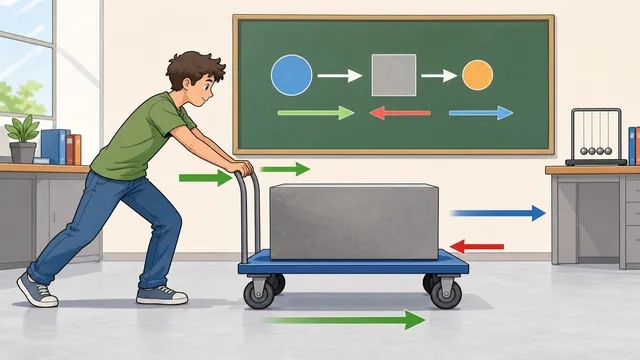
When force is applied in the direction of motion (θ = 0°), work equals force times distance: W = Fd. A person pushing a crate with 200 N over 5 m does 1000 J of work. If the force is applied at an angle, only the component along the direction of motion contributes — pushing at 30° from horizontal gives W = 200 × 5 × cos(30°) ≈ 866 J.
Work can be negative. When force opposes motion (θ = 180°), cos(180°) = −1, so work is negative. Friction always does negative work because it acts opposite to the direction of movement, removing kinetic energy from the system.
W = F × d × cos(θ)
W is work in joules, F is force in newtons, d is displacement in metres, and θ is the angle between force and displacement.
W = ΔKE = ½mv₂² − ½mv₁²
The work–energy theorem: net work equals the change in kinetic energy.
Positive work, zero work, and negative work
The sign of work depends on the angle between the applied force and the displacement. Positive work happens when the force points partly along the motion, which adds energy to the object. Zero work happens when the force is perpendicular to the displacement, so none of the force acts along the motion. Negative work happens when the force points partly opposite the motion, removing energy from the object instead of adding it.
This is why the formula for work in physics uses cosine. At 0°, cos(θ) = 1 and the force contributes fully. At 90°, cos(θ) = 0 and no work is done. At 180°, cos(θ) = -1 and the work becomes fully negative. The sign is not just a mathematical detail; it tells you whether the force is adding or removing kinetic energy.
Work done by friction formula and work done by gravity formula
The work done by friction formula is the same physics equation: `W = Fd cos(θ)`. Because friction points opposite the displacement, the angle is typically 180°, so the formula simplifies to `W = -Fd`. That negative sign is the important part. It means friction removes mechanical energy and usually turns it into heat.
The work done by gravity depends on direction. If an object moves downward, gravity and displacement point in the same direction and gravity does positive work. If you lift the object upward, gravity opposes the displacement and does negative work. Near Earth's surface, vertical lifting problems often reduce to `W = ±mgh`, which is the same idea expressed in a gravitational setting.
W_friction = -F_friction × d
For friction acting directly opposite the displacement.
W_gravity = m × g × h
Magnitude of the work associated with vertical motion near Earth's surface; sign depends on whether gravity helps or opposes the motion.
Work, energy, and power
Work and energy share the same unit: the joule (J). Power is the rate at which work is done: P = W/t, measured in watts (W). One watt equals one joule per second. A 75 kg person climbing a 3 m staircase does about 2207 J of work against gravity. Completing it in 4 seconds requires 552 W of power output.
The kilowatt-hour (kWh), commonly used in electricity billing, equals 3.6 million joules. Understanding the relationship between work and energy is essential for engineering efficiency calculations.
How the work-energy theorem fits this calculator
The work-energy theorem formula says that net work equals the change in kinetic energy: `W_net = ΔKE`. In practice, that means any net positive work makes an object speed up and any net negative work makes it slow down. The theorem is one of the fastest ways to connect force-and-distance problems with changes in speed, especially when acceleration is not constant or when force acts at an angle.
This page is still a direct work equation calculator, not a full work-energy theorem solver for mass and velocity. Even so, the theorem explains why the headline result matters. Once you know the net work done, you know how much the object's kinetic energy changed. If your problem starts with mass and initial and final speed instead, a dedicated kinetic-energy tool is usually the better next step.
Suppose a 40 N horizontal force pushes a sled 6 m across level snow. With θ = 0°, the work done is `W = 40 × 6 × cos(0°) = 240 J`. If the same 40 N force is applied 60° above the direction of motion, the work falls to `120 J` because only half of the force contributes along the displacement. If the same 40 N instead acts as friction in the opposite direction, the work becomes `-240 J`.
Gravity examples work the same way. Lifting an 8 kg backpack upward by 2 m requires about `157 J` of positive work by you, while gravity does `-157 J` over the same displacement. Letting the bag descend 2 m flips the sign: gravity does `+157 J` because the force and displacement now point in the same direction.
Common mistakes when using a physics work calculator
The most common mistake is using the wrong angle. The angle in the work equation is always the angle between the force vector and the displacement direction, not the angle of a ramp or the angle drawn somewhere else in the diagram. If the force is horizontal and the motion is horizontal, the correct angle is 0°, even if the rope or object itself is drawn at another angle.
Another common mistake is forgetting that work depends on displacement, not just effort. Holding a heavy object stationary feels hard, but the displacement is zero, so mechanical work is zero. Students also often mix up force and net force: the work-energy theorem uses net work, which means you have to account for all forces that do work on the object, not just one of them.
Further reading
The Physics Classroom — Work — Physics teaching reference covering the angle convention, sign of work, and common mistakes in textbook-style problems.
NIST Guide to the SI — NIST reference for the joule, watt, and SI measurement conventions used on this page.
Frequently asked questions
Is work done when holding a heavy object stationary?
No. In physics, work requires displacement. Holding a 20 kg weight motionless means d = 0, so W = Fd = 0. Your muscles do consume metabolic energy to maintain tension, but no mechanical work is done on the weight because it does not move.
Why does carrying a box across a flat floor do zero work against gravity?
Gravity acts vertically downward, but the motion is horizontal. The angle between force and displacement is 90°, and cos(90°) = 0, so gravitational work is zero. You are doing work against friction and air resistance (horizontal forces), but not against gravity during horizontal transport.
What is the relationship between work and potential energy?
Lifting an object increases its gravitational potential energy by exactly the amount of work done against gravity: W = mgh. This work is stored as PE and can be recovered when the object descends. The conservation of energy ensures that work done equals the change in potential energy for conservative forces.
What is the formula for work in physics?
The full formula for work in physics is `W = Fd cos(θ)`, where `F` is force, `d` is displacement, and `θ` is the angle between the force and the displacement. When force and motion are parallel, the formula simplifies to `W = Fd`. When the force is perpendicular to the motion, work is zero.
How do I calculate work done by friction?
Use the same work equation and set the angle to 180° if friction directly opposes the motion. Because `cos(180°) = -1`, the work done by friction becomes negative: `W = -Fd`. The negative sign means friction removes mechanical energy from the moving object.
How do I calculate work done by gravity?
Near Earth's surface, the magnitude is often `mgh`, but the sign depends on direction. Gravity does positive work when the object moves downward and negative work when the object moves upward. In the full work equation, you still treat gravity as a force with an angle relative to the displacement.
Why is the angle important in a work done calculator?
Only the component of force along the displacement does work. The cosine term extracts that component. A larger angle reduces the effective force along the motion, which lowers the work. At 90° the force is perpendicular, so the calculator correctly returns zero work.
Is this the same as a work-energy theorem calculator?
Not exactly. This page directly solves the work equation `W = Fd cos(θ)`. The work-energy theorem says net work equals the change in kinetic energy, so the result here can still be used in that framework, but if your problem starts with mass and speed change rather than force and distance, a kinetic-energy or dedicated work-energy theorem calculator is a better fit.
What units are used for work in physics?
The SI unit of work is the joule (J), which is equivalent to one newton-metre. This calculator also converts to kilojoules, calories, kilocalories, watt-hours, and BTU so you can compare mechanical work with common energy units.