Friction calculator guide: static friction, kinetic friction, and coefficient of friction
Friction is the resistive force between two surfaces in contact. People usually reach this page asking for the friction formula, how to calculate friction force, or how static friction differs from kinetic friction. The calculator handles both static friction, which prevents motion from starting, and kinetic friction, which resists ongoing motion.
The friction equation: f = μN
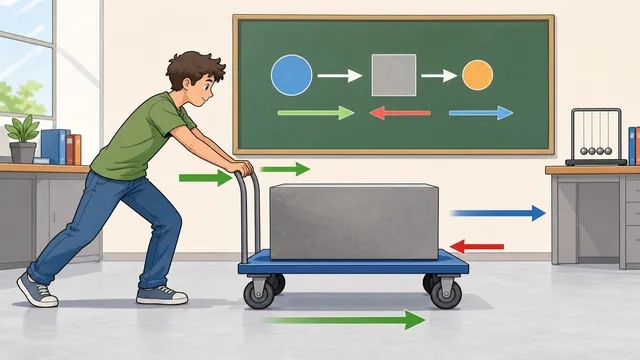
The friction force f equals the coefficient of friction μ multiplied by the normal force N. On a flat surface, the normal force equals the object's weight (N = mg). A 20 kg box on concrete (μ_k ≈ 0.6) requires a horizontal force greater than 0.6 × 20 × 9.81 ≈ 117.7 N to keep sliding.
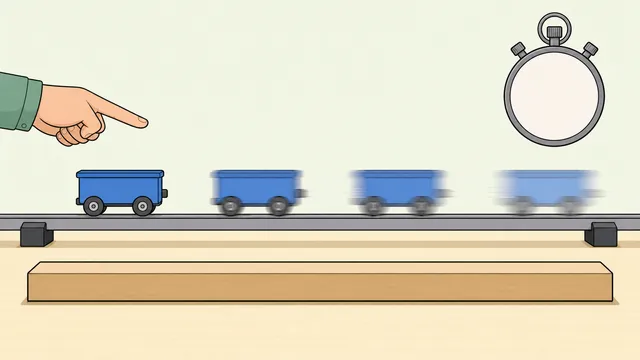
Static friction (μ_s) is typically higher than kinetic friction (μ_k) for the same material pair. This is why more force is needed to start an object moving than to keep it moving. For rubber on dry concrete, μ_s ≈ 0.8 while μ_k ≈ 0.6.
f = μ × N
f is the friction force, μ is the coefficient of friction (static or kinetic), and N is the normal force perpendicular to the contact surface.
N = m × g × cos(θ)
On an inclined surface at angle θ, the normal force is reduced by the cosine of the incline angle.
Common coefficients of friction
Friction coefficients are determined experimentally and vary with surface condition, temperature, and contamination. Typical kinetic values include: rubber on dry asphalt 0.5–0.8, steel on steel 0.4–0.6, wood on wood 0.25–0.5, ice on ice 0.03, and Teflon on steel 0.04. Lubrication can reduce coefficients by an order of magnitude.
Static versus kinetic friction in real problems
The distinction between static and kinetic friction is one of the main reasons people use a friction calculator instead of mental arithmetic. Static friction is a ceiling rather than one fixed always-on force. It increases as needed up to its maximum value to keep an object from moving. Once motion begins, kinetic friction usually drops below that threshold.
That is why it takes more force to start a heavy object moving than to keep it moving. It also explains why a solver needs to know whether the problem is about impending motion or ongoing sliding before choosing the correct coefficient.
Why the coefficient is never truly universal
High-ranking rival pages often list friction coefficients as if they are permanent constants. In reality, they are experimentally determined ranges that depend on surface roughness, contamination, lubrication, temperature, material deformation, and how the surfaces are prepared.
That means the calculator output is only as good as the coefficient you choose. The formula is simple, but the coefficient still needs engineering judgement or a reliable reference table when the stakes are practical rather than classroom-based.
Frequently asked questions
Why is static friction greater than kinetic friction?
At rest, microscopic surface irregularities interlock more thoroughly, forming stronger bonds between the surfaces. Once motion begins, the surfaces spend less time in contact at each point, resulting in weaker bonds and lower resistance. This is why it takes more force to start pushing a heavy piece of furniture than to keep it sliding.
Does friction depend on contact area?
For rigid surfaces, friction is largely independent of contact area. A brick lying flat or standing on end exerts the same friction force because the normal force is identical. However, for deformable materials like rubber tyres, a larger contact patch can increase grip because the material conforms to the surface texture.
How does an incline affect friction?
On an incline, the normal force decreases to N = mg cos(θ), reducing friction. Simultaneously, the component of gravity pulling the object down the slope is mg sin(θ). The object begins sliding when mg sin(θ) exceeds μ_s × mg cos(θ), which simplifies to tan(θ) > μ_s.
Where do friction coefficients come from?
They come from experiment, not from a fixed universal constant. Surface roughness, contamination, lubrication, temperature, and material deformation all affect the measured coefficient, so any table value should be treated as a range or starting point rather than a law of nature.
What does the normal force have to do with friction?
Friction is proportional to the normal force in the simple dry-friction model. If the normal force goes up, the maximum friction force usually goes up too. That is why heavier objects or steeper contact forces often require more force to move.