Skip to content
Calcipedia
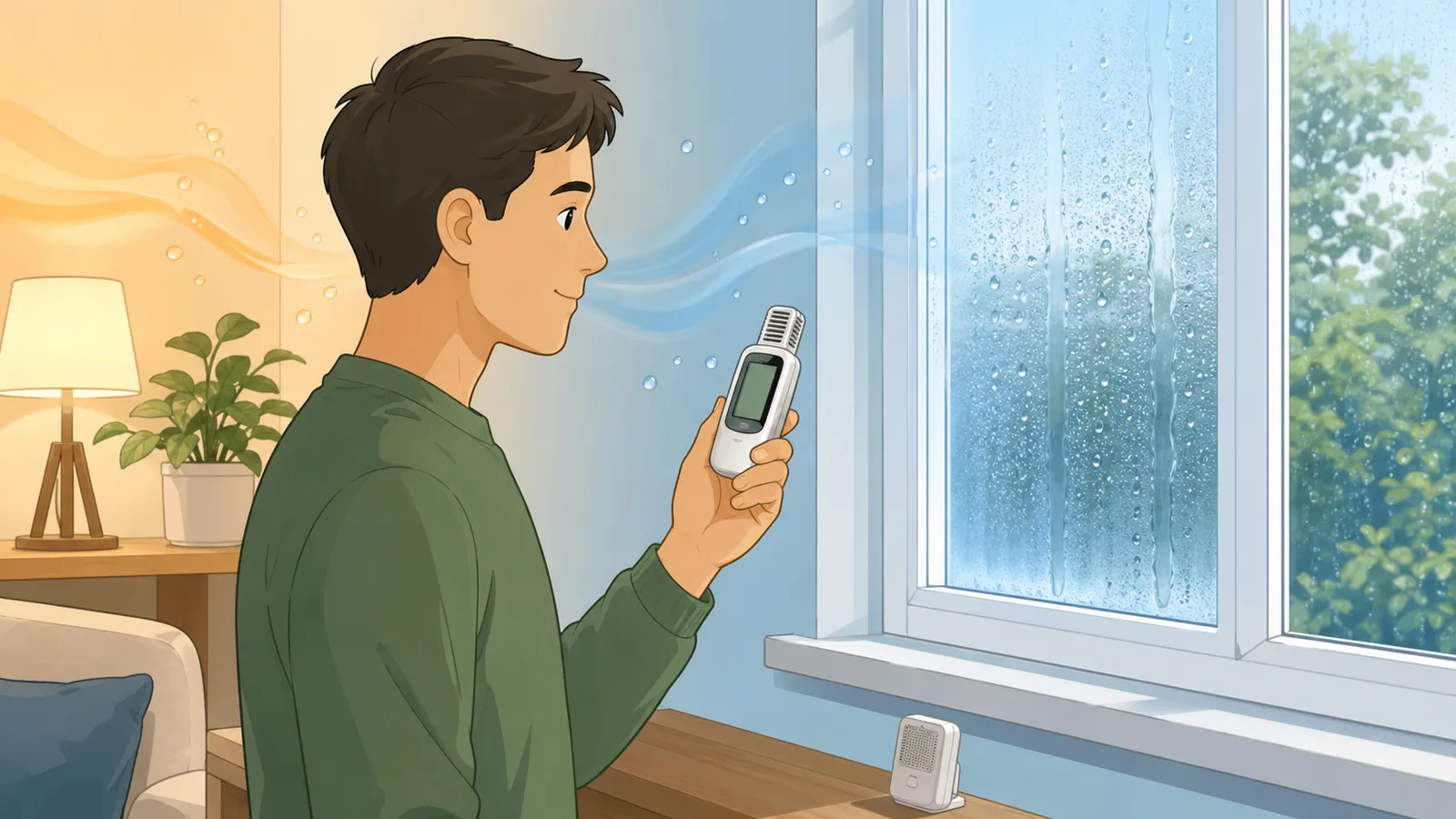
Dew Point Calculator instructional illustration

Dew Point Calculator

Calculate dew point from temperature and humidity, reverse-solve RH, then check comfort bands, condensation risk, cold-surface margin, and safe RH ceiling.

Last updated

Use this dew point calculator to solve for dew point from air temperature and relative humidity, or reverse it to solve for relative humidity from air temperature and dew point. The result helps you read comfort, mugginess, and condensation risk faster than a static dew point chart because it keeps the moisture number tied to a practical interpretation.

Quick scenarios

Comfortable room: 71.6 °F and 50% RH; surface 59 °F.Sticky summer: 86 °F and 75% RH; surface 71.6 °F.Window fog check: 68 °F with 60.8 °F dew point; surface 59 °F.Cold dry air: 41 °F and 40% RH; surface 35.6 °F

Temperature

Solve for

Use a window, duct, pipe, wall corner, or drink-glass surface temperature to estimate condensation risk and a safe RH ceiling.

Result

Dew point

62.1 °F

At 77.0 °F and 60.0% RH, the dew point is 62.1 °F.

Watch indoor surfaces This is the “getting sticky” band where rooms start to feel muggy and the air loses drying margin. The moisture load is meaningful, but there is still some buffer before the air reaches saturation at the current temperature.
Air temperature
77.0 °F
Dew point
62.1 °F
Relative humidity
60.0%
Temp-dew spread
8.3 °C
Comfort band
Humid
Moisture margin
Moderate drying margin
Surface temperature
60.8 °F
Surface-dew margin
-0.7 °C
Safe RH ceiling
57.4%

What this usually feels like

This is the “getting sticky” band where rooms start to feel muggy and the air loses drying margin.

The moisture load is meaningful, but there is still some buffer before the air reaches saturation at the current temperature.

Planning note

Watch indoor surfaces

Use this range for planning checks: if you cool the room or a surface by several degrees, relative humidity can climb quickly and comfort can drop.

Surface check

Condensation likely

The selected surface is at or below the dew point, so water can form on glass, metal, ducts, or other cool materials. Keep relative humidity at or below about 57.4% if that surface temperature is the limiting cold spot.

Comfort guide

Use the dew point band, not just the humidity percentage

This quick table mirrors the competitor gap around dew point comfort levels, sticky thresholds, and when condensation becomes more plausible indoors.

BandDew point (°C)Dew point (°F)How it feelsWhat to watch
DryBelow 10 °CBelow 50 °FAir in this band usually feels dry to comfortable, and sweat can evaporate easily.Condensation is usually low unless a surface is much colder than the surrounding air.
Comfortable10 to 15.9 °C50 to 60.7 °FMoisture is noticeable but still comfortable for many indoor spaces and routine outdoor use.Normal ventilation is often enough unless windows, ducts, or slab surfaces run cold.
Slightly humid16 to 17.9 °C60.8 to 64.3 °FThis is the “getting sticky” band where rooms start to feel muggy and the air loses drying margin.Start watching windows, chilled drinks, and poorly insulated ducts for early condensation.
Humid18 to 20.9 °C64.4 to 69.6 °FThe air now feels properly humid, and many people will describe the room or weather as muggy.Ventilation, air conditioning, or dehumidification often matters more than temperature changes alone.
Very humid21 to 23.9 °C69.8 to 75.1 °FThis band is oppressive for many people, especially once air temperature is also warm.Expect fast condensation on cold surfaces and reduced comfort without active moisture control.
Extremely humid24 °C and above75.2 °F and aboveThe air is carrying very heavy moisture, so heat stress and severe stickiness become much more likely.Treat this as a high-moisture environment that usually needs cooling, dehumidification, or reduced exposure time.
← All Physics calculators

Science — Physics

Dew point calculator guide: humidity, condensation, and comfort levels

Use this dew point calculator to solve for dew point from air temperature and relative humidity, or solve for relative humidity from air temperature and dew point when you already know the moisture reading.

Why dew point often matters more than relative humidity

Relative humidity depends on both moisture content and air temperature, which is why the same amount of water vapour can look like a different humidity percentage as the day warms or cools. Dew point is steadier because it reflects the temperature to which the air would need to cool for saturation to occur at the same pressure.

That is why weather, HVAC, and indoor-comfort pages increasingly target both dew point and humidity phrasing. Users often want to know whether the air is truly muggy, whether condensation is likely, or why a high relative humidity reading on a cold morning does not feel the same as a high humidity reading in summer. Searches such as dew point calculator, dew point vs humidity, dew point chart, and relative humidity calculator all point to the same practical question: how much moisture is really in the air?

Magnus formula for dew point

The August-Roche-Magnus approximation gives the dew point from air temperature T (°C) and relative humidity RH (%): γ = (aT)/(b+T) + ln(RH/100); Td = bγ/(a−γ), with constants a = 17.625 and b = 243.04 °C. This formula is accurate to about ±0.35 °C for temperatures between -40 °C and 60 °C. The reverse calculation - RH from T and Td - inverts the same equation.

For practical calculator use, that is what powers common tasks like solving for dew point from temperature and relative humidity, or solving for relative humidity when temperature and dew point are already known. It is fast, accurate enough for most everyday and educational use, and closely matches what many browser-based dew point tools implement.

γ = (aT) / (b + T) + ln(RH / 100)

Intermediate Magnus term used to combine air temperature and relative humidity into a dew point estimate.

Td = bγ / (a - γ)

Final dew point equation, using a = 17.625 and b = 243.04 °C.

RH = 100 × exp((aTd)/(b + Td) - (aT)/(b + T))

Reverse form used when you already know the air temperature and dew point.

Worked example: 25 °C and 60% RH

If the air temperature is 25 °C and relative humidity is 60%, the calculator returns a dew point of about 16.7 °C. That means the air is not saturated yet, but it is close enough that the room can feel noticeably clammy on a warm day.

The reverse mode gives the same relationship in the other direction. If you know the air temperature is 25 °C and the dew point is 16.7 °C, the relative humidity works out to roughly 60%. That round-trip example is useful for checking that the calculator and the underlying formula are aligned.

  • Air temperature: 25 °C
  • Relative humidity: 60%
  • Dew point: 16.7 °C
  • Dew point depression: 8.3 °C

Dew point depression, comfort, and condensation risk

A dew point below 10 °C is comfortable; 10-16 °C is slightly humid; 16-21 °C is noticeable; 21-24 °C is very uncomfortable; above 24 °C can be oppressive, as sweat cannot evaporate efficiently. The dew point depression - air temperature minus dew point - indicates how far the air is from saturation: a small spread means high relative humidity and a greater chance of condensation.

That comfort framing is why dew point often feels more intuitive than humidity percentage once you know the bands. A hot day with a high dew point usually feels heavy and sticky because the air is already carrying a lot of moisture, while a hot day with a lower dew point can still feel much more tolerable even if the temperature alone is high.

When the spread closes to just a few degrees, surfaces such as windows, ductwork, or cold drink glasses can drop to the dew point and collect moisture. That is the practical reason many HVAC, greenhouse, and weather pages treat dew point as a condensation cue, not just a comfort number.

Further reading

Dew point, condensation, and window moisture

Condensation forms when a surface is at or below the dew point of the surrounding air. That is why cold drinks sweat, windows fog, and uninsulated surfaces collect moisture even when the room itself does not feel obviously wet. The dew point gives a direct clue about when that condensation risk appears.

This also explains long-tail searches like dew point for condensation, window dew point, and dew point temperature formula. People are often not looking for meteorology alone. They are trying to understand a practical moisture problem in a room, greenhouse, workshop, HVAC system, or weather setup.

Practical uses: weather, HVAC, and indoor comfort

Weather: once you know the dew point, you can compare two warm days that look similar on a forecast but feel very different. HVAC: a high dew point can explain why a room feels sticky even if the thermostat looks reasonable, which is why dehumidification often matters as much as cooling. Indoor comfort: the same reading can help you decide whether ventilation, a dehumidifier, or better insulation will make the biggest difference.

The reverse calculation is also useful for planning. If you know a room is being held at a specific air temperature and you want to understand how humid it is likely to feel, solving for relative humidity from dew point gives you a clearer moisture picture than temperature alone. This is especially useful when users search for relative humidity calculator, dew point chart, or dew point calculator and actually need the relationship between moisture and comfort rather than a single isolated number.

For more atmospheric moisture reference, NOAA READY also provides a moisture calculator that converts between dew point, wet-bulb temperature, and relative humidity.

Further reading

Comfort bands in Celsius and Fahrenheit

People often search for what dew point feels uncomfortable or dew point comfort levels because they want a direct answer in everyday language. A useful rule of thumb is that dew points below about 10 °C (50 °F) generally feel dry to comfortable, 10-16 °C (50-61 °F) feels comfortable for many people, 16-18 °C (61-64 °F) starts to feel sticky, 18-21 °C (64-70 °F) feels properly humid, and values above 21 °C (70 °F) can quickly become oppressive on warm days.

Those bands are practical planning ranges, not hard physiological cutoffs. Air movement, sun exposure, clothing, and indoor surface temperatures still matter. Even so, this comfort-band framing is why many people find a dew point chart or dew point comfort chart easier to use than a standalone humidity percentage. The number stays tied to how much moisture is really present, rather than changing every time air temperature moves.

This also explains why a summer day at 30 °C with a dew point above 21 °C usually feels far more uncomfortable than a much cooler morning with very high relative humidity. The relative humidity can look dramatic on the cool morning, but the actual moisture load is usually lower than the high dew point on the warm day.

Further reading

Using dew point for indoor planning instead of only weather talk

Dew point is useful indoors because it helps answer a practical question: if I cool this room or cool a nearby surface, will water start condensing? If the room air has a dew point of 16 °C and your window glass or duct surface reaches 16 °C or lower, condensation becomes plausible. That is why window fog, sweating supply vents, basement clamminess, and damp corners often make more sense when you track dew point rather than just the thermostat setting.

This is also where the reverse humidity mode is useful. If you already know the room temperature and a measured dew point from a monitor or HVAC reading, solving for relative humidity lets you compare your setup with common indoor targets while keeping the underlying moisture level visible. In other words, the calculator helps you move between the language of dew point and the language of RH without losing the real-world meaning.

For day-to-day planning, high indoor dew points usually suggest moisture control rather than more raw cooling. A room can feel cold and still feel damp if the dew point remains high. In that situation, drying the air, improving ventilation timing, or insulating cold surfaces may do more than lowering the temperature a little further.

Further reading

Cold-surface margin and safe RH ceiling

The calculator also lets you enter the coldest surface you care about, such as a window pane, duct, pipe, wall corner, or chilled equipment surface. It compares that surface temperature with the calculated dew point and reports the surface-dew margin. A negative margin means the surface is already at or below dew point; a small positive margin means condensation can appear if the room cools a little, humidity rises, or the surface loses heat overnight.

The safe RH ceiling is the reverse of that same condensation check. It estimates the highest relative humidity the room can hold at the entered air temperature before the selected cold surface reaches dew point. For example, if a room is warm but the inside of a window is much colder, the safe RH ceiling can be lower than the broad comfort range people normally quote for indoor humidity.

This makes the page more useful than a static dew point chart for indoor troubleshooting. Instead of only asking whether the air feels muggy, you can ask whether a specific cold spot has enough buffer. If the safe RH ceiling is below your measured humidity, the practical next step is usually moisture control, warmer surfaces, better air sealing, or ventilation timing rather than another raw temperature change.

Surface margin = surface temperature − dew point

A direct condensation buffer: zero or negative means the selected surface can collect moisture under the entered air conditions.

Safe RH ceiling = 100 × exp((aTs)/(b + Ts) − (aT)/(b + T))

Reverse Magnus form used to estimate the highest RH before a selected surface temperature Ts reaches dew point.

What this dew point calculator does not model

This page uses the August-Roche-Magnus approximation because it is fast, widely used, and reliable for most everyday weather, classroom, and indoor-comfort use. It does not attempt a full psychrometric model with pressure variation, instrument error, or specialised industrial constraints. If you are working on process control, aviation, laboratory drying, or detailed HVAC commissioning, the calculator should be treated as a quick estimate rather than a final engineering answer.

That limitation matters most near edge conditions. Very cold air, unusual pressure conditions, or situations that depend on precise wet-bulb, enthalpy, or mixing-ratio calculations can need a fuller psychrometric chart or specialist software. The same goes for mold investigations or building failures, where the surface temperature, insulation detail, and exposure duration matter just as much as the air dew point.

So the right way to use this page is as an interpretation tool and fast moisture calculator: it is strong for checking whether a dew point is comfortable, whether a dew point chart would likely show muggy conditions, and whether condensation risk is heading up or down. It is not a substitute for field measurements and domain-specific design methods when the consequences are high.

Further reading

Frequently asked questions

What is the difference between dew point and relative humidity?

Relative humidity (RH) expresses current moisture as a percentage of the air's maximum capacity at that temperature. Because warm air holds more moisture, RH changes with temperature even if the actual water content is constant. Dew point is an absolute measure of moisture content and does not change with temperature alone, making it more useful for comfort assessment.

Can the dew point exceed the air temperature?

No - by definition, the dew point cannot exceed the air temperature. When dew point equals air temperature, relative humidity is 100% and the air is saturated. This is why the calculator returns null if a dew point above air temperature is entered.

What dew point usually feels muggy or uncomfortable?

Many people start to notice mugginess once dew point climbs into the mid-teens Celsius, and it often feels very uncomfortable above about 21 °C. Exact comfort varies, but dew point is a practical way to compare how sticky different warm days are likely to feel.

Why do windows or cold surfaces collect moisture?

Because the surface temperature has fallen to or below the dew point of the nearby air. Once that happens, the air next to the surface can no longer hold the same amount of water vapour, so condensation forms.

What does dew point depression tell me?

Dew point depression is the gap between air temperature and dew point. A small gap means the air is close to saturation, so it feels more humid and condensation is more likely on cool surfaces. A larger gap means the air has more drying capacity.

Is relative humidity enough to judge comfort?

Not by itself. Relative humidity changes with temperature, so the same RH reading can feel very different on a cool day versus a hot day. Dew point is usually the better single number if you want to judge how muggy the air feels.

When should I use the reverse humidity mode?

Use the reverse mode when you already know the air temperature and dew point and want to see the implied relative humidity. It is useful for HVAC checks, weather comparisons, and any time you want to compare a dew point reading against a humidity percentage.

What dew point in Fahrenheit starts to feel sticky?

A useful shorthand is that many people begin to notice stickiness once dew point rises past about 60 °F, which is roughly 15.6 °C. Around 65-70 °F, the air often feels properly humid, and above 70 °F many people will describe conditions as muggy or oppressive if the air temperature is also warm. These are practical comfort bands, not universal biological thresholds, but they are a good reason dew point comfort chart searches are so common.

Why can 50% relative humidity feel worse on a hot day than 90% on a cool day?

Relative humidity is a temperature-dependent percentage, not a direct measure of moisture amount. On a cool morning, 90% RH can still correspond to a modest dew point because cool air cannot hold much water vapour. On a hot afternoon, even 50% RH can pair with a high dew point, meaning the air is carrying much more moisture. That is why dew point usually tracks mugginess better than RH alone.

Does lowering the air temperature without removing moisture change the dew point?

Not by much on its own. Dew point mainly follows the actual moisture content in the air. If you cool the air but do not remove water vapour, the dew point stays broadly similar while the relative humidity rises. Once you cool enough for condensation to begin, moisture is removed and the dew point can then drop. This is why air conditioning can change comfort in two ways: it cools the room and, if condensation forms on the coil, it also dries the air.

Can I use dew point to decide whether I need a dehumidifier?

Yes, as a planning guide. If indoor dew point stays high enough that rooms feel sticky, windows fog, or basement surfaces feel damp, dew point can be a clearer trigger than relative humidity alone because it tracks the underlying moisture load. A falling temperature can make RH look worse without any new moisture entering the room, but a persistently high dew point usually means the air actually contains a lot of water vapour and may benefit from dehumidification or better ventilation timing.

How does dew point help explain window condensation?

Window condensation appears when the glass temperature falls to or below the dew point of the nearby air. The calculator helps because it gives you the target temperature where that change becomes possible. If the room dew point is 16 °C and the inner glass surface cools to 16 °C or below, moisture can start collecting there even if the room air temperature is much warmer. That makes dew point especially useful for diagnosing winter window fogging, sweating ducts, and cold-corner moisture.

When is a full psychrometric chart better than this calculator?

A full psychrometric chart or specialist software is better when pressure, enthalpy, wet-bulb temperature, or exact HVAC process paths matter. This calculator is excellent for quick dew point, humidity, comfort, and condensation interpretation, but it does not replace a full engineering workflow for commissioning, industrial drying, aviation weather analysis, or high-stakes building-forensics work.

What is a safe RH ceiling for condensation control?

A safe RH ceiling is the highest relative humidity that should keep a selected cold surface just above dew point at the entered air temperature. It is useful for window condensation, duct sweating, wall-corner dampness, and dehumidifier planning because it links a room humidity target to a real surface temperature. It is still an estimate: if the surface is colder than assumed, or if air leaks and thermal bridges cool one spot more than the rest of the room, condensation can occur sooner.

Guides

Featured in articles

Step-by-step guides that use this calculator to solve real problems.

Also in Physics

Related

More from nearby categories

These related calculators come from the same leaf category, nearby sibling categories, or the same top-level topic.