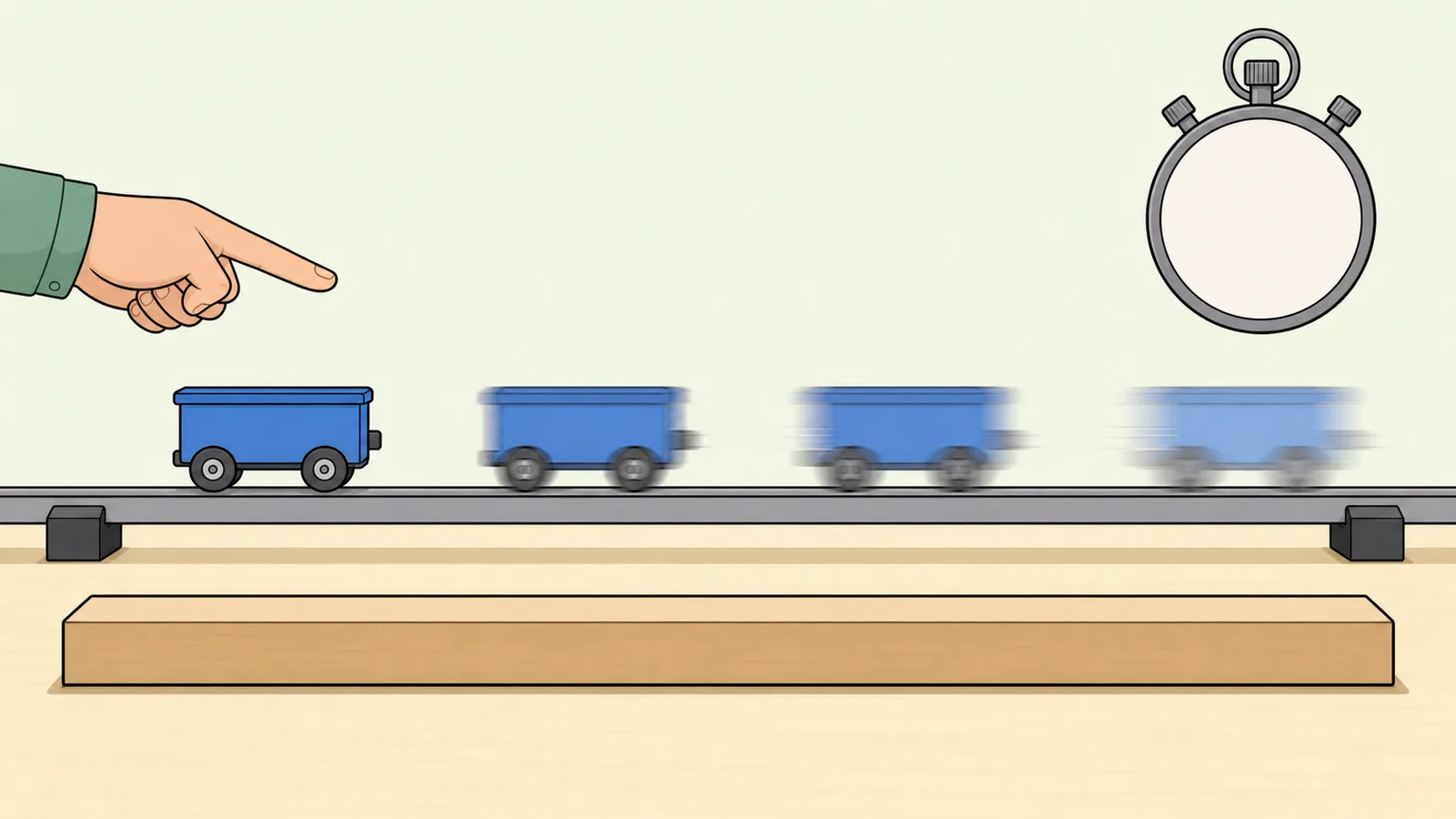
Calculate acceleration, initial velocity, final velocity, or time from constant-acceleration equations, with average velocity, distance, g-force, checkpoints.
Last updated
Solve constant-acceleration motion from the values you know Use velocity and time, distance and time, or velocity and displacement when acceleration is the unknown.
The calculator keeps units consistent and shows g-force, displacement, checkpoints, and sign interpretation.
Example scenarios
Solve for
Acceleration method
What this model assumes
This calculator uses constant acceleration. It is a good planning and teaching model for straight-line motion, but it will not capture jerk, traction limits, drag growth, or changing acceleration over time.
Acceleration result
5 m/s2
Changes speed by 20 m/s over 4 s, covering 40 m in the constant-acceleration model.
Formula used
a = (v - u) / t
G-force
0.51 g
Average velocity
10 m/s
Acceleration magnitude
5 m/s²
Speeding up in the selected direction The final speed is higher than the initial speed, so the acceleration increases speed across the interval. The magnitude is 5 m/s², or 0.51 g.
Scenario sheet
Use the change in velocity over elapsed time to solve for constant linear acceleration.
Initial velocity
0 m/s
0 m/s
Final velocity
20 m/s
20 m/s
Acceleration
5 m/s2
5 m/s²
Elapsed time
4 s
4 s
Change in velocity
20 m/s
20 m/s
Signed displacement
40 m
s = ut + 1/2at²
Progress checkpoints
These rows show the motion state at evenly spaced points through the solved interval.
Checkpoint
Elapsed time
Velocity
Distance
25% of elapsed time
1 s
5 m/s
2.5 m
50% of elapsed time
2 s
10 m/s
10 m
75% of elapsed time
3 s
15 m/s
22.5 m
100% of elapsed time
4 s
20 m/s
40 m
Time to achieve the same speed change at common accelerations
These comparison rows keep the same total change in velocity and only swap the acceleration level.
Profile
Acceleration
G-force
Time for same Δv
Gentle build-up
1.5 m/s2
0.15 g
13.33 s
Everyday car pull
3 m/s2
0.31 g
6.67 s
Hard launch or braking
6 m/s2
0.61 g
3.33 s
1 g event
9.81 m/s2
1 g
2.04 s
Where constant-acceleration estimates break down Real vehicles and machines rarely accelerate uniformly for an entire run. Gear changes, drag, traction limits, and power curves all push real performance away from this constant-acceleration model.
Acceleration describes the rate at which velocity changes over time. This acceleration calculator uses constant-acceleration kinematics to solve for acceleration, initial velocity, final velocity, or elapsed time from any two known values, then shows average velocity, distance travelled, g-force, progress checkpoints, and same-Δv comparison scenarios.
Kinematic equation
Linear acceleration a equals the change in velocity (final minus initial) divided by elapsed time: a = (v − u) / t. Rearranging gives v = u + at, u = v − at, and t = (v − u) / a.
The calculator also computes average velocity, distance travelled using s = ut + ½at², and acceleration in multiples of g (9.80665 m/s²). Those supporting outputs are useful because a bare acceleration value does not always show how far the object moved or whether the interval represents gentle acceleration, hard braking, or a high-g event.
a = (v - u) / t
Average acceleration equals change in velocity divided by elapsed time.
v = u + at
Final velocity follows from initial velocity, constant acceleration, and time.
s = ut + 1/2 at^2
Distance travelled during the interval follows from the same constant-acceleration model.
Distance and displacement acceleration methods
Sometimes the missing value is still acceleration, but you do not have both starting and ending velocity plus time. The distance-and-time method uses a = 2(s − ut) / t² when you know initial velocity, signed displacement, and elapsed time. The velocity-and-distance method uses a = (v² − u²) / 2s when you know initial velocity, final velocity, and signed displacement but not the time directly.
These methods are especially useful for questions such as “what acceleration is needed to cover 100 m in 10 seconds from rest?” or “what average acceleration explains this speed change over a measured displacement?” The calculator keeps displacement signed so the formula can still represent motion in a chosen positive or negative direction.
Use velocity and time when the start speed, end speed, and elapsed time are known.
Use distance and time when the object covers a known displacement in a known time from a known starting velocity.
Use velocity and distance when the measured interval has start and end velocities plus displacement but no stopwatch value.
Keep the sign convention consistent: signed displacement, signed velocity, and signed acceleration must all use the same positive direction.
Units and practical examples
Consumer cars typically accelerate at 3–7 m/s² (0.3–0.7 g). Formula 1 cars can reach 15 m/s² (~1.5 g) under acceleration and over 50 m/s² (5 g) during emergency braking. Fighter pilots experience 7–9 g in sustained turns.
Common unit conversions: 1 g = 9.80665 m/s²; 1 km/h/s = 0.278 m/s²; 1 ft/s² = 0.305 m/s². This added context connects the displayed result to the assumptions, method, and practical interpretation shown elsewhere on the page.
Acceleration is a vector quantity, so the sign matters. If you choose forward as positive and the final velocity is lower than the initial velocity, the calculator returns a negative acceleration. That does not mean the calculation is wrong; it means the acceleration acts opposite the selected positive direction. In everyday language, that is usually deceleration or braking.
If the initial and final velocities have opposite signs, the object reverses direction during the interval under the constant-acceleration model. That case is common in classroom physics problems, vertical motion, and robotics path planning. The interpretation block in the calculator calls this out so the sign is not mistaken for a formatting issue.
Positive acceleration in the same direction as velocity means speed increases.
Negative acceleration while moving forward means speed decreases.
Opposite-signed initial and final velocities imply a direction reversal.
Acceleration magnitude shows how strong the acceleration is regardless of sign.
Average velocity and distance travelled
For constant acceleration, average velocity over the interval is halfway between initial and final velocity: v_avg = (u + v) / 2. Multiplying that average velocity by elapsed time gives the same displacement as s = ut + 1/2at². This is why the calculator reports average velocity and distance alongside the main acceleration result.
Those outputs help with practical sanity checks. A vehicle can have a reasonable acceleration value but still cover a long distance if the time interval is long. A braking event can have a manageable g-force but still need more stopping distance than expected if the initial speed is high. Looking at acceleration, distance, and checkpoints together gives a better motion picture than one headline number.
Worked example: 0 to 20 m/s in 4 seconds
Suppose a vehicle starts from rest and reaches 20 m/s in 4 seconds. The acceleration is a = (20 - 0) / 4 = 5 m/s², which is about 0.51 g. Under the same constant-acceleration assumption, the distance travelled during that run is s = ut + 1/2at² = 0 + 0.5 × 5 × 16 = 40 m.
That example is also useful for the comparison table. If the same 20 m/s speed change happened at only 1.5 m/s², it would take much longer. If it happened at 1 g, it would take about 2 seconds. Those reference rows help users judge whether their scenario is gentle, brisk, or extremely aggressive.
When the constant-acceleration assumption is useful
Constant-acceleration equations are useful for classroom kinematics, lab measurements, average vehicle acceleration, simple braking estimates, conveyor ramp-up checks, and first-pass robotics motion planning. They work best when the acceleration is roughly steady across the interval or when you only need the average acceleration between two measured velocities.
They are less reliable when acceleration changes strongly with time. Gear shifts, aerodynamic drag, rolling resistance, traction control, jerk-limited motion profiles, slopes, and changing forces all move real motion away from the ideal model. In those cases, treat the result as an average over the interval rather than a detailed prediction of the whole motion curve.
Common acceleration-calculator mistakes
The most common mistake is mixing units or time periods. A speed change in miles per hour over a time in seconds is fine only if the calculator converts units internally; doing the arithmetic manually without conversion gives the wrong result. This page converts velocity, acceleration, and time units into SI values before solving.
Another common mistake is using a negative time or expecting a positive time from a sign-inconsistent acceleration. If you solve for time, the acceleration must point in the direction needed to move from the initial velocity to the final velocity. Otherwise the constant-acceleration setup is physically inconsistent and the calculator asks for valid values.
Use zero initial velocity when the object starts from rest.
Keep one direction convention for all signed velocities and accelerations.
Read negative acceleration as direction, not automatically as an error.
Use a force calculator instead when mass and force are the known values.
Frequently asked questions
What is the difference between acceleration and velocity?
Velocity is the rate of change of position (how fast you are moving). Acceleration is the rate of change of velocity (how fast your speed is changing). You can be moving fast at constant speed (zero acceleration) or moving slowly while accelerating rapidly.
How is this different from force calculation?
Force equals mass times acceleration (F = ma). This calculator handles kinematics — motion relationships — without mass. To find force, multiply the calculated acceleration by the object's mass.
What formula does this acceleration calculator use?
The main formula is a = (v - u) / t, where u is initial velocity, v is final velocity, and t is elapsed time. The calculator also rearranges the same relationship to solve for initial velocity, final velocity, or time.
Can I calculate acceleration from distance and time?
Yes. Choose the distance-and-time method when you know initial velocity, signed displacement, and elapsed time. The calculator uses a = 2(s - ut) / t^2, then derives the final velocity and the same supporting g-force and checkpoint outputs.
Can I calculate acceleration without time?
Yes, if you know initial velocity, final velocity, and signed displacement. The velocity-and-distance method uses a = (v^2 - u^2) / 2s and then solves the implied elapsed time when the signs are physically consistent.
Why is my acceleration negative?
A negative result means acceleration points opposite the positive direction you chose. If an object is moving forward and slowing down, negative acceleration is the expected signed result. The magnitude tells you how strong the deceleration is.
Can this calculator handle braking or deceleration?
Yes. Enter a final velocity lower than the initial velocity, or solve for time with an acceleration that points opposite the motion. The result will be signed, and the interpretation will describe the interval as slowing down or braking.
Why does the calculator show average velocity?
For constant acceleration, average velocity is halfway between initial and final velocity. It helps explain the distance travelled during the interval and is a useful check when the acceleration result looks plausible but the travel distance seems surprising.
Is acceleration the same as g-force?
G-force expresses acceleration as a multiple of standard gravity. One g is 9.80665 m/s². The calculator reports both signed acceleration and g-force so you can compare the result with familiar gravity-based benchmarks.
Can I calculate acceleration from force and mass here?
This page focuses on kinematics: velocity, acceleration, time, and distance under constant acceleration. If force and mass are your known values, use Newton's second law, F = ma, or a force calculator.
Does this calculator model changing acceleration?
No. It assumes acceleration is constant across the interval. If acceleration varies, the result should be read as an average acceleration between the start and end velocities, not a complete motion simulation.