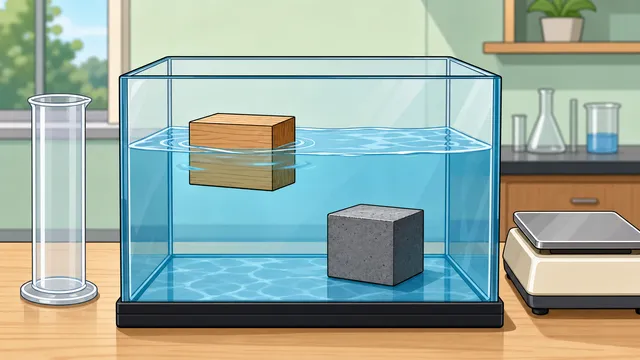
Calculate mass, density, or volume from the other two known values using the mass = density × volume relationship, with SI unit conversions.
Last updated
Mass, density, and volume worksheet Use this mass calculator to solve m = ρ × V, density = mass ÷ volume, or volume = mass ÷ density with unit conversions kept visible for checking.
Quick scenarios
Result
1000 kg/m³ across 1 L gives a mass of 1 kg. The density is close to Water.
1 kg
Mass
1
Formula
m = ρ × V
Closest reference
Water
Mass (kg)
1
Density (kg/m³)
1,000
Volume (m³)
0
Planning check
Value
Why it helps
Water-equivalent volume
1 L
How many litres of water would have roughly the same mass.
Earth weight-force context
9.81 N
Force under standard Earth gravity; mass itself does not change with location.
Density compared with water
1 × water
A quick buoyancy and sanity-check ratio for the entered density.
Conversion
Value
Mass
1 kg
Mass
1,000 g
Mass
2.2 lb
Density
1,000 kg/m³
Density
1 g/cm³
Volume
0 m³
Volume
1 L
Volume
0.26 US gal
Reference material
Density
Selected vs ref
Air
1.23 kg/m³
816.33×
Water
1,000 kg/m³
1×
Concrete
2,400 kg/m³
0.42×
Steel
7,850 kg/m³
0.13×
Gold
19,300 kg/m³
0.05×
Mass is not weight The Earth weight-force row is only a context check. Use a weight-force calculator when local gravity, force units, or non-Earth conditions matter.
Mass calculator guide: solve mass, density, or volume with unit-conversion examples
Mass, density, and volume are linked by the relationship rho = m / V. Rearranged, that means you can solve for mass, density, or volume from the other two values. This calculator handles all three modes and keeps the unit conversions visible enough to check whether the result is physically sensible.
The mass–density–volume relationship
Mass (m) is the amount of matter in an object, measured in kilograms. Density (ρ) is mass per unit volume, commonly in kg/m³ or g/cm³. Volume (V) is the space the object occupies. The three are related by m = ρV. Water at 4 °C has a density of 1000 kg/m³, which means one litre weighs exactly one kilogram — a useful anchor for real-world estimates.
Worked example: one litre of water
A helpful check case is water near 4 °C. If the density is 1000 kg/m³ and the volume is 1 L, the volume converts to 0.001 m³ and the mass becomes 1 kg. The same example also works cleanly in mixed units because 1 g/cm³ multiplied by 1 L gives the same final mass once the calculator converts both quantities into SI units internally.
That kind of anchor example matters because density and volume units often look interchangeable when they are not. Confusing cm³ with m³ or g/cm³ with kg/m³ can change the result by factors of 1000 or more even when the arithmetic itself is correct.
Unit conversions and practical examples
A steel ball with density 7850 kg/m³ and volume 500 cm³ (0.0005 m³) has a mass of 3.925 kg. Switching to g/cm³ for density and cm³ for volume gives the same result: 7.85 g/cm³ × 500 cm³ = 3925 g = 3.925 kg. The calculator converts all inputs to SI before computing, then converts the result back to your chosen output unit.
How the calculator checks the answer
A mass from density and volume calculator is most useful when it does more than return one number. This page also shows common mass, density, and volume conversions, compares the selected density with reference materials such as water and steel, and gives a water-equivalent volume as a quick scale check.
Those context rows are meant to catch common mistakes. If one litre of a material with water-like density does not come out near one kilogram, check whether the volume was entered as litres, cubic centimetres, or cubic metres. If a dense metal result looks too light, check whether the density was entered as g/cm³ but interpreted as kg/m³.
Mass vs weight in real calculations
Mass measures matter; weight is a force caused by gravity. Everyday language often uses the two interchangeably, but physics and engineering calculations separate them. The calculator includes an Earth weight-force context row only to help users connect mass to familiar force units under standard gravity.
If the problem gives force in newtons or asks what something weighs on Earth, the Moon, or another acceleration field, use a weight-force workflow instead of treating the force as mass. The mass-density-volume equation still needs actual mass, density, and volume values.
Using the calculator for irregular, hollow, or composite objects
For irregular objects, measure volume first by displacement, 3D model volume, or a separate geometry calculator, then enter that volume with the material density. For hollow objects, decide whether you need material mass or apparent density: material mass uses the volume of the walls or shell, while apparent density uses the full outside volume including void space.
Composite objects need either a measured effective density or separate calculations by material. For example, a steel-and-foam assembly should not use steel density across the full outside volume unless the entire volume is actually steel.
How to keep density, mass, and volume units consistent
The easiest workflow is to keep one unit system in mind from start to finish. If you enter density in kg/m³, pair it with volume in m³ and let the calculator return mass in kilograms. If you prefer cgs units, keep density in g/cm³ and volume in cm³ so the arithmetic stays aligned with the unit scale you expect.
That consistency check is useful when the answer seems too large or too small. In many cases the issue is not the mass formula itself but a hidden unit mismatch, such as mixing litres with cubic metres or grams with kilograms.
Frequently asked questions
What is the difference between mass and weight?
Mass is the amount of matter in an object and is constant regardless of location. Weight is the gravitational force acting on that mass (W = mg) and varies with gravitational acceleration — you weigh less on the Moon, but your mass is unchanged.
Which density value should I use for a composite object?
Use the effective density: total mass divided by total volume. For a hollow object, use the total external volume including any air spaces, which gives the apparent density used in buoyancy calculations.
How do I calculate mass from density and volume?
Use mass = density × volume. Enter the density and volume in compatible units, then convert the result into the output unit you need. For example, 7.85 g/cm³ × 500 cm³ gives 3925 g, which is 3.925 kg.
Can I use this calculator for irregular or hollow shapes?
Yes, if you know the total occupied volume or the effective density. For irregular objects, measure or estimate the volume first. For hollow objects, use the full external volume rather than the material thickness alone if you want the apparent density.
Why does the result change when I switch units?
The underlying physics does not change, but the displayed number can change a lot when the units change. A kilogram is 1000 grams, and a cubic metre is 1,000,000 cubic centimetres, so a unit mismatch can produce a result that looks dramatically different even when the converted answer is identical.
What if I only know weight, not mass?
Weight is a force, not a mass value, so you first need to convert it using the local gravitational field. If you are working from force rather than matter content, use a weight-force calculator or the same mass relationship after converting the force into mass under the relevant gravity assumption.
Why does one litre of water equal about one kilogram?
Water near its maximum-density temperature is close to 1000 kg/m³, which is the same as 1 kg/L or 1 g/cm³. That makes one litre of water a useful check case for a mass density volume calculator.
Can this calculator identify a material from density?
It can compare the calculated density with a few common reference materials, but that is only a sanity check. Many materials overlap by density, and temperature, porosity, impurities, and hollow space can change the effective density.
How do I calculate mass for a hollow container?
Use the volume of the actual material if you want material mass. Use the outside volume only if you are calculating apparent density or buoyancy behavior for the whole object, including the air or empty space inside.
Is density always constant?
No. Density can change with temperature and pressure, especially for gases and some liquids. For precise lab, engineering, or safety-critical calculations, use density data measured under the same conditions as the sample.