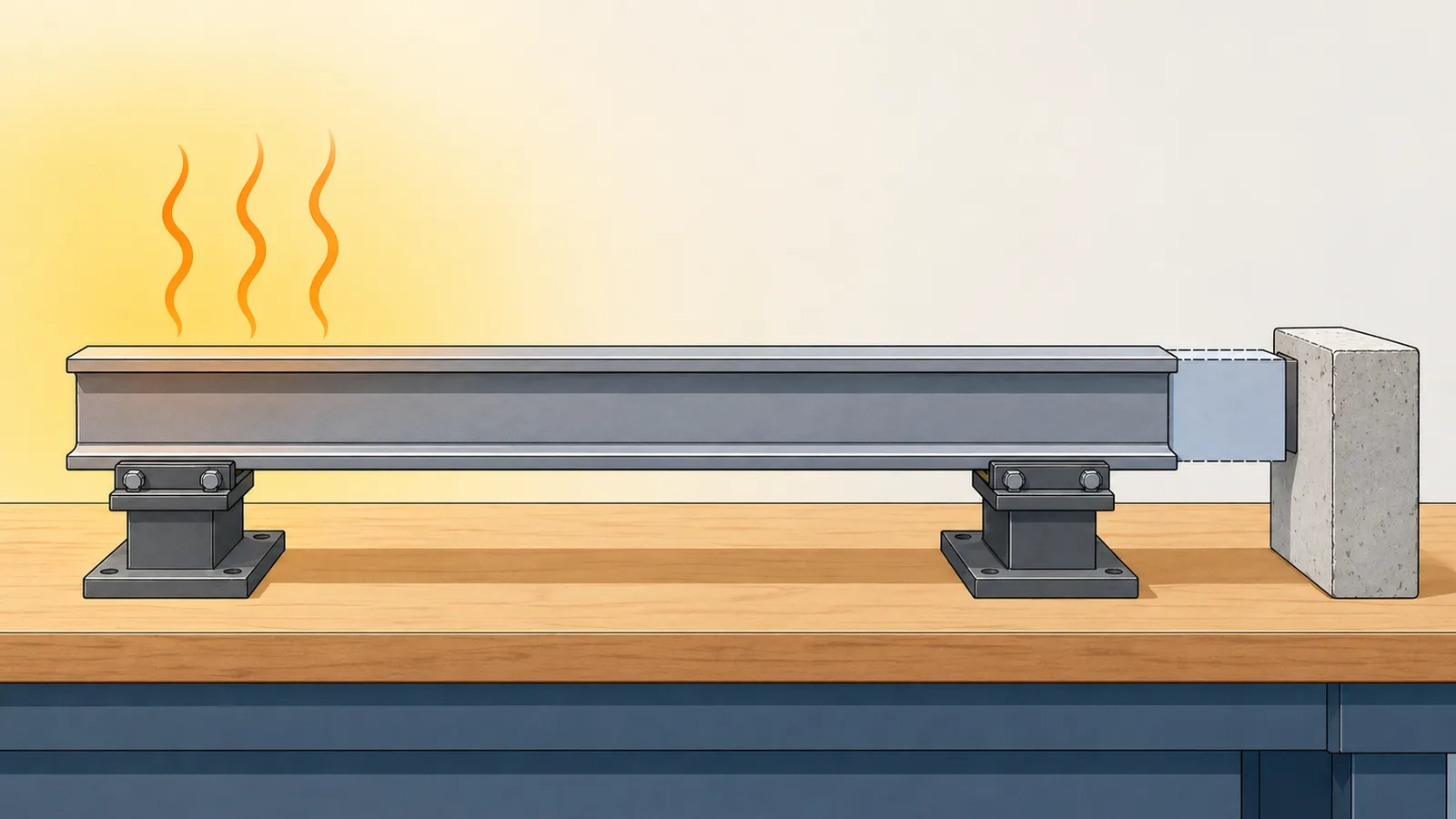
How much does steel expand per metre per degree?
Using a typical linear coefficient near 12 × 10⁻⁶ per °C, one metre of steel grows by about 0.012 mm for every 1°C rise in temperature. Over long lengths or large temperature swings, that small per-degree change adds up quickly.
Why does aluminium expand more than steel?
Because aluminium has a higher coefficient of thermal expansion. A typical aluminium value is roughly double a typical steel value, so the same length and temperature rise produce more movement in aluminium than in steel.
Why are area and volume expansion often written as 2α and 3α?
For small temperature changes in isotropic solids, each dimension expands by roughly the same fractional amount. Two dimensions produce the 2α area approximation and three dimensions produce the 3α volume approximation. These are useful engineering shortcuts, not universal laws for every material and condition.
Can I use this calculator to size an expansion joint?
You can use it to estimate the free movement that a joint may need to absorb, but joint sizing also depends on restraint, support spacing, pressure, fatigue, materials, and code rules. Final design should come from the governing product data and an engineering review.
Why can the real expansion differ from the calculator result?
Because published coefficients are usually average values, not exact constants for every alloy, product grade, moisture state, or temperature band. Once tolerances are tight or the assembly is constrained, the correct material data sheet and engineering design method matter more than a generic reference coefficient.
Does cooling just reverse the sign of thermal expansion?
For a simple constant-coefficient estimate, yes. A negative temperature change gives a negative movement, so the part contracts instead of expanding. In practice, the cold condition can be just as important as the hot condition because contraction may open joints, unload seals, or pull components away from stops.
How do I use the result to check whether a gap is large enough?
Compare the predicted free movement with the actual travel the detail can tolerate. If the calculated movement is smaller than the available gap or joint allowance, the detail may be adequate at a first-pass level. If the movement exceeds the available allowance, you need more gap, a shorter free run, a smaller temperature swing, a different material, or a redesigned support/joint detail.
Why does the calculator treat water as a direct volumetric coefficient?
The common 3α shortcut is for isotropic solids when you start from a linear coefficient. Liquids are usually tabulated with a direct volumetric coefficient instead. Applying 3α to a number that is already volumetric would double-count the expansion effect and overstate the result.
When do I need thermal stress analysis instead of a thermal expansion calculator?
You need the stress side when the part cannot move freely because it is restrained by anchors, welds, bonded interfaces, or surrounding geometry. In that case the main concern may be force, stress, buckling, cracking, or anchor load, not just movement. Free expansion is still useful, but it is only the start of the design check.
What does the fully restrained stress estimate mean?
It estimates the stress that would develop in a simple linear member if thermal expansion or contraction were completely blocked. The formula is σ ≈ EαΔT, so the answer depends on the material's Young's modulus, the linear coefficient of expansion, and the temperature swing. Real supports and joints may relieve some movement, so use the value as a screening check rather than a final structural design result.
Can I use the same coefficient over a very large temperature range?
Usually only as a rough first estimate. Coefficients are often average values near a limited temperature band, and they can change enough over wide ranges that a constant-α model becomes inaccurate. For high-temperature, cryogenic, or precision work, use manufacturer or handbook data that match the actual operating range.
Why do borosilicate and soda-lime glass behave so differently?
Because their compositions are different and that changes their thermal properties. Borosilicate glass is designed to have a much lower coefficient of thermal expansion than ordinary soda-lime glass, which is why it is commonly chosen where thermal shock resistance or dimensional stability matters.