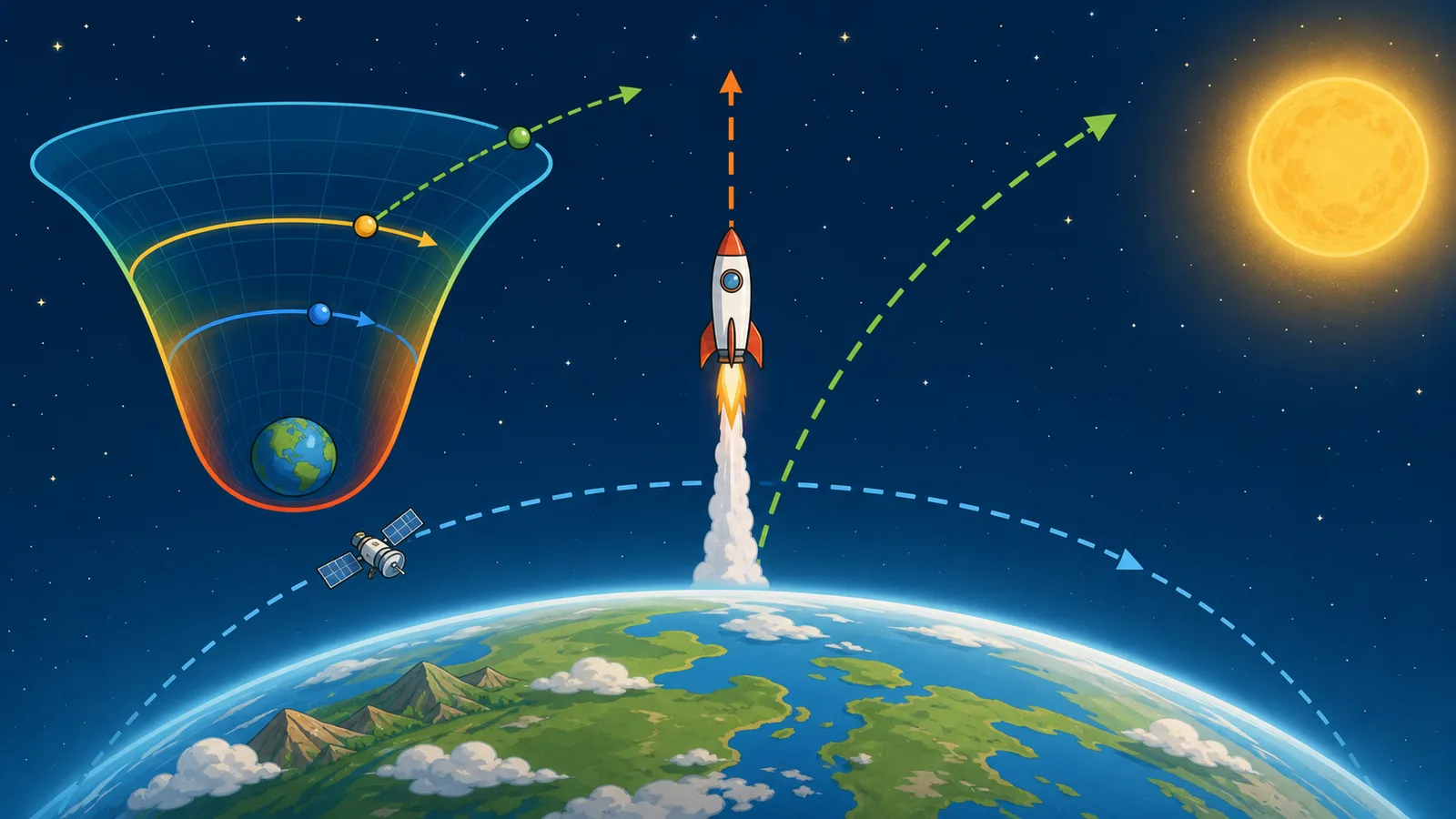
Estimate escape velocity for Earth, Moon, Mars, Jupiter, Sun, or a custom body from mass, radius, and launch altitude, then compare local orbital speed.
Last updated
Body preset
Compare gravitational wells, not rocket mass Escape speed is calculated for an ideal airless launch from the current orbital radius. Add altitude above the surface to see how the required speed changes away from the body's surface.
11.19 km/s
Escape velocity at the current radius
11,185.98 m/s from an orbital radius of 6,371 km.
Circular orbit speed
7.91 km/s
Surface altitude
0 km
Surface gravity
9.82 m/s²
In kilometres per hour
40,269.52 km/h
In miles per hour
25,022.32 mph
Escape/orbit ratio
1.41×
What this result means
This is the ideal speed needed for total mechanical energy to reach zero in a two-body model. Real rockets do not have to hit that speed instantly at launch; continuous thrust, atmospheric drag, planetary rotation, and mission trajectory all change the practical mission profile.
Formula snapshot
v = √(2GM / r)
Here, r is the body's radius plus altitude. The matching circular-orbit speed is √(GM / r), which is why ideal escape velocity is √2 times the local circular orbital speed.
Escape velocity calculator guide: formula, orbital-speed comparison, and planet examples
An escape velocity calculator helps you estimate how fast an object must move to break free from a planet, moon, star, or custom body without additional propulsion. This version lets you compare Earth, Moon, Mars, Jupiter, the Sun, or a custom body from mass, radius, and launch altitude, then interpret the result alongside local circular-orbit speed, surface gravity, km/h, mph, and the escape/orbit ratio.
What escape velocity means in practice
Escape velocity is the minimum ideal speed required for an object to move away from a gravitating body and never fall back if no further thrust is added. In the simplest two-body model, that means the object's total mechanical energy reaches zero exactly as it recedes to an infinite distance.
For Earth at sea level, the familiar benchmark is about 11.2 km/s. Smaller bodies such as the Moon have lower escape speeds because their mass is much smaller, while more massive planets such as Jupiter require dramatically higher launch energy. The Sun's escape speed near its visible radius is far higher again, which makes it a useful upper-end preset for order-of-magnitude comparison. That is why an escape velocity calculator is useful both for classroom physics and for quick comparisons across celestial bodies.
The number is best read as an energy threshold, not as a literal launch command. Real rockets do not need to instantaneously jump to escape speed at liftoff. They can continue to accelerate while climbing, and the actual mission profile depends on thrust, staging, trajectory, drag, and the rotation of the launch body.
How the escape velocity formula works
The standard formula comes from equating kinetic energy with the magnitude of gravitational potential energy: v = √(2GM/r). Here G is the gravitational constant, M is the mass of the planet or moon, and r is the distance from the body's centre. On a surface launch, r is the body's radius. If you launch from altitude, r becomes radius plus altitude.
That radius term matters more than many people expect. Two bodies can have similar surface gravity but very different escape speeds if one is much larger, because the object must climb out of the gravitational well over a greater distance. Escape velocity therefore depends on both mass and radius, not on surface gravity alone.
This calculator also reports the local circular orbital speed at the same radius. That comparison is valuable because the ideal escape speed is always √2 times the circular-orbit speed at the same location. If the orbital speed looks familiar but the escape speed does not, this relationship helps anchor the result.
v_escape = √(2GM / r)
Escape velocity from a spherical body's centre-of-mass distance r.
v_orbit = √(GM / r)
Circular orbital speed at the same radius; ideal escape velocity is √2 times this value.
r = R_body + h
When launch altitude h is above the surface, use body radius plus altitude for the orbital radius.
Worked example: Earth surface versus low Earth orbit
Using Earth's mass (5.972 × 10^24 kg) and mean radius (6371 km), the surface escape speed is about 11.19 km/s. The matching circular orbital speed at the same radius is about 7.91 km/s. That ratio of about 1.414 is exactly the √2 relationship predicted by the ideal formulas.
Now raise the launch point to roughly 400 km above Earth's surface, comparable to a low Earth orbit altitude. The orbital radius becomes about 6771 km, the local circular orbital speed drops slightly, and the escape velocity falls to about 10.85 km/s. The change is not huge, but it shows why altitude belongs in a stronger escape velocity calculator rather than being treated as a footnote.
The same comparison helps with planet-to-planet intuition. The Moon's escape speed is only about 2.38 km/s, while Mars is about 5.03 km/s, Jupiter exceeds 60 km/s near its cloud-top reference radius, and the Sun is roughly 618 km/s near its reference radius. Those differences explain why some bodies are easier to leave, easier to retain an atmosphere, or harder to access energetically.
Surface gravity, speed units, and the Sun preset
Competitor escape speed tables often show a short list of planets but leave users to convert units or infer why bodies with similar surface gravity can still have different escape speeds. This calculator reports escape speed in km/s, km/h, and mph, then adds surface gravity so the gravity-well comparison is easier to read.
Surface gravity is calculated at the body's reference radius, while escape velocity is calculated at radius plus altitude. The two ideas are related but not interchangeable. Surface gravity describes local acceleration near the surface; escape velocity describes the total energy needed to climb out of the gravitational well.
The Sun preset is included for scale. It is not a launch-planning scenario, but it is useful for understanding why stellar gravity wells are so much deeper than planetary ones and why escape speed depends on both mass and radius.
g_surface = GM / R²
Surface gravity at the body's reference radius R.
v_escape / v_orbit = √2
In the same ideal circular two-body model, escape speed is always √2 times circular orbital speed at that radius.
Escape velocity versus orbital velocity and common misconceptions
A common search intent on this topic is whether escape velocity and orbital velocity are the same thing. They are not. Orbital velocity is the speed needed to keep falling around a body in a closed path, while escape velocity is the higher threshold needed to avoid remaining bound. At the same radius in the ideal model, escape speed is √2 times orbital speed.
Another frequent misconception is that rocket mass should appear in the escape velocity equation. It does not. The rocket's mass affects how much propellant and thrust are needed to achieve a given trajectory, but the local escape-speed threshold itself depends only on the gravitating body's mass, the orbital radius, and the gravitational constant. The mass of the test object cancels out when kinetic and gravitational potential energy are equated.
People also often ask whether a vehicle must reach escape velocity immediately at launch. The answer is no. Continuous propulsion can add energy over time, and real launch trajectories are optimized around staging, drag losses, gravity losses, and mission targets rather than a single instantaneous speed threshold at the pad.
This page intentionally uses a clean spherical two-body model, which makes it excellent for learning and for rough comparisons but not for mission design. The calculation assumes a vacuum, so it ignores atmospheric drag and heating. It also assumes the body is spherically symmetric and does not correct for local topography, oblateness, or changing density with altitude.
It does not model the boost from planetary rotation, which can matter substantially for launches near the equator, and it does not estimate delta-v budgets, staging, transfer windows, or finite-thrust trajectories. In other words, the result is a physics reference value rather than a launch-plan answer.
That scope is still useful. The tool gives you a fast way to compare gravitational wells, check textbook numbers, understand why low-orbit speed and escape speed are linked, and decide when you need a more detailed astrodynamics model instead of a simple escape velocity formula calculator.
Escape velocity is the minimum ideal speed needed for an object to leave a body's gravitational field without any further propulsion. In the standard two-body model, it is the speed at which the object's kinetic energy is just enough to offset the gravitational potential-energy barrier. For Earth near the surface, that reference value is about 11.2 km/s.
Is escape velocity the same as orbital velocity?
No. Circular orbital velocity keeps an object bound to the planet or moon, while escape velocity is the higher threshold needed to become unbound. At the same radius in the ideal model, escape speed is exactly √2 times the local circular orbital speed, so the two numbers are related but not interchangeable.
Does the mass of the rocket affect escape velocity?
Not in the ideal escape-speed formula itself. When you derive escape velocity by equating kinetic energy and gravitational potential energy, the mass of the launched object cancels out. Rocket mass still matters enormously for real mission design because it changes the propulsion problem, fuel fraction, staging requirements, and achievable trajectory, but it does not change the local escape-speed threshold for a given body and radius.
Do rockets need to reach escape velocity instantly at launch?
No. Real rockets can keep adding energy while they climb, so they do not need to achieve one single instantaneous speed at the launch pad. The ideal escape-velocity number is best understood as a reference energy threshold. Actual launches are shaped by continuous thrust, drag, gravity losses, steering, staging, and the mission objective, which is why a real interplanetary launch is planned with delta-v and trajectory analysis rather than one raw speed target.
Why does the calculator show surface gravity too?
Surface gravity helps explain the local acceleration near the body's reference radius, while escape velocity measures the total energy threshold needed to leave the gravity well. A large body can have moderate surface gravity but a high escape speed because the object must climb out over a much larger distance.
Why include the Sun in an escape velocity calculator?
The Sun preset gives a scale reference for a much deeper gravity well than a planet or moon. It is not meant as a real launch scenario, but it makes the mass-radius relationship behind escape speed much easier to compare.