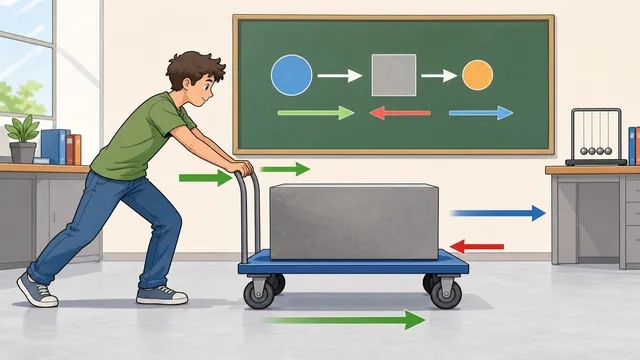
Momentum is the product of an object's mass and velocity: p = mv. It is a fundamental conserved quantity in physics — in any closed system, total momentum before and after a collision remains constant. This calculator computes momentum, or solves for mass or velocity when the other values are known.
Linear momentum: p = mv
A 1000 kg car travelling at 20 m/s has a momentum of 20,000 kg·m/s. A 0.145 kg baseball pitched at 40 m/s has a momentum of 5.8 kg·m/s. Despite the enormous difference in mass, the baseball's momentum is enough to knock a bat backward, illustrating that velocity matters just as much as mass.
Momentum is a vector quantity — it has both magnitude and direction. Two objects with equal mass and speed moving in opposite directions have momenta that cancel when summed, giving zero net momentum for the system.
p = m × v
p is momentum in kg·m/s, m is mass in kg, and v is velocity in m/s.
Impulse = F × Δt = Δp
The impulse–momentum theorem states that a force applied over time equals the change in momentum.
Conservation of momentum in collisions
In an isolated system, total momentum is conserved: m₁v₁ + m₂v₂ = m₁v₁' + m₂v₂'. In a perfectly inelastic collision, the objects stick together and move with a common velocity. In an elastic collision, both momentum and kinetic energy are conserved. Real-world collisions fall between these extremes.
Worked example and interpretation
A worked example helps translate the momentum calculator maths into a realistic scenario so the user can compare the headline result with a concrete set of inputs.
That matters because a result is easier to trust when the page shows how the same logic behaves in a practical case instead of leaving the formula abstract.
Frequently asked questions
What is the difference between momentum and kinetic energy?
Momentum (p = mv) is a vector and scales linearly with velocity. Kinetic energy (KE = ½mv²) is a scalar and scales with the square of velocity. Doubling velocity doubles momentum but quadruples kinetic energy. Momentum is always conserved in collisions; kinetic energy is only conserved in perfectly elastic collisions.
Why do airbags reduce injury in car crashes?
Airbags increase the time over which a passenger decelerates. Since impulse (FΔt) equals the change in momentum, extending the time Δt for the same momentum change reduces the average force F on the body. This is the same principle behind crumple zones and padded dashboards.
How can I check the momentum calculator result manually?
The safest manual check is to follow the same formula or rule one step at a time and compare that working with the calculator output. That catches sign errors, bracket mistakes, and input-order mixups without requiring any extra method beyond the underlying maths itself.