Calculate force, mass, or acceleration with Newton's second law F = ma, combine signed net forces, convert newtons, kilonewtons, pound-force, kilogram-force.
Last updated
Solve Newton's second law with clear units Use F = ma to calculate force, mass, or acceleration. Enter signed force values when direction matters:
positive and negative pushes are combined into the net force used by the formula.
Solve for
Example presets
Assumptions
This is a one-dimensional net-force calculator for classical mechanics. Use signs to represent direction,
use mass rather than weight, and use a separate free-body diagram when forces act in multiple directions.
Result
Force
20 N
The net force points in the positive direction of your sign convention and produces 0.203943 g of acceleration magnitude.
Force is the interaction that changes the motion of an object. Newton's second law defines force as the product of mass and acceleration: F = ma. This calculator solves for force, mass, or acceleration when the other two are known, covering everything from everyday pushing and pulling to engineering load analysis.
Newton's second law: F = ma
Force equals mass multiplied by acceleration. A 10 kg object accelerating at 3 m/s² experiences a net force of 30 N. The same equation rearranges to find mass (m = F/a) or acceleration (a = F/m). The SI unit of force is the newton (N), defined as the force needed to accelerate 1 kg at 1 m/s².
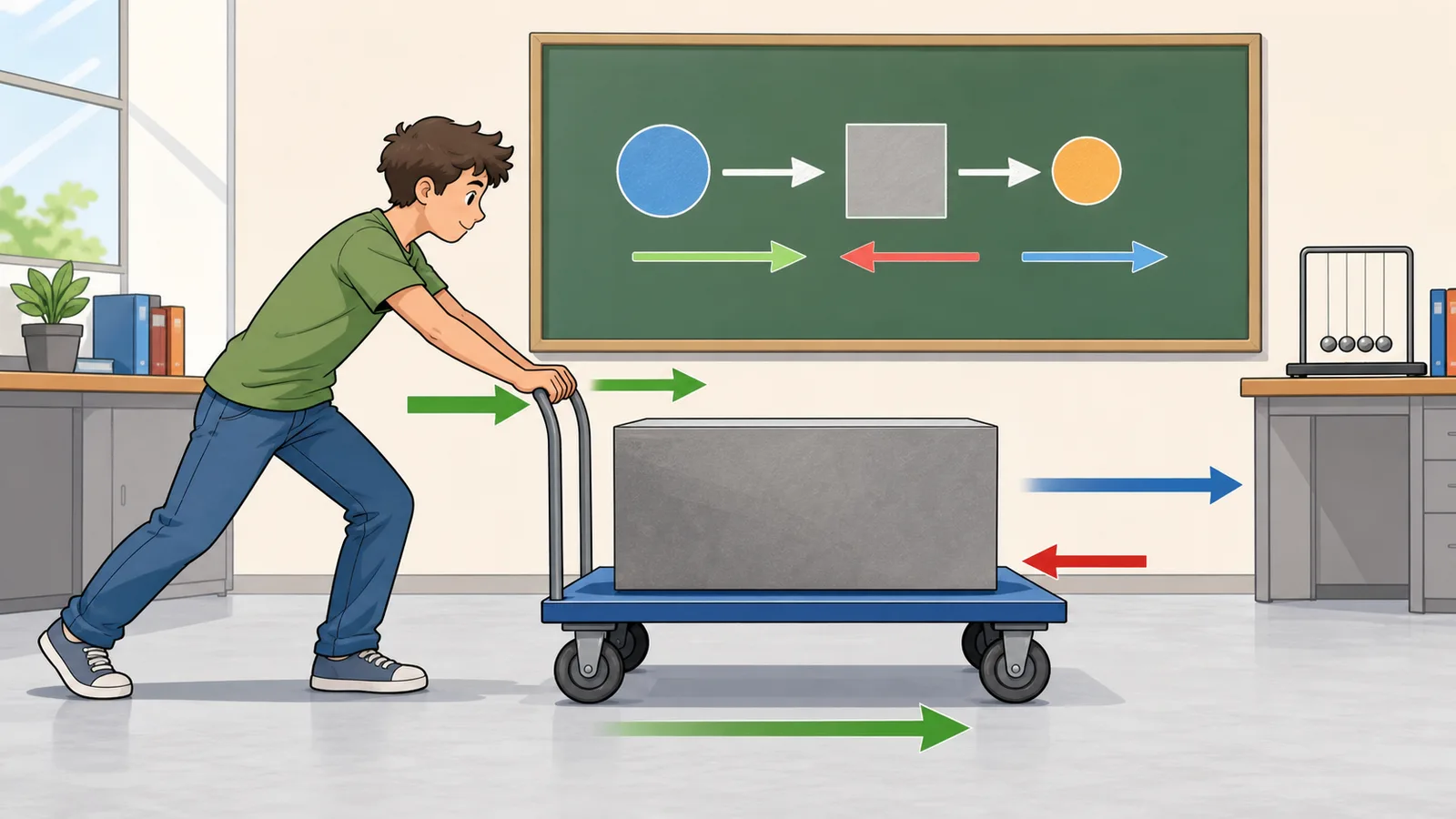
When multiple forces act on an object, the net force determines the resulting acceleration. If two people push a box with 50 N and 30 N in opposite directions, the net force is 20 N in the direction of the larger push, and only that net force appears in F = ma.
F = m × a
F is force in newtons, m is mass in kilograms, and a is acceleration in metres per second squared.
W = m × g
Weight is a special case of F = ma where the acceleration is gravitational acceleration (g ≈ 9.81 m/s²).
Common force units and conversions
Engineers and scientists use several force units. One kilonewton (kN) equals 1000 N and is common in structural engineering. One pound-force (lbf) equals approximately 4.448 N. One dyne (used in the CGS system) equals 10⁻⁵ N. The kilogram-force (kgf) equals 9.80665 N and represents the force of gravity on a 1 kg mass at sea level.
Signed net force and direction
Newton's second law uses net force, not every applied force separately. If two forces act along the same line, choose one direction as positive and enter opposing forces with the opposite sign. A +120 N push and a −30 N resistive force combine to a +90 N net force.
The sign of the result is a direction convention. A negative force or acceleration does not mean the value is invalid; it means the net force points opposite your chosen positive direction. This is why the calculator reports the force direction as positive, negative, or zero.
Mass, weight, and pound-force
Mass and weight are often confused. Mass measures how much matter is in an object; weight is the gravitational force on that mass. In SI units, mass is entered in kilograms and force is returned in newtons. In US customary examples, pound-mass (lbm) and pound-force (lbf) are related through standard gravity, so unit conversion matters.
For ordinary classroom and engineering estimates, this calculator treats lb as pound-mass and lbf as pound-force. If you are calculating weight rather than a general F = ma problem, use the related weight-force calculator because it makes the gravity assumption explicit.
Worked example with opposing forces
Suppose a 12 kg cart is pushed forward by 120 N while friction and drag oppose the motion with 30 N. The signed net force is 120 − 30 = 90 N. Solving for acceleration gives a = F/m = 90/12 = 7.5 m/s².
If the same cart needed to accelerate at 2 m/s², the required net force would be F = ma = 12 × 2 = 24 N. Any combination of pushes and resistance that leaves 24 N in the chosen positive direction would produce that acceleration in this simplified one-dimensional model.
When this simple force calculator is not enough
This page is a scalar, one-dimensional Newton's second law calculator. It is best for straight-line problems where forces have already been resolved into a single direction. It does not draw a free-body diagram, decompose angled vectors into components, model friction coefficients, or solve systems of connected bodies.
For circular motion, impacts, and weight under different gravity values, use the specialised centripetal force, impact force, or weight-force calculators. Those pages make the extra assumptions visible instead of hiding them inside a single F = ma result.
NIST — SI units — NIST reference for SI units, including derived units used in mechanics.
Frequently asked questions
What is the difference between mass and force?
Mass is the quantity of matter in an object, measured in kilograms, and it does not change with location. Force is an interaction measured in newtons that can cause a mass to accelerate. Weight is the gravitational force on a mass, so it changes depending on the local gravitational field.
Why does F = ma not work for objects near the speed of light?
At speeds approaching the speed of light, relativistic effects become significant. The classical F = ma is an approximation valid at everyday speeds. At relativistic speeds, the relationship between force and acceleration depends on the Lorentz factor, and momentum rather than acceleration becomes the more fundamental quantity.
How do I calculate force when acceleration is not constant?
When acceleration varies over time, force also varies. F = ma still applies at each instant, so you evaluate it at specific moments or use calculus (F = m × dv/dt) to describe the force as a continuous function of time.
What does net force mean in the force calculator?
Net force is the sum of the forces acting along the direction you are analysing. Forces in the same direction are added; forces in the opposite direction should be entered with the opposite sign. The resulting net force is the value used in F = ma.
Can force or acceleration be negative?
Yes. In a one-dimensional force calculation, the sign tells you direction relative to the positive direction you chose. A negative force or acceleration is physically meaningful when the net force points opposite that convention.
Should I enter mass in pounds or weight in pounds?
For this page, lb means pound-mass and lbf means pound-force. If you know an object's weight due to gravity rather than its mass, use a weight-force calculator or convert carefully because weight changes when gravity changes.
Does this force calculator handle angled vectors?
No. Resolve angled forces into x and y components first, then use this page on one component at a time. A full free-body diagram or vector calculator is needed when forces act in multiple directions.