Estimate gutter width, downspout count and outlet size, section load, and pitch-adjusted roof drainage area from roof area, pitch, gutter run length.
Last updated
Roof drainage sizing planner Estimate the design roof area, gutter width, downspout count, and outlet size from plan area, roof pitch, gutter run length, and 5-minute rainfall intensity.
Quick gutter scenarios
Recommended gutter
6 in
Based on a section load of
1,260
ft²
and an IA value of
6,300.
Downspouts
2
40 ft per section
Round downspout size
3 in round
2 x 3 in rectangular equivalent
Design area
2,520 ft²
Required outlet area
5.25 sq in
Required gutter width
5.06 in
Rounded up to the nearest checked planning size.
Pitch factor
1.05x
Applied to the entered roof plan area before section sizing.
Pitch-adjusted gutter depth
The rectangular-gutter approximation uses a depth-to-width ratio of 0.75, which yields a planning depth of
4.5
in.
Common gutter-width checks for this section
5 in
Undersized
Max section design area:
1,216.36
ft²
6 in
Works
Max section design area:
2,026.61
ft²
7 in
Works
Max section design area:
3,120.47
ft²
8 in
Works
Max section design area:
4,535.22
ft²
How to use this result
The calculation applies a pitch factor to convert roof plan area into design area, then sizes each gutter section and downspout on the assumption that no section should exceed roughly 50 ft between ends or expansion points.
Keep each downspout-served section near the calculated section length before checking actual outlet locations.
The recommendation fits within the common planning sizes checked here, but the final profile still depends on the selected gutter system.
Use the local authority's rainfall intensity and return period rather than a generic regional average when the result affects code compliance.
This is a first-pass gutter-sizing estimate only. Final outlet spacing, gutter profile, fascia detail, and the governing rainfall return period still need to be confirmed against local code and the selected system details.
Gutter width, downspout count, and outlet sizing from roof area and rainfall
A gutter sizing calculator helps turn roof area, pitch, run length, and local rainfall intensity into a practical roof-drainage layout before the gutter profile is selected. This version estimates pitch-adjusted design area, splits long gutter runs into downspout-served sections, sizes the outlet area, and recommends a rectangular-gutter width using SMACNA-style roof-drainage methods.
What this gutter sizing calculator is estimating
A gutter system is not sized from roof area alone. Rainfall intensity, roof pitch, gutter run length, and outlet spacing all affect how much water a gutter section has to carry before it reaches a downspout.
This calculator starts with the roof plan area drained to a single gutter run, applies a pitch factor to produce a design drainage area, then divides the run into practical sections based on the common 50 foot limit between ends or expansion points.
How downspout size is estimated
SMACNA-style sizing methods use rainfall intensity and design roof area to determine how much roof area each square inch of downspout can drain. A commonly used rule is that one square inch of downspout area drains about 1,200 square feet of roof at 1 inch per hour rainfall, with capacity falling as rainfall intensity rises.
The calculator uses that drainage factor to estimate the minimum outlet area required for each section. It then selects the smallest standard round downspout size that clears the requirement and shows a rectangular equivalent for planning.
How gutter width is estimated
For rectangular gutters, the key load is IA, or rainfall intensity multiplied by section design area. The calculator uses a rectangular-gutter width approximation with a depth-to-width ratio of 0.75 to estimate the minimum gutter width for the section being served by each downspout.
That produces a planning recommendation for a rectangular or K-style-equivalent gutter width. Because actual gutter profiles vary, the result should be read as a first-pass width recommendation rather than a final product submittal.
Choosing rainfall intensity for a gutter size calculator
Rainfall intensity is the input that most often separates a useful gutter size calculator from a generic roof-area shortcut. A 2,000 square foot drainage area in a mild climate is not the same design problem as the same roof under a high-intensity coastal storm, so the calculator keeps rainfall intensity visible instead of hiding it inside a broad regional preset.
For SMACNA-style gutter and downspout sizing, the rainfall value should come from the authority having jurisdiction or a precipitation-frequency source appropriate to the project. If you only have a state average or a broad climate label, treat the result as a screening estimate and rerun the calculation once the local design intensity is known.
When more downspouts beat a wider gutter
Several weaker rain gutter calculators try to solve every overflow problem by choosing a wider trough. In practice, the downspout count and spacing can be just as important because water has to travel along the gutter before it can leave the system. A long run with too few outlets can overflow near the middle even when the nominal gutter width looks large enough.
This page therefore reports downspout count, section length, required outlet area, round and rectangular downspout equivalents, and common gutter-width checks. That gives you a clearer planning path: add outlets when a run is too long or the section load is too high, then confirm that the selected gutter profile and outlet details work together.
Using the result to check existing gutters
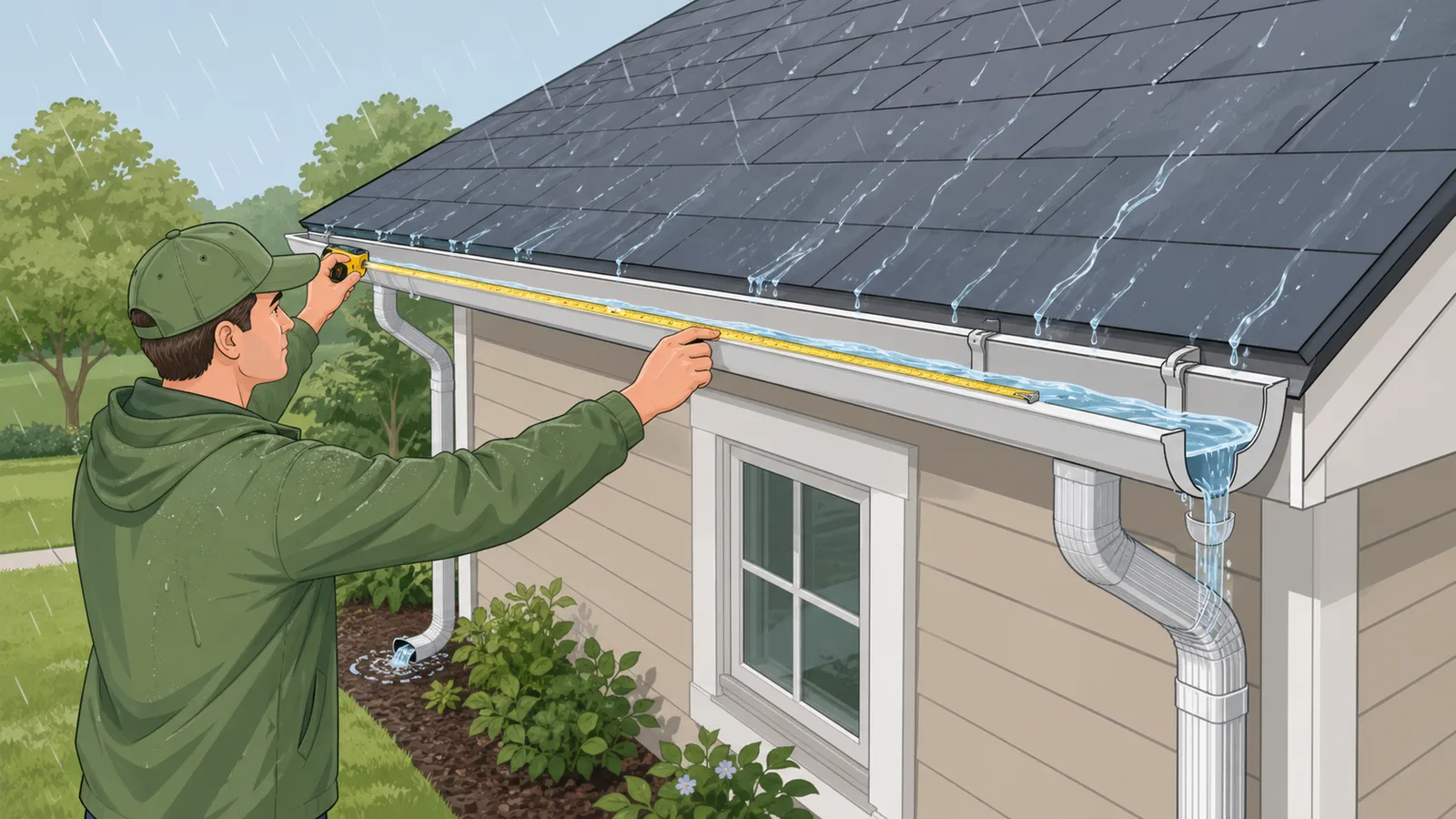
The same workflow can be used as a downspout sizing calculator for an existing roof. Enter the roof area drained to the current run, the local rainfall intensity, and the actual run length, then compare the recommended gutter width, downspout count, and outlet area with what is installed.
A mismatch does not automatically prove the existing system is defective, because slope, debris, outlet shape, valley discharge, fascia placement, and product profile all affect real performance. It does, however, identify the questions to ask before replacing a 5 inch gutter with a 6 inch gutter, adding a downspout, or changing outlet size.
Worked example
A 3,600 square foot roof plan area draining to one 120 foot gutter run with a flat roof factor of 1.00 and 6 inches per hour rainfall gives a design area of 3,600 square feet. Splitting the run into three 40 foot sections keeps each section within the common 50 foot rule, so each downspout serves about 1,200 square feet.
At that loading, the required outlet area is about 6 square inches per downspout, which points to a 3 inch round downspout as the first standard size above the minimum. The rectangular-gutter width approximation yields a width a little above 5 inches, so the calculator rounds the planning recommendation up to a 6 inch gutter.
Frequently asked questions
How do you size a gutter and downspout?
Start with the roof area that drains to the run, adjust that area for roof pitch if required by the sizing method, apply the local 5-minute rainfall intensity, and then size both the downspout outlet area and the gutter width for the section length served by each downspout.
Why does roof pitch matter in gutter sizing?
Steeper roofs move water into the gutter faster and increase the design drainage load compared with the same plan area on a flatter roof. That is why SMACNA-style methods use a pitch factor rather than plain roof plan area alone.
How far apart should downspouts be?
A common planning rule is to keep gutter sections to about 50 feet or less between ends or expansion points unless the system is specially engineered. The calculator uses that as a conservative section-length starting point before checking outlet size.
Can I use hourly rainfall data instead of 5-minute intensity?
Only if the governing local method allows it. SMACNA-style gutter sizing commonly references short-duration rainfall intensity, so the local authority or design standard should determine which duration and return period are appropriate.
Should leaf guards change how I size the gutter?
Leaf guards can reduce clogging risk, but they do not remove the need to size the gutter and downspout for the rainfall load. In practice, guards may affect maintenance and flow behavior, but the drainage calculation still starts with roof area, pitch, rainfall intensity, and section length.
Is a 5 inch or 6 inch gutter better for my house?
A 5 inch gutter can be adequate for many smaller or moderate-rainfall roof sections, while a 6 inch gutter is often the next planning size when the roof drainage area, pitch factor, or local rainfall intensity is higher. The calculator shows the required width and common width checks so you can see whether the next larger gutter is solving a real hydraulic load or simply adding cost.
How do I find the rainfall intensity for gutter sizing?
Use the local design rainfall intensity required by the authority having jurisdiction, a recognised precipitation-frequency source, or the standard specified for the project. Avoid using a generic annual rainfall total, because gutter sizing depends on short-duration storm intensity rather than how much rain falls across a whole year.
Can this calculator size half-round gutters?
The calculator reports a rectangular or K-style-equivalent planning width from the SMACNA-style rectangular-gutter approximation. Half-round profiles have different capacity behaviour, so use this result as a load and outlet planning check, then confirm the exact half-round size against the selected manufacturer's capacity table or the governing standard.
Why does adding downspouts change the gutter recommendation?
Adding downspouts shortens the section of gutter served by each outlet and reduces the design roof area each section has to drain. That can lower the required outlet area and make a common gutter size workable without forcing the entire run into a larger custom profile.
What should I check if gutters overflow even though the size looks adequate?
Check for clogged outlets, undersized drop outlets, insufficient slope, water entering from valleys or upper roofs, blocked downspouts, poor end-cap or corner detailing, and roof edges that overshoot the gutter in intense rain. A sizing result only checks the drainage load; it cannot see installation defects or maintenance problems.