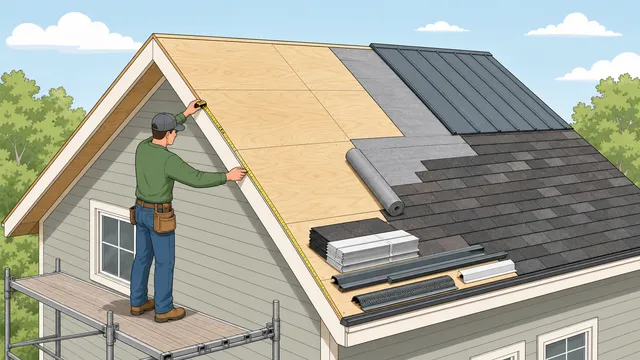
Estimate plywood or OSB sheathing sheets for roof decking from measured area or footprint plus pitch, with roof squares, waste guidance, spare coverage.
Last updated
Roof decking and sheathing takeoff Estimate plywood or OSB sheathing sheets from measured roof area or footprint plus pitch, then compare waste-adjusted order count, roof squares, spare coverage, and cost before you place the panel order.
Quick takeoff examples
Input method
Layout complexity
Sheets to order
37 panels
That covers about 1,159.18 sq ft after waste, or roughly 10.73 roofing squares before contingency.
Base sheets
34
Waste sheets
3
Purchased coverage
1,184 sq ft
Spare coverage
24.82 sq ft
Takeoff check
Value
Footprint area
960 sq ft
Pitch multiplier
1.12
Estimated roof area
1,073.31 sq ft
Area with waste
1,159.18 sq ft
Panel coverage each
32 sq ft
Recommended waste range
5% to 8%
Estimated material cost
Add a sheet price
How to use this result
Use the base-sheet count for the clean geometric takeoff, then use the order quantity for purchasing. The waste-range check helps you decide whether the current allowance fits a simple gable roof, a hip roof with valleys, or a wall-sheathing job with more opening cuts.
Footprint plus pitch is a planning shortcut for simple rectangular roofs. If the job has dormers, multiple planes, or a measured tear-off area from plans, switch to measured roof area for a more reliable plywood or OSB sheathing estimate.
Plywood sheathing calculator for roof decking, OSB sheet count, roof squares, and waste
A plywood sheathing calculator helps you estimate how many sheets of plywood or OSB you need for roof decking, wall sheathing, or a repair patch before you call the supplier.
Why a roof sheathing calculator needs more than square footage alone
Weak plywood sheet calculators stop at area divided by panel coverage. That is enough for a rough material count, but it is not enough for a real roof sheathing estimate. Roof pitch changes actual deck area, roof complexity changes waste, and the panel size you order changes how much extra coverage you buy beyond the waste-adjusted target.
That is why this plywood sheathing calculator is structured as a roof decking calculator first and a generic sheet count tool second. It returns base sheets, waste sheets, purchased coverage, roof squares, and spare coverage so you can move from a rough count to a practical order quantity.
Measured roof area versus footprint plus pitch
If you already have a measured roof area from plans, a drone report, or a tear-off measurement, use that value directly. That is the cleaner input because it reflects the actual roof deck surface instead of an approximation. It is especially helpful on roofs with hips, valleys, offsets, dormers, or a lot of penetrations.
If you only know the building footprint, use the footprint plus pitch option. The calculator multiplies the footprint area by a pitch multiplier to estimate the sloped roof area. That works best for simple rectangular roofs such as gable and shed layouts. Once the roof breaks into multiple planes, measured area is usually the more reliable choice.
Footprint area = Length x Width
The projected plan area of the building before pitch is applied.
Pitch multiplier = sqrt(1 + (Pitch / 12)^2)
Converts plan area into estimated roof deck area for a simple pitched roof.
Estimated roof area = Footprint area x Pitch multiplier
Useful for simple roofs when measured deck area is not available.
How many sheets of plywood for a roof: the core panel-count math
A standard 4-by-8 sheet of plywood or OSB covers 32 square feet. Larger sheets such as 4-by-9, 4-by-10, or 4-by-12 panels increase the coverage per sheet, which can reduce seams and change the order quantity. The calculator first works out the base sheet count with no contingency, then applies the waste allowance to reach a purchase quantity.
That distinction matters in practice. The base-sheet count answers the geometry question. The order quantity answers the purchasing question. When a supplier quote is tight or you are trying to compare sheathing panel sizes, seeing both values is more useful than a single rounded number.
Base sheets = ceil(Roof area / Sheet area)
The clean sheet count before waste is added.
Sheets to order = ceil((Roof area x (1 + Waste%)) / Sheet area)
Adds contingency for cuts, damage, layout loss, and unusable off-cuts.
Waste sheets = Sheets to order - Base sheets
Shows how much of the purchase quantity is contingency rather than base coverage.
Waste allowance for gable roofs, hip roofs, dormers, and wall sheathing
Waste is where many roof sheathing calculators become misleading. A simple gable roof with clean panel runs may land near 5% to 8% waste. A hip roof or valley layout often needs closer to 10% to 15%. Roofs with dormers, skylights, chimney openings, and repair patches can easily move into the 12% to 18% range. Wall sheathing with doors and windows often sits around 8% to 12%, depending on opening layout and panel orientation.
The calculator exposes those ranges so you can judge whether the current waste assumption is realistic. That is a better workflow than the common competitor pattern of hard-coding 10% for every project, even though roof decking, OSB sheathing, and wall panel takeoffs produce very different off-cut behavior.
Roofing squares, purchased coverage, and spare panel area
Roofers and suppliers often think in squares, where one square equals 100 square feet of roof area. Converting the deck takeoff into roofing squares helps when you are comparing the roof sheathing quantity with shingle, underlayment, or tear-off numbers from the same job.
Purchased coverage and spare coverage are also practical outputs. Purchased coverage tells you how many square feet of panel area you are actually buying. Spare coverage shows how much panel area remains beyond the waste-adjusted target. If that number is small on a complex roof, the order may be tighter than it looks.
Roofing squares = Roof area / 100
Converts sheathing area into the same unit often used in roofing estimates.
Purchased coverage = Sheets to order x Sheet area
Total panel coverage purchased before off-cuts and installation losses.
Worked example: 24 x 40 gable roof at 6/12 pitch
Suppose a simple rectangular building is 24 feet by 40 feet with a 6/12 pitch and you plan to sheath it with 4-by-8 OSB panels. The footprint area is 960 square feet. A 6/12 pitch multiplier is about 1.118, which puts the estimated roof deck area at about 1,073 square feet.
If you allow 8% waste for a simple gable layout, the waste-adjusted target becomes about 1,159 square feet. Dividing that by 32 square feet per panel gives 36.2 sheets, which rounds up to 37 sheets to order. The base sheet count before waste is 34 sheets. That means the job carries three waste sheets, buys about 1,184 square feet of panel coverage, and represents about 10.7 roofing squares of roof deck.
Plywood versus OSB, panel spacing, and span ratings
For estimating, plywood and OSB follow the same coverage math. The important distinction is not the sheet-count formula but the actual product you plan to install. Rated sheathing panels are stamped with span ratings that indicate the maximum support spacing for roof and floor applications. Those marks matter more than generic rules of thumb when you are checking whether a specific panel suits the framing condition.
Panel spacing also matters. APA builder guidance recommends a 1/8-inch space at panel edge and end joints to reduce buckling risk from moisture-related expansion. That spacing recommendation does not change the sheet-count math materially for most estimates, but it does matter once you move from takeoff into installation.
Further reading
APA panel trademark guide — APA explanation of panel grades, span ratings, performance categories, and bond classifications for structural wood panels.
This calculator is a material-planning tool, not a structural design tool. It does not determine panel thickness, fastening schedule, edge support, uplift design, diaphragm requirements, or whether the framing and local code require a different panel grade or performance category.
Use the result to estimate how many sheets of plywood for a roof or wall you are likely to buy, then confirm thickness, span rating, fastening, spacing, and installation details from the product literature, the plans, and the local code before you order material.
Frequently asked questions
How many sheets of plywood do I need for a roof?
Divide the roof deck area by the coverage of one panel, then add a waste allowance that matches the roof complexity. A standard 4-by-8 sheet covers 32 square feet, but the right waste factor can change the order quantity by several sheets on a hip roof or dormer-heavy layout.
What is the difference between a plywood sheathing calculator and a roof sheathing calculator?
They are usually solving the same core problem: estimating structural panel sheets for the roof deck. The main difference is emphasis. A roof sheathing calculator tends to focus on roof pitch, roofing squares, and roof waste, while a more generic plywood sheathing calculator may also cover wall sheathing or other panel takeoffs.
Can I use this as an OSB sheathing calculator?
Yes. The panel-count math is the same for plywood and OSB as long as the sheet size is the same. The final product choice should still follow the rated sheathing stamp, span rating, and manufacturer installation requirements for the job.
What waste factor should I use for roof decking?
A simple gable or shed roof often lands around 5% to 8% waste. Hip roofs, valleys, and broken roof lines often need 10% to 15%. Roofs with dormers, skylights, penetrations, and repair patches can need 12% to 18% or more. Measured tear-off area is usually better than guessing low on a complicated roof.
Should I enter measured roof area or building footprint?
Use measured roof area when you have it. It is more reliable because it reflects the actual deck surface. Use footprint plus pitch when you only know the basic building dimensions and the roof is simple enough for the pitch multiplier shortcut to be reasonable.
How many square feet does a sheet of roof sheathing cover?
A 4-by-8 sheet covers 32 square feet, a 4-by-9 sheet covers 36 square feet, a 4-by-10 sheet covers 40 square feet, and a 4-by-12 sheet covers 48 square feet.
What thickness plywood is used for roof sheathing?
Thickness depends on framing spacing, load conditions, and the rated panel selected for the job. Common residential roof sheathing products are often discussed in 7/16-inch OSB or 15/32-inch plywood terms, but the panel stamp, span rating, plans, and local code are what control the final choice.
Do roof sheathing panels need a gap between sheets?
APA builder guidance recommends a 1/8-inch space between panel edge and end joints to help limit buckling from moisture-related expansion. Installation details should still follow the panel manufacturer and job requirements.
Can this calculator help with wall sheathing too?
Yes. If you already know the net wall sheathing area after opening deductions, use the measured-area mode and choose the wall-sheathing complexity setting. That gives you a more realistic waste target for windows, doors, and corner cuts.
Does the cost result include labor and fasteners?
No. The optional price field is a material-only shortcut based on sheet count. It does not include labor, tear-off, delivery, fasteners, H-clips, underlayment, flashing, or permit costs.