Skip to content
Calcipedia
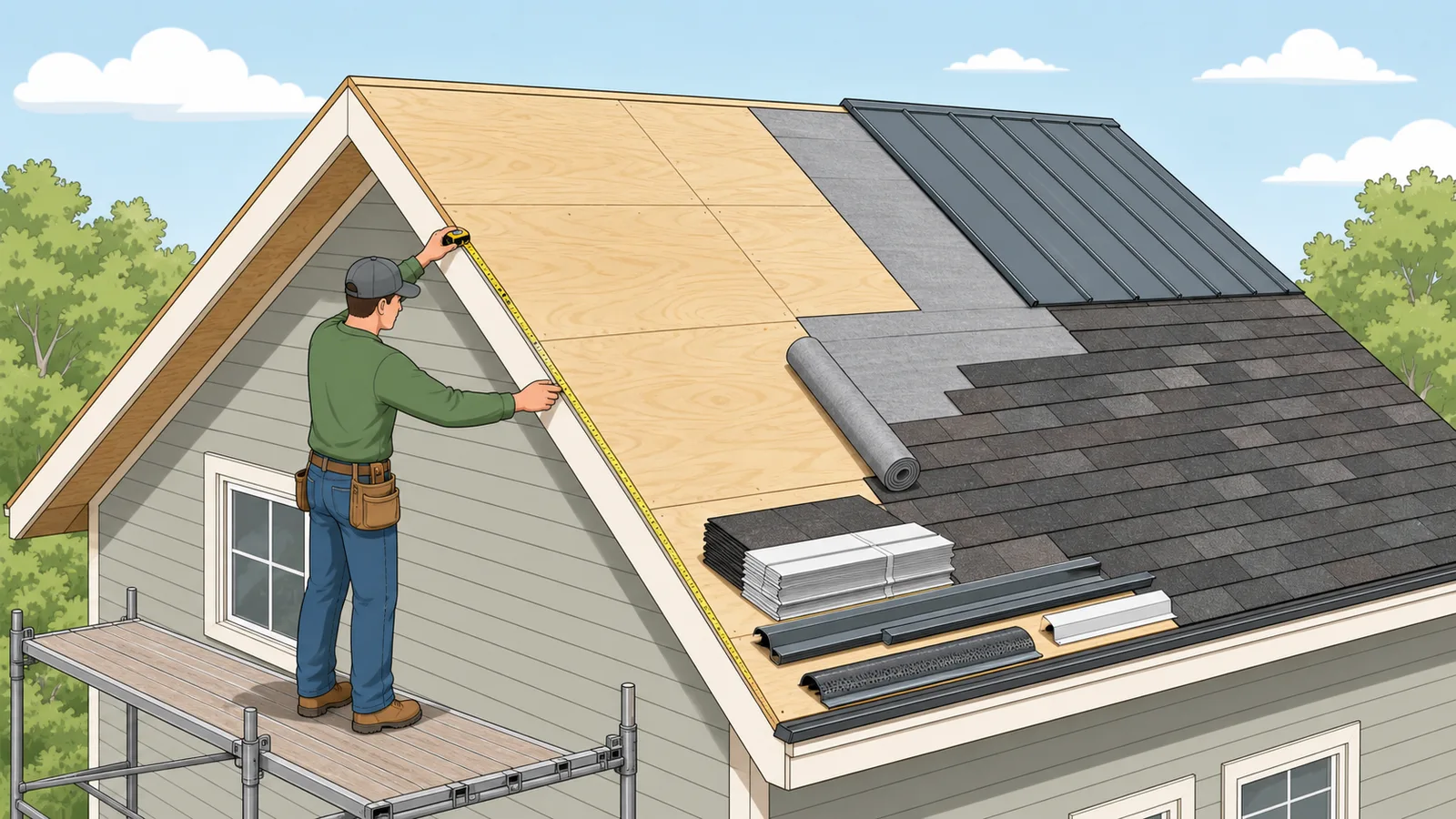
Roof Calculator instructional illustration

Roof Calculator

Estimate roof area, roofing squares, shingle bundles, underlayment, starter strip, drip edge, ridge cap, nails, metal panels, waste scenarios.

Last updated

Roof calculator suite Estimate roof area, pitch-adjusted roofing squares, shingle bundles, installed-cost ranges, underlayment, starter strip, drip edge, ridge cap, nails, and metal roofing panels from one canonical roof planning page.

Roof workflow

Choose a roof planning workflow

Start with roofing estimate, material takeoff, or metal panels to open the matching calculator module.

Start with the matching roofing question Use the workflow links above to preserve roof area, roofing material, and metal panel intent without forcing every specialist calculator to hydrate on first load.
← All Roofing calculators

Roofing Estimating

Roof calculator suite: roof area, roofing squares, materials, and metal panels

A roof calculator estimates roof area, roof pitch effects, roofing squares, shingle bundles, underlayment rolls, drip edge, ridge cap, nails, metal panels, trim pieces, and optional cost from roof dimensions or measured roof area.

Choose the right roof workflow

Use the roofing estimate workflow when you need roof area, roof squares, bundles, waste scenarios, rough installed cost, or a quick comparison across asphalt, metal, tile, and wood-shake assumptions. It is the broad roof calculator for answering how many roofing squares do I need and what waste factor should I use.

Use the roofing material calculator workflow when the order list matters more than the headline area. It keeps field bundles, underlayment, starter strip, drip edge, hip and ridge cap, and roofing nails visible instead of hiding them behind one bundle count.

Use the metal roofing calculator workflow when panel layout matters. Metal roof estimates need panel coverage width, slope length, trim overlap, standing-seam clips, exposed-fastener screws, and panel cut length; those details are not safely represented by a generic square-foot material factor.

How roof area is calculated from pitch

A roof pitch multiplier converts the flat plan area into the true sloped surface area. A steeper pitch means more surface to cover. The multiplier is derived from the rise-over-run ratio and applied to the footprint area to get the actual roofing area.

Once the sloped area is known, the calculator divides by the coverage per roofing square to estimate bundles or squares, adds a waste factor for hips, valleys, and starter courses, and optionally applies a price per square for cost planning.

If you already have measured roof surface area from a roof report, drone report, plan takeoff, or field measurement, use direct roof-area mode. That avoids relying on a simple rectangular gable assumption when the roof has hips, dormers, valleys, additions, or irregular planes.

Shingles, bundles, squares, and underlayment

Roofing materials are typically sold by the square, which covers 100 square feet of roof area. Many asphalt shingle products are planned at about three bundles per square, but the wrapper or manufacturer coverage statement should always override a generic rule.

Underlayment, drip edge, starter strip, and ridge cap are estimated from different measurements. Underlayment follows roof area, while drip edge, starter strip, hip, and ridge products are linear-foot items. The material takeoff workflow separates those assumptions so you can replace estimated lengths with field-measured values where available.

Waste allowance for roofing

A simple gable roof may need only 5 to 10 percent waste. A hip roof or a roof with multiple valleys, dormers, skylights, penetrations, steep sections, or short runs may need 15 to 20 percent or more because of the additional cutting and fitting required at angles and transitions.

Waste should be treated as an ordering assumption, not as proof that every extra bundle or roll will be used. Layout, starter courses, valley treatment, ridge products, material fragility, installer practice, and return policy all affect the final buy quantity.

Metal roofing panel planning

Metal roofing is not just a roof area calculation. For a simple gable roof, panel count is driven by the roof side length divided by net coverage width, while panel cut length is driven by slope length from eave to ridge. The metal workflow therefore keeps roof length, slope length, panel width, coverage width, waste, and trim overlap separate.

Standing-seam and exposed-fastener roofs also use different fastening assumptions. Standing-seam systems usually need clip or concealed-fastener planning down the panel length, while exposed-fastener panels use screw counts tied to roofing squares plus trim. Manufacturer instructions and local wind requirements still control the final fastening schedule.

Worked examples

For a 30 ft by 40 ft simple gable footprint at 6/12 pitch, the pitch multiplier is about 1.118, so the roof surface is about 1,342 square feet before waste. With 10 percent waste, the order area is about 1,476 square feet, or about 14.8 roofing squares.

For a measured 2,200 square foot roof with 15 percent waste, the material order area is 2,530 square feet. The material workflow can then estimate field bundles, felt or synthetic underlayment rolls, starter strip, drip edge pieces, hip and ridge cap bundles, and nail boxes from the chosen accessory assumptions.

For metal panels, a 30 ft roof side with 34 inches of net panel coverage needs 11 panels per side before waste. The slope length controls cut length, while trim piece length and overlap determine ridge, rake, and eave trim pieces.

When this calculator is not enough

This page is a planning calculator, not a roof-design or code-approval tool. Complex roofs should be broken into individual planes, valleys, hips, dormers, skylights, chimneys, wall intersections, and low-slope sections before ordering.

Confirm low-slope rules, ice barrier, flashing, ventilation, fastener schedule, manufacturer installation limits, local code requirements, roof-deck condition, tear-off needs, and delivery access before buying materials or accepting a quote.

Frequently asked questions

How do I calculate roof area from pitch?

Multiply the flat footprint area by the pitch multiplier for your roof slope. For example, a 6/12 pitch has a multiplier of about 1.118, so a 1,000 square foot footprint becomes roughly 1,118 square feet of roofing area before waste.

How many bundles of shingles do I need?

Divide the waste-adjusted roof area by 100 to get roofing squares, then multiply by the bundle-per-square coverage for the product. A common asphalt planning shortcut is three bundles per square, but manufacturer packaging should always win.

How much waste should I add to a roof estimate?

A simple gable roof may be close to 5 to 10 percent waste, while roofs with hips, valleys, dormers, skylights, steep sections, or many penetrations may need 15 to 20 percent or more. The right allowance depends on layout complexity and installer practice.

What is a roofing square?

A roofing square is 100 square feet of roof area. Contractors use squares because they make material ordering and pricing easier to compare across different roof sizes.

Should I enter roof area or footprint plus pitch?

Enter measured roof area if you have it from a plan, roof report, drone report, or field takeoff. Use footprint plus pitch when the roof is simple enough for a rectangular gable estimate.

How many rolls of underlayment do I need?

Divide the waste-adjusted roof area by the usable roll coverage and round up. The calculator includes felt and synthetic roll assumptions, but lap requirements, low-slope details, and product coverage can change the count.

How much starter strip, drip edge, and ridge cap do I need?

Those are linear-foot items. Measure eaves and rakes for starter and drip edge, then measure total hips and ridges for ridge cap. The material workflow can estimate those lengths, but measured lengths are better whenever the roof is not a simple rectangle.

Can I estimate roof replacement cost with this roof calculator?

Yes, as a planning estimate. The roofing estimate workflow combines material, labor, and optional tear-off assumptions, but a real quote can change because of flashing, decking repairs, disposal, permits, access, and local pricing.

Can this roof calculator estimate metal roofing panels?

Yes. The metal roofing workflow estimates panel count, panel cut length, ridge cap, rake trim, eave trim, underlayment, and standing-seam clips or exposed-fastener screws for a simple rectangular gable roof.

What is the difference between panel width and coverage width?

Panel width is the full physical panel width. Coverage width is the net width the panel actually covers after side lap or seam allowance. Coverage width is the number that should drive metal panel count.

Do I need a dedicated roof pitch calculator too?

Use a roof pitch calculator when the main task is converting rise, run, angle, and slope. Use this roof calculator when pitch is one input in a material estimate for roof area, squares, bundles, accessories, or panels.

Can I use house square footage instead of roof square footage?

Not safely. House floor area is a poor substitute for roof surface area because overhangs, pitch, roof shape, and number of stories all change the real coverage requirement.

Also in Roofing

You may also need

Related

More from nearby categories

These related calculators come from the same leaf category, nearby sibling categories, or the same top-level topic.