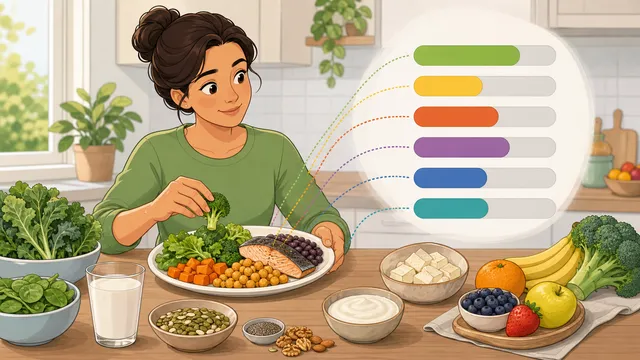
Nutrient density comparator guide: per serving, per 100 g
A nutrient density comparator is most useful when it shows the same foods through more than one lens. This guide explains why ranking foods per serving, per 100 g, and per 100 kcal can produce different winners, and why that matters when users are choosing between convenience, calorie efficiency, and absolute nutrient yield.
Why one ranking is not enough
A food can look impressive per 100 g yet deliver much less in a realistic serving, or it can look dense per serving while becoming less efficient once calories are considered. That is why a good comparator should let the user switch the ranking basis instead of pretending there is one universal answer.
Seeing those different rankings side by side helps users make better trade-offs for meal planning. A user trying to maximise vitamin C with minimal calories may want a different answer from someone trying to add calcium in a compact portion.
Why per serving and per 100 kcal answer different questions
Per serving is the most practical “what does this portion give me?” view. Per 100 kcal is the better “what gives me the most nutrient for the energy cost?” view. Both are useful, but they should not be mixed together as though they mean the same thing.
That distinction becomes especially important for seeds, oils, liver, and fortified foods, where a very small serving or a very energy-dense food can distort the interpretation if the basis is not made explicit.
Why a curated comparator still needs caution
Food composition data are representative values. Real products vary by brand, cultivar, fortification practice, moisture content, and cooking method. So the ranking is best understood as a structured comparison tool, not as a laboratory claim about the exact food in a kitchen.
A comparator is also only as useful as the food list it includes. Curated lists are practical and readable, but they are not exhaustive inventories of every food in the food-supply database.
How to use this page well
Start by choosing the nutrient you actually care about and the dietary pattern you want to stay inside. Then decide whether practical serving yield or calorie efficiency is the more important question for that situation.
That workflow makes the comparison more realistic. It stops users from chasing a theoretical ranking that does not fit their diet pattern, meal size, or energy goals.
Frequently asked questions
Why does the top food change when I switch from per serving to per 100 kcal?
Because those views answer different questions. Per serving rewards practical portion yield, while per 100 kcal rewards calorie efficiency.
Is the highest-ranked food always the best personal choice?
No. The best choice still depends on the rest of the meal, calorie goals, dietary pattern, tolerance, budget, and how realistic the serving size is for you.
Why are oils and seeds sometimes strong for essential-fat density?
Because they are naturally concentrated fat sources. That can make them excellent for essential-fat delivery, but also very energy-dense compared with foods chosen for other nutrients.
Can I treat the ranking as a complete food database search?
No. It is a curated comparison list built for practical planning. It is useful for structured comparisons, but it is not an exhaustive catalogue of every possible food.