

Body Fat vs BMI: Which Metric Should You Actually Trust?
Understand the real differences between body fat percentage and BMI — what each measures, where each falls short, and how to use both wisely.
The number on the chart is not the whole story
If you’ve ever been told your BMI puts you in an “overweight” category and thought, that doesn’t feel right, you’re not imagining things. BMI is one of the most widely used health metrics in the world, and it is also one of the most misunderstood. It was never designed to assess an individual’s health — it was created in the 1830s by a mathematician studying population-level statistics. Somehow it ended up in your doctor’s office as a verdict on your body.
I say this not to dismiss BMI entirely, but to give you the context that’s usually missing. When I work with clients at my nutrition practice, one of the first things we do is step back from single-number thinking. No single metric — not your weight, not your BMI, not your body fat percentage — tells the full story of your health. But when you understand what each measurement actually captures and where it falls short, you can use them together as genuinely useful tools instead of sources of anxiety.
Let’s walk through the three metrics that matter most for understanding your body composition, and talk honestly about what each one can and cannot do.
What BMI actually measures (and what it misses)
BMI stands for Body Mass Index, and the math behind it is straightforward: your weight in kilograms divided by your height in meters squared. That’s it. It doesn’t know whether your weight comes from muscle, fat, bone, or water. It doesn’t account for where you carry your weight, your age, your sex, or your ethnic background — all of which meaningfully affect health risk.
This means BMI works reasonably well as a rough screening tool for large groups of people, but it can be seriously misleading for individuals. A muscular person who strength trains regularly may have a BMI in the “overweight” range while carrying very little excess fat. An older adult who has lost muscle mass over the years might have a “normal” BMI despite carrying a higher percentage of body fat than is healthy. Research has consistently shown that BMI misclassifies a significant portion of the population.
That said, BMI isn’t useless. If your BMI is very high or very low, that’s still meaningful information. It’s a starting point — just not an ending point.
Use the Body Metrics Calculator to see where you fall on the standard BMI scale:
Measurement quality comes first
- Measure waist after a normal exhale, with the tape level and snug but not compressing the abdomen.
- Measure hips at the widest repeatable point around the hips and buttocks, again with a level tape.
- Take two readings when the result matters. If the numbers differ noticeably, remeasure before interpreting the body metrics.
Result
26.93 BMI
BMI and waist screens both deserve attention. BMI is 26.93 (Overweight), waist-to-height ratio is 0.5, waist-to-hip ratio is 0.824, BAI is 28.8%, and BRI is 3.36.
Combined screening signal
BMI and waist screens both deserve attention
BMI is above the healthy adult band and at least one waist-based screen is raised, even though BAI stays in its normal range. That disagreement is exactly why a broad body metrics calculator is more useful than any one number alone.
Waist target to keep under half of height
84 cm
The common half-height waist line is 84 cm, and the current waist is already 0 cm below it.
Remeasure first, then verify with a narrower body-composition tool
This reads more like a waist-led risk pattern than a pure weight-only issue
Repeat waist and hip measurements once or twice under the same conditions. If the pattern persists, use the body fat calculator or a clinician-guided assessment to add narrower body-composition context.
26.93
BMI: Overweight
70.3 kg
BMI target: Target BMI 24.9
28.8%
BAI: Normal
3.36
BRI: Low BRI
0.5
Waist-to-height: Increased central adiposity
0.824
Waist-to-hip: Moderate-risk screen
Pear (triangle)
Body shape: Moderate risk
Mesomorph
Body type: Overweight range
| Module | Result | How to read it |
|---|---|---|
| BMI | 26.93 · Overweight | About 5.7 kg less would return to BMI 24.9 at this height. |
| BMI target | 70.3 kg · Target BMI 24.9 | The upper edge of the healthy BMI range is usually the most practical first BMI target, with the midpoint acting as a deeper second-stage goal. |
| BAI | 28.8% · Normal | Within the healthy body adiposity range. |
| BRI | 3.36 · Low BRI | Below the lower reference band used in recent mortality research; interpret alongside nutrition, muscle mass, and clinical context. |
| Waist-to-height | 0.5 · Increased central adiposity | The half-height target at this height is 84 cm; the entered waist is 0 cm below that line. |
| Waist-to-hip | 0.824 · Moderate-risk screen | This is above the usual female lower-risk threshold. It is a screening signal rather than a diagnosis, and it works best alongside BMI, waist-to-height ratio, and clinical context. |
| Body shape | Pear (triangle) · Moderate risk | Lower-body-led proportions: hips are carrying more width than the bust, so the silhouette reads as pear-like. |
| Body type | Mesomorph · Overweight range | This result points to a more athletic build, with a stronger tendency toward muscularity and shoulder width than either extreme leanness or fat storage. |
BMI target weight and milestones
The upper edge of the healthy BMI range is usually the most practical first BMI target, with the midpoint acting as a deeper second-stage goal.
| Checkpoint | Target BMI | Target weight | Change |
|---|---|---|---|
| BMI 24.9 (enter healthy range) | 24.9 | 70.3 kg | 5.7 kg |
| BMI 22.5 (healthy midpoint) | 22.5 | 63.5 kg | 12.5 kg |
Specialist pages to keep separate
Some formulas answer narrower questions than this broad body metrics calculator. Use these retained pages when their inputs match the question.
Look at that number with curiosity, not judgment. If it surprises you in either direction, that’s exactly why we need more context — which is where body fat percentage comes in.
And if your BMI is high or low enough to raise concerns, treat that as a prompt for a fuller conversation, not a self-diagnosis. BMI is a screening tool. It can flag patterns worth paying attention to, but it cannot tell you on its own whether a specific person is metabolically healthy, under-fuelled, highly muscular, fluid-retaining, peri-menopausal, or recovering from illness.
What body fat percentage reveals
Body fat percentage does what BMI cannot: it distinguishes between fat mass and everything else. Instead of treating all weight the same, it tells you what proportion of your total weight is actually adipose tissue. This is a much more direct measure of body composition and a better indicator of metabolic health risk.
There are several ways to estimate body fat. Clinical methods like DEXA scans and hydrostatic weighing are highly accurate but expensive and not always accessible. The US Navy tape-measure method, which uses circumference measurements of your waist, neck, and hips, provides a solid estimate you can do at home with a flexible tape measure and a few minutes of your time.
Healthy body fat ranges depend on age and sex. General guidelines suggest roughly 10 to 20 percent for men and 18 to 28 percent for women, though individual variation is completely normal. What matters more than hitting a specific number is understanding where you are and how that number changes — or doesn’t — over time.
One thing I always tell my clients: extremely low body fat is not a goal. Essential fat exists because your body needs it for hormone production, brain function, organ protection, and temperature regulation. Pushing body fat too low can cause serious health problems, including hormonal disruption, bone loss, and immune suppression. More is not always worse, and less is not always better.
Try the Body Fat Calculator to estimate your current body fat percentage using the Navy method:
Field estimate, not a scan
This body fat calculator uses circumference equations similar to the Navy-style field method. It is useful for planning and trend tracking, but it is still an estimate rather than a DXA, Bod Pod, hydrostatic weighing, or clinical body-composition measurement.
Tape-measure technique
Averaging two close tape readings reduces noise from tape angle, posture, breathing, and tension.
- Keep the tape level and snug without compressing soft tissue.
- Measure after a relaxed exhale rather than sucking in the stomach.
- Repeat the same landmark and method when comparing body fat percentage over time.
Estimated result
16.44%
Body composition band: Fitness range.
16.44%
Body fat percentage
12.82 kg
Fat mass
65.18 kg
Lean mass
Fitness range
Interpretation
0.48
Waist-to-height context
Same-lean-mass target check
At 15% body fat with the same lean mass, estimated scale weight would be 76.68 kg (-1.32 kg from now).
- Target body fat
- 15%
- Estimated target weight
- 76.68 kg
- Scale change if lean mass holds
- -1.32 kg
Reference ranges used for quick context
These ranges are population-level orientation points, not clinical cut-offs for every age, sport, or medical context.
Athletic range
6-13%
Fitness range
14-17%
Average range
18-24%
If your body fat estimate and your BMI tell different stories, you’re seeing exactly why relying on one metric alone can be misleading. A person with a high BMI but moderate body fat likely carries significant muscle mass. A person with a normal BMI but high body fat may have low muscle mass — sometimes called “normal weight obesity” — which carries its own set of health risks that BMI completely misses.
It is also worth remembering that home body-fat methods are still estimates. Tape measurements, smart scales, calipers, and handheld devices can all shift with hydration, meal timing, cycle phase, recent exercise, and plain old measurement error. If you want the number to be useful, measure under similar conditions each time and pay more attention to the trend than to tiny week-to-week changes.
The missing piece: lean body mass
There’s a third metric that ties the picture together, and it’s one most people never think about. Lean body mass is everything in your body that isn’t fat — your muscles, bones, organs, water, and connective tissue. It’s calculated by subtracting your fat mass from your total weight.
Why does this matter? Because lean mass is metabolically active tissue. The more lean mass you carry, the more energy your body burns at rest, the better your insulin sensitivity tends to be, and the more resilient your body is as you age. Preserving lean mass is one of the most important things you can do for long-term health, especially after your 30s when muscle loss naturally accelerates if you don’t actively work against it.
This is also why the scale can be so misleading during a fitness journey. If you’re strength training and eating well, you might gain muscle while losing fat. Your weight might barely change, your BMI might stay the same, but your body composition could be improving dramatically. Without tracking lean mass, you’d never know.
Use the Lean Body Mass Calculator to see how your weight breaks down:
Estimation route
Use this route when you already trust a body-fat estimate from calipers, BIA, DEXA, or another calculator.
Lean body mass sheet
62.4 kg
At 78 kg and 20% body fat, estimated lean mass is 62.4 kg and fat mass is 15.6 kg.
15.6 kg
Fat mass
80%
Lean share
20%
Fat share
78 kg
Body weight
Body composition sheet
This result splits the current body weight into estimated lean and fat components from the body-fat percentage you entered.
| Body weight used | 78 kg |
| Body fat entered | 20% |
| Lean body mass | 62.4 kg |
| Fat mass | 15.6 kg |
| Fat-to-lean ratio | 0.25 fat : 1 lean |
| Mass per 1 body-fat point | 0.78 kg |
Same body weight at common body-fat levels
These rows keep the same scale weight and show how lean and fat mass would change at different body-fat percentages.
| Body fat % | Lean mass | Fat mass |
|---|---|---|
| 10% | 70.2 kg | 7.8 kg |
| 15% | 66.3 kg | 11.7 kg |
| 20% | 62.4 kg | 15.6 kg |
| 25% | 58.5 kg | 19.5 kg |
| 30% | 54.6 kg | 23.4 kg |
If the body-fat estimate is off
Home body-fat readings often swing a few percentage points depending on the method, hydration, and timing. These rows show how the lean-mass estimate changes if the same scale weight is a little leaner or softer than the headline input suggests.
| Scenario | Body fat % | Lean mass | Fat mass | Why it matters |
|---|---|---|---|---|
| -5 body-fat points | 15% | 66.3 kg | 11.7 kg | Useful when home body-fat readings may drift a few percentage points between methods or testing days. |
| -2 body-fat points | 18% | 63.96 kg | 14.04 kg | Useful when home body-fat readings may drift a few percentage points between methods or testing days. |
| Current estimate | 20% | 62.4 kg | 15.6 kg | Your current body-fat estimate. |
| +2 body-fat points | 22% | 60.84 kg | 17.16 kg | Useful when home body-fat readings may drift a few percentage points between methods or testing days. |
| +5 body-fat points | 25% | 58.5 kg | 19.5 kg | Useful when home body-fat readings may drift a few percentage points between methods or testing days. |
If lean mass stayed the same
This table keeps the current lean mass fixed and shows what scale weight would look like at different body-fat levels. It is useful when you want to translate body-composition goals into realistic target-weight checkpoints instead of chasing one abstract lean-mass number.
| Body fat % | Target weight | Fat mass | Planning note |
|---|---|---|---|
| 12% | 70.91 kg | 8.51 kg | A leaner body-fat target usually requires more caution around sustainability and performance. |
| 15% | 73.41 kg | 11.01 kg | A leaner body-fat target usually requires more caution around sustainability and performance. |
| 20% | 78 kg | 15.6 kg | Shows what the scale could read if current lean mass stayed unchanged while body-fat level changed. |
| 25% | 83.2 kg | 20.8 kg | Shows what the scale could read if current lean mass stayed unchanged while body-fat level changed. |
| 30% | 89.14 kg | 26.74 kg | Shows what the scale could read if current lean mass stayed unchanged while body-fat level changed. |
Lean-mass protein anchors
Some lifters and clinicians prefer to anchor protein to lean mass instead of total scale weight. These rows turn the current lean-mass estimate into rough daily protein checkpoints.
| Use case | g/kg lean mass | Protein / day | When it helps |
|---|---|---|---|
| Maintenance floor | 1.6 | 99.84 g | Useful as a steady baseline when training is consistent but body-weight change is not the main goal. |
| Recomposition target | 1.8 | 112.32 g | Common middle ground when trying to maintain lean mass during fat loss or improve body composition. |
| Aggressive cut or heavy training | 2.2 | 137.28 g | Often used when calorie intake is tighter or training stress is higher. |
This number gives you a more complete understanding of what’s happening beneath the surface. If you’re losing weight, you want most of that loss to come from fat, not muscle. If your lean body mass is holding steady or increasing while your body fat drops, you’re on a genuinely healthy trajectory — regardless of what the scale or BMI chart says.
Lean mass estimates deserve the same caution as body-fat estimates: they are directional, not diagnostic. A large swing from one reading to the next is more likely to reflect hydration or measurement conditions than a dramatic overnight change in muscle tissue. That does not make the number useless. It just means you should use it to notice patterns over time instead of turning it into a daily referendum on your progress.
Using all three together
Here’s the approach I recommend to my clients: check all three metrics at the same time, no more than once every four to six weeks. Write them down. Look at the trends over months, not the readings from any single session. Bodies fluctuate day to day based on hydration, hormones, sleep, stress, and a hundred other factors. Trends are what matter.
BMI gives you a quick, population-level reference point. Body fat percentage tells you how much of your weight is fat. Lean body mass tells you how much is everything else. Together, they form a picture that no single number can provide.
There is one more piece of context I often bring in when these numbers seem confusing: where fat is carried matters too. Someone with a middling BMI and an ordinary-looking body-fat estimate can still have a higher health risk if most of that fat is carried around the abdomen. That is one reason waist measurements and other clinical markers still matter. Body composition numbers are helpful, but they are not the whole appointment.
And here’s what I wish more people heard: these numbers are tools for understanding, not grades on a test. Your worth is not determined by your body fat percentage. Your health is not captured by a single ratio. The goal is not to optimize every metric to some idealized standard — it’s to know your body well enough to take care of it with confidence and compassion.
When to dig deeper
If your numbers raise questions — for instance, if your body fat seems high despite regular exercise, if your lean mass is declining despite strength training, or if body-composition tracking is becoming emotionally distressing — that’s valuable information worth discussing with a healthcare professional. These calculators give you a starting point for that conversation, not a final answer.
This is especially important if you have a history of disordered eating, significant weight changes, PCOS, thyroid disease, are peri-menopausal or post-menopausal, or are taking medication that affects weight, water balance, or appetite. In those situations, body-composition maths can still be informative, but it should sit alongside personalised guidance from a physician, registered dietitian, or another qualified clinician. The calculators in this guide are educational tools, not medical advice.
Calculators used in this article
Health / Body Metrics
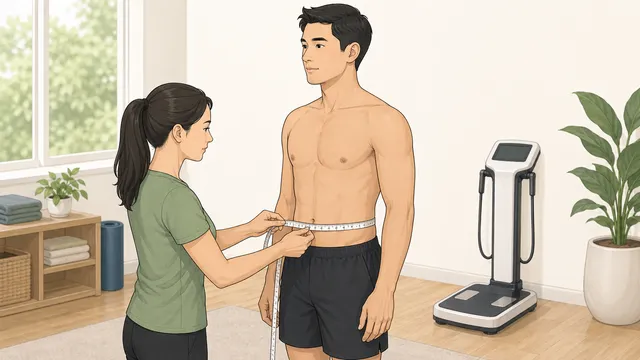
Body Fat Calculator
Estimate body fat percentage with circumference measurements, then compare fat mass, lean mass, waist-to-height context.
Health / Body Metrics
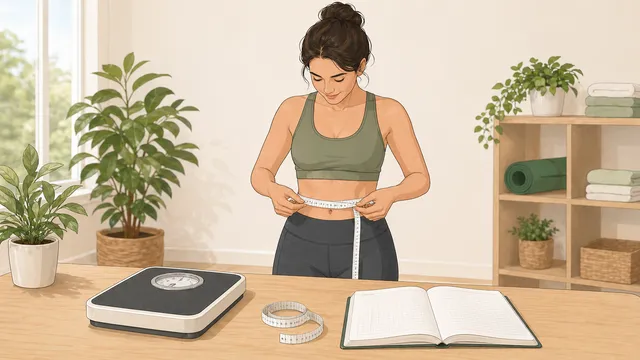
Body Metrics Calculator
Use this body metrics calculator to compare BMI, BAI, BRI, body fat distribution, waist-to-height ratio, waist-to-hip ratio.

Health / Body Metrics
Lean Body Mass Calculator
Estimate lean body mass from body fat percentage or Boer, James, and Hume height-and-weight formulas, then compare fat mass, lean share, formula spread.