

Child Growth Percentiles Explained: Height, Weight, BMI, and When to Worry
A practical guide to child growth percentiles, growth charts, height-for-age, weight-for-age, and BMI-for-age, including what a dropped percentile means and when to talk to your paediatrician.
Health Disclaimer: This article is for educational purposes only and is not a substitute for medical advice, diagnosis, or treatment. Growth charts are screening tools. If you are worried about your child’s feeding, growth, energy, development, puberty, or weight trend, speak with your paediatrician, GP, or health visitor.
The number that sends parents spiralling
I spent years working in maternal and paediatric health settings, and I can tell you the single phrase most likely to make a new parent’s stomach drop: “Your child has dropped a percentile.” It doesn’t matter whether the child is thriving, eating well, and hitting every milestone — hearing that their number has shifted can trigger a wave of anxiety that’s hard to shake.
Here’s what I wish every parent heard before their first growth check: a percentile is not a grade. It’s not a pass or a fail. It’s a statistical description of where your child falls relative to other children of the same age and sex. A child at the 15th percentile is not “worse” than a child at the 85th. They are simply different sizes, and healthy children genuinely come in all shapes and sizes.
That said, growth charts exist for a good reason. They’re one of the most reliable tools we have for spotting potential issues early — nutritional problems, hormonal conditions, or chronic illness can all show up as unusual growth patterns long before other symptoms appear. The trick is knowing what the numbers mean, what matters, and when to bring it up with your child’s doctor.
How growth charts work: the basics
Growth charts plot a single measurement — height, weight, or head circumference — against your child’s age. The curved lines on the chart represent percentiles. The 50th percentile line is the median: half of children that age are above it, half are below. The 3rd percentile line means 3% of children are smaller; the 97th means only 3% are larger.
Your child’s paediatrician typically tracks three key measurements:
- Length or height for age — how tall your child is compared to peers
- Weight for age — how heavy your child is compared to peers
- BMI for age (from age 2 onwards) — a weight-to-height ratio that helps assess whether weight is proportionate to stature
For children under 2, the World Health Organization (WHO) charts are the standard in most countries. These charts describe how healthy breastfed infants should grow under optimal conditions. From age 2 to 18, many countries switch to national reference charts (such as the CDC charts in the US or the Royal College of Paediatrics and Child Health charts in the UK), which describe how children in that population actually grow.
The difference matters. Breastfed babies often follow a slightly different trajectory from formula-fed babies in the first year — they may gain weight faster initially and then slow down. If a breastfed baby is plotted on a chart designed around formula-fed growth data, it can create a false alarm. Always check which chart standard your health visitor or paediatrician is using.
Which growth chart should you be using?
This is one of the most overlooked parts of the conversation, and it explains a lot of parent confusion. A percentile only makes sense if the child has been plotted on the right chart for their age and measurement type.
For babies and toddlers under 2 years, clinicians generally use WHO growth standards. These focus on:
- Length for age
- Weight for age
- Weight for length
- Head circumference for age
For children aged 2 years and older, clinicians usually switch to CDC or country-specific reference charts for:
- Height for age
- Weight for age
- BMI for age
That transition matters because a child can appear to “drop a percentile” around their second birthday even when nothing is wrong. Under 2, proportionality is usually assessed with weight-for-length. From age 2 onwards, it is usually assessed with BMI-for-age. Standing height also measures slightly shorter than recumbent length. In other words, the chart system itself changes, and the apparent shift may be mathematical rather than clinical.
This is also why BMI is not usually the right headline number for infants. If your child is younger than 2, ask whether the clinician is looking at weight-for-length instead. And if your child is still in the first two years of life, remember that head circumference is part of routine growth assessment too, because rapid changes in head growth can matter in a way they usually do not later on.
What percentiles actually tell you (and what they don’t)
Let’s clear up the most common misunderstanding: the 50th percentile is not the “ideal.” It is simply the middle. A perfectly healthy child can track along the 10th percentile their entire childhood. What matters far more than the absolute number is the pattern over time.
Paediatricians look for two things:
- Consistency — Is the child following roughly the same percentile curve over months and years? A child who has always been around the 25th percentile and continues to track there is growing normally, full stop.
- Crossing lines — Is the child’s percentile shifting significantly up or down? A jump from the 50th to the 90th, or a drop from the 75th to the 25th, over a short period may warrant investigation. One or two small shifts are usually normal, especially in the first two years when growth is naturally uneven. But a sustained drift across two or more major percentile lines is something to discuss with your doctor.
The emphasis on trends is crucial. A single data point tells you very little. It’s the trajectory that tells the story.
Why one “dropped percentile” reading can be misleading
This is where most panic starts. A parent hears that their child used to be on the 60th percentile and is now on the 40th, and it sounds as if something concrete and dangerous has happened. Sometimes it has. Very often, it has not.
Small percentile changes happen for ordinary reasons:
- Measurement noise — a wiggling infant, bent knees, shoes left on, a slightly different scale, or a rushed clinic measurement
- Timing — children often gain weight before a height spurt, then look proportionally heavier for a while
- Recent illness — a stomach bug, fever, poor appetite, or dehydration can temporarily affect weight
- Chart transition effects — especially around age 2, when the measurement method and growth reference change
What deserves more attention is a persistent shift that remains after repeat measurements, especially if it is paired with symptoms such as feeding trouble, fatigue, diarrhoea, vomiting, delayed puberty, chronic pain, or slower linear growth. That is very different from one isolated reading that changes the next time the child is measured properly.
If your clinician mentions a z-score, do not be alarmed. It is simply another way of expressing how far a measurement sits from the average for a child’s age and sex. In everyday parent conversations, percentiles are easier to grasp. In clinical follow-up, z-scores can help doctors describe larger deviations more precisely.
How to check your child’s height percentile
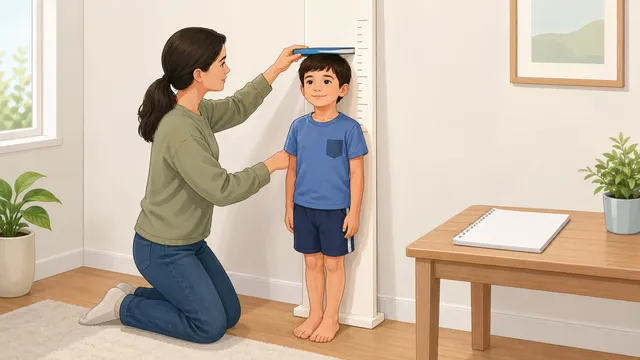
If your child is under 2, a clinician will usually rely on WHO infant charts that include length, weight, and head circumference rather than the school-age tools below. For children aged 2 and over, the Child Height Percentile Calculator is a useful way to see where stature-for-age sits on the chart.
Units
Sex on growth chart
Use percentile as screening context
One point is not a diagnosis: a low or high percentile can still be normal for a child who tracks steadily.
Trend matters most: crossing percentiles over time often matters more than one isolated measurement.
Under age 2 is different: infants are usually assessed on WHO infant standards rather than the CDC 2-to-20-year charts used here.
Result
After running the numbers, resist the urge to compare your child’s percentile with another child’s. Growth is influenced by genetics, ethnicity, birth size, feeding history, puberty timing, and dozens of other factors. Two children sitting side by side at playgroup can be at the 20th and the 80th percentile respectively, and both be growing exactly as they should.
If the result shows a percentile that feels “low” or “high” to you, take a breath. Ask yourself: has this been roughly consistent over time? Is my child eating, sleeping, and developing normally? If yes, the number is often simply part of their natural pattern. If you’re unsure, bring the numbers to your next well-child visit rather than trying to interpret them alone.
It also helps to remember that height is only as reliable as the measurement. Shoes on, bent knees, a tape measure against a skirting board, or a fidgety child can all make the chart look more dramatic than it really is. In clinic, a properly taken height over several visits tells a much more trustworthy story than one anxious check at home.
Understanding child and teen BMI
BMI (Body Mass Index) in adults is straightforward: weight divided by height squared, with fixed categories that apply to everyone. Child BMI is fundamentally different, and this is where many parents get confused.
For children and teens aged 2 to 18, BMI is interpreted using age-and-sex-specific percentiles, not the fixed adult ranges. A BMI of 18 means something very different for a 6-year-old than for a 16-year-old, because body composition changes dramatically through childhood and puberty. The raw BMI number on its own is meaningless for a child — it only becomes useful when converted to a percentile for their age and sex.
The standard categories for children are:
- Below the 5th percentile: underweight
- 5th to below the 85th percentile: healthy weight
- 85th to below the 95th percentile: overweight
- 95th percentile and above: obese
These are screening categories, not diagnoses. A muscular, athletic teenager might plot above the 85th percentile without carrying excess body fat. Equally, a child at the 80th percentile who has recently crossed up from the 50th might warrant more attention than one who has always tracked at the 80th. Context is everything.
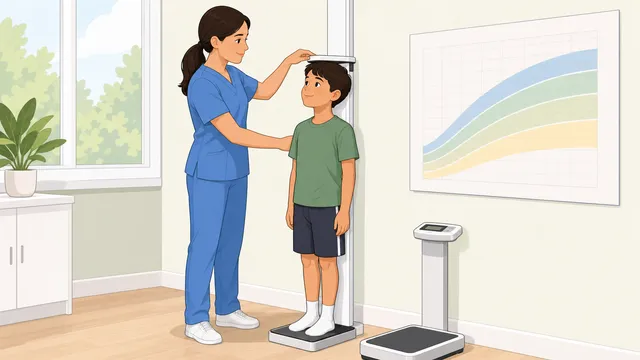
The Child & Teen BMI Calculator converts your child’s measurements into an age-appropriate BMI percentile.
Why this is not adult BMI
Child BMI has to be read against age- and sex-specific percentile curves. The same BMI value can map to a different percentile when the child is a year younger or older on the chart, which is why exact date of birth and measurement date matter here.
Quick examples
Units
Sex on growth chart
Use percentile as screening context
Trend matters most: a steady growth pattern often matters more than one isolated reading.
Exact age matters: near-threshold results can move when you change the birth date or assessment date by only a few months.
Under age 2 is different: infants are usually assessed with weight-for-length rather than BMI-for-age.
BMI-for-age result
54th percentile
BMI-for-age for a 10 years old boy using the CDC 2-to-20-year growth charts.
16.8
BMI
Healthy weight
Category
Not applicable
Obesity class
76%
% of 95th percentile
10 years
Exact chart age
50th-percentile weight
31.66 kg
This is the middle of the CDC chart for the same age, sex, and height.
Healthy-band midpoint
31.96 kg
This sits halfway between the 5th- and 85th-percentile weights at the same height.
Gap to midpoint
0.04 kg
The current weight is almost exactly at the healthy-band midpoint.
Same-height threshold sheet
| Band | BMI | Weight | Current comparison | Meaning |
|---|---|---|---|---|
| 5th percentile | 14.21 | 27.05 kg | 4.9 kg above | Below this line, CDC screening shifts into underweight. |
| 50th percentile | 16.62 | 31.66 kg | 0.3 kg above | This is the middle of the CDC chart for the same age and sex. |
| 85th percentile | 19.36 | 36.86 kg | 4.9 kg below | At this line, CDC screening shifts into overweight. |
| 95th percentile | 22.11 | 42.1 kg | 10.1 kg below | At this line, CDC screening shifts into obesity. |
| 120% of 95th | 26.53 | 50.52 kg | 18.5 kg below | This is the usual class II / severe-obesity screening threshold. |
Same child, different chart age
With the same height and weight, the percentile label shifts from 63rd percentile to 43rd percentile across the age checkpoints shown here.
| Scenario | Chart age | Percentile | Category | % of 95th |
|---|---|---|---|---|
| Same child one year younger | 9 years | 63rd percentile | Healthy weight | 79.85% |
| Current chart age | 10 years | 54th percentile | Healthy weight | 76% |
| Same child one year older | 11 years | 43rd percentile | Healthy weight | 72.53% |
CDC thresholds used here
Healthy weight spans the 5th to under-85th percentiles. Overweight begins at the 85th percentile, obesity begins at the 95th percentile, and class II obesity screening usually begins at 120% of the 95th percentile or BMI 35 kg/m².
A word of caution: if your child is old enough to be aware of body image, be thoughtful about how, and whether, you share BMI results with them. These numbers are clinical tools for parents and healthcare providers. They were never designed to be handed to a child as a judgment about their body.
If the percentile lands outside the usual healthy-weight band, do not jump straight to dieting advice or food restriction. Paediatric clinicians look at growth trend, family history, pubertal stage, medical conditions, medication effects, sleep, activity, blood pressure, and sometimes laboratory markers before drawing conclusions. If you are worried, the right next step is a conversation with your paediatrician or health visitor, not a crash intervention at home.
It is also worth knowing that BMI percentiles are primarily a screening tool, not a body-fat scan and not a verdict on health. A sporty teenager with more muscle can land higher than expected. A child with a lower BMI percentile may still be perfectly well if they have always tracked there and are otherwise thriving. The number becomes more useful when you interpret it alongside height percentile, weight percentile, puberty timing, and the child’s overall clinical picture.
Tracking weight percentile specifically
Weight is the measurement parents fixate on most — partly because it’s the easiest to check at home, and partly because it changes week to week in ways that height doesn’t. But precisely because weight fluctuates, it’s also the measurement most likely to cause unnecessary worry.
Short-term weight changes in children can be caused by a growth spurt (children often gain weight before they grow taller), a stomach bug, a change in activity level, or simply the time of day the measurement was taken. A child who “dropped” from the 60th to the 50th percentile over a single month has almost certainly not experienced a meaningful change — that’s within normal variation.
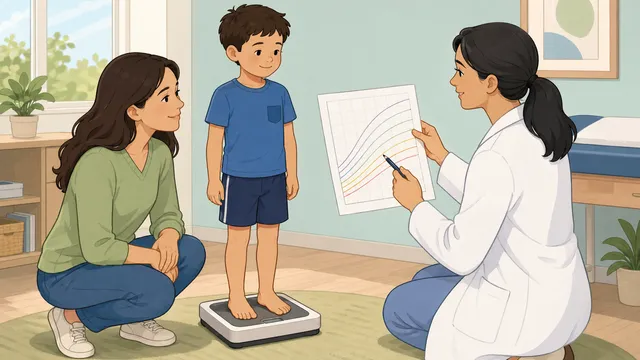
Use the Child Weight Percentile Calculator to see where your child’s weight falls for their age and sex.
Units
Sex on growth chart
Quick examples
Use percentile as screening context
One point is not a diagnosis: a low or high percentile can still be normal for a child who tracks steadily.
Trend matters most: crossing percentiles over time often matters more than one isolated measurement.
Under age 2 is different: infants are usually assessed on WHO infant standards rather than the CDC 2-to-20-year charts used here.
Result
The most useful thing you can do with weight percentile data is track it over time. Write down the number at each check-up, or ask your health visitor for a copy of the chart. After three or four data points spread over several months, you’ll have a far clearer picture of the trend line.
Weight is also the easiest number to overreact to because it moves first. Children often gain weight before they shoot up in height, and illness can temporarily nudge the line down. A short-lived wobble is not the same thing as a persistent change in pattern. What matters is whether the child returns to roughly their usual track once life settles again.
What if height, weight, and BMI percentiles do not match?
Parents often assume the three numbers should line up neatly. They usually do not, and that by itself is not a problem.
A child can be:
- Tall and slim — high height percentile, lower BMI percentile
- Short and solidly built — lower height percentile, higher weight percentile, but still proportionate overall
- Average for height but temporarily heavier or lighter because of a normal growth phase
Clinicians care less about the fact that the numbers differ and more about whether they make sense together over time. A child at the 90th percentile for height and the 90th percentile for weight may simply be a large child. A child at the 90th percentile for weight and the 20th percentile for height may still be completely well, but it raises a different question about proportionality and is worth interpreting with BMI and the growth trend, not by weight alone.
This is one reason I prefer parents to look at height, weight, and BMI as a set of signals, not as three separate pass-fail grades. The more the numbers are interpreted in context, the less likely you are to overreact to one isolated result.
What to bring to the next appointment
If you plan to ask about your child’s growth, bring more than a single number. The most helpful information is:
- Two or more measurements over time, ideally taken by the same clinic or on similar equipment
- Notes about appetite, energy, sleep, bowel habits, and activity, because growth concerns rarely live in isolation
- Any recent illness, medication changes, or feeding difficulties, especially if the shift was sudden
- Family context, such as very tall, very short, or late-puberty parents, which often helps explain the pattern
This is also where it helps to keep perspective. Doctors are not just looking at whether a line is above or below average. They are asking whether the whole child makes sense: history, examination, development, family background, and the growth curve together.
When to talk to your doctor
Most of the time, growth percentiles are reassuring. But there are situations where bringing the numbers to a healthcare professional is the right call:
- Sustained crossing of two or more major percentile lines (up or down) over 6–12 months
- Weight percentile significantly different from height percentile — for example, weight at the 90th but height at the 25th, or vice versa — which may suggest the child’s weight is disproportionate to their frame
- Falling below the 3rd percentile for height or weight, especially if it’s a new development rather than a lifelong pattern
- BMI above the 95th percentile, particularly if it’s been rising steadily
- Your own concern, even if the numbers look “fine.” Parental instinct is a legitimate clinical input. If something feels off about your child’s eating, energy levels, or growth, raise it. No good doctor will dismiss a parent’s concern just because a percentile looks normal.
Remember that growth charts are screening tools, not diagnostic instruments. An unusual percentile doesn’t mean something is wrong — it means something is worth investigating. Most investigations end with reassurance, and the earlier a real issue is spotted, the easier it usually is to address.
If you are also trying to make sense of family height patterns and whether a child’s current growth fits that background, How Tall Will Your Child Be? Prediction Methods Explained is a useful companion read. It walks through mid-parental height, growth trajectories, and why a percentile is not the same thing as an adult-height prediction.
Frequently asked questions
Is the 50th percentile the healthy or ideal percentile?
No. The 50th percentile is simply the middle of the reference group. Healthy children can naturally track at the 5th, 25th, 75th, or 95th percentile. The more important question is whether your child is following a reasonably consistent growth pattern over time.
Is being in the 10th percentile bad?
Not by itself. A child in the 10th percentile can be perfectly healthy if they have always tracked there, are developing normally, and the rest of the clinical picture fits. A low percentile becomes more concerning when it is a new change, when it keeps falling, or when it comes with other symptoms.
What does it mean if my child dropped a percentile?
It means the latest measurement sits lower on the chart than before. That can reflect true change, but it can also happen because of normal variation, a recent illness, measurement error, or a change in chart type around age 2. What matters is whether the shift persists on repeat measurements and whether it is large enough to change the overall trend.
Should height and weight percentiles match?
Not exactly. Many healthy children have different height and weight percentiles. Doctors look at whether the child appears proportionate overall, whether BMI-for-age is in a reasonable range when appropriate, and whether the pattern has been stable over time.
When should BMI percentiles be used in children?
Generally from age 2 onwards. Before age 2, clinicians usually rely more on weight-for-length than BMI. That is why a child who seems to “drop a percentile” at age 2 may simply be moving from one measurement system to another.
Does a high percentile mean my child will be tall or large as an adult?
Not necessarily. A current percentile describes where your child sits compared with peers now. Adult size depends on genetics, nutrition, health conditions, and puberty timing. Growth charts help track development, but they do not predict final adult size on their own.
How often should I check my child’s growth at home?
Usually less often than anxious parents want to. Official measurements at routine well-child visits are generally more useful than frequent home checks, because clinic equipment and technique are more consistent. Home measurements can be helpful in some situations, but weekly checking often creates more noise than clarity.
When should I call the doctor about a growth percentile?
Call sooner if you see a persistent drop or rise across major percentile lines, poor feeding, vomiting, diarrhoea, fatigue, developmental concerns, delayed or very early puberty, or a major mismatch between what the chart shows and how your child seems clinically. If you are uneasy even without a dramatic number, that is still a good reason to ask.
Healthy growth starts with perspective
If there’s one thing I’ve learned from years in maternal and child health, it’s this: the parents who cope best with growth data are the ones who understand what the numbers can and cannot tell them. A percentile describes where your child sits on a population curve. It does not measure health, happiness, intelligence, or potential.
Here’s a practical routine that keeps you informed without tipping into obsession:
- Weigh and measure at well-child check-ups — not at home every week. Let your health visitor or paediatrician handle the official measurements with calibrated equipment.
- Ask for the percentile and write it down. Over time you’ll build a trend line that’s far more useful than any single number.
- Compare your child to themselves, not to other children. Their trajectory is what matters.
- Use BMI percentiles from age 2 onwards as an additional data point, but never as the only one.
- Talk to your doctor if you see a pattern shift — and trust that a single unusual reading is almost never cause for alarm.
Children grow in bursts, stalls, and sideways shuffles. Some are tall and lean. Some are short and stocky. Some shoot up at 4 and plateau at 8. The growth chart captures all of this variation — it was designed for it. Your job is to feed your child well, keep them active, show up for their check-ups, and keep asking questions if something does not sit right.
If you are worried about growth, weight, delayed puberty, feeding, or development, do not wait for the chart to look dramatic before raising it. A calm conversation with your paediatrician or health visitor is exactly what these tools are for. The numbers should support good care, not replace it.
Calculators used in this article
Health / Body Metrics
Child Height Percentile Calculator
Use this child height percentile calculator to look up CDC height-for-age percentile for children and teenagers, compare the result with chart lines.
Health / Body Metrics
Child Teen BMI Calculator
Calculate BMI-for-age for children and teenagers using CDC growth-chart percentiles, then review the 5th, 50th, 85th, and 95th cut-offs.
Health / Body Metrics
Child Weight Percentile Calculator
Look up child weight percentile using CDC weight-for-age chart data, with a percentile sheet for clinical context and a paediatric screening explanation.