

How Tall Will Your Child Be? Prediction Methods Explained
Explore the science behind childhood growth predictions — from mid-parental height formulas to growth percentiles — and what the numbers can and can't tell you.
Health Disclaimer: This article is for informational and educational purposes only. It is not a substitute for professional medical advice, diagnosis, or treatment. Every child grows differently. Please consult your paediatrician or family doctor for guidance specific to your child’s development.
The question every parent asks
If you have ever watched your toddler stretch on tiptoes to reach a doorknob, or noticed your ten-year-old suddenly outgrowing shoes every few months, you have probably wondered: how tall will they actually be when they are done growing? It is one of the most common questions parents bring to well-child appointments, and the answer is more nuanced — and more interesting — than most people expect.
During my years working in rural maternal and child healthcare clinics, I saw this curiosity come up constantly. Parents compared siblings, worried about late bloomers, and wondered whether a growth spurt meant their child would tower over the family or simply level off. The truth is that predicting adult height involves a mix of genetics, nutrition, hormonal timing, and a fair amount of biological uncertainty. No formula will give you an exact answer, but several well-studied methods can provide a reasonable estimate — and understanding how they work puts you in a much better position to interpret what your child’s growth chart is actually telling you.
The mid-parental height formula
The most widely used clinical shortcut for predicting a child’s adult stature is the mid-parental height method, sometimes called the Tanner method after the British paediatric endocrinologist James Tanner who helped popularize it. The calculation is straightforward. For boys, you take the average of both parents’ heights and add roughly 6.5 centimetres (about 2.5 inches). For girls, you take the same average and subtract 6.5 centimetres. The result is the child’s “target height,” and most children will end up within about 10 centimetres of that target in either direction.
It is a useful starting point, but it comes with limitations. The formula assumes both parents reached their own genetic height potential — that neither was significantly malnourished during childhood, dealt with untreated hormonal conditions, or experienced chronic illness that stunted growth. It also assumes the child will grow up in similarly favourable conditions. In communities I worked in where food insecurity was a real concern, I saw children whose growth trajectories fell well below their mid-parental target, not because of genetics, but because of environment.
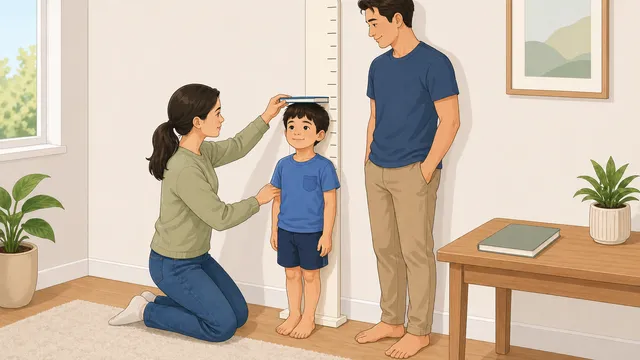
Let’s use the Height Calculator to estimate your child’s predicted adult height based on parental measurements and current growth data:
Height converter input
Height calculator overview
This height calculator combines a height converter, a quick height difference calculator, and a mid-parental height calculator so you can switch between centimetres and feet/inches, compare two heights exactly, and keep the family-height context in one place.
The stronger workflow is to use the converter for exact form-ready numbers, then use the family snapshot and measurement-sensitivity rows below if the target-height estimate looks surprising and you want to check whether the source heights or the chosen child estimate are driving that result.
Parental height input
Height difference input
Quick comparison, not a full chart
Use this height difference calculator when you only need the exact gap between two heights. If you want side-by-side bars or need to compare 3 or more people, move to the dedicated height comparison calculator.
Height conversion
175 cm converts to 5 ft 8.9 in, 1.75 m, and 1,750 mm.
175 cm
5 ft 8.9 in • 1.75 m • 1,750 mm
Use the feet-and-inches value when a form asks for imperial height, and keep the centimetre value for BMI tools, medical records, or growth-chart comparisons.
| Centimetres | 175 cm |
| Metres | 1.75 m |
| Feet and inches | 5 ft 8.9 in |
| Total inches | 68.9 in |
| Decimal feet | 5.74 ft |
| Millimetres | 1,750 mm |
Form-ready interpretation
Use 175 cm for clinical tools, growth charts, BMI forms, and most official records. Use 5 ft 8.9 in for everyday comparison, sports rosters, or forms that still expect feet and inches.
Adult height prediction
175.5 cm (5 ft 9.1 in) is the mid-parental target height, with a likely band from 167 cm (5 ft 5.7 in) to 184 cm (6 ft 0.4 in).
175.5 cm
5′ 9.1″ predicted adult target height
The midpoint is the centre of the target band. The lower and upper rows show a screening range rather than a promise that a child will finish at one exact height.
- Target range
- 167 cm (5′ 5.7″) – 184 cm (6′ 0.4″)
- Mid-parental midpoint
- 169 cm (5′ 6.5″)
- Sex adjustment
- +13 cm
Family height snapshot
These rows keep the parents, midpoint, and selected estimate in one worksheet so you can see whether the chosen target height sits closer to the taller parent, the shorter parent, or directly around the family midpoint.
| Father's height | 175 cm (5 ft 8.9 in) |
| Mother's height | 163 cm (5 ft 4.2 in) |
| Mid-parental midpoint | 169 cm (5′ 6.5″) |
| Parent height difference | 12 cm |
| Boy estimate vs taller parent | 0.5 cm taller |
| Boy estimate vs shorter parent | 12.5 cm taller |
Same parents, both target-height rows
This keeps the same parent heights but shows both sex-specific estimates so the standard 13 cm split in the mid-parental method is easier to audit.
| Estimate | Predicted height | Target range |
|---|---|---|
| Boy estimate | 175.5 cm (5 ft 9.1 in) | 167 cm (5′ 5.7″) – 184 cm (6′ 0.4″) |
| Girl estimate | 162.5 cm (5 ft 4 in) | 154 cm (5′ 0.6″) – 171 cm (5′ 7.3″) |
| Predicted adult height | 175.5 cm (5 ft 9.1 in) |
| Lower target height | 167 cm (5 ft 5.7 in) |
| Upper target height | 184 cm (6 ft 0.4 in) |
| Range width | 17 cm |
Measurement sensitivity check
These rows show how much the selected target-height estimate moves if one or both parent heights were rounded, taken in shoes, or measured slightly differently.
| Scenario | Predicted height | Shift |
|---|---|---|
| If both parents were measured 2 cm taller When both source heights move together, the selected target-height estimate moves by the same amount. | 177.5 cm (5 ft 9.9 in) | +2 cm |
| If only one parent was measured 2 cm taller Because the method averages both parents first, a small correction to one parent shifts the estimate by about half as much. | 176.5 cm (5 ft 9.5 in) | +1 cm |
| If both parents were measured 2 cm shorter This is a quick sense-check for rounded-up heights, shoes, or posture effects in the source measurements. | 173.5 cm (5 ft 8.3 in) | −2 cm |
Height difference
Person A is 7 cm (0 ft 2.8 in) taller than Person B.
7 cm
Exact difference: 7 cm (0 ft 2.8 in)
Person A is the taller recorded height in this pair.
- Taller entry
- Person A
- Difference in inches
- 2.8 in
- Difference in cm
- 7 cm
| Person A | 175 cm (5 ft 8.9 in) |
| Person B | 168 cm (5 ft 6.1 in) |
| Exact difference | 7 cm (0 ft 2.8 in) |
If the result surprises you — either higher or lower than you expected — remember that this is an estimate rooted in averages. It does not account for the full complexity of your child’s individual biology.
Growth percentiles and what they actually mean
When your paediatrician plots your child’s height and weight on a growth chart, they are comparing your child to a large reference population of children of the same age and sex. A child at the 75th percentile for height is taller than roughly 75 percent of their peers — but that does not mean they are “better” at growing or destined to be tall as an adult. What matters far more than the specific percentile is whether the child stays on a consistent curve over time.
A child who has tracked along the 40th percentile since infancy and continues doing so at age eight is growing normally. A child who drops from the 80th percentile to the 30th percentile over two years may warrant further investigation. Paediatric endocrinologists refer to this as “crossing percentile lines,” and it is one of the key signals that prompts a deeper look at thyroid function, growth hormone levels, or nutritional adequacy.
The World Health Organization (WHO) growth standards, used for children from birth to age five, are based on data from children raised in optimal conditions across six countries. After age five, many clinicians switch to the Centers for Disease Control and Prevention (CDC) growth charts, which are based on a broader cross-section of the population. Both are valuable tools, but neither is a crystal ball. They describe how populations of children grow, not how your individual child will.
The role of bone age
For children whose growth pattern raises questions — a dramatic growth spurt, delayed puberty, or a significant deviation from their expected percentile — a paediatrician may order a bone age X-ray. This is a simple radiograph of the left hand and wrist that reveals how mature the growth plates are compared to chronological age. A child whose bone age is two years behind their actual age still has more growing time ahead and may end up taller than their current trajectory suggests. Conversely, a child with advanced bone age may be closer to their final height than their current growth rate implies.
Bone age assessment, often scored using the Greulich-Pyle atlas, is one of the most accurate tools available for refining height predictions. When combined with the mid-parental formula and current growth data, it narrows the range of uncertainty considerably. If your paediatrician has never mentioned bone age testing and you have concerns about your child’s growth, it is a perfectly reasonable thing to ask about.
Nutrition, BMI, and the growth connection
Height prediction does not exist in isolation from overall health. A child’s nutritional status — reflected in part by their body mass index — plays a meaningful role in whether they reach their genetic height potential. Chronic undernutrition can delay growth and puberty, reducing final adult height. On the other hand, childhood obesity is associated with earlier onset of puberty, which can lead to an initial growth advantage followed by an earlier cessation of growth, sometimes resulting in a shorter adult stature than expected.
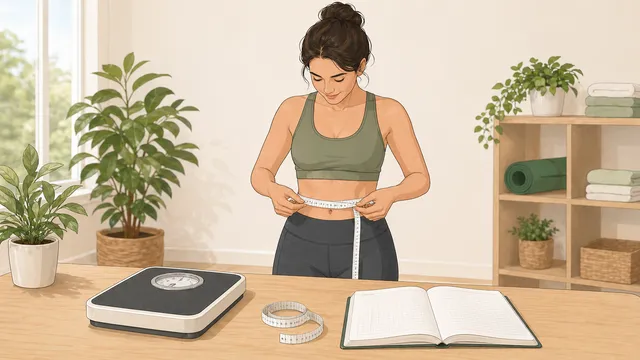
Monitoring your child’s BMI alongside their height gives you a more complete picture of their growth trajectory. The Body Metrics Calculator below can help you assess where weight falls relative to height for adult BMI context:
Measurement quality comes first
- Measure waist after a normal exhale, with the tape level and snug but not compressing the abdomen.
- Measure hips at the widest repeatable point around the hips and buttocks, again with a level tape.
- Take two readings when the result matters. If the numbers differ noticeably, remeasure before interpreting the body metrics.
Result
26.93 BMI
BMI and waist screens both deserve attention. BMI is 26.93 (Overweight), waist-to-height ratio is 0.5, waist-to-hip ratio is 0.824, BAI is 28.8%, and BRI is 3.36.
Combined screening signal
BMI and waist screens both deserve attention
BMI is above the healthy adult band and at least one waist-based screen is raised, even though BAI stays in its normal range. That disagreement is exactly why a broad body metrics calculator is more useful than any one number alone.
Waist target to keep under half of height
84 cm
The common half-height waist line is 84 cm, and the current waist is already 0 cm below it.
Remeasure first, then verify with a narrower body-composition tool
This reads more like a waist-led risk pattern than a pure weight-only issue
Repeat waist and hip measurements once or twice under the same conditions. If the pattern persists, use the body fat calculator or a clinician-guided assessment to add narrower body-composition context.
26.93
BMI: Overweight
70.3 kg
BMI target: Target BMI 24.9
28.8%
BAI: Normal
3.36
BRI: Low BRI
0.5
Waist-to-height: Increased central adiposity
0.824
Waist-to-hip: Moderate-risk screen
Pear (triangle)
Body shape: Moderate risk
Mesomorph
Body type: Overweight range
| Module | Result | How to read it |
|---|---|---|
| BMI | 26.93 · Overweight | About 5.7 kg less would return to BMI 24.9 at this height. |
| BMI target | 70.3 kg · Target BMI 24.9 | The upper edge of the healthy BMI range is usually the most practical first BMI target, with the midpoint acting as a deeper second-stage goal. |
| BAI | 28.8% · Normal | Within the healthy body adiposity range. |
| BRI | 3.36 · Low BRI | Below the lower reference band used in recent mortality research; interpret alongside nutrition, muscle mass, and clinical context. |
| Waist-to-height | 0.5 · Increased central adiposity | The half-height target at this height is 84 cm; the entered waist is 0 cm below that line. |
| Waist-to-hip | 0.824 · Moderate-risk screen | This is above the usual female lower-risk threshold. It is a screening signal rather than a diagnosis, and it works best alongside BMI, waist-to-height ratio, and clinical context. |
| Body shape | Pear (triangle) · Moderate risk | Lower-body-led proportions: hips are carrying more width than the bust, so the silhouette reads as pear-like. |
| Body type | Mesomorph · Overweight range | This result points to a more athletic build, with a stronger tendency toward muscularity and shoulder width than either extreme leanness or fat storage. |
BMI target weight and milestones
The upper edge of the healthy BMI range is usually the most practical first BMI target, with the midpoint acting as a deeper second-stage goal.
| Checkpoint | Target BMI | Target weight | Change |
|---|---|---|---|
| BMI 24.9 (enter healthy range) | 24.9 | 70.3 kg | 5.7 kg |
| BMI 22.5 (healthy midpoint) | 22.5 | 63.5 kg | 12.5 kg |
Specialist pages to keep separate
Some formulas answer narrower questions than this broad body metrics calculator. Use these retained pages when their inputs match the question.
Keep in mind that BMI in children is interpreted differently than in adults. Paediatric BMI is expressed as a percentile for age and sex, because body composition shifts dramatically during childhood and adolescence. A BMI at the 85th to 94th percentile is considered overweight, and at the 95th percentile or above, obese. Your paediatrician can help you interpret these numbers in the context of your child’s overall health, activity level, and family history.
When to talk to your paediatrician
Most variation in childhood growth is entirely normal. Some children are early bloomers who shoot up at ten and stop growing at fourteen. Others are late bloomers who barely grow during primary school and then add fifteen centimetres during a late adolescent growth spurt. Both patterns can result in perfectly healthy adult heights.
However, certain signs are worth discussing with a healthcare provider. If your child’s growth has stalled for six months or longer, if they have dropped more than two major percentile lines on their growth chart, if puberty seems to be arriving very early (before age eight in girls or nine in boys) or very late (no signs by age thirteen in girls or fourteen in boys), or if there is a significant discrepancy between their height and their mid-parental target, a conversation with a paediatric endocrinologist may be helpful.
In my clinical experience, the vast majority of parents who sought evaluation were reassured that their child’s growth was a normal variant. But for the smaller number of children who did have an underlying condition — growth hormone deficiency, coeliac disease, Turner syndrome, hypothyroidism — early identification made a meaningful difference in outcomes. Asking the question is never wrong.
The bottom line
Predicting your child’s adult height is part science, part educated guessing, and part patience. The mid-parental formula gives you a useful target. Growth percentiles help you track the journey. Bone age testing can refine the estimate when needed. And good nutrition provides the foundation that allows your child’s genetic potential to express itself fully.
No calculator or formula can tell you exactly how tall your child will be. But understanding the tools that exist — and their limitations — can help you have more informed conversations with your child’s doctor, worry less about normal variation, and focus on the things that genuinely matter: a balanced diet, regular physical activity, adequate sleep, and a home where your child feels supported and loved. Growth, in every sense of the word, takes care of itself when those foundations are in place.
Calculators used in this article
Health / Body Metrics
Height Calculator
Use the height calculator to convert centimetres, metres, feet, inches, and millimetres, compare the exact difference between two heights.
Health / Body Metrics
Body Metrics Calculator
Use this body metrics calculator to compare BMI, BAI, BRI, body fat distribution, waist-to-height ratio, waist-to-hip ratio.