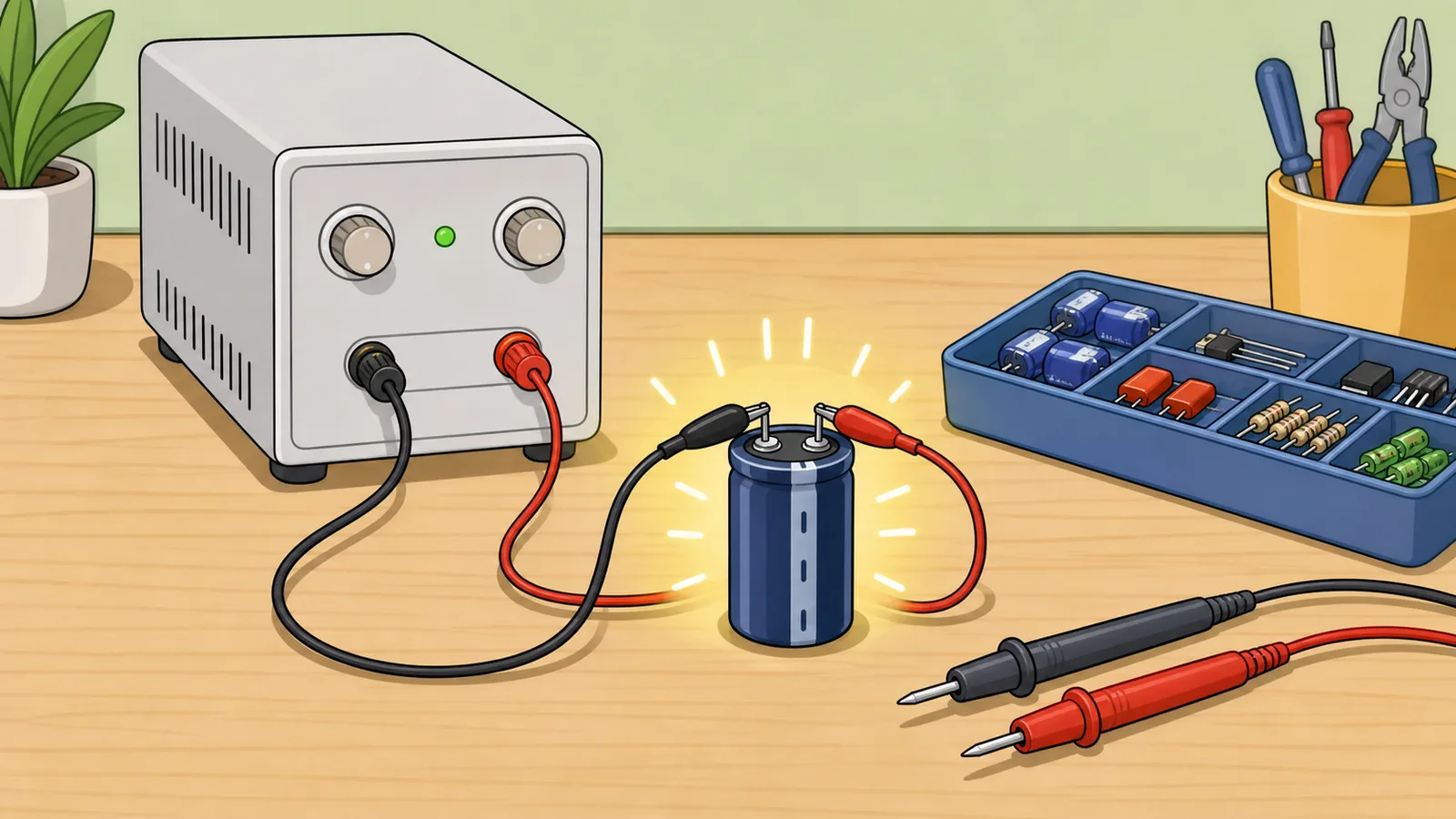
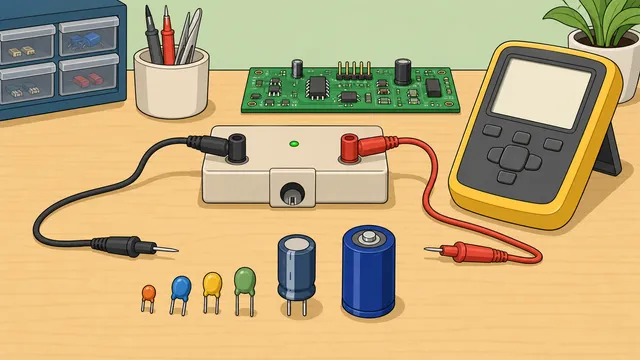
Use a capacitance to charge calculator to convert capacitance and voltage into coulombs with Q = C × V, farad normalization, and mC, µC, and nC outputs.
Last updated
Capacitance to charge calculator Convert capacitance and voltage into electric charge using the standard Q = C × V relationship, with pF, nF, µF, mF, and F inputs normalized to farads before the coulomb result is shown.
Try a capacitor example
µF is normalized to farads before the charge calculation.
Capacitor planning
Use this to compare capacitor values, stored charge, and simple electrostatics examples without manual unit conversion.
Enter capacitance and voltage Provide the capacitance and voltage to calculate electric charge in coulombs.
Capacitance to charge calculator: convert capacitance and voltage into coulombs
A capacitance to charge calculator converts capacitance and voltage into stored electric charge using the direct Q = C × V relationship. It is useful for capacitor examples, electrostatics teaching, circuit checks, and quick electronics worksheets where you need the answer in coulombs without manually normalizing farads, millifarads, microfarads, nanofarads, or picofarads first.
What this capacitance to charge calculator solves
This page takes a capacitance value and a voltage, converts the selected capacitance unit into farads, and then solves the corresponding electric charge in coulombs. It also reports millicoulombs, microcoulombs, and nanocoulombs so smaller capacitor results stay readable without changing the headline unit.
That makes the calculator a good fit for capacitor sizing examples, quick lab checks, and any workflow where the entered capacitance is more naturally expressed in mF, µF, nF, or pF rather than full farads. The example buttons are included for common electronics scales: a decoupling capacitor, a bulk capacitor, and a small ceramic capacitor.
The charge formula behind the result
Electric charge equals capacitance in farads multiplied by voltage in volts. If the capacitance is entered in millifarads, microfarads, nanofarads, or picofarads, the calculator first normalizes that value into farads and then applies the same physical relationship.
The result panel shows the exact working equation with the normalized farad value so you can verify both the unit conversion and the final charge arithmetic together. This is the same relationship used in introductory circuit and electrostatics references when a capacitor's charge, capacitance, and voltage are related directly.
Q = C x V
Use when capacitance in farads and voltage in volts are known.
Common capacitance units are converted to farads before charge is calculated.
mC = C x 1,000; µC = C x 1,000,000; nC = C x 1,000,000,000
Supporting outputs show the same charge at smaller scales for readability.
Further reading
OpenStax — Capacitance and charge — Open physics text covering the capacitor relationship between charge, capacitance, and potential difference.
How to interpret the coulomb result
The coulomb result is the amount of charge associated with the entered capacitance and voltage pair. Larger capacitance stores more charge at the same voltage, and higher voltage stores more charge on the same capacitor value.
The supporting millicoulomb, microcoulomb, and nanocoulomb figures help when the headline value is small, while the normalized-farads display keeps the unit conversion explicit and easy to audit.
For a 100 µF capacitor charged to 12 V, the charge is 0.0012 C, or 1.2 mC. For a 220 pF capacitor at 3.3 V, the charge is only 0.726 nC. Seeing both scales on the same page helps avoid mistakes when moving between power-electronics examples and small-signal electronics examples.
Where this simple capacitor relationship stops
This calculator models the direct static charge relationship only. It does not estimate discharge curves, ESR, leakage, stored energy, dielectric limits, frequency response, or dynamic circuit behaviour.
Use it as an educational and planning aid. If you need transient or component-specific analysis, move to a fuller capacitor model that includes the actual circuit conditions.
Frequently asked questions
Why does the calculator convert my capacitance into farads first?
Because the charge equation Q = C × V is defined with capacitance in farads. Normalizing the input keeps the physics correct and makes the working equation easy to verify.
Why are millicoulombs and microcoulombs shown as well?
Because many practical capacitor examples produce small charge values. Showing the same result in mC and µC makes the answer easier to read without changing the underlying physics.
Does this replace a full capacitor discharge or transient model?
No. It only solves the direct capacitance-voltage-to-charge relationship. Real dynamic behaviour still depends on the wider circuit, losses, and timing.