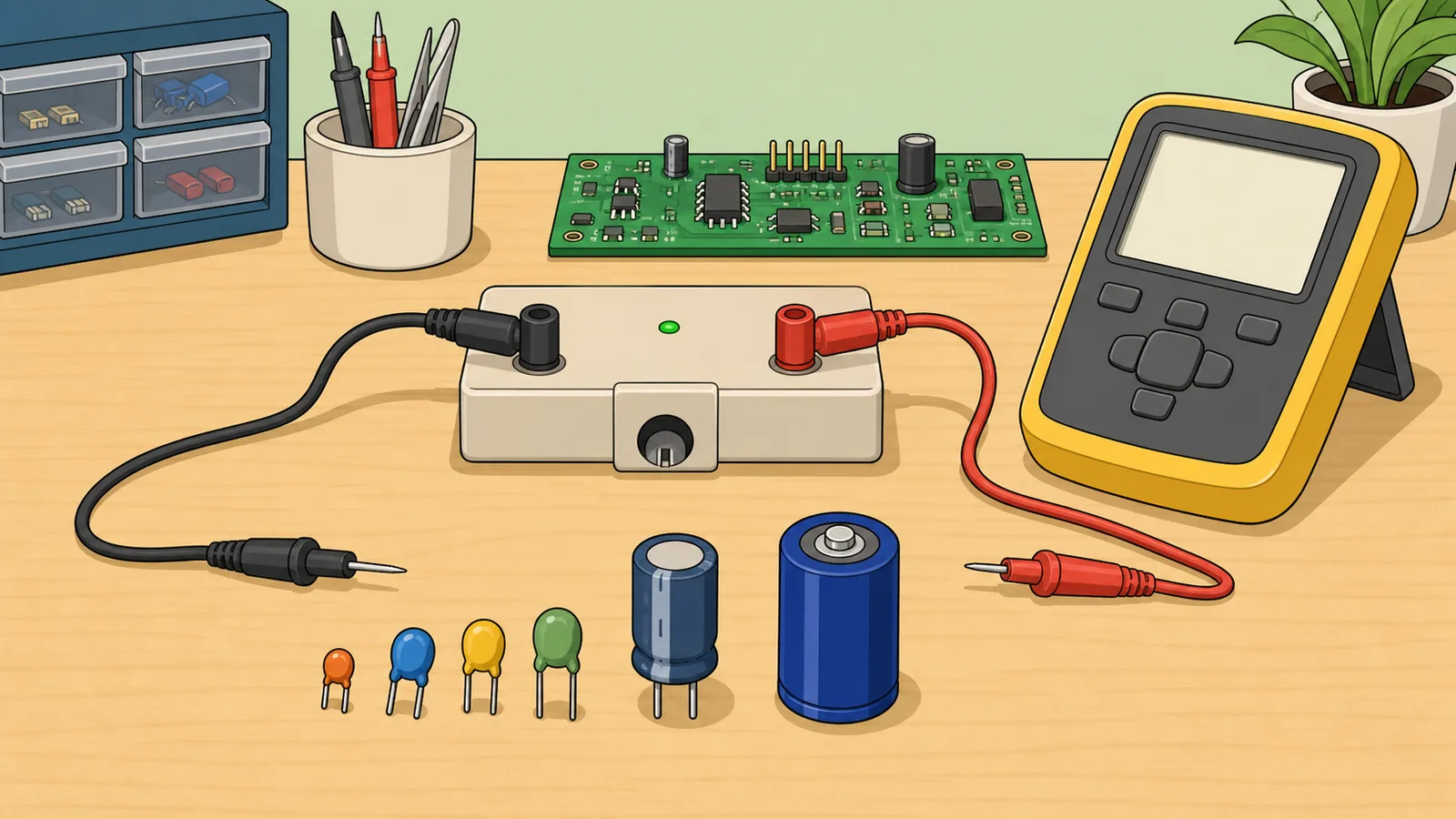
Convert capacitance between farads, µF, nF, pF, fF, C/V, abfarads, and statfarads, then review direct target output, range notes, and optional voltage context.
Last updated
Electrostatic capacitance converter Convert capacitance across farads, femtofarads, everyday capacitor prefixes, coulombs per volt, and CGS electrostatic references without losing track of the farad baseline.
Presets
What this converter covers
The calculator treats capacitance as a unit conversion first. The optional voltage field only adds quick charge and stored-energy context with Q = C × V and E = 1/2 × C × V².
Result
100,000 nF
100 µF equals 1e-4 F. The headline follows your direct target unit; the readable scale is 100 µF.
Target
100,000 nF
Farads
1e-4 F
Microfarads
100 µF
Nanofarads
100,000 nF
Picofarads
1e+8 pF
Coulombs per volt
1e-4 C/V
Charge at 5 V
5e-4 C
Energy at 5 V
0.0013 J
Range interpretation
Microfarad values are common for decoupling, bulk filtering, coupling, and general electronics parts.
Definition and voltage context
C = Q / V, Q = C × V, E = 1/2 × C × V²
One farad is one coulomb per volt. The optional voltage field turns the converted farad value into quick charge and stored-energy context without replacing a full capacitor-design check.
Common capacitance units
Everyday capacitor values and SI prefixes from farads through picofarads.
Farads
F reference
1e-4 F
Millifarads
mF reference
0.1 mF
Microfarads
µF reference
100 µF
Nanofarads
nF reference
100,000 nF
Picofarads
pF reference
1e+8 pF
Small-signal units
Femtofarads help with parasitic, on-chip, RF, and precision-measurement references.
Femtofarads
fF reference
1e+11 fF
Large prefix units
High-capacitance and engineering-scale references.
Kilofarads
kF reference
1e-7 kF
Megafarads
MF reference
1e-10 MF
Gigafarads
GF reference
1e-13 GF
Definition equivalent
One farad is one coulomb per volt, connecting the unit conversion back to C = Q / V.
Coulombs per volt
C/V reference
1e-4 C/V
CGS reference units
Historical electrostatic and electromagnetic capacitance units.
Abfarads
abF reference
1e-13 abF
Statfarads
statF reference
89,875,500 statF
Common capacitance landmarks
Use these rows as magnitude checks before applying a converted value to a part, note, or design assumption.
On-chip or parasitic reference
Tiny parasitic or integrated-circuit capacitances may sit in the femtofarad range.
1e-14 F
Crystal load capacitor
Small oscillator and RF parts are often specified in picofarads.
2.2e-11 F
Decoupling capacitor
100 nF is a common local decoupling reference in digital electronics.
1e-7 F
Bulk electrolytic
Hundreds of microfarads are common for bulk filtering and short-term storage.
4.7e-4 F
Supercapacitor cell
Farad-scale values usually mean energy storage rather than ordinary signal coupling.
An electrostatic capacitance converter compares capacitance across the farad family, practical capacitor prefixes such as µF, nF, pF, and fF, the definition-equivalent coulomb per volt, and the historical CGS reference units used in older electrostatics texts.
What this capacitance converter solves
This page converts one capacitance value into a full result sheet covering farads, millifarads, microfarads, nanofarads, picofarads, femtofarads, kilofarads, megafarads, gigafarads, coulombs per volt, abfarads, and statfarads.
That makes it useful for everyday electronics work, quick farad to microfarad or microfarad to nanofarad conversions, small-signal pF and fF checks, and older electrostatic or electromagnetic unit systems that do not use the same naming conventions as modern SI-focused datasheets.
The direct target unit is there for quick answers such as µF to nF, nF to pF, pF to F, or statfarad to farad, while the grouped result sheet keeps the surrounding units visible so magnitude mistakes are easier to catch.
Farads stay as the baseline
The converter first resolves the chosen unit into farads. Every supporting result is then just the same capacitance expressed at another scale, which is why the farad baseline is always shown directly in the result summary.
Keeping that baseline visible helps avoid mistakes when moving between everyday capacitor labels such as µF and nF, very small parasitic values in pF or fF, and much larger or historical reference units.
Common electronics and small-signal units are powers-of-ten expressions of the farad.
1 F = 1 C/V
The farad is equivalent to one coulomb per volt by the capacitance definition.
1 abF = 10^9 F
The abfarad is a very large CGS electromagnetic capacitance unit.
1 statF ≈ 1.11265 x 10^-12 F
The statfarad provides the electrostatic CGS reference point.
How to use the grouped sections
The common unit section is the fastest way to compare the ranges used in real capacitor parts, from electrolytic values down to small ceramic or RF values. The small-signal section highlights femtofarads because parasitic capacitance, integrated circuits, and precision measurements can fall below the picofarad range.
The definition section shows coulombs per volt so the converter does not hide what a farad means physically. The specialized section isolates statfarad and abfarad so those historical CGS units are visible without crowding the everyday electronics scales.
Use the range note before applying the number
A converted capacitance value is more useful when the scale is interpreted. Femtofarads and picofarads often point to parasitic, RF, oscillator, and small-signal work. Nanofarads and microfarads often point to timing, coupling, decoupling, filtering, and general electronics parts. Millifarads and farads usually shift the concern toward energy storage, ripple current, leakage, ESR, and voltage rating.
The range note and landmark rows are designed to catch unit slips before they move into a schematic or part search. Confusing 100 nF with 100 µF changes the capacitance by a factor of 1,000, while confusing pF and nF can move a small-signal value into a completely different design context.
Voltage context links capacitance to charge and energy
Many capacitance converter pages stop at the unit ladder, but the definition of capacitance is charge per volt. The optional voltage field uses the converted farad value to show charge in coulombs and stored energy in joules for a simple ideal-capacitor context.
That context helps answer the practical follow-up question behind many capacitor conversions: not just what the unit is, but how much charge or energy the same capacitance represents at a stated voltage. It remains a quick context check rather than a replacement for component derating, ESR, leakage, ripple-current, temperature, or safety analysis.
C = Q / V
Capacitance equals charge divided by voltage.
Q = C × V
Once capacitance and voltage are known, charge can be estimated for an ideal capacitor.
E = 1/2 × C × V²
Stored energy rises with capacitance and with the square of voltage.
What this page does not estimate
This calculator does not estimate reactance, ESR, leakage, tolerance drift, dielectric absorption, ripple current, resonant circuit behaviour, capacitor code markings, or the physical geometry needed to create a capacitance. It is a capacitance unit converter with optional ideal voltage context.
Use it as a reference and planning aid. If the next task is to estimate charge, energy, capacitor code markings, AC reactance, or plate geometry more deeply, switch to the calculator that models that electrical relationship directly.
Frequently asked questions
Why are both µF and nF shown when they represent the same capacitance?
Because different parts of electronics use different scales by convention. Power and decoupling parts are often discussed in µF, while timing, coupling, signal, and small ceramic capacitors are often discussed in nF or pF.
What are abfarads and statfarads for?
They are historical CGS-system capacitance units. They are not the usual choice for modern parts work, but they still appear in older references and specialist electrostatics material.
Is one farad the same as one coulomb per volt?
Yes. One farad is equivalent to one coulomb per volt. That definition is why the converter includes a C/V row and why the optional voltage context can estimate ideal charge from Q = C × V.
Why include femtofarads?
Femtofarads are useful for very small capacitance values such as parasitic capacitance, on-chip structures, RF layouts, and precision measurement contexts. Most everyday components use pF, nF, or µF, but fF support helps with small-signal and electrostatic references.
What is the difference between pF, nF, and µF?
They are powers-of-ten versions of the same capacitance quantity. One nF equals 1,000 pF, and one µF equals 1,000 nF or 1,000,000 pF.
Does this tell me how much energy a capacitor stores?
It can provide quick ideal energy context when you enter a voltage, using E = 1/2 × C × V². It does not replace a full capacitor energy, safety, derating, ESR, leakage, or application check.
Can this convert capacitor code markings?
No. A capacitor code tool decodes printed markings, usually into picofarads. This converter assumes you already know the capacitance value and only need to express it in another unit.
When should I use farads instead of µF, nF, or pF?
Use farads when you need the SI baseline, supercapacitor-scale values, or formulas such as Q = C × V and E = 1/2 × C × V². Use µF, nF, or pF when those units make the component value easier to read.
Does this calculate capacitive reactance?
No. Capacitive reactance depends on frequency as well as capacitance. This page converts capacitance units and gives ideal voltage context only; use a reactance calculator when frequency behaviour is the main question.