Convert electric field strength between V/m, µV/m, N/C, V/cm, V/in, kV/in, statV/cm, and dBµV/m with grouped result sheets that keep the V/m baseline visible.
Last updated
Electric field strength converter Convert field strength across µV/m, V/m, N/C, V/cm, V/in, kV/in, and statV/cm while keeping the base volts-per-metre value visible.
Presets
What this converter covers
This converter treats electric field strength as a pure unit conversion around V/m and includes microvolt-per-metre, newton-per-coulomb, centimetre, millimetre, inch-based, and CGS reference scales used in electrical, EMC, and electrostatic work.
Quick anchors
1 N/C = 1 V/m. 1 V/cm = 100 V/m. 1 V/in = 39.3701 V/m. dBµV/m is shown as a reference level when the field is above zero.
Enter a field strength Provide a value to compare SI field-strength scales, N/C, centimetre, millimetre, inch-based units, and the CGS reference unit.
Electric field strength converter: compare V/m, N/C, V/cm, V/in, kV/m, and statV/cm
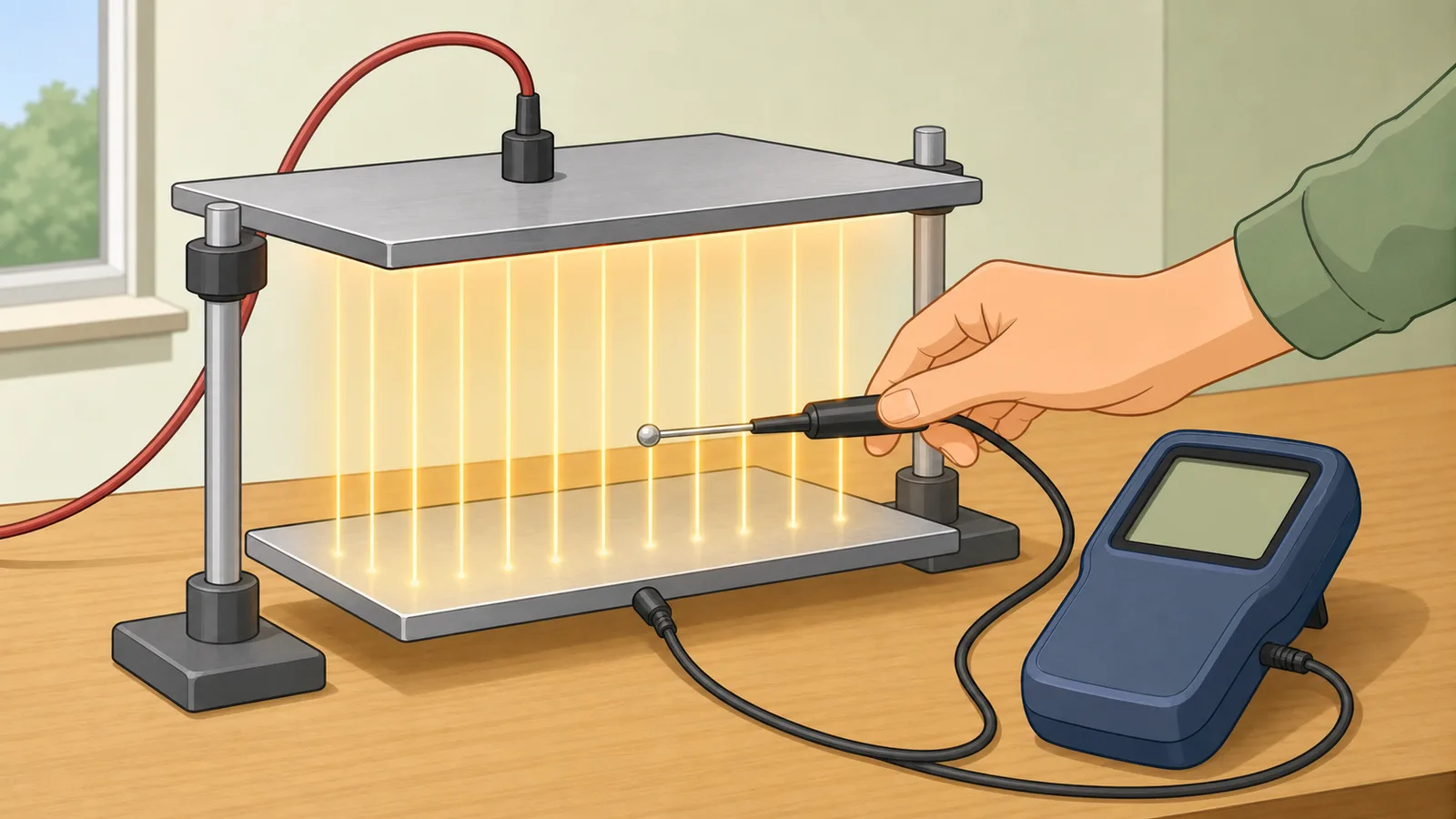
An electric field strength converter expresses one field value across the metre-, centimetre-, millimetre-, inch-, force-per-charge, and CGS-based scales that appear in electronics, insulation, EMC notes, and electrostatics references. It is useful when a result starts in volts per metre but a datasheet, calculation note, lab measurement, or older source uses N/C, V/cm, kV/in, dBµV/m, or statV/cm instead.
What this electric field strength converter covers
This page converts a non-negative electric field strength into microvolts per metre, millivolts per metre, volts per metre, kilovolts per metre, megavolts per metre, newtons per coulomb, volts per centimetre, volts per millimetre, kilovolts per centimetre, volts per inch, kilovolts per inch, and statvolts per centimetre.
That grouped layout keeps the SI baseline visible while still making short-gap, inch-based, force-per-charge, EMC reference, and historical CGS expressions easy to compare side by side.
The calculator also reports a dBµV/m reference when the field is above zero. That logarithmic line is not a separate linear conversion unit; it is a convenient way to read a non-zero field-strength level against a one-microvolt-per-metre reference.
V/m stays as the baseline
The converter first normalizes the entered unit into volts per metre. Every supporting result is then just the same field written against a different distance scale, force-per-charge equivalent, legacy notation, or logarithmic reference.
Keeping the V/m baseline visible reduces mistakes when a field value moves between insulation references, short-gap bench work, EMC measurement notes, and electrostatics material that does not use modern SI phrasing.
1 N/C = 1 V/m
Newtons per coulomb is numerically identical to volts per metre for electric field strength.
1 V/cm = 100 V/m; 1 V/mm = 1,000 V/m
Shorter metric distance units represent the same field value against smaller lengths.
1 V/in ≈ 39.3701 V/m; 1 kV/in ≈ 39,370.0787 V/m
Inch-based references are included for older datasheets and insulation specifications.
1 statV/cm ≈ 29,979.2458 V/m
The statvolt-per-centimetre unit is included for historical CGS electrostatics references.
dBµV/m = 20 log10((V/m) / 0.000001)
The dBµV/m reference is defined only for field strengths greater than zero.
How to read the grouped result sheet
The SI section is usually the best reference for modern engineering work. The N/C line is useful in physics examples, the centimetre and millimetre section is practical when a value is written against a shorter gap, and the inch-based section helps with legacy specifications that still use volts per inch.
The headline result picks a readable scale automatically, but the grouped sheet is the safer cross-check when you need to confirm exactly how one source's notation maps onto another.
For very small field strengths, µV/m and dBµV/m help avoid unreadable decimals. For high field strengths, kV/cm, kV/in, and MV/m keep insulation and electrostatic examples easier to compare.
Where each unit tends to appear
Volts per metre is the standard field-strength baseline, while newtons per coulomb often appears in introductory physics because it emphasizes force per unit charge.
Volts per centimetre, volts per millimetre, and kilovolts per centimetre are common when the physical gap is short. Volts per inch and kilovolts per inch can appear in older equipment notes, dielectric references, and inch-based specifications.
StatV/cm belongs to historical CGS electrostatics. It is included so older source material can be compared with SI values without forcing a separate lookup.
What this converter does not model
This calculator does not estimate dielectric breakdown, charge distribution, fringe effects, near-field geometry, radiated emissions compliance, or full electrostatic geometry. It converts one electric field strength quantity into equivalent unit expressions only.
Use it as an educational and planning reference. If the next step depends on insulation coordination, antenna measurements, geometry, material behaviour, or compliance limits, switch to a calculator or model that includes those assumptions directly.
Frequently asked questions
Why show both V/m and N/C for the same electric field strength?
They are equivalent for electric field strength. V/m is the standard SI-style electrical expression, while N/C is common in physics because it describes the force on each coulomb of charge.
Why show both V/m and V/cm for the same field strength?
Because different references prefer different length scales. V/m is the standard baseline, while V/cm or V/mm can be easier to read when the field is described across a short physical gap.
When would kV/in be more useful than kV/m?
kV/in can be useful when a legacy datasheet, insulation note, or inch-based specification gives electric field strength over an inch-scale clearance. The converter keeps V/m visible so the same value can still be compared with SI references.
What does dBµV/m mean?
dBµV/m is a logarithmic way to express electric field strength relative to one microvolt per metre. It is useful for non-zero field levels in EMC-style references, but it is not defined for a zero field.
Does this tell me whether insulation will break down?
No. Breakdown depends on geometry, materials, contamination, temperature, pressure, waveform details, and safety margins. This page only converts the field-strength quantity itself between units.
Why include statV/cm at all?
Older electrostatics and CGS-based references can use statvolts per centimetre. Including statV/cm lets you compare those older values with modern SI-style V/m values.