Skip to content
Calcipedia
Cubic Yards Calculator instructional illustration

Cubic Yards Calculator

Use the cubic yards calculator to estimate concrete, gravel, mulch, and soil orders from dimensions, square footage plus depth, or cubic feet.

Last updated

Cubic yards calculator for concrete, gravel, mulch, and soil Use this cubic yard calculator to figure cubic yards from project dimensions or convert cubic feet to cubic yards, then add a waste allowance, bag comparison, and rounded supplier order.

Quick scenarios

Cost currency

Set the display currency before entering optional material price and delivery estimates.

Material

Good for patios, slabs, and footings where concrete yardage and bag count both matter.

Input method

Order estimate

1.63 cu yd

Waste-adjusted cubic yards calculator result for your concrete order. Raw volume is 1.48 cu yd before waste.

Raw cubic yards
1.48
Cubic feet to order
44
Estimated tons
3.3 tons
Rounded supplier order
1.75 cu yd
Wheelbarrow loads
15
Dump truck loads
1
Project area
120 sq ft
Coverage per cubic yard
81 sq ft
Waste added
0.15 cu yd
Estimated delivered cost
$280.00

80-lb concrete bags

74

Cost checkpoint

At $160.00 per cubic yard, the rounded 1.75 cu yd order costs $280.00 before delivery and $280.00 with the entered fee.

The delivered cost works out to about $189.00 per raw cubic yard placed before waste.

Your waste buffer is in the normal planning range

This order includes 10% extra, which is in line with common planning allowances for concrete jobs.

How to use this cubic yard estimate

One cubic yard equals 27 cubic feet, so this cu yd calculator shows both units to make it easier to compare supplier quotes, pickup loads, and bag counts.

For concrete yardage, the 80-lb bag estimate helps you compare bagged mix with ready-mix. Once the job gets close to 1 cubic yard, ready-mix pricing is often worth checking.

← All Dimensions & Conversions calculators

Volume Measurement

Calculate cubic yards for material ordering and project planning

A cubic yards calculator converts length, width, and depth measurements into cubic yards, the standard ordering unit for bulk materials such as concrete, gravel, mulch, and topsoil in construction and landscaping projects.

What is a cubic yard?

A cubic yard is a unit of volume equal to the space inside a cube that measures three feet on each side. Because 3 × 3 × 3 equals 27, one cubic yard contains exactly 27 cubic feet. The cubic yard is the standard volume unit used across the construction and landscaping industries in the United States for ordering and delivering bulk materials.

When suppliers quote prices for concrete, gravel, mulch, topsoil, sand, or fill dirt, the price is almost always given per cubic yard. Understanding how to calculate cubic yards from your project dimensions is essential for accurate ordering and cost estimation.

The cubic yards formula

To calculate cubic yards, first find the volume in cubic feet by multiplying length, width, and depth in feet. Then divide by 27, because one cubic yard equals 27 cubic feet. This two-step process works for any rectangular area such as a patio slab, garden bed, driveway, or foundation footing.

If your depth is measured in inches rather than feet, divide by 12 first to convert to feet before multiplying by the other dimensions. Many construction projects specify slab or fill depth in inches — for example, a 4-inch concrete slab or a 3-inch mulch layer — so this conversion step is common.

For circular areas such as tree rings, round patios, or cylindrical post holes, calculate the area in square feet using π × radius² and then multiply by the depth in feet before dividing by 27. For irregular shapes, break the area into simpler rectangles or triangles, calculate each section separately, and sum the cubic yardage.

Cubic yards = (Length × Width × Depth in feet) ÷ 27

Calculate volume in cubic feet first, then divide by 27 to convert to cubic yards. If depth is in inches, divide by 12 to convert to feet first.

Ordering bulk materials

Most bulk construction materials are sold by the cubic yard. Knowing the cubic yardage of your project area lets you order the right amount of concrete, gravel, mulch, or soil without significant waste or shortfall. Under-ordering means an extra delivery trip and potential delays; over-ordering wastes money and leaves excess material to dispose of.

It is common to add 5 to 10 percent extra to account for compaction, spillage, uneven ground, and slight measurement inaccuracies. For gravel and crushed stone, compaction can reduce volume by 10 to 15 percent after settling, so experienced contractors often order on the higher end of that margin. For mulch, which is lighter and less prone to compaction, 5 percent extra is usually sufficient.

Suppliers may not sell fractions of a cubic yard. If your calculation yields 4.3 cubic yards, ask your supplier whether they sell partial yards. Some will; others round up to the nearest half or full yard. When in doubt, rounding up is safer than falling short mid-project.

Area, depth, and cost planning

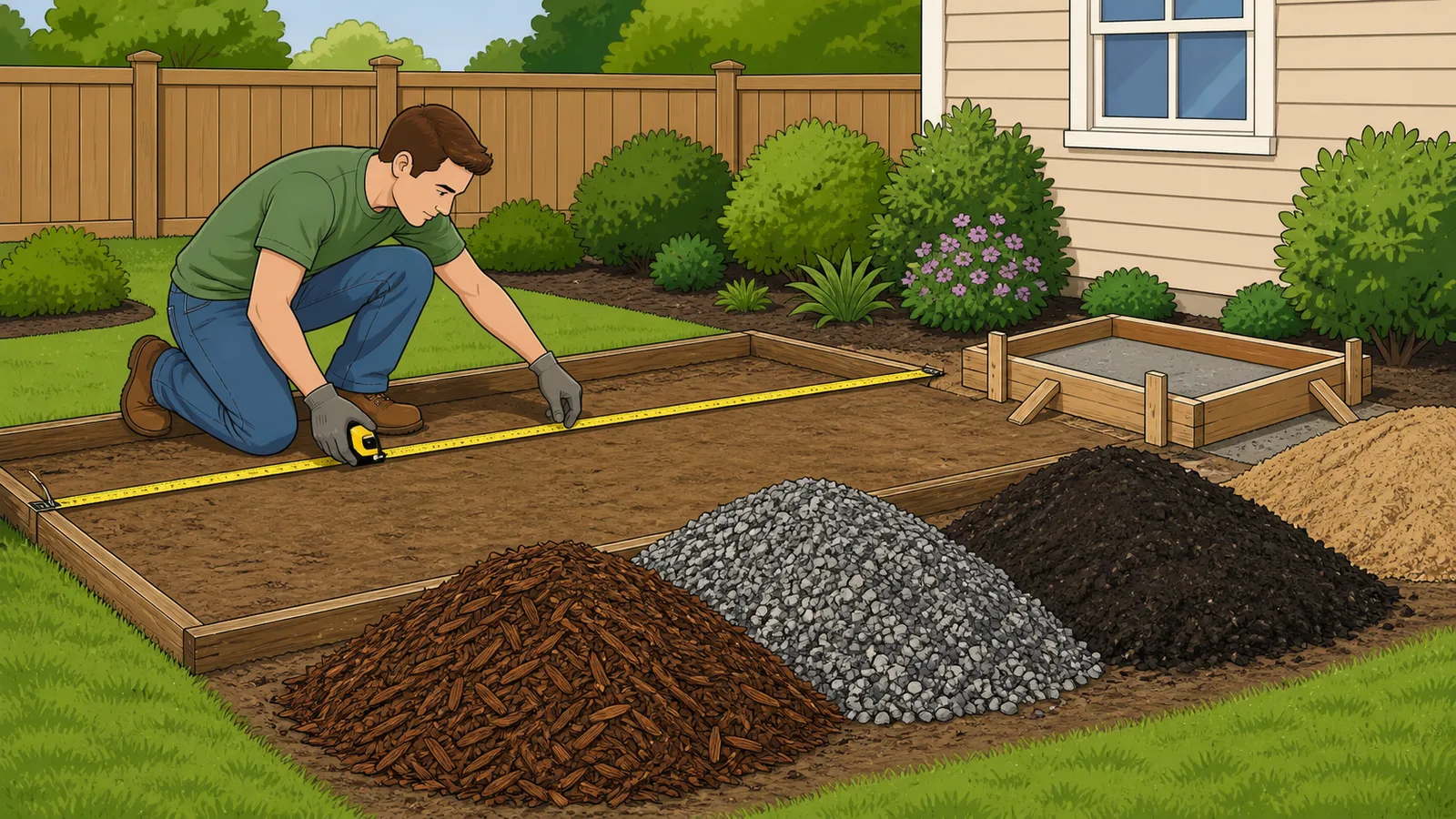
Many real projects start with a known square footage rather than separate length and width. A contractor may already know the driveway area, a landscaper may have measured a bed footprint, or a homeowner may be working from a plan that lists square feet. In that case, the area plus depth workflow is faster: multiply square feet by depth in feet, divide by 27, then apply waste and supplier rounding.

Cost planning is a separate step from the raw cubic-yard formula. The calculator now lets you enter a price per cubic yard and any delivery or short-load fee, then applies that price to the rounded supplier order rather than the unrounded raw volume. That mirrors how many suppliers quote bulk gravel, mulch, topsoil, fill dirt, and ready-mix concrete.

This is useful when comparing bagged material with a bulk order. A bulk yardage result can look cheaper per unit, but delivery fees, short-load minimums, pickup limits, and local supplier increments can change the real purchase decision.

How many cubic feet are in a yard and other quick conversion checks

One cubic yard contains 27 cubic feet, so the fastest cubic feet to cubic yards conversion is simply to divide by 27. That is the same as asking how many cubic feet are in a yard or how many cubic feet are in one cubic yard: the answer is always 27 because a cubic yard is a 3-foot by 3-foot by 3-foot cube.

This matters because many people measure a project in feet and inches but order in yards. A concrete patio, gravel base, mulch bed, or soil fill layer is often measured on site in feet, then converted into cubic yards only at the ordering stage. Keeping both units visible makes it easier to audit the calculation and compare it with supplier quotes.

If you only know the flat footprint, use a square feet to cubic yards approach by adding the installation depth first. Area alone is not enough for a bulk-material order because the supplier needs a three-dimensional volume rather than a two-dimensional surface measurement.

Worked example: planning a concrete patio slab

Suppose you are pouring a concrete patio that measures 12 feet long by 10 feet wide with a standard 4-inch slab depth. First convert the depth: 4 inches ÷ 12 = 0.333 feet. Next calculate cubic feet: 12 × 10 × 0.333 = 40 cubic feet. Finally convert to cubic yards: 40 ÷ 27 = 1.48 cubic yards.

Standard concrete weighs approximately 150 pounds per cubic foot, so this 40-cubic-foot slab would weigh roughly 6,000 pounds or about 3 tons. The calculator also estimates that this project would require roughly 14 wheelbarrow loads (at 3 cubic feet per load) and would fit within a single standard dump truck trip.

Adding 10 percent for waste and overfill brings the order to about 1.63 cubic yards. Most ready-mix suppliers would round this to 1.75 or 2 cubic yards to ensure full coverage.

Concrete yardage, gravel loads, mulch coverage, and soil fill

A general cubic yard calculator becomes much more useful when it helps you translate the same raw volume into the way the material is actually bought. Concrete projects often care about concrete yardage, rounded ready-mix order size, and whether the pour is still small enough for bagged mix. Gravel jobs often care about both cubic yards and tons because the same supplier may quote by either method. Mulch orders tend to care about coverage at a chosen depth and the comparison between bulk delivery and standard bag sizes. Topsoil and fill dirt projects often care about yardage plus the way the material settles after watering and grading.

That is why it helps to treat material type as more than a label. A gravel calculator yards workflow may use a higher waste allowance because of compaction. A mulch calculator may care more about square-foot coverage per cubic yard at 2 or 3 inches deep. A soil yards calculator may need a deeper fill assumption than mulch or gravel because raised beds and low spots commonly use thicker layers. The underlying volume formula is the same, but the ordering decision is different.

Concrete also introduces the common bag-count question. Because an 80 lb bag of concrete mix typically yields about 0.6 cubic feet, one full cubic yard is roughly 45 bags before any waste allowance is added. That makes bag counts useful for small repairs and posts, but once the order approaches a full yard, many users are better served by comparing the rounded yardage estimate with ready-mix minimums.

Common material weights and coverage

Different bulk materials vary widely in density, which affects both the weight per cubic yard and how the material is priced and delivered. Concrete typically weighs between 140 and 150 pounds per cubic foot (roughly 3,780 to 4,050 pounds per cubic yard). Gravel and crushed stone range from 90 to 110 pounds per cubic foot depending on the type, while topsoil averages 75 to 100 pounds per cubic foot and mulch is much lighter at 20 to 30 pounds per cubic foot.

Coverage area depends on the depth of application. One cubic yard of mulch covers approximately 324 square feet at 1 inch deep, 162 square feet at 2 inches deep, or 108 square feet at 3 inches deep. One cubic yard of gravel covers about 108 square feet at 3 inches deep, and one cubic yard of concrete covers approximately 81 square feet at a standard 4-inch slab depth.

A standard dump truck carries roughly 10 cubic yards per trip. A standard wheelbarrow holds about 3 cubic feet, so moving one cubic yard by wheelbarrow takes 9 loads. These practical estimates help you plan labour time and delivery logistics alongside your material volume.

How to round the result for ordering

A cubic yard estimate is rarely the final order number by itself. Concrete is often rounded to the nearest quarter yard or half yard after a waste buffer is applied. Gravel, topsoil, and mulch may be rounded to the nearest half yard or full yard depending on the supplier’s minimum sale size and delivery schedule.

A practical workflow is to calculate the raw cubic yards, apply a material-appropriate waste allowance, and then round the order to the supplier increment. That process is usually more reliable than trying to guess the final order without first checking the raw volume.

Limitations and scope

This calculator provides volume and weight estimates for rectangular project areas using standard conversion factors. It does not account for circular, triangular, or irregular shapes directly — for those, calculate the area in square feet separately and enter the result as a cubic feet value in direct-input mode.

The weight estimate depends on the material density value you enter. Real-world density varies by moisture content, compaction, aggregate size, and supplier. The default density of 100 lbs/cu ft is a general starting point — always confirm the actual density with your material supplier for accurate weight calculations.

Cubic yards are the primary bulk volume unit in the United States. In countries that use the metric system, bulk materials are typically sold by the cubic metre (1 cubic yard ≈ 0.7646 cubic metres). This tool reports results in US customary units.

Frequently asked questions

How many cubic feet are in a cubic yard?

One cubic yard equals exactly 27 cubic feet. This is because a yard is 3 feet, and the volume of a cube is calculated by cubing the side length: 3 × 3 × 3 = 27. This conversion factor is the basis of every cubic yardage calculation.

How do I convert depth in inches to cubic yards?

Divide the depth in inches by 12 to convert it to feet, then multiply by the length and width (both in feet) to get cubic feet, and finally divide by 27 to get cubic yards. For example, a 6-inch depth over a 10 × 10 foot area: 6 ÷ 12 = 0.5 ft, then 10 × 10 × 0.5 = 50 cu ft, then 50 ÷ 27 ≈ 1.85 cubic yards.

How much does a cubic yard of concrete weigh?

A cubic yard of standard concrete weighs approximately 3,700 to 4,050 pounds (roughly 1.85 to 2 tons). The exact weight depends on the mix design and aggregate type. Lightweight concrete mixes can weigh as little as 3,000 pounds per cubic yard, while heavier mixes with dense aggregate may exceed 4,000 pounds.

How much area does one cubic yard of mulch cover?

One cubic yard of mulch covers approximately 324 square feet at a 1-inch depth, 162 square feet at 2 inches, or 108 square feet at 3 inches. Most landscapers recommend a 2-to-3-inch mulch layer for effective weed suppression and moisture retention, so one cubic yard typically covers between 100 and 160 square feet in practice.

Should I add extra material for waste and settling?

Yes. It is standard practice to add 5 to 10 percent extra to your calculated volume. Gravel and crushed stone compact more heavily (add 10 to 15 percent), while mulch and topsoil need less overage (5 to 10 percent). Concrete should be ordered with at least 10 percent extra to account for spillage, uneven subgrade, and slight measurement errors. Under-ordering is more costly than a small surplus.

What is the difference between cubic yards and square yards?

Square yards measure area (length × width) in two dimensions, while cubic yards measure volume (length × width × depth) in three dimensions. A square yard covers a 3 × 3 foot area (9 square feet), while a cubic yard fills a 3 × 3 × 3 foot space (27 cubic feet). When ordering bulk materials, you always need cubic yards because depth matters.

How many cubic yards does a dump truck hold?

A standard single-axle dump truck holds about 5 cubic yards, while a tandem-axle (full-size) dump truck holds roughly 10 cubic yards. Tri-axle trucks can carry 12 to 16 cubic yards depending on the material weight and local road regulations. The calculator estimates dump truck loads assuming a standard 10-cubic-yard capacity.

Is it cheaper to buy bulk materials by the cubic yard or by the bag?

Buying in bulk by the cubic yard is almost always cheaper than buying bagged material for projects larger than about 1 cubic yard. A 40-pound bag of topsoil contains roughly 0.5 cubic feet, so you would need about 54 bags to equal one cubic yard — the cost per bag adds up quickly. For small projects under half a cubic yard, bags may be more practical since you avoid delivery fees.

How do I calculate cubic yards for a circular area?

Measure the diameter of the circle in feet, divide by 2 to get the radius, then use the formula: Area = π × radius². Multiply the area by the depth in feet to get cubic feet, then divide by 27 for cubic yards. For example, a 10-foot diameter circle at 4 inches deep: radius = 5, area = 3.14159 × 25 = 78.54 sq ft, volume = 78.54 × 0.333 = 26.15 cu ft, yardage = 26.15 ÷ 27 ≈ 0.97 cubic yards.

How many bags of concrete are in a cubic yard?

As a planning rule, one cubic yard is about 45 standard 80 lb bags of concrete mix because each bag yields roughly 0.6 cubic feet. If you add a 10 percent waste allowance, the bag count rises further, which is why larger pours often make more sense as ready-mix orders.

Can I use one cubic yards calculator for gravel, mulch, topsoil, and concrete?

Yes, as long as the calculator lets you adjust depth, density, and waste assumptions. The volume maths is the same for all of those materials, but the ordering decision changes because gravel may be quoted by the ton, mulch is often compared with bag count and depth coverage, and concrete often needs a rounded ready-mix order or bag estimate.

Should I order the exact cubic yard result or round it up?

Most projects are safer when you round up after applying an appropriate waste allowance. Concrete jobs often round to the nearest quarter or half yard, while gravel, mulch, and soil orders are commonly rounded to the supplier’s nearest half-yard or full-yard increment.

Can I calculate cubic yards from square feet and depth?

Yes. If you already know the project area, multiply the square feet by the depth in feet to get cubic feet, then divide by 27 to get cubic yards. The calculator’s area plus depth mode handles this square feet to cubic yards workflow directly.

How do I estimate the cost of cubic yards?

Enter the supplier price per cubic yard and any delivery or short-load fee. The calculator applies that price to the rounded supplier order, which is usually closer to the amount you will actually buy than pricing only the raw unrounded cubic-yard result.

Also in Dimensions & Conversions

You may also need

Related

More from nearby categories

These related calculators come from the same leaf category, nearby sibling categories, or the same top-level topic.