Convert decimal inches, fractional inches, and millimetres into ruler-friendly inch fractions with selectable 1/2 to 1/64 precision.
Last updated
Inch fractions
Convert decimal inches, fractional inches, and millimetres into ruler-friendly inch fractions
Use this inch fraction calculator to convert decimal inches to fractions, mixed-number fractions back to exact decimal inches, or metric millimetres into the nearest imperial tape-measure mark at the precision you choose.
Mode
Workshop note
Inch fractions on rulers and tape measures are usually dyadic fractions with denominators that double each step: 1/2, 1/4, 1/8, 1/16, 1/32, and 1/64. Higher precision is more exact, but it is also slower to read on physical tools.
Enter a measurement Enter a decimal inch value to convert to the nearest fractional inch.
Inch fraction calculator guide: convert decimal inches, mixed fractions
An inch fraction calculator converts decimal inches into common fractional inch marks, turns mixed-number inch fractions back into exact decimal inches, and helps convert metric millimetres into the nearest practical imperial fraction. This is especially useful in woodworking, machining, fabrication, and construction where drawings, calipers, rulers, and tape measures do not always express the same dimension in the same format.
What an inch fraction calculator is doing
An inch fraction calculator usually starts from one of three workflows: decimal inches to fractional inches, fractional inches to decimal inches, or millimetres to the nearest fractional inch. All three depend on the same underlying idea: one length can be written in several equally valid notations, but the most practical notation depends on the tool in your hand.
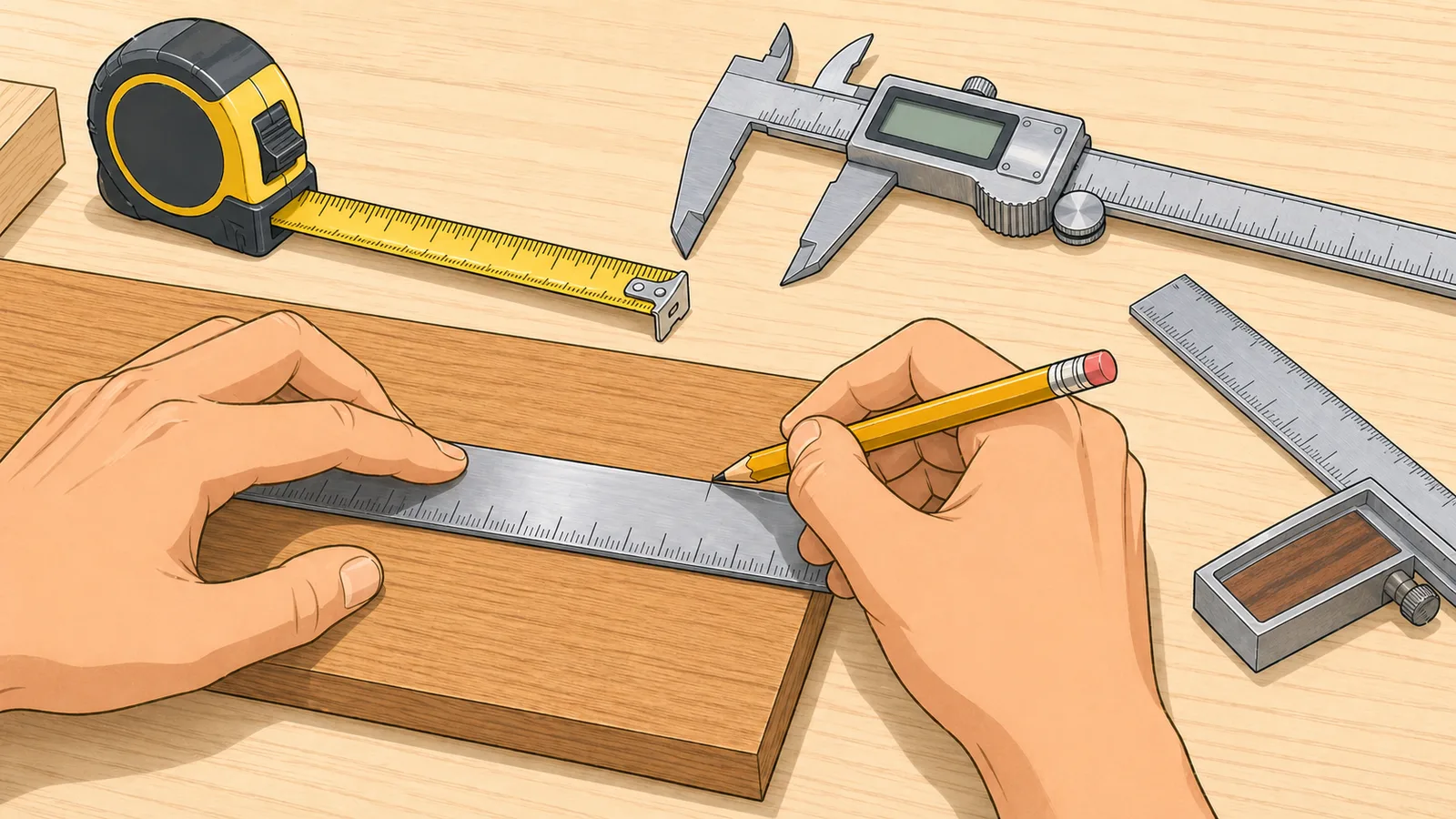
A digital caliper, CAD drawing, or machine spec may show 0.4375 inches. A tape measure may show the same distance as 7/16 inch. A metric drawing may give 11.11 mm. The calculator helps you move between those formats without losing the practical meaning of the dimension.
That is why search intent for inch fraction calculator overlaps with decimal to fraction calculator, inches to fraction calculator, and mm to inches fraction calculator. The user is usually not looking for abstract fraction arithmetic. They are trying to match a physical measurement to a usable shop, site, or drafting format.
Why inch fractions use denominators such as 2, 4, 8, 16, 32, and 64
Fractions on rulers and tape measures usually use denominators that double each step: halves, quarters, eighths, sixteenths, thirty-seconds, and sixty-fourths. These are dyadic fractions, which means the denominator is a power of two. That structure makes physical marks easier to lay out and easier to halve repeatedly on a measuring tool.
This matters because converting decimal inches to a regular mathematical fraction is not the same thing as converting decimal inches to a tape-measure fraction. A decimal such as 0.22 inches might be represented exactly as 11/50 in general arithmetic, but that is not a useful ruler mark. In an inch fraction calculator, the practical question is usually 'what is the nearest 1/16, 1/32, or 1/64?' rather than 'what is the exact rational form?'
Core formulas behind the conversion
The decimal-to-fraction side separates the whole inches from the decimal remainder, multiplies that decimal remainder by the chosen denominator, rounds to the nearest whole numerator, and simplifies the resulting fraction. The metric side first converts millimetres to decimal inches using the exact inch definition, then applies the same fraction-rounding step.
Fraction-to-decimal conversion is simpler: divide the numerator by the denominator, then add any whole-inch portion. That gives the exact decimal-inch value before any optional rounding for display.
Fraction numerator = round(decimal remainder x chosen denominator)
The decimal remainder is rounded to the nearest available fractional mark at the selected precision.
Millimetres = Inches x 25.4
One international inch equals exactly 25.4 millimetres.
Mixed-number inch fractions are converted back into decimal inches by division plus the whole-inch portion.
Choosing 1/16, 1/32, or 1/64 precision
The best fraction precision depends on the tolerance you actually need and how you will read the measurement. In many carpentry and rough construction workflows, 1/16 inch is enough because it matches what most tape-based layout work can be marked consistently. For finer fit-up work, cabinetmaking, metal fabrication, or machining checks, 1/32 or 1/64 may be more appropriate.
Higher precision is not automatically better. A finer fraction reduces rounding error, but it also produces smaller marks that are slower to read and easier to mis-mark on a physical tool. A useful inch fraction calculator should therefore show the selected precision and also let you compare nearby precision levels before deciding which mark is practical.
Use 1/16 inch for common tape-measure and framing work when faster reading matters more than tiny tolerance gains.
Use 1/32 inch when the part fit or layout is tighter but still read from common workshop tools.
Use 1/64 inch when you want a finer imperial reference or when you are translating from digital tools into fractional notation.
Keep the decimal-inch value if the rounded fraction would hide a tolerance that still matters.
Worked example: convert 2.695 inches to a fraction
Suppose a measured value is 2.695 inches and you want the nearest 1/16 inch. Remove the whole-number portion 2, leaving 0.695. Multiply 0.695 by 16 to get 11.12, then round to the nearest whole numerator, which is 11. The result is 2 11/16 inches.
If you compare that same value at finer precision, the nearest 1/32 becomes 2 11/16 as well, while the nearest 1/64 becomes 2 45/64. Seeing those precision comparisons side by side helps you decide whether the coarser mark is already good enough for the job or whether the finer fraction is worth keeping.
Worked example: convert 19 mm to a fractional inch
A metric value of 19 mm converts to 19 / 25.4 = 0.7480 inches approximately. If you round that decimal inch value to the nearest 1/16 inch, the closest practical mark is 3/4 inch. If you compare it at 1/32 or 1/64, you can also see the remaining rounding delta in millimetres.
This is one of the most common real-world uses of a mm to inches fraction calculator. Metric tools, drill sizes, or fastener specs often need to be compared against imperial measuring tools, and the practical question is usually not the raw decimal alone but which nearby fractional mark best matches the dimension.
Where this conversion is useful
Woodworkers use inch fraction conversion when switching between calipers, plans, and tape marks. Machinists and fabricators use it when a digital readout is decimal but a spec sheet or shop note is fractional. Builders and remodelers use it when reconciling site dimensions, prefabricated parts, and mixed-unit drawings.
The tool is also useful as a sense-check. If a dimension rounds to a very different fraction at 1/16 than it does at 1/64, the decimal value may be more important to preserve than the ruler-style fraction. That kind of judgement matters more than the conversion itself whenever the tolerance is tight.
Further reading
NIST Handbook 44 — 2026 Edition — NIST handbook showing the exact international foot and inch relationships used for small-length conversion.
This calculator is a conversion and rounding aid, not a substitute for a tolerance stack-up, a manufacturing drawing, or the measurement system used by the actual specification. The decimal-inch value may be exact for the given input while the displayed fraction is still an approximation chosen for a particular denominator.
That is why the result should always be read with the selected precision in mind. For critical dimensions, use the decimal or metric value that matches the drawing or instrument, then use the nearest fraction only when that rounded mark is truly acceptable for the task.
Frequently asked questions
How do I convert decimal inches to the nearest fraction?
Separate the whole inches from the decimal remainder, multiply the decimal remainder by the denominator you want, round that to the nearest whole number, then place it over the denominator and simplify. For tape-measure style output, the denominator is usually 2, 4, 8, 16, 32, or 64 rather than an arbitrary fraction.
Why is 11/50 not a useful inch fraction on a ruler?
Because rulers and tape measures normally use dyadic fractions whose denominators double each step: 2, 4, 8, 16, 32, and 64. A fraction such as 11/50 may be mathematically valid, but it does not map to a standard tape mark, so it is less useful in construction, woodworking, or layout work.
How many millimetres are in one inch?
One international inch equals exactly 25.4 millimetres. That exact relationship is why metric-to-imperial conversion starts by dividing millimetres by 25.4 to get decimal inches before any fractional rounding is applied.
What precision should I use for woodworking or construction?
For general tape-measure work, 1/16 inch is often enough. For finer joinery, cabinetry, or fabrication, 1/32 may be more useful. For tighter imperial comparison work or careful translation from digital tools, 1/64 gives a finer mark. The best choice depends on the tolerance you can actually mark and build to.
Is the displayed fraction exact?
Not always. If you start with a decimal inch or metric input, the displayed fraction is the nearest available mark at the selected denominator. The decimal and metric values may be exact for the input while the fraction is a rounded practical representation.
Can I convert a mixed number such as 3 7/16 back into decimal inches?
Yes. Divide the numerator by the denominator and add the whole inches. For 3 7/16, divide 7 by 16 to get 0.4375, then add 3, giving 3.4375 inches.
Why do negative measurements still work?
Negative values can be useful in offset, comparison, or machining contexts where a dimension is being expressed as an undersize, oversize, or directional difference. The calculator preserves the sign while still showing the equivalent fraction or decimal form.
What is the difference between decimal inches and fractional inches?
Decimal inches express the measurement in base ten, such as 0.625 inches. Fractional inches express the same measurement as a rational number, such as 5/8 inch. Decimal inches are often easier for digital tools and calculations, while fractional inches are often easier to read from physical rulers and tapes.
How do I convert millimetres to a fractional inch?
First divide the millimetre value by 25.4 to get decimal inches. Then round the decimal remainder to the nearest denominator you want, such as 1/16 or 1/32. For example, 19 mm is about 0.748 inches, which rounds to 3/4 inch at 1/16 precision.
When should I keep the decimal value instead of using the fraction?
Keep the decimal when the rounding error at the chosen denominator is too large for the job, or when the drawing, machine, or inspection process already works in decimals. Fractions are useful for human-readable tool marks, but they are not always the best format for tight tolerances.