Solve a regular hexagon from side length, area, perimeter, across flats, across points, apothem, radius, or triangle area, with fit and scale comparisons.
Last updated
Regular hexagon calculator Solve a regular hexagon from side length, area, across-flats size, across-points span,
apothem, circumradius, or one equilateral-triangle area. The result also compares fit,
scale, and packing relationships instead of stopping at raw dimensions.
Known measurement
Quick examples
How this worksheet helps
Use this when one edge length is already known. Every regular-hexagon measure reduces back to side length, so one trusted number is enough to rebuild the whole polygon.
This page also shows the flat-to-flat span, corner-to-corner span, equilateral-triangle split, and simple fit comparisons that tend to matter more in planning than the formula alone.
Result
Side = 6
Solved from side length 6. Every regular-hexagon measurement collapses back to side length, which is why one trusted dimension is enough to solve the whole shape.
Area
93.53
Perimeter
36
Across flats
10.39
Across points
12
Apothem
5.2
Circumradius
6
Short diagonal
10.39
One triangle area
15.59
Fit and packing checks
These rows help when a hexagon must fit inside a simple box or circle, or when you want to know how much of that enclosing shape the hexagon actually occupies.
Comparison
Amount
Why it matters
Bounding rectangle area
124.71
If the hexagon sits flat-side up, this is the simple width-by-height rectangle that contains it.
Inscribed circle area
84.82
This is the largest full circle that fits inside the hexagon and touches each side.
Circumscribed circle area
113.1
This is the smallest full circle that contains the hexagon by passing through all six vertices.
Hexagon vs bounding rectangle
75%
A regular hexagon fills exactly three quarters of its flat-side-up bounding rectangle.
Hexagon vs outer circle
82.7%
This shows how much of the circumscribed circle is actually solid hexagon area.
Inner circle vs hexagon
90.69%
Useful when a circular insert or hole has to fit entirely inside the hexagon.
Scale checkpoints
This comparison makes the square-law growth easy to see before you resize a tile, fastener head, opening, or honeycomb cell.
Scenario
Side
Area
Perimeter
Across flats
Across points
Meaning
Half scale
3
23.38
18
5.2
6
Perimeter halves, but area falls to one quarter because area scales with the square of side length.
Entered size
6
93.53
36
10.39
12
This is the solved regular hexagon from your chosen starting measurement.
Double scale
12
374.12
72
20.78
24
Doubling side length doubles the major spans and perimeter, while quadrupling the filled area.
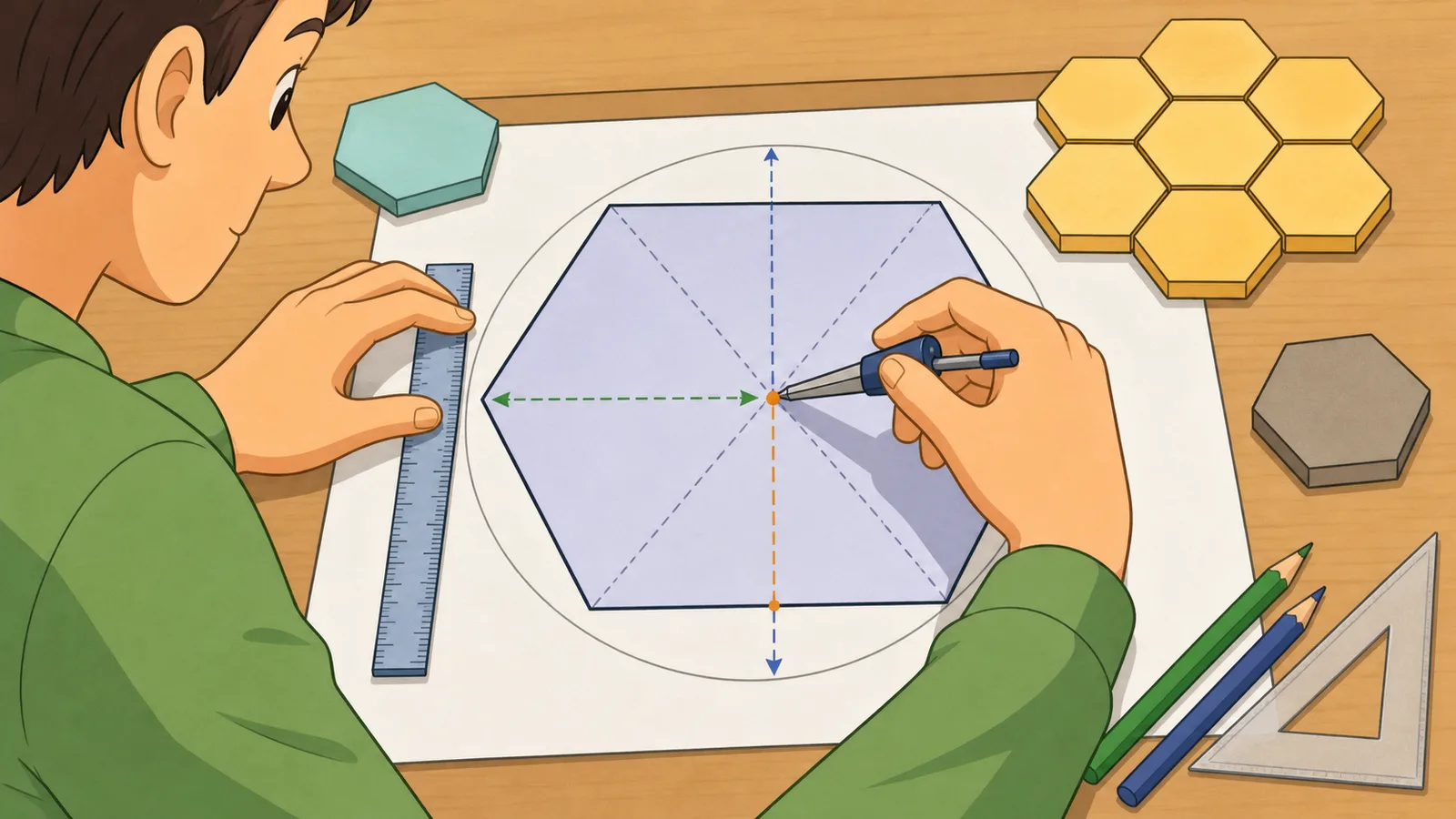
Useful relationship A regular hexagon always splits into six equilateral triangles. That is why the side length equals the circumradius, the across-points span equals twice the side, and the flat-to-flat span equals the short diagonal.
Regular hexagon calculator from side, area, across flats, across points, or apothem
Use this hexagon calculator to solve a regular hexagon from side length, area, perimeter, across-flats size, across-points span, apothem, circumradius, short diagonal, or one of the six equilateral-triangle areas inside the shape.
Why one regular-hexagon measurement is enough
A regular hexagon is unusually convenient because it breaks into six congruent equilateral triangles. That one fact explains most of the shortcut formulas people look for when they search hexagon calculator, regular hexagon calculator, or hexagon area calculator. Once the side length is known, the perimeter, diagonals, apothem, radii, and area all follow from the same underlying triangle geometry.
That is why this page solves the shape by converting every supported starting measurement back to side length first. Some pages stop at side, area, and perimeter. A stronger worksheet also supports practical entry points such as across flats, across points, and one triangle area, because those are often the dimensions people actually have from a drawing, a tile, a honeycomb cell, or a hex-head part.
A = (3 sqrt(3) / 2) s^2
Area from side length s. This is the specific relationship the calculator applies when building the result.
P = 6s, R = s, a = (sqrt(3) / 2) s
Perimeter P, circumradius R, and apothem a of a regular hexagon.
Across points = 2s, across flats = sqrt(3) s
The corner-to-corner span and opposite-side span for the regular hexagon.
Across flats versus across points
Across points is the widest overall span: a vertex-to-vertex distance through the centre. Across flats is the opposite-side distance when the hexagon is resting flat-side up. These two dimensions answer different practical questions, which is why a good regular hexagon calculator should treat both as first-class solve modes instead of assuming the user always starts from side length.
Across flats is often the dimension used for tool clearance, socket sizing, packing layouts, and hex bar references because it measures the width between parallel sides. Across points is more useful for overall envelope clearance because it is the maximum outer span. In a regular hexagon, across points equals 2s and across flats equals sqrt(3) × s, so both reduce cleanly to the same side length once you know which span you actually have.
Worked example from across flats
Suppose the width across flats is 10.3923 units. Because across flats = sqrt(3) × s, the side length is 10.3923 / sqrt(3) = 6. From there, perimeter = 36, across points = 12, apothem = 5.1962, and area ≈ 93.53 square units.
This is a better real-world example than starting from side length alone because it mirrors what happens in many drawings and machining notes. You may be given the flat-to-flat dimension first, then need to recover the rest of the polygon. The calculator now supports that directly.
Across flats 10.3923 gives side length 6
Perimeter then becomes 36
Across points becomes 12
Area becomes about 93.53 square units
Solving from one equilateral-triangle area
A regular hexagon is six congruent equilateral triangles, so one triangle area is also a valid solve mode. If one triangle area is known, multiply by 6 to recover the full area of the hexagon. You can then solve the side length from the equilateral-triangle formula and rebuild the rest of the polygon.
This is helpful when the geometry is introduced through a subdivision drawing instead of as a finished polygon. It also makes the structure of the shape easier to understand: the side length, circumradius, and triangle edge are the same line in a regular hexagon.
Triangle area = (sqrt(3) / 4) s^2
Area of one of the six equilateral triangles inside the regular hexagon.
Hexagon area = 6 × triangle area
Recover the full hexagon from the repeated triangle unit.
Fit checks: rectangle and circle comparisons
People often do not need only the raw hexagon dimensions. They need to know how the shape compares with a simple container around it. If a regular hexagon sits flat-side up, its smallest axis-aligned bounding rectangle has width equal to the across-points span and height equal to the across-flats span. The hexagon fills exactly three quarters of that rectangle by area.
Circle comparisons are useful too. The inscribed circle shows the largest full circle that fits completely inside the hexagon. The circumscribed circle shows the smallest full circle that contains the hexagon completely. These comparisons help with clearance, cutout, packing, or material-usage questions that a thin formula-only page usually leaves unanswered.
How scaling changes a regular hexagon
Linear measurements such as side length, across flats, across points, apothem, and perimeter scale directly. Area does not. If the side length doubles, the perimeter doubles and the flat-to-flat span doubles, but the covered area becomes four times as large. That square-law growth is one of the most important planning ideas on the page.
This is why the calculator now includes scale checkpoints. They make it easier to compare a prototype, the current size, and a doubled version without re-entering the geometry several times by hand.
Apothem, circumradius, and the six-triangle structure
The apothem is the centre-to-side distance. In a regular hexagon it is also the inradius of the inscribed circle. The circumradius is the centre-to-corner distance. Unlike many regular polygons, a regular hexagon has circumradius equal to side length exactly. That shortcut is a direct consequence of the six equilateral triangles meeting at the centre.
Those relationships are why hexagons appear so often in tilings, mesh layouts, and geometric planning. The hexagon is not only symmetric; it also gives unusually clean conversions between side length, radii, spans, and area.
Common mistakes with regular hexagon formulas
A frequent mistake is mixing across flats with across points. They are not interchangeable. Across points is the maximum corner-to-corner distance. Across flats is the distance between opposite sides. Using the wrong one will shift every other solved value.
Another common mistake is using regular-hexagon formulas on an irregular hexagon. This page solves regular hexagons only. If the sides or angles are not all equal, one measurement is not enough to recover the full shape.
What this calculator does not cover
This calculator assumes ideal Euclidean geometry. It does not model chamfers, corner radii, material thickness, manufacturing tolerances, or irregular six-sided polygons.
Use it as a geometry and planning worksheet first. If you are working from a fabrication drawing, confirm which dimension standard is being used and whether the drawing means side length, across flats, across corners, or a toleranced nominal size.
Frequently asked questions
How do you calculate the area of a regular hexagon?
Use A = (3 sqrt(3) / 2) s^2 when the side length s is known. If the side length is not known, solve it first from area, perimeter, apothem, across flats, across points, or another supported measurement and then apply the same formula.
What is the difference between across flats and across points?
Across flats is the distance between opposite sides. Across points is the widest corner-to-corner span through the centre. Across points is larger. In a regular hexagon, across points = 2s and across flats = sqrt(3) × s.
Does the circumradius equal the side length in a regular hexagon?
Yes. A regular hexagon divides into six equilateral triangles, so the centre-to-corner radius is exactly the same length as each side. That shortcut is specific to the regular hexagon and does not hold for every regular polygon.
Can I solve a regular hexagon from area alone?
Yes. Rearranging the area formula gives side length first, then the perimeter, apothem, circumradius, and both major spans can be calculated from that solved side length.
Can I solve a regular hexagon from across flats?
Yes. Across flats is one of the most useful practical inputs because it appears in layout, tool, and packing contexts. Since across flats = sqrt(3) × side, divide the flat-to-flat distance by sqrt(3) to recover side length.
How do I find the width across points of a regular hexagon?
If the side length is known, across points is simply 2 × side. If a different measure is known, solve the side first and then double it. Across points is the same as the long diagonal running through the centre.
Why does one triangle area solve the whole hexagon?
Because a regular hexagon is made from six congruent equilateral triangles. If you know the area of one of those triangles, multiply by 6 to get the full area, then solve the side length from the equilateral-triangle formula.
What rectangle contains a regular hexagon exactly?
If the hexagon is oriented flat-side up, the simplest bounding rectangle has width equal to the across-points span and height equal to the across-flats span. The regular hexagon fills exactly 75% of that rectangle by area.
What circle fits inside or outside a regular hexagon?
The inscribed circle touches each side and has radius equal to the apothem. The circumscribed circle passes through all six vertices and has radius equal to the circumradius, which equals the side length.
If I double the side length, what happens to the area?
The linear spans and perimeter double, but the area becomes four times as large. This is because area scales with the square of side length, not directly with the side length itself.
Will this work for an irregular hexagon?
No. The formulas on this page rely on the hexagon being regular, which means all six sides and all six angles are equal. Irregular hexagons need more measurements and a different solve method.
Why does the short diagonal equal the across-flats span here?
For a regular hexagon, both are equal to sqrt(3) × side. They arise from different geometric descriptions, but the final numerical value is the same.