Calculate ellipse area, perimeter, foci, and eccentricity
Enter the semi-major and semi-minor axes, then choose the centre and major-axis direction to calculate area, Ramanujan perimeter, eccentricity, foci, vertices, standard-form equation, and reference comparisons.
Quick examples
Result
47.12
Area
Semi-major axis 5 and semi-minor axis 3 define a highly elongated centred at 0, 0 with area 47.12 and eccentricity 0.800.
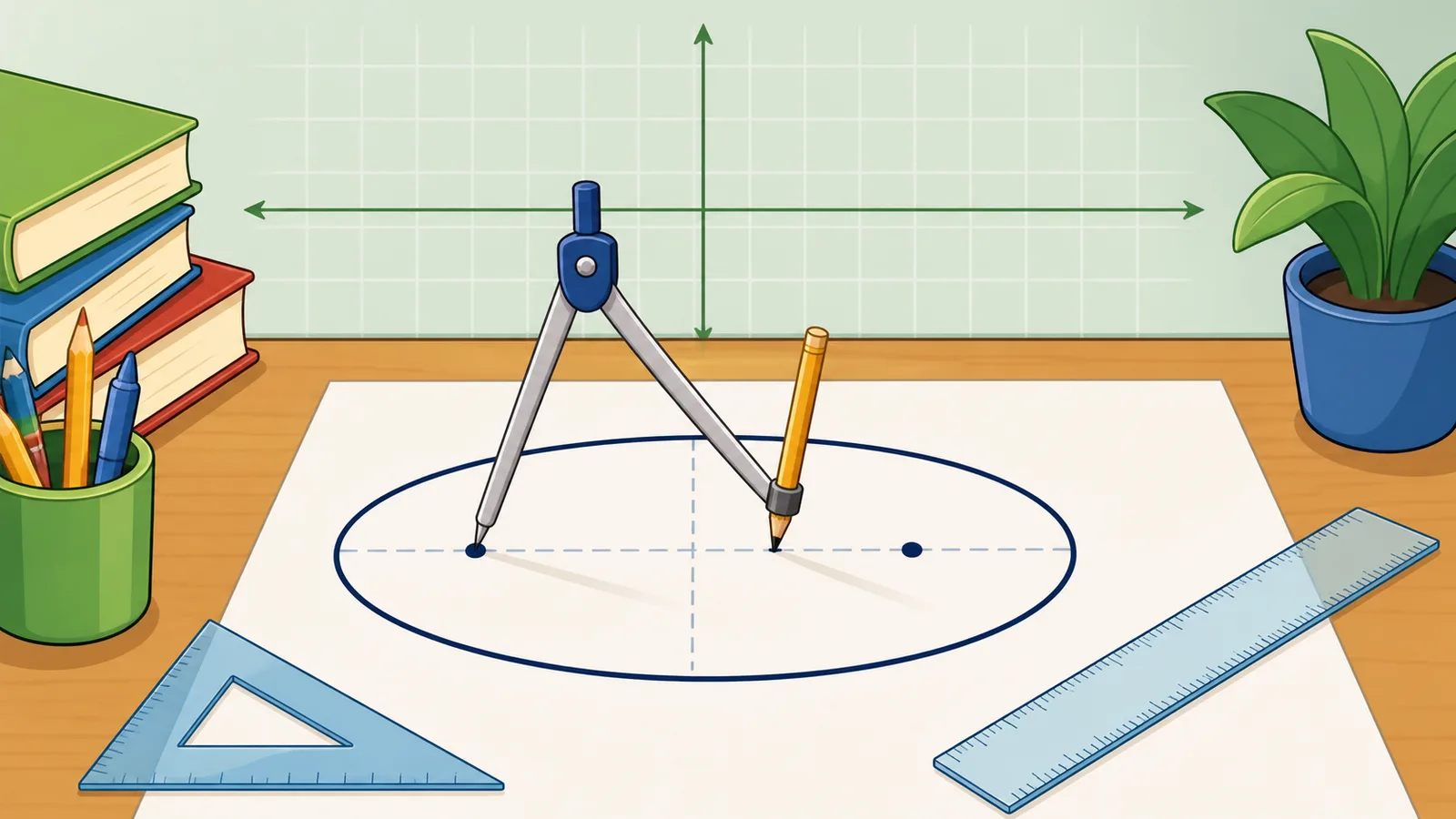
The centre-to-focus distance is 4.000, so the two foci are 8.000 units apart along the horizontal major axis.
25.53
Perimeter (approx.)
0.8
Eccentricity
4
Focal distance
10 / 6
Major / Minor diameter
Highly elongated
Shape class
0.6
Aspect ratio (b / a)
0.4
Flattening
1.8
Semi-latus rectum
Centre and orientation
(0, 0); Horizontal major axis
Standard equation
x^2/25 + y^2/9 = 1
Foci coordinates
(-4, 0) and (4, 0)
Focus-to-focus distance
8
Vertices
(-5, 0) and (5, 0)
Co-vertices
(0, -3) and (0, 3)
Reference comparison
Circle checka=5, b=5, area=78.54, perimeter≈31.42, e=0, Circle
Current ellipsea=5, b=3, area=47.12, perimeter≈25.53, e=0.8, Highly elongated
More elongateda=5, b=1.5, area=23.56, perimeter≈21.93, e=0.95, Highly elongated
Calculate the area, approximate perimeter, eccentricity, and focal distance of an ellipse from its two semi-axis lengths. This page also explains the main assumptions behind the ellipse area, perimeter, and eccentricity result, highlights the supporting figures shown by the calculator, and helps the reader use the estimate without overstating what a quick online tool can prove.
Ellipse formulas
Area = pi * a * b, where a and b are the semi-major and semi-minor axes. Unlike the circle, the exact perimeter of an ellipse has no simple closed-form expression.
The Ramanujan approximation gives a highly accurate estimate: P ≈ pi * (3(a+b) - sqrt((3a+b)(a+3b))). Eccentricity measures how "stretched" the ellipse is: e = sqrt(1 - (b/a)^2), where 0 is a circle and values approaching 1 are very elongated.
The calculator now also shows the standard equation, centre, orientation, foci coordinates, vertices, co-vertices, aspect ratio, flattening, and semi-latus rectum. Those extra outputs are useful because many ellipse problems begin with area or perimeter but then ask for graphing, focus placement, or shape comparison.
A = pi * a * b
Exact area. This is the specific relationship the calculator applies when building the result.
e = sqrt(1 - (b/a)^2)
Eccentricity, 0 ≤ e < 1. This is the specific relationship the calculator applies when building the result.
c = sqrt(a^2 - b^2)
Centre-to-focus distance. This is the specific relationship the calculator applies when building the result.
x^2/a^2 + y^2/b^2 = 1
Standard equation for an ellipse centred at the origin with its major axis horizontal.
How to read the foci, vertices, and standard equation
The calculator treats the larger semi-axis as a and the smaller semi-axis as b. You can then choose whether the major axis is horizontal or vertical and enter the centre coordinates h and k. That keeps the area, perimeter, eccentricity, and focal distance tied to the same two lengths while making the coordinate output fit the graph you actually need.
For a horizontal ellipse centred at (h, k), the standard equation is (x - h)^2/a^2 + (y - k)^2/b^2 = 1. The foci and vertices move along the x-direction. For a vertical ellipse, the larger denominator belongs under the y-term instead, and the foci and vertices move above and below the centre.
For the 5 by 3 example centred at the origin with a horizontal major axis, the equation is x^2/25 + y^2/9 = 1. The foci are at (-4, 0) and (4, 0), the vertices are at (-5, 0) and (5, 0), and the co-vertices are at (0, -3) and (0, 3).
Semi-major axis a is the longer centre-to-edge distance.
Semi-minor axis b is the shorter centre-to-edge distance.
Focal distance c is measured from the centre to each focus.
Focus-to-focus distance is 2c.
Eccentricity is c/a, so a circle has eccentricity 0.
The centre coordinates shift every focus, vertex, and co-vertex by the same h and k offset.
Using the centre and orientation controls
Many high-ranking ellipse calculators only ask for two radii, but algebra problems often give an ellipse as a graphing task: find the standard form, foci, vertices, and co-vertices for a shifted horizontal or vertical ellipse. The centre and orientation controls close that gap without changing the core area or perimeter formulas.
If the major axis runs left to right, choose horizontal. If it runs up and down, choose vertical. Then enter the centre coordinates exactly as they appear in the graph or equation. A centre of (2, -1), for example, changes the coordinate labels and equation terms even though the area and eccentricity still come from the same semi-axis lengths.
(x - h)^2/a^2 + (y - k)^2/b^2 = 1
Horizontal-major-axis standard form for an ellipse centred at (h, k).
(x - h)^2/b^2 + (y - k)^2/a^2 = 1
Vertical-major-axis standard form for the same semi-axis lengths when the long axis is vertical.
Limitations
The perimeter uses the Ramanujan approximation, which is accurate to within 0.01% for most ellipses. The exact perimeter requires an elliptic integral.
That limitation matters most for highly elongated ellipses or technical work where a perimeter tolerance is specified. The calculator labels the perimeter as approximate and shows shape context so users do not confuse the Ramanujan estimate with an exact elementary formula.
Worked example: semi-major axis 5 and semi-minor axis 3
If an ellipse has semi-major axis 5 and semi-minor axis 3, its area is about 47.12 square units. The focal distance is 4, which means the two foci sit 4 units from the centre along the major axis. Its eccentricity is 0.8, which is noticeably stretched but still far from an extremely thin ellipse.
That example is useful because it also shows the circle comparison. If both semi-axes were 5 instead, the eccentricity would drop to 0 and the ellipse would become a circle. The calculator's comparison rows make that shift easier to see than a single output number on its own.
For the same 5 by 3 ellipse, the major diameter is 10 and the minor diameter is 6. The aspect ratio b/a is 0.6, the flattening is 0.4, and the semi-latus rectum is 1.8. Those values help translate between a geometry worksheet, a graphing problem, and a practical oval layout.
Diameter inputs versus semi-axis inputs
Some ellipse calculators ask for major diameter and minor diameter instead of semi-major and semi-minor axes. This page uses semi-axes because most formulas are written in terms of a and b. If you have full diameters, divide each diameter by 2 before entering it.
For example, an oval that is 10 units wide and 6 units tall has semi-axes 5 and 3. Entering 10 and 6 directly would describe a much larger ellipse with area four times as large, because both dimensions would have been doubled.
When to use a different ellipse tool
Use this ellipse calculator when you know the two semi-axis lengths and want area, approximate perimeter, eccentricity, foci, vertices, standard form, and graphing context. Use a dedicated ellipse perimeter calculator when your main question is comparing perimeter approximation methods. Use a conic-section or graphing calculator when the ellipse is rotated or given by a general quadratic equation.
The calculator supports horizontal and vertical major axes plus shifted centres, but it does not rotate the ellipse or complete the square from a raw quadratic expression. If the xy term is present or the axes are tilted, a full conic transformation is needed before these coordinate labels apply.
Frequently asked questions
What happens when both axes are equal?
The ellipse becomes a circle. Area = pi * r^2, eccentricity = 0, and the perimeter equals the circumference 2 * pi * r.
What is the focal distance?
The distance from the centre to each focus: c = sqrt(a^2 - b^2). An ellipse has two foci, equidistant from the centre along the major axis.
What is the difference between the semi-major and semi-minor axis?
The semi-major axis is the longer radius from the centre to the edge of the ellipse, and the semi-minor axis is the shorter one. If the ellipse is stretched horizontally, the horizontal axis is the semi-major axis; if it is stretched vertically, the vertical one is.
Why is the ellipse perimeter only approximate?
The perimeter of an ellipse does not have a simple closed-form expression like a circle does. Calculators therefore use accurate approximations such as the Ramanujan formula, which is very close for most practical ellipses.
How do I calculate ellipse area from the axes?
Multiply pi by the semi-major axis and the semi-minor axis: A = pi × a × b. If one axis is 5 and the other is 3, the area is about 47.12 square units.
How do I find the foci of an ellipse?
First find c = sqrt(a^2 - b^2), where a is the semi-major axis and b is the semi-minor axis. For a horizontal ellipse centred at the origin, the foci are at (±c, 0). For a vertical ellipse, the same distance is placed on the y-axis instead.
What is the standard equation of an ellipse?
For a centre-origin ellipse with the major axis horizontal, the standard equation is x^2/a^2 + y^2/b^2 = 1. If the ellipse is shifted, the x and y terms are replaced by (x-h) and (y-k). This calculator shows the simple centre-origin form from the two semi-axis lengths.
How do I calculate a shifted ellipse equation?
Enter the semi-major and semi-minor axes, then enter the centre coordinates h and k. For a horizontal ellipse, the calculator reports (x - h)^2/a^2 + (y - k)^2/b^2 = 1. For a vertical ellipse, the larger denominator is under the y-term.
When should I choose a vertical ellipse?
Choose vertical when the longest diameter runs up and down. The area, perimeter, and eccentricity do not change, but the foci and vertices move along the y-axis and the standard-form equation places a^2 under the y term.
Can I enter full diameters instead of semi-axes?
No. The inputs are semi-axis lengths, which are half of the full major and minor diameters. If your drawing gives full width and height, divide each by 2 before entering the values.
What does eccentricity tell me about an ellipse?
Eccentricity describes how far the ellipse is from being a circle. A value of 0 is a circle. Values closer to 1 are more elongated. The calculator also shows aspect ratio and flattening so the shape can be interpreted from more than one angle.
What is the semi-latus rectum of an ellipse?
The semi-latus rectum is b^2/a for a horizontal ellipse. It is the half-length of a chord through a focus perpendicular to the major axis, and it appears in conic-section and orbital geometry contexts.
Why does the calculator swap the axes if I enter them backwards?
The semi-major axis is always the longer semi-axis by definition. If the smaller value is entered first, the calculator normalises the pair so a is the longer value and b is the shorter value before calculating eccentricity, foci, and the standard equation.